

You can usually spot an AI-written blog post from a mile away, can't you? It has that certain robotic flavor. The sentences are a little too perfect, the tone is bland, and it’s missing the personality that makes you want to keep reading. It just feels hollow.
So, how do you use the incredible speed of AI without churning out content that sounds like a machine wrote it? How do you get the best of both worlds: SEO-friendly content that also connects with your audience?
That's what this guide is all about. We'll walk through a simple framework for using AI as your creative partner, not just a content machine. It's about creating articles that are built to rank but are also genuinely interesting to read. And honestly, the whole process is much easier when you start with a tool designed to produce a human-sounding first draft, like the eesel AI blog writer.
AI can help create polished, human-sounding content when used correctly, turning a blank page into a nearly finished product.
Why AI-generated content can miss the human touch
To fix the problem, you first have to understand why it happens. AI models are trained on massive datasets of text from the internet. They learn by spotting and copying common patterns, which is great for summarizing information but not so great for creating something with a unique voice. This pattern-matching is what leads to that generic, predictable style that readers can sniff out in a second. Here are the four biggest giveaways that a text was written by AI:
Predictable sentence structures and rhythm
One of the biggest giveaways is the cadence. AI tends to write paragraphs where every sentence is about the same length and structure. This creates a monotonous rhythm that feels completely unnatural. Humans write with a natural ebb and flow: a long, descriptive sentence followed by a short, punchy one for emphasis. AI writing often lacks this musicality, making it a chore to read.
I've actually tried prompts like this and they work way better than just doing straight up 'rewrite to sound human.' I noticed too, if you tell the AI to purposely mess stuff up a bit, toss in some meandering or a joke that kinda flops, the detection tools freak out and think it’s just a regular person rambling.

Overuse of "AI-isms" and filler words
Ever read a blog post and cringed at phrases like "in the realm of" or "a rich tapestry of"? These are classic AI-isms. According to Wikipedia's list and countless discussions among SEO pros, certain words and phrases are dead giveaways. Words like "pivotal," "underscore," and "harness" are huge red flags for savvy readers and editors. They’re fluff that a human writer would almost always cut.
Lack of personal experience and emotion
Here’s the one thing AI can never fake: lived experience. AI doesn't have memories, embarrassing stories, or actual opinions. It can’t tell you about the time a project went completely sideways or a surprising lesson it learned from a client. It can only simulate these things based on the data it has seen, and that simulation often feels hollow to a reader looking for a real connection.
Absence of a unique point of view
Because AI just synthesizes information that already exists, it struggles to offer a fresh or controversial perspective. It’s built to find the consensus, not to challenge it. As one expert puts it, AI can’t produce truly original ideas; it just remixes what’s already out there. A human writer can connect different ideas, offer a contrarian view, and create a unique take that AI simply can't.
Step 1: Laying the foundation with the right tools
The quality of your final blog post is directly tied to the quality of your first draft. It's much smarter to spend a few extra minutes setting things up correctly than to spend hours trying to edit a robotic, generic piece of text into something readable. A strong start makes all the difference.
The limitations of generic chatbots for blogging
Tools like ChatGPT are powerful and versatile, but they aren't built specifically for creating polished blog posts. To get a decent article out of a generic chatbot, you have to become a master of layered, complex prompting. Even then, you often just get a "wall of text." It lacks the SEO-friendly structure, in-depth research, and rich media (like images, tables, or video embeds) that a publish-ready post needs. You’re left with a ton of manual work to turn that text into something you’d actually put on your site.
The advantage of using a specialized AI blog writer
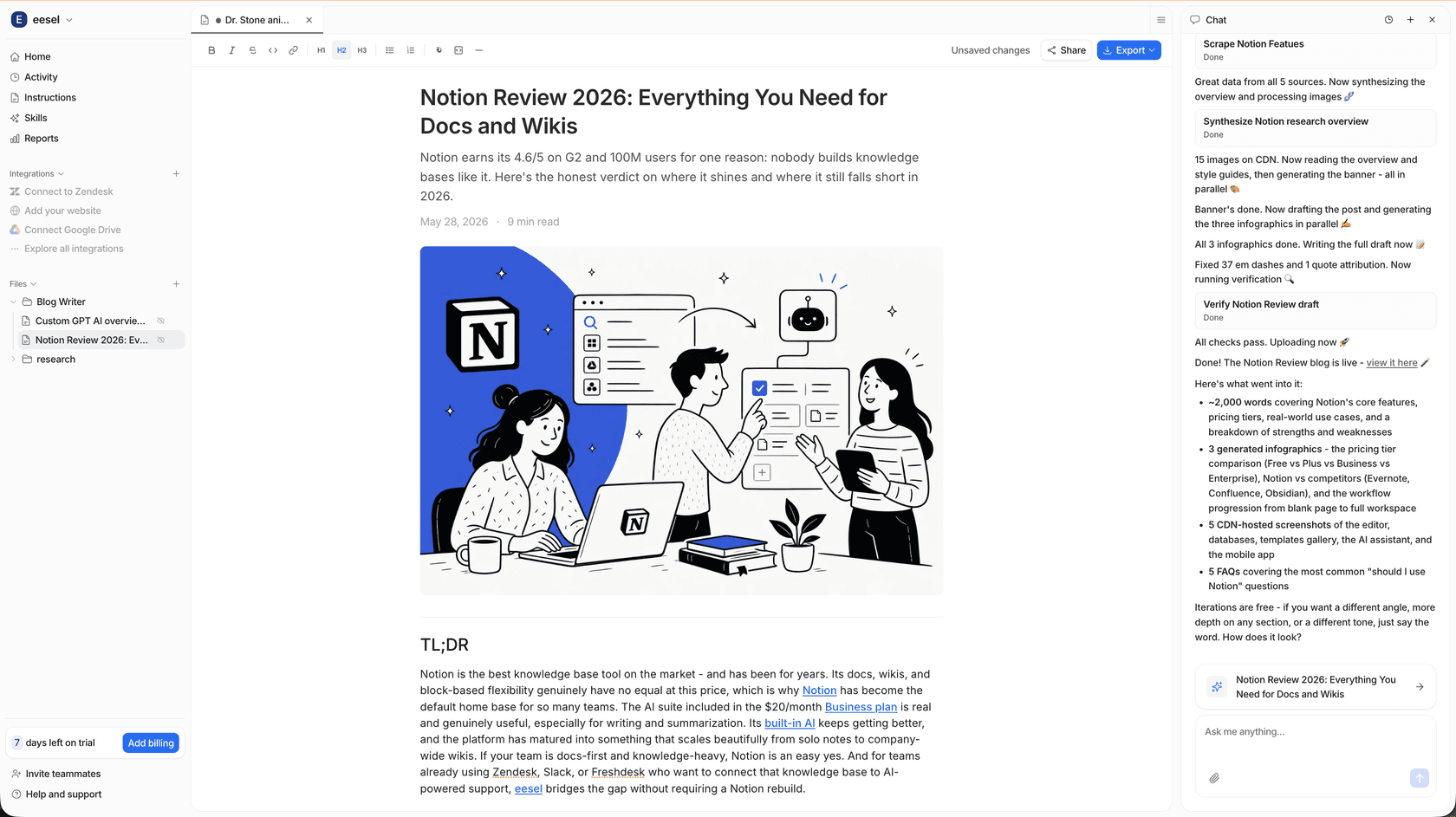
This is where tools designed specifically for content creation are beneficial. They’re already trained on what a great blog post looks like. They understand SEO structure, know how to integrate research, and are tuned to generate a more conversational tone from the start. An AI blog generator like the eesel AI blog writer is a great starting point because it handles the heavy lifting for you. Instead of a wall of text, you get a fully-formed draft with headings, images, and even relevant quotes from social media.
How to craft a detailed brief with prompt engineering
Whether you’re using a generic tool or a specialized one, giving the AI a detailed brief is a must. Think of it like briefing a freelance writer, the more context you give, the better the result will be. According to seasoned prompt engineers, a great brief should include several key elements to guide the AI.
I did the smarter thing, I went back over the years, collected links of all my blog posts and fed them to the AI... So it’s both trained on my voice and is provided my words for the content and then simply fleshes it out.
Here’s a breakdown of what a solid prompt should contain:
| Prompt Element | Description | Example |
|---|---|---|
| Persona | Tell the AI who you want it to be to guide its expertise. | "Act as an expert content marketer with 10 years of experience in B2B SaaS." |
| Audience | Define exactly who the blog post is for to tailor the language. | "The target audience is non-technical marketing managers at small startups." |
| Tone of Voice | Describe the writing style you're after for brand consistency. | "Use a friendly, conversational, and slightly witty tone. Avoid corporate jargon." |
| Goal | Explain what you want the article to accomplish to focus the output. | "The goal is to demystify a complex topic and make it feel approachable." |
| Constraints | Set ground rules, including words to avoid and formatting preferences. | "Do not use these words: leverage, synergy, unlock. Aim for a Flesch reading score of 80 or higher." |
Step 2: Injecting your unique human experience into the draft
Okay, this is the most important step. This is what separates content that just exists from content that actually connects with people and builds a loyal audience. The AI gives you a solid framework, but you have to provide the soul. This is where your expertise, your stories, and your personality come in.
Add personal stories and anecdotes
Nothing builds rapport faster than a short, relevant story. Instead of saying "It's important to be prepared," you could say, "I remember working with a client who thought they were prepared for their product launch, but they overlooked one tiny detail that almost derailed everything." This makes your advice feel tested, real, and memorable. Content experts suggest this is one of the most effective ways to make AI text feel more authentic.
Weave in your original insights and opinions
Don't be afraid to have a take! AI synthesizes the general consensus, so your unique point of view is your superpower. Do you disagree with a common piece of industry advice? Say so, and explain why. Do you have a prediction about the future of your industry that no one else is talking about? Share it. This is what establishes you as a thought leader, not just a content aggregator.
At the end of the day, what you're saying matters way more than how perfectly it's dressed up. Content beats style, hands down.
Use specific, real-world examples
Vague statements are the enemy of engaging content. An AI might write, "Many companies benefit from implementing this strategy." A human touch transforms that into, "A company like Slack used this exact strategy to grow its user base from 500,000 to 4 million in just one year by focusing on…" Concrete examples with real names and real numbers make abstract concepts click for the reader.
Fact-check everything and cite credible sources
This is a big one. AI can, and does, get facts wrong. Sometimes it will confidently state something that is completely incorrect or even "hallucinate" sources and statistics. As one writer pointed out, AI sometimes lies, so it's your job to be the editor-in-chief. Verify every claim, check every statistic, and link out to authoritative sources. This not only makes your content more reliable but also builds trust with your readers and search engines.
To make your content truly human, you need to add the four key elements of human experience: personal stories, unique insights, specific examples, and your own well-founded opinions.
Step 3: Polishing the language until it flows naturally
You’ve got a solid draft infused with your personal expertise. The final step is a detailed editing pass to sand down the rough edges, catch any lingering AI-isms, and make sure the writing flows as smoothly as a real conversation.
The ultimate test: Read it out loud
This trick is simple, but it’s incredibly powerful. Read your entire blog post out loud. If you stumble over a sentence, find yourself running out of breath, or just feel awkward saying something, it’s a sign that it will be awkward for your audience to read. Rewrite those clunky parts until they flow smoothly off the tongue. If it sounds good, it will read well.
Vary your sentence structure and use contractions
To avoid that robotic, monotonous rhythm, consciously mix up your sentence lengths. Follow a long, detailed sentence with a short, punchy one. This creates a more dynamic and engaging reading experience. And don’t be afraid to use contractions like "it's," "you're," and "we've." They instantly make your writing feel more conversational and less stiffly formal.
Cut the fluff and slash common AI phrases
Be ruthless with your editing. Go on a hunt for useless transitional phrases and filler words that AI loves to use. The SEO community has identified a long list of these "tells," but here are a few of the worst offenders to slash from your text:
- In conclusion...
- Furthermore...
- It is important to note that...
- Navigating the landscape of...
- Ultimately...
Seeing this process in action can be helpful. For a visual guide on this editing process, check out this video on how an experienced writer tackles an AI-generated draft to inject personality and flow.
How the eesel AI blog writer creates human-like posts faster
This whole polishing stage is where you can lose hours of your time. This is why starting with a better draft is so important. The eesel AI blog writer is specifically engineered to produce a much more human-sounding first draft, which means you spend significantly less time editing.
It's designed to add authenticity from the very beginning. For example, it can automatically find and integrate real Reddit quotes and relevant YouTube videos directly into the post. This grounds your content in actual human conversations and saves you the manual effort of hunting for these assets yourself. It’s also optimized for AEO (Answer Engine Optimization), ensuring your content is perfectly structured for new search formats like Google's AI Overviews.
By providing a more polished and context-rich starting point, you can focus your energy on adding your unique insights, not on fixing robotic sentence structures.
It’s about collaboration, not replacement
So, what's the secret to writing a blog post like a human using AI? It’s not about finding the perfect prompt that will do 100% of the work for you. It's about changing your workflow.
The best approach is a three-step framework:
- Start with a strong foundation by using a specialized tool and a detailed brief.
- Inject your unique human experience-your stories, opinions, and examples.
- Meticulously polish the final text until it sounds like something you'd actually say.
Treat AI as your co-pilot. It’s there to handle the heavy lifting: the research, the structuring, the initial drafting. But you are still the pilot, responsible for steering the content, adding the soul, and making sure it connects with your audience. As Google's own guidelines confirm, they reward high-quality content, no matter how it’s produced. The goal is value, not a specific creation method.
Ready to see how much faster you can create content that actually connects with people? Try the eesel AI blog writer for free and generate your first human-sounding blog post in minutes.