How an AI blog writer helps scale your multilingual SEO websites

Katelin Teen
Katelin Teen
Last edited January 15, 2026
If you want to succeed globally, a simple translation isn't enough. You need to understand local search habits, cultural details, and technical SEO elements like "hreflang" tags, which tell search engines what language and region you're targeting. Trying to manage all of this by hand is a significant bottleneck for most companies.
Here’s a look at the common hurdles:
- High costs and resource drain: Hiring professional translators, local marketers, and SEO experts for every market is expensive. Professional translation services can cost anywhere from $0.08 to $0.25 per word. When you're scaling content across several languages, that adds up fast.
- Technical SEO complexity: Getting "hreflang" tags right is a common challenge. It needs careful coordination and is easy to implement incorrectly, like using the wrong region code or forgetting return links. These mistakes can confuse search engines and lead to the wrong version of your site appearing in local searches.
- Risk of duplicate content: If you have similar content for different regions (like the US, UK, and Australia), it could be flagged by search engines. Hreflang tags are supposed to prevent this, but without them, you might run into duplicate content issues that hurt your rankings.
- Maintaining brand consistency: Keeping your brand voice and message consistent across dozens of languages is tough. When local teams have total control, you often end up with different priorities and a brand that feels disconnected globally.
- Slow and inefficient workflows: The manual process of translating, localizing, and optimizing every article and landing page takes a long time. This slow pace makes it hard to be agile and pursue new market opportunities.
How AI solves multilingual SEO challenges
An AI blog writer helps with the biggest challenges: cost, complexity, and consistency. It automates the most time-consuming parts of creating content. It’s not about replacing your human experts, but giving them better tools to work faster and more strategically.
Here's how it helps:
- Scalability: AI can generate first drafts at a speed a human team cannot match. This lets you build out a solid base of content for multiple regions at once.
- Consistency: Modern AI tools can be trained on your brand’s voice and style guides. This ensures your main message stays consistent, which makes for a better starting point for accurate, on-brand translations.
- Efficiency: AI cuts down the time you spend on research, outlining, and writing. This frees up your team to focus on more important work like refining cultural details, checking local keyword strategies, and building local backlinks.
- Creating a "golden copy": A key advantage is creating a well-researched, structured, and SEO-optimized "source of truth" article in your main language. Starting with this quality base makes the whole translation and localization process quicker, cheaper, and more accurate.
Using the eesel AI blog writer for multilingual SEO
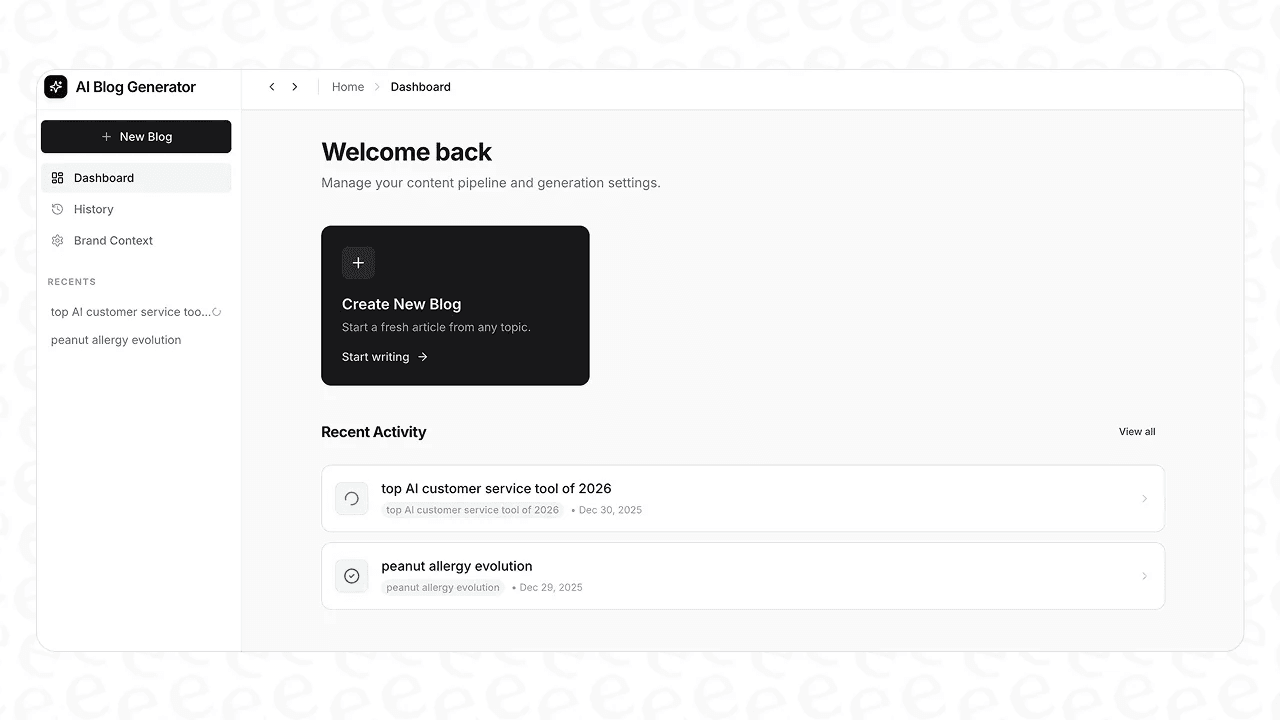
The eesel AI blog writer is designed to create a high-quality "golden copy" and then help you adapt it for global markets. The process is straightforward, taking you from a keyword to a finished article in minutes.
Step 1: Generate a high-quality source article
You start by giving the tool a keyword with global appeal, like "customer service automation." Then, you add your website URL. The eesel AI blog writer uses this to learn your products, positioning, and brand voice. From there, it generates a deeply researched, SEO-optimized article that includes:
- Automatic assets: AI-generated images, infographics, and tables are included to make the content more readable and engaging.
- Authentic social proof: It finds real quotes and insights from Reddit and other forums to add a human touch.
- Internal and external links: It automatically adds citations and links to other pages on your site to build authority and improve site structure.
Step 2: Translate to any language instantly
Once your source article is done, the eesel AI blog writer can translate the post into any language with a single click. This isn't just a basic translation. The AI uses the context of the whole article to create a quality draft that keeps the original meaning and structure.
Step 3: Layer in human expertise for localization
The AI-generated translation gives your local experts a great starting point. Instead of translating from scratch, they can focus on localization. This means:
- Adapting cultural references: Making sure any idioms, examples, or humor make sense to the local audience.
- Verifying local keywords: Checking that the translated keywords are what people in that region actually search for.
- Adjusting the tone: Tweaking the article's tone to fit cultural expectations, whether that means being more formal or casual.
This hybrid approach, combining AI speed with human insight, is a practical way to scale a high-quality multilingual SEO strategy.
The results: How we scaled to 750,000+ daily impressions in 3 months
We don't just talk about this in theory; we have applied it ourselves. We used the same eesel AI blog writer to scale our own content. By publishing over 1,000 optimized blog posts, we grew our daily organic impressions from about 700 to over 750,000 in just three months.
This is the kind of speed that can help you compete in multiple markets at once, and it is possible with an AI-powered workflow.
Key benefits of using an AI blog writer for multilingual SEO
Using a mix of AI and human expertise for your international SEO has clear advantages that can affect your bottom line.
- Significant cost reduction: You can rely less on expensive translation services. AI does the initial heavy lifting, letting you use human translators for high-impact review and localization instead.
- Faster speed to market: You can go from an idea to published articles for multiple markets in days, not months. This lets you pursue opportunities in new regions much faster than competitors who use manual methods.
- Global brand consistency: By starting every translation from a single, on-brand "golden copy," you ensure your core message and brand identity stay consistent everywhere.
- Focus on strategy, not execution: You can free your marketing team from the tedious work of manual translation. Let AI handle the groundwork so your team can focus on high-level strategy, market analysis, and building local relationships.
For those interested in seeing how different tools approach translation and localization, the following video provides a helpful overview of AI tools designed for marketing content.
Scaling your global content strategy
Expanding globally is a great way to grow, but traditional, manual methods of creating multilingual content can be a major roadblock. They are often slow, expensive, and complicated.
An AI blog writer is key to an efficient and scalable multilingual SEO strategy. By creating high-quality, on-brand source articles and providing instant, context-aware translations, it lets your team focus on what really matters: connecting with new audiences in a meaningful way.
Ready to scale your global content? Try the eesel AI blog writer for free and generate your first publish-ready article in minutes.

Frequently Asked Questions
Share this article

Article by
Katelin Teen
Katelin is an operations specialist at eesel where she uses her psychology training and education experience to optimize B2B SaaS processes. Outside of work, she unwinds with story-driven games, writing, and keeping up with latest tech innovations.