Zendesk vs eesel AI: Which should you choose in 2026?

Stevia Putri
Last edited April 29, 2026
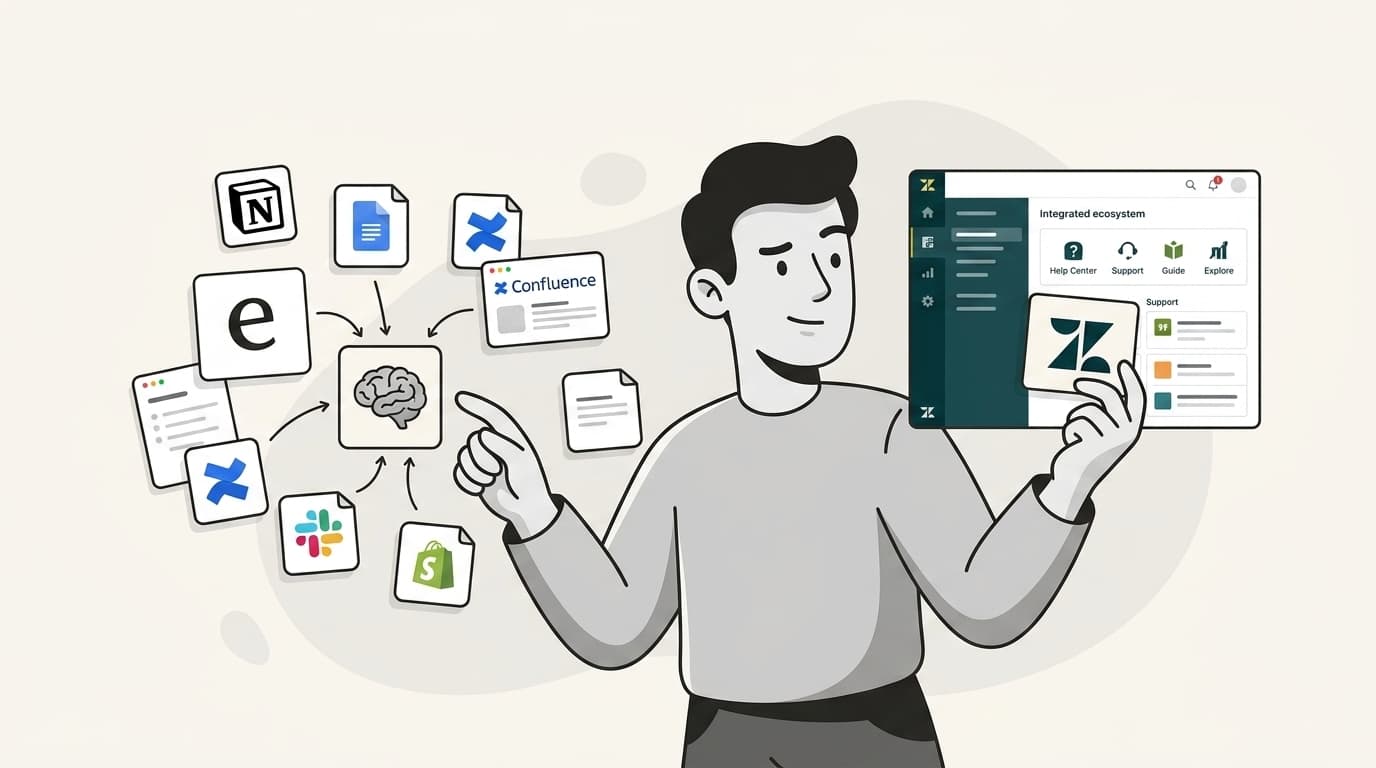
If your support knowledge lives entirely within your helpdesk, Zendesk's native AI is a secure, integrated winner. But for teams with documentation scattered across Notion, Google Docs, and Confluence, an agile AI layer like eesel AI often resolves 30 percent more tickets by unifying those silos. Full 2026 breakdown below.
Choosing the right support strategy has changed. It used to be about which helpdesk had the best ticketing UI. Now, it is about which "brain" powers your automation. If your AI cannot see your product specs in Notion or your shipping policies in Google Docs, it is only half-effective. We are seeing a shift where teams no longer just look for a place to store tickets, they look for a way to resolve them without human intervention. This comparison breaks down whether you should double down on a native ecosystem like Zendesk or layer on a specialized AI teammate.
What is Zendesk?
Zendesk remains the "Gold Standard" for enterprise support operations in 2026. It is a comprehensive customer service suite designed to unify conversations across every possible channel, from email and chat to voice and social media. Founded in 2007, it has spent nearly two decades building the infrastructure that 100,000+ companies rely on to keep their support teams running.
The platform is not just a single tool but a collection of core products. Zendesk Support handles the ticketing, Zendesk Guide powers the knowledge base, and Zendesk Explore provides the deep analytics needed to track metrics like CSAT and resolution time. For large organizations, this all-in-one approach is hard to beat. It offers a level of security, HIPAA compliance, and data residency options that regulated industries require.
Native capabilities like Intelligent Triage help teams automatically predict intent, sentiment, and language of incoming tickets. This ensures that a frustrated customer asking about a refund is routed to a senior agent immediately, while a routine password reset can be handled by a bot. It is this kind of enterprise logic that has kept Zendesk at the top of the market for so long.
However, being the gold standard comes with enterprise-level baggage. Implementing Zendesk thoroughly often requires certified consultants or a dedicated admin team to manage the complex triggers and custom roles. It is built for scale and deep customization, which is perfect if you have the resources to maintain it. For more on how it stacks up against other giants, see our Zendesk comparison guide.
What is eesel AI?
We built eesel AI to be the "plug-and-play" AI teammate that enhances your existing helpdesk rather than replacing it. We noticed that most support teams have their "source of truth" scattered across different apps. Your help center might be in Zendesk, but your technical troubleshooting steps are in Confluence and your latest internal policies are in a Slack thread.
Our key differentiator is knowledge unification. We bridge the gap between your helpdesk data and your external documentation. By connecting to 100+ sources including Google Docs, Notion, and Shopify, we create a centralized brain for your AI. This means our AI agents can answer questions that native tools simply cannot see.
Beyond just answering questions, we focus on the "human" side of support. Our Tone Matching capability allows our AI to learn from your past tickets, delivering consistent, human-like responses that sound like your best agent on their best day. We also include features like Theme Analysis, which automatically surfaces recurring patterns and ticket volume trends from the last seven days, giving your team the insights they need to fix root causes rather than just closing tickets.
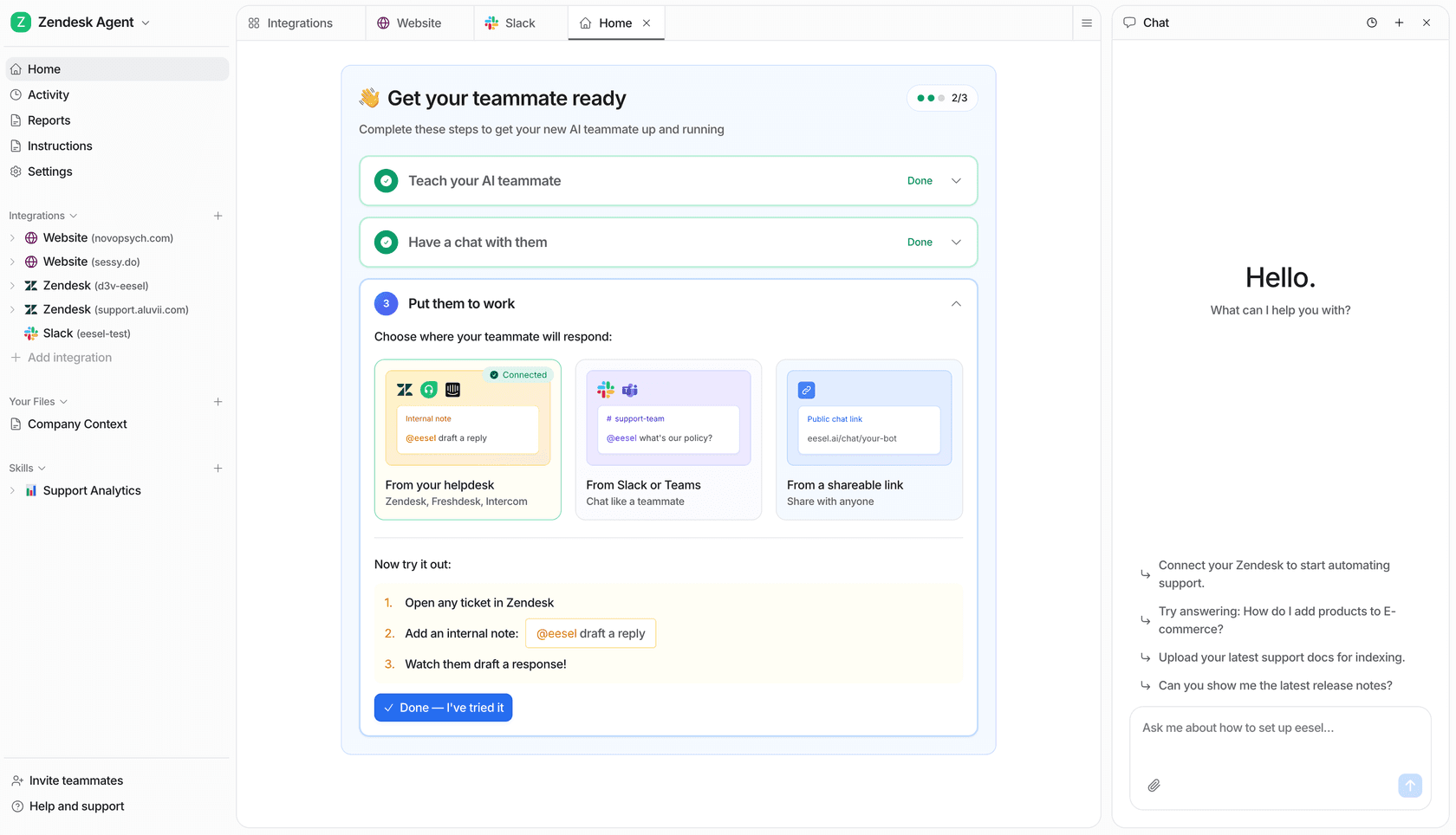
We focus on speed and immediate value. You can get started in about two minutes with a self-serve setup. There are no lengthy onboarding sessions or enterprise sales cycles. We are a layer that sits on top of tools like Zendesk or Freshdesk, handling tickets end-to-end so your team can focus on more complex tasks. For a deeper look at the trade-offs, check out our Zendesk review covering pros and cons.
AI capabilities compared: Native vs specialized
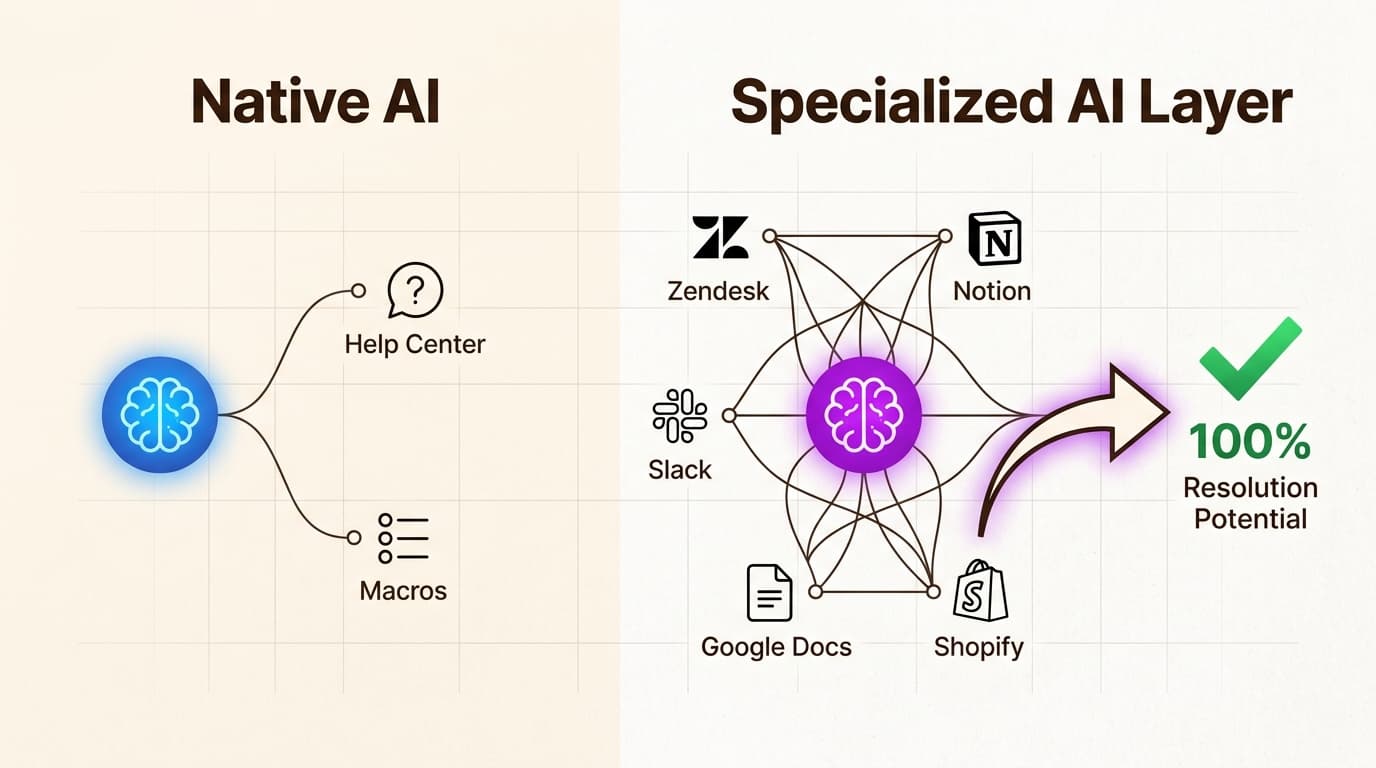
The "native vs specialized" debate comes down to where your data lives. Zendesk AI agents are deeply integrated with the data already inside the Zendesk ecosystem. They are excellent at leveraging your existing macros and help center articles to drive resolutions. Zendesk also uses a "Resolution Learning Loop" that uses billions of CX interactions to improve performance over time.
Our specialized layer at eesel AI takes a different approach. We focus on cross-app knowledge unification. While native AI tools usually only read from your help center or website, our AI teammates learn from your actual solved tickets across any of your platforms. We use LLM-driven autonomous resolution to handle everything from order status to complex technical troubleshooting without human intervention. We even include Automatic KB Drafting, which identifies knowledge gaps and drafts new help articles based on resolved tickets. For a look at what native tools can do, see our breakdown of Zendesk AI capabilities.
To see this in action, imagine a customer asks about a specific edge-case return policy that is only mentioned in a random Slack thread from last month. A native AI tool, limited to the knowledge base, would likely fail and escalate the ticket. Our AI agent, having indexed that Slack channel, would find the answer, draft a reply in your brand voice, and resolve the ticket before a human ever had to look at it.
| Feature | Zendesk AI | eesel AI | Advantage |
|---|---|---|---|
| Knowledge Sources | Guide, Macros, Website | 100+ (Notion, Slack, Docs, etc.) | eesel AI |
| Setup Time | Days to Weeks | 2 Minutes | eesel AI |
| Integration | Deep native integration | Plug-and-play layer | Zendesk (Native) |
| Testing | Sandbox environment | Simulation Mode (Past data) | eesel AI |
| Voice Matching | Template-based | Learns from past tickets | eesel AI |
| Learning | Resolution Learning Loop | Training on solved tickets | Tie |
Zendesk's native AI is fantastic for logical triggers and routing based on sentiment or intent. If your team has spent years perfecting a library of Zendesk macros, their AI will feel like a natural extension of that work. They also offer an Agent Copilot that provides suggested replies and ticket summarization for human agents. But if you need an AI that can "think" across your entire company stack, a specialized layer is the more agile choice.
Implementation and speed to value
Zendesk is a powerhouse, but it is not something you "turn on" in an afternoon. A thorough enterprise implementation often takes weeks of planning and configuration. Large teams often benefit from certified consultants to ensure the data residency and HIPAA compliance settings are mapped correctly. It is a high-reward path, but the "speed to value" is relatively slow.
In contrast, we designed eesel AI for one-click integration with Zendesk. You do not need to migrate any data or change your existing workflow. We simply plug into your helpdesk and start learning. Most of our users are up and running in minutes, not weeks.
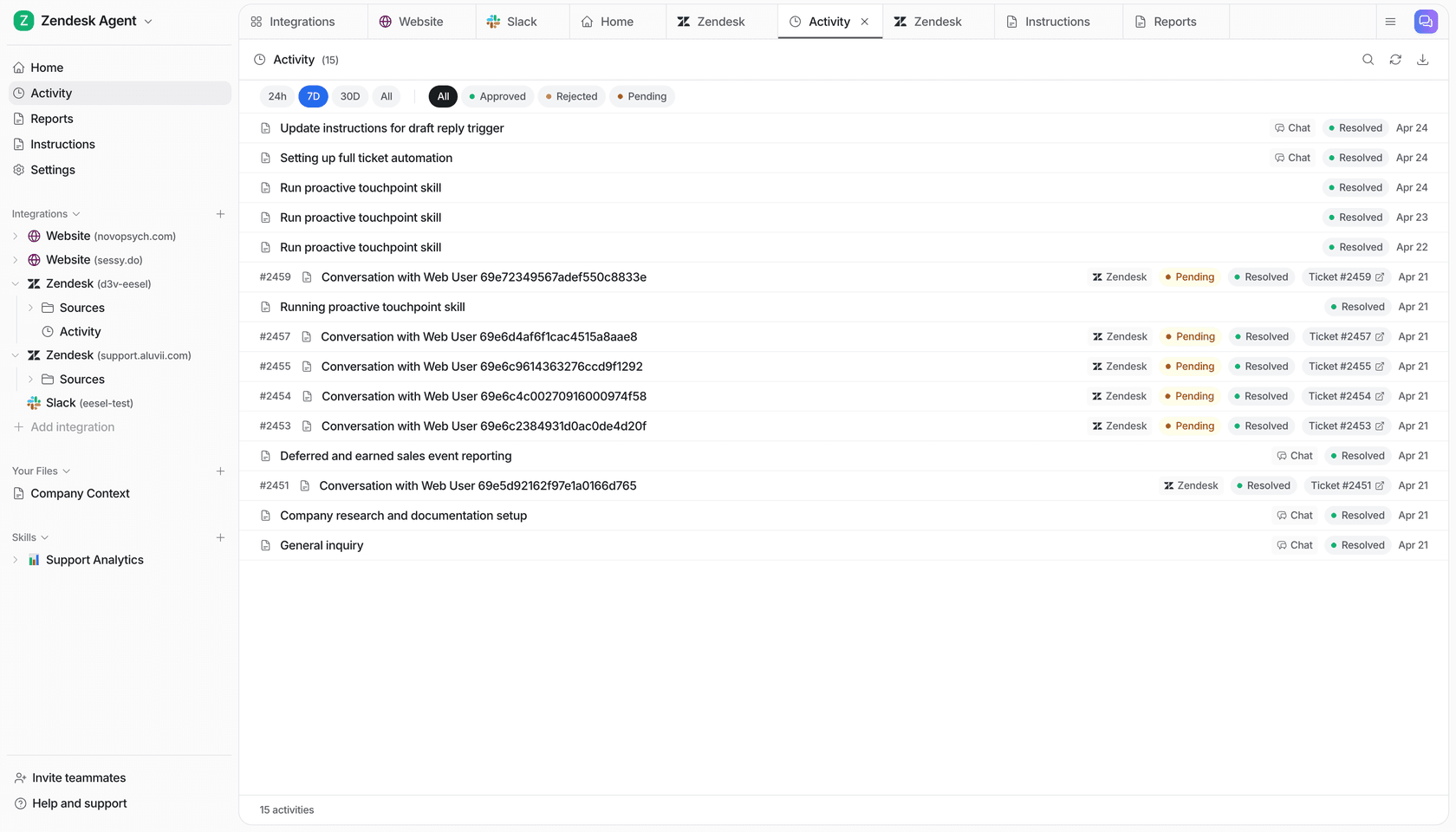
One of our favorite features is Simulation Mode. This allows you to test our AI performance on your historical ticket data before you ever go live. You can see exactly how the AI would have handled last week's tickets, identify any knowledge gaps, and fill them before your customers ever see an AI-generated reply. It is a high-trust rollout that eliminates the "black box" anxiety often associated with support automation.
Pricing breakdown: 2026 costs
Zendesk pricing is based on a per-agent seat model, with AI capabilities often requiring specific plans or add-ons. For most teams, this means a predictable but potentially high total cost of ownership as your team grows. Their Zendesk Suite plans are tiered to include more features and help centers as you move up.
| Plan | Annual Price (per agent/mo) | Monthly Price (per agent/mo) | Key Inclusions |
|---|---|---|---|
| Support Team | $19 | $25 | Ticketing, social channels, basic routing |
| Suite Team | $55 | $69 | Messaging, live chat, 1 help center, Essential AI |
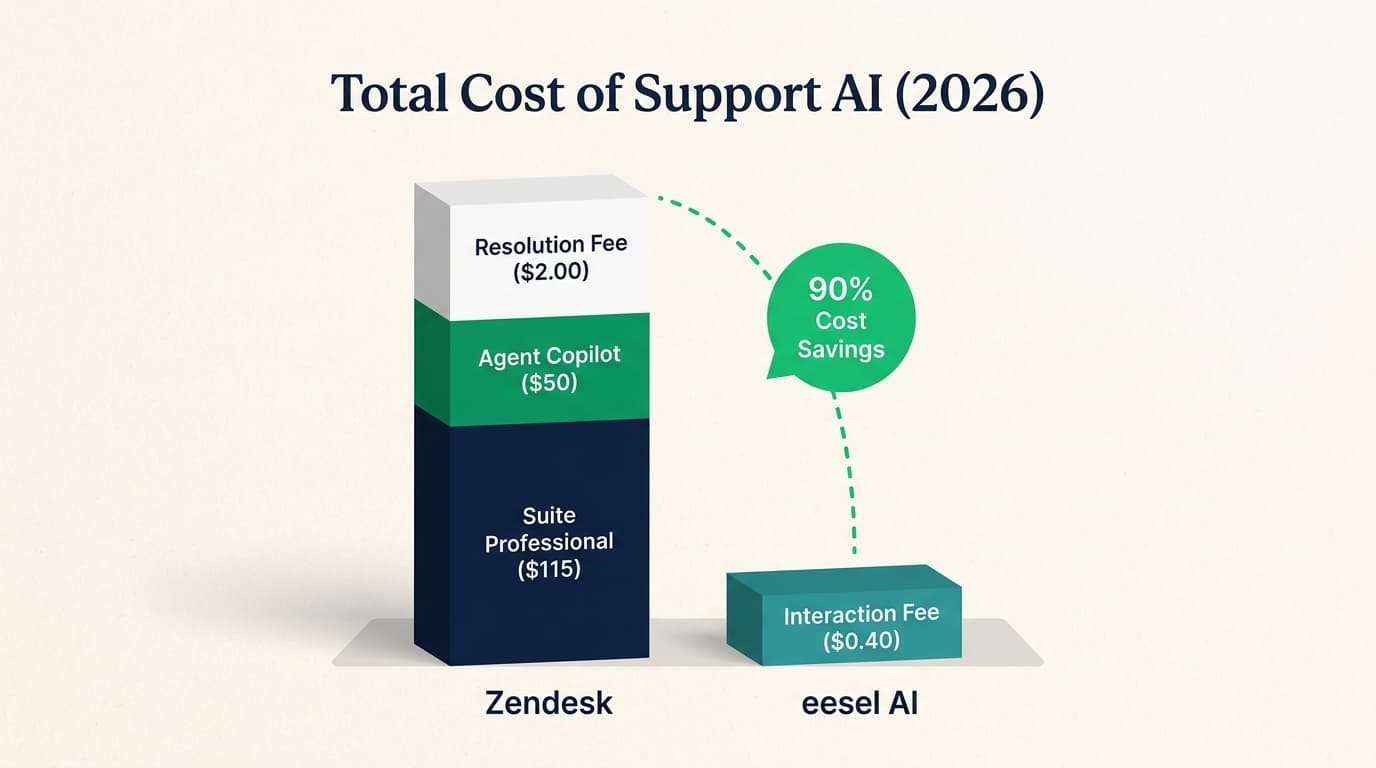
| Suite Professional | $115 | $149 | 5 help centers, SLAs, HIPAA, CSAT |
| Suite Enterprise | $169 | $219 | 300 help centers, sandbox, custom roles |
There are also hidden costs to consider. Zendesk AI pricing can include a $50 per agent/month fee for their Agent Copilot. Automated resolutions beyond your plan's included limits can cost between $1.50 and $2.00 each.
At eesel AI, we use an interaction-based pricing model. You pay for what your AI actually does, not for the number of people on your team. This makes it a scalable choice for fast-growing SMBs that want to keep headcount low.
| Plan | Price | Key Limits/Inclusions |
|---|---|---|
| Free Trial | $50 free usage | Everything unlocked, no credit card required |
| Regular Task | $0.40 per ticket | One ticket = one task (unlimited replies) |
| Heavy Task | $4.00 per post | Includes research, writing, and SEO |
| Enterprise | $2,100/mo | Compliance, SSO, HIPAA, dedicated support |
Our model means you are never charged for tickets your human agents handle. If you have a slow month, your bill reflects that. There are no platform fees or per-seat costs to worry about.
Choosing the right AI strategy for your support team
So, which path should you take? The answer depends on your infrastructure. If your team is already happy with Zendesk and your knowledge base is pristine and comprehensive, sticking with their native AI is a solid move. It is built to work within their walls, and for many enterprises, those walls are exactly what they need for security and consistency.
However, you should consider adding our specialized AI layer if:
- Your support knowledge lives in 5 different apps (Notion, Docs, Slack).
- You are growing fast and cannot afford the months-long enterprise implementation cycle.
- You want a "human-like" AI that learns from your actual brand voice and past tickets.
- You prefer paying for successful resolutions rather than monthly agent seats.
The best part? It does not have to be an "either/or" decision. Many of our most successful customers use the "Better Together" approach. They keep Zendesk as their core ticketing system and enterprise infrastructure, but layer eesel AI on top to handle the actual resolutions. This gives you the best of both worlds: enterprise-grade reliability with agile, cross-app intelligence.
Start supercharging your Zendesk setup with eesel AI today
The bottom line is that AI in 2026 is only as good as the knowledge it can access. Zendesk is a world-class platform for managing support, but it was never designed to be the single home for every piece of documentation in your company.
By adding an agile layer like eesel AI, you bridge those gaps. You turn your scattered docs into a unified support brain that can resolve tickets end-to-end. Whether you want to automate 80 percent of your tier-1 requests or just give your agents better drafts to work with, we can help.
Ready to see the difference? You can run a free simulation on your past Zendesk tickets today. It takes two minutes to connect, and you will see exactly where our AI can step in to save your team time.

Frequently Asked Questions
Share this article

Article by
Stevia Putri
Stevia Putri is a marketing generalist at eesel AI, where she helps turn powerful AI tools into stories that resonate. She’s driven by curiosity, clarity, and the human side of technology.