Zendesk outbound after solve: Why it happens and how to work around it

Stevia Putri
Last edited March 5, 2026
You've just solved a ticket and realized you need to send a quick follow-up to the customer. Maybe it's a courtesy check-in, a compliance requirement, or additional information that came in after you hit "solve." You try to send the message and... nothing. Zendesk won't let you.
This is the "Zendesk outbound after solve" limitation, and it's one of the most frustrating quirks of the platform. Let's break down why it happens, what you can do about it, and how modern alternatives handle post-resolution communication.

What does "outbound after solve" mean in Zendesk?
In Zendesk, "outbound after solve" refers to the platform's restriction on sending outbound communications (emails, messages, updates) after a ticket has been marked as solved or closed. Once a ticket reaches either of these terminal statuses, Zendesk locks down outbound messaging to preserve the integrity of the ticket record.
This becomes a problem in several common scenarios:
- Follow-up communication: You want to check in with a customer a few days after resolution to ensure their issue is truly resolved
- Compliance tracking: Regulated industries need to document all customer interactions, including post-resolution outreach
- Proactive outreach: You need to send additional information that became available after the ticket was solved
- Quality assurance: Managers want to add internal notes or send satisfaction surveys after closure
The restriction exists because of how Zendesk structures its ticket lifecycle. Understanding that lifecycle is key to working around the limitation.
Solved vs closed tickets: The critical difference
Zendesk has two "terminal" ticket statuses that sound similar but behave very differently: solved and closed.
Solved status
When an agent marks a ticket as solved, they're indicating they believe the customer's issue is resolved. The ticket remains accessible and can be reopened if the customer replies. Agents have full access to update fields, add comments, and modify the ticket.
Think of "solved" as "resolved pending customer confirmation." The conversation can technically continue, but Zendesk still restricts certain outbound actions to prevent accidental changes to what should be a completed record.
Closed status
Closed tickets are locked and archived. They can't be reopened. If a customer replies to a closed ticket, Zendesk creates a new follow-up ticket instead of reopening the original. Agents have limited ability to modify closed tickets (only certain fields like tags can be updated via API).
The auto-close automation
By default, Zendesk includes an automation called "Close ticket 4 days after status is set to solved." This automatically transitions tickets from solved to closed, giving customers a window to respond if they need further assistance. You can adjust this timeframe anywhere from 1 hour to 28 days based on your workflow needs.
Most teams leave tickets in solved status for 3-5 days before moving to closed, giving customers enough time to re-engage on the same ticket if needed.
Why Zendesk blocks outbound messages after closure
The restriction isn't arbitrary. Zendesk's architecture treats solved and closed tickets as historical records that should remain unchanged for data integrity purposes.
Technical reasons
Zendesk's ticket locking mechanism prevents changes to preserve the historical record. This matters for:
- Reporting accuracy: Metrics like "time to resolution" and "ticket volume" depend on tickets having a clear, unchanging endpoint
- Audit trails: Compliance requirements often mandate that resolved tickets remain unchanged
- Data consistency: Preventing post-resolution edits ensures that ticket data remains consistent across integrations and API calls
Workflow philosophy
Zendesk's design assumes a clean separation between active and resolved issues. Once a ticket is solved, the platform expects the conversation to end unless the customer initiates a reopening. This philosophy works well for simple support workflows but creates friction for teams that need ongoing post-resolution communication.
User frustration points
The limitation creates real operational challenges:
- Can't add notes: Agents can't add internal notes to solved tickets for context that emerges after resolution
- Blocked follow-ups: Proactive customer communication is blocked even when it'd improve the customer experience
- Compliance gaps: Teams in regulated industries can't easily document post-resolution interactions within the original ticket
- Fragmented records: Workarounds (like creating new tickets) split the customer interaction history across multiple records
Workarounds for post-solve communication in Zendesk
While Zendesk doesn't provide a direct solution, teams have developed several workarounds. Each has trade-offs.
Automation approach with tags
One common workaround uses Zendesk's automation system to auto-solve tickets while maintaining tracking capabilities:
- Create an automation that solves tickets after a period of inactivity (e.g., 48 hours)
- Add a unique tag (like "auto_solved") to these tickets before solving
- Create a custom view that shows all tickets with the "auto_solved" tag
- Use this view to identify tickets that might need follow-up

Limitations: This approach still doesn't allow outbound communication on solved tickets. It only provides better tracking of which tickets were auto-solved versus manually resolved.
Manual workaround: Create new tickets
For critical follow-ups, some teams create new tickets specifically for post-resolution communication:
- When follow-up is needed on a solved ticket, create a new ticket
- Reference the original ticket number in the subject or description
- Link the tickets using Zendesk's ticket linking feature
- Handle the follow-up communication in the new ticket
Limitations: This splits the customer interaction history and creates administrative overhead. It also doesn't solve the compliance problem of having a complete record in one place.
IVR and voice workarounds
For teams using Zendesk Talk, some limitations can be worked around using voicemail and call logging:
- Use voicemail for outbound messages when the call isn't answered
- Log call attempts as internal notes (though this is also restricted on closed tickets)
- Route inbound calls from customers to the appropriate agent using IVR
Limitations: These workarounds are specific to voice channels and don't address email or chat limitations.
Reporting workarounds
Some teams use custom views and reports to track tickets that might need follow-up:
- Create views filtered by solve date and tags
- Use Zendesk Explore to build reports on auto-solved tickets
- Export ticket data for external tracking of post-resolution follow-ups
Limitations: This adds manual work and doesn't actually enable the blocked communication. It's a tracking solution, not a communication solution.
How eesel AI handles post-resolution communication differently
The fundamental issue with Zendesk's approach is its rigid ticket lifecycle. Modern AI-powered support platforms take a different approach, treating support as continuous conversations rather than discrete tickets with terminal states.
The teammate mental model
At eesel AI, we approach support differently. You don't configure rigid workflows. Instead, you hire an AI teammate that learns your business and handles conversations naturally. Like a human agent, eesel can continue a conversation whenever needed, without arbitrary status locks.
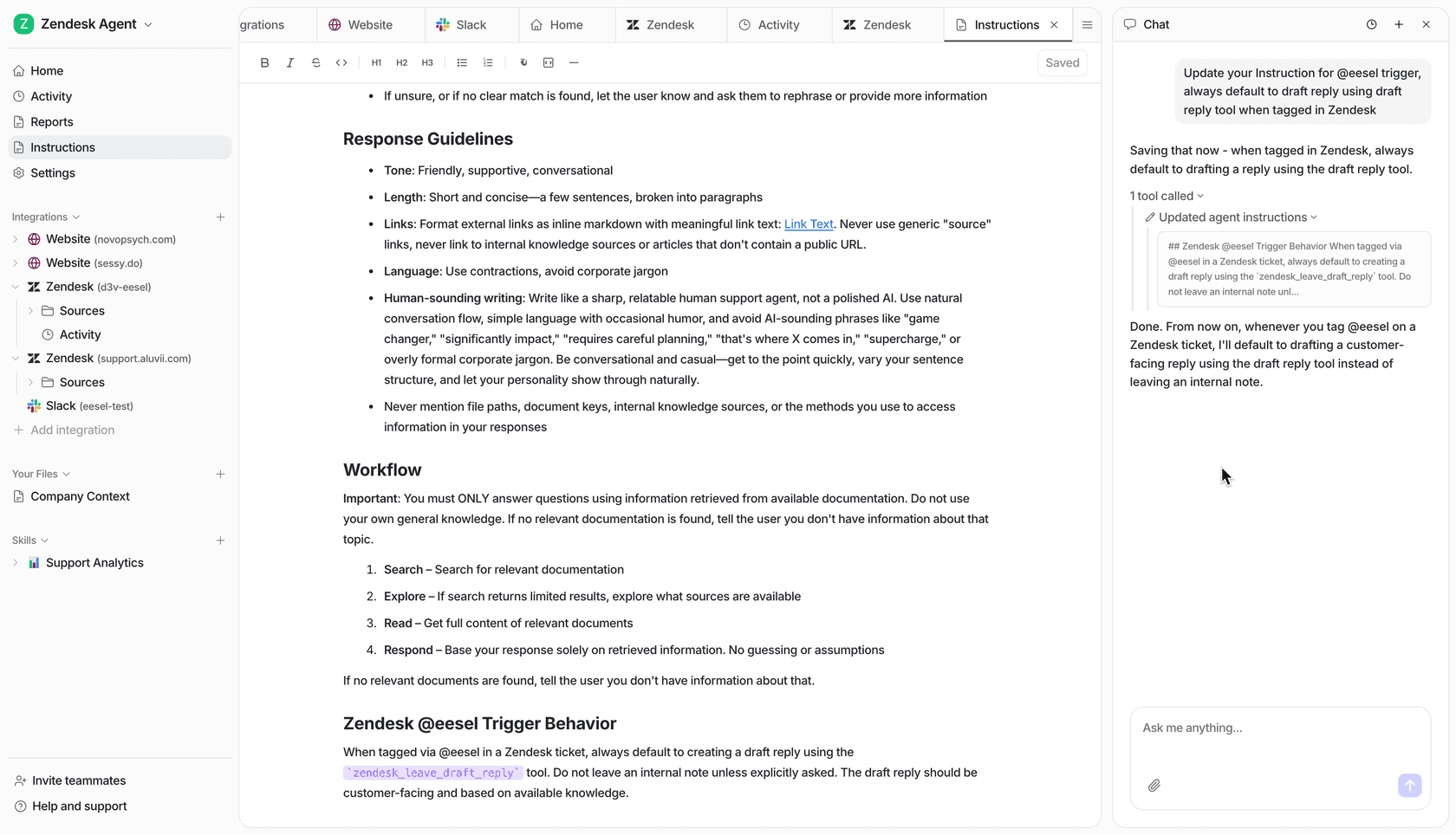
This means:
- No arbitrary ticket locks: Conversations continue naturally without status constraints
- Continuous context: eesel remembers the full conversation history regardless of "status"
- Natural follow-ups: Post-resolution communication happens seamlessly when needed
- Plain-English escalation: Define when to involve humans using natural language, not complex trigger configurations
Continuous learning from all interactions
Unlike Zendesk's static ticket records, eesel AI learns from every interaction, including post-resolution follow-ups. This means:
- Corrections you make to eesel's responses train the AI for future conversations
- Post-resolution context improves eesel's understanding of your customers
- No need to split records across multiple tickets
Flexible workflow without rigid states
eesel AI doesn't force conversations into rigid "solved" or "closed" buckets. Instead, it uses natural language instructions to determine when a conversation is complete and when human escalation is needed.
For example, you might tell eesel:
"If the customer confirms their issue is resolved, thank them and end the conversation. If they reply again later, treat it as a new request but reference the previous context if relevant."
This approach eliminates the "outbound after solve" problem entirely. The conversation can continue as long as needed, with eesel handling routine follow-ups on its own and escalating to humans only when appropriate.
Zendesk integration
For teams already using Zendesk, eesel AI integrates directly as an AI agent and copilot within your existing workflow. You can:
- Deploy eesel AI within Zendesk to handle frontline support
- Use eesel's AI Copilot to draft replies for human agents
- Let eesel handle routine follow-ups without the status restrictions
- Keep your existing Zendesk setup while gaining AI-powered flexibility
Choosing the right approach for your team
Whether Zendesk's limitations are a dealbreaker depends on your specific needs.
When Zendesk workarounds are sufficient
Zendesk's built-in functionality may be adequate if:
- Your support workflow is straightforward with minimal post-resolution communication needs
- You have low ticket volume, making manual workarounds manageable
- Your industry doesn't have strict compliance requirements for post-resolution documentation
- Your team is already invested in Zendesk and the switching costs are high
When to consider alternatives
Consider alternatives like eesel AI if:
- You frequently need post-resolution follow-up communication
- You're in a regulated industry requiring complete interaction records
- You want AI-powered support that learns and improves over time
- You're looking for more flexible workflow management without rigid status constraints
- You need AI-powered help desk tools that can handle complex support scenarios
Migration considerations
If you're considering switching from Zendesk to a more flexible solution like eesel AI:
- Data preservation: eesel AI can learn from your past Zendesk tickets, keeping institutional knowledge intact
- Workflow continuity: The AI learns your existing tone and processes, minimizing disruption
- Gradual transition: You can start with eesel AI as a copilot for human agents before moving to full automation
- Integration options: eesel works alongside Zendesk, so you don't need a complete platform switch to gain AI capabilities
Start handling post-resolution communication without limitations
Zendesk's "outbound after solve" limitation is a byproduct of its rigid ticket lifecycle architecture. While workarounds exist, they add complexity and don't fully solve the underlying problem.
Modern AI-powered support platforms like eesel AI take a fundamentally different approach. By treating support as continuous conversations rather than discrete tickets with terminal states, they remove the friction of post-resolution communication while adding AI-powered capabilities that improve over time.
If you're tired of wrestling with Zendesk's limitations and want a support solution that handles follow-ups naturally, try eesel AI for free. Our AI learns your business in minutes and starts handling frontline support without the rigid constraints of traditional ticket systems.


Frequently Asked Questions
Share this article

Article by
Stevia Putri
Stevia Putri is a marketing generalist at eesel AI, where she helps turn powerful AI tools into stories that resonate. She’s driven by curiosity, clarity, and the human side of technology.