Zendesk for insurance support: A complete guide for 2026

Stevia Putri
Last edited March 5, 2026
Insurance customer support is unlike any other industry. When someone's house floods or their car gets totaled, they're not just looking for answers. They're stressed, anxious, and need help fast. That's why insurance companies have specific needs when it comes to customer service software.
Zendesk has become a popular choice for insurance providers looking to streamline their support operations. But is it the right fit for your team? Let's break down how insurance companies use Zendesk, what it costs, and what alternatives you should consider.
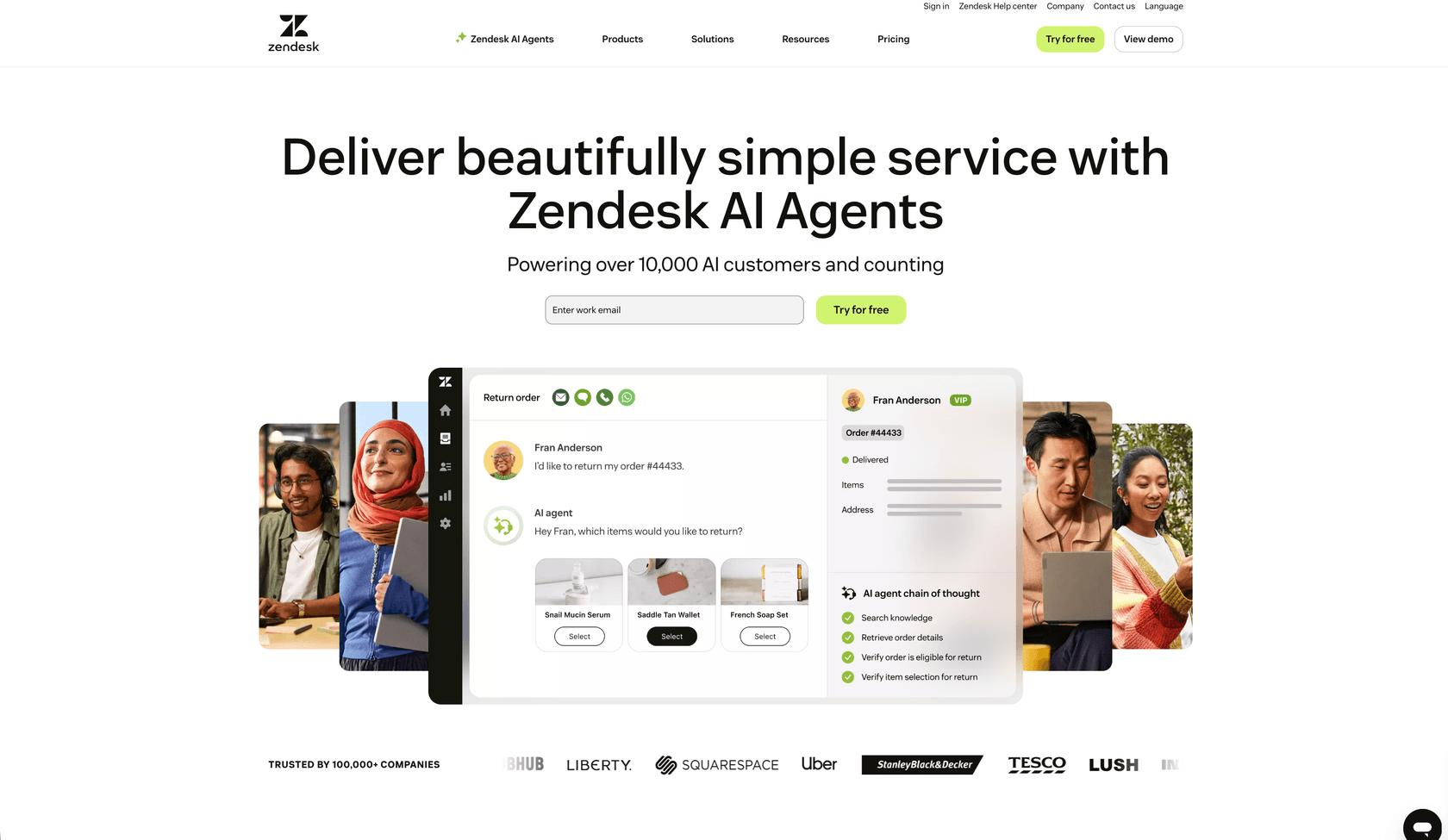
What is Zendesk and how do insurance companies use it?
Zendesk is a customer service platform that combines ticketing, messaging, voice support, and AI-powered automation. Insurance companies use it to manage the high volume of inquiries that come with the territory: policy questions, claims processing, billing issues, and coverage verification.
The platform works by converting customer interactions (emails, phone calls, chat messages) into tickets that agents can track, prioritize, and resolve. For insurance teams, this means every claim, policy question, or billing inquiry gets logged and routed to the right person.
Insurance companies choose Zendesk for a few key reasons. First, it handles the complexity of regulated industries. You can set up custom fields for policy numbers, claim IDs, and coverage types. Second, it scales from small agencies to enterprise carriers. And third, it offers omnichannel support, which matters when customers want to reach you by phone during a crisis but prefer chat for routine questions.
Real insurance companies using Zendesk include Lemonade (the AI-powered insurtech), PURE Insurance, and various health insurance providers. Many use it alongside specialized insurance systems for policy management and claims processing.
Key features of Zendesk for insurance support
Ticket management and routing
Insurance teams deal with distinct request types that need different expertise. A billing question goes to accounting. A claim dispute needs a claims adjuster. Policy coverage questions might require an underwriter.
Zendesk lets you set up custom ticket forms that capture the right information upfront. For example, a claims form might include fields for claim number, date of incident, and policy type. This data then feeds into automatic routing rules that send tickets to the right team without manual sorting.
You can also create views that show agents only the tickets relevant to their role. Claims agents see open claims. Billing specialists see payment issues. This reduces noise and helps teams focus.
Multi-channel support
Insurance customers communicate through multiple channels, often depending on urgency. Zendesk brings these together:
- Email for detailed policy questions and documentation
- Phone via Zendesk Talk for urgent claims and complex issues
- Live chat for quick questions while customers browse your website
- Social messaging including WhatsApp, Instagram, and Facebook
- Web forms for structured submissions like new claims
This matters because insurance customers are often under stress. When someone's basement is flooding, they want to call and talk to a human immediately. When they're checking if a procedure is covered, they might prefer a quick chat. Having all channels in one platform means agents have full context, no matter how the customer reached out.
Knowledge base and self-service
Many insurance questions are repetitive. "What's my deductible?" "Is this covered?" "How do I file a claim?" A well-built help center can deflect these from your agents.
Zendesk's help center lets you create articles organized by topic (coverage, claims, billing, account management). You can restrict certain articles to logged-in customers, which is useful for policy-specific information. The generative search feature uses AI to help customers find relevant articles even when they don't use the exact right keywords.
For insurance companies, this means fewer "how do I..." tickets and faster resolution for customers who prefer self-service.
Reporting and analytics
Insurance support has specific metrics that matter. How long do claims take to resolve? What's the first response time during catastrophe season? Are certain policy types generating more support volume?
Zendesk includes prebuilt dashboards for common metrics like ticket volume, resolution time, and customer satisfaction. Suite Professional and Enterprise plans add customizable reporting where you can build dashboards specific to insurance KPIs.
Setting up Zendesk for insurance: Implementation basics
Getting Zendesk running for insurance support isn't a weekend project. Here's what the process typically involves:
Configuration and customization. You'll need to set up ticket forms for your specific use cases: policy questions, claims, billing, coverage verification. Each form needs custom fields to capture relevant data (policy numbers, claim IDs, etc.).
Workflow automation. Routing rules, triggers, and automations need to be configured so tickets reach the right teams. This includes setting up business hours, SLAs, and escalation paths.
Integration with insurance systems. Zendesk doesn't replace your policy administration or claims management systems. You'll likely need to integrate it so agents can see policy details, claim status, and customer information without switching applications.
Agent training. Your team needs to learn the interface, workflows, and best practices. This takes time, especially if you're moving from email or a simpler system.
For teams that want to accelerate this process, Gravity CX offers a pre-built insurance template for $499. It includes pre-configured ticket forms for policy questions, claims processing, provider network inquiries, and more. The template also sets up views, triggers, and reporting dashboards specific to insurance use cases.
Zendesk pricing for insurance companies
Zendesk uses per-agent pricing, which means your costs scale directly with team size. Here's the breakdown:
| Plan | Annual Price (per agent/month) | Monthly Price | Best For |
|---|---|---|---|
| Support Team | $19 | $25 | Small teams focused on email support only |
| Suite Team | $55 | $69 | Growing teams needing AI, chat, and voice |
| Suite Professional | $115 | $149 | Established teams needing custom reporting and HIPAA compliance |
| Suite Enterprise | $169 | $219 | Large teams with complex workflows and multiple brands |
Key considerations for insurance teams:
- Suite Professional is the minimum for HIPAA compliance, which most health insurance companies need
- AI agents are included in all Suite plans (Essential tier), but Advanced AI agents require an add-on
- Voice support requires Suite Team or higher
- Add-ons like Copilot ($50/agent/month), Quality Assurance ($35/agent/month), and Workforce Management ($25/agent/month) add up quickly
For a 20-agent insurance support team on Suite Professional with Copilot, you're looking at approximately $3,300 per month ($165 x 20 agents).
Real-world examples: Insurance companies using Zendesk
Lemonade
Lemonade is the insurtech company that disrupted traditional insurance with AI and behavioral economics. They use Zendesk alongside their own AI systems to serve over 1.5 million customers.
What makes Lemonade notable is their claims speed. While the industry average for claim payouts is 30 to 45 days, Lemonade's AI can pay claims in as little as 3 seconds. Their record is a claim approved and paid instantly through their mobile app. About 40% of their claims are handled instantly by AI, with the rest escalated to human agents.
Lincoln Investment
Lincoln Investment, a financial services company, faced a common problem: their growth had created 18 separate help desks across different departments. After implementing Zendesk, they consolidated everything into one platform.
The result? They cut first response and resolution times in half. As their VP of applications development noted, having a seamless help desk solution that works across the enterprise helps them identify and remove roadblocks quickly.
PURE Insurance
PURE Insurance takes a digital-first approach in an industry filled with paper forms and notary stamps. They've used Zendesk since 2016, starting with IT support and expanding to more complex use cases.
Their VP of infrastructure services highlighted how Zendesk reduces friction in ticket escalation. Teams can collaborate and share information smoothly, which creates better experiences for agents, brokers, and ultimately customers.
Limitations of traditional help desks for insurance
Zendesk is a solid platform, but it's not without challenges for insurance teams.
Configuration complexity. Setting up Zendesk properly takes significant time and expertise. You're essentially building a custom system within their framework. For insurance teams without dedicated IT resources, this can be a barrier.
Per-seat pricing. As your team grows, costs scale linearly. Adding seasonal staff during catastrophe season or open enrollment means paying for full seats that might sit idle during slow periods.
AI limitations out of the box. While Zendesk includes AI agents in Suite plans, the Essential tier has limitations. Advanced AI capabilities require additional add-ons, and getting AI to handle complex insurance inquiries autonomously takes significant configuration.
Training and change management. Moving to Zendesk requires training agents on new workflows. The platform has a learning curve, and adoption can be slow if the implementation isn't well-planned.
The configuration-to-autonomy gap. There's a significant distance between "Zendesk is set up" and "Zendesk is handling claims autonomously." Most teams spend months in the middle ground where the system helps but doesn't fully automate.
Modern AI alternatives for insurance support
Traditional help desks like Zendesk were built for an era where humans handled most interactions. Today's AI-native solutions take a different approach.
At eesel AI, we approach insurance support as a learning problem, not a configuration problem. Instead of building complex routing rules and decision trees, you connect eesel to your existing systems (Zendesk, Freshdesk, your help center, past tickets) and it learns your business from the data.
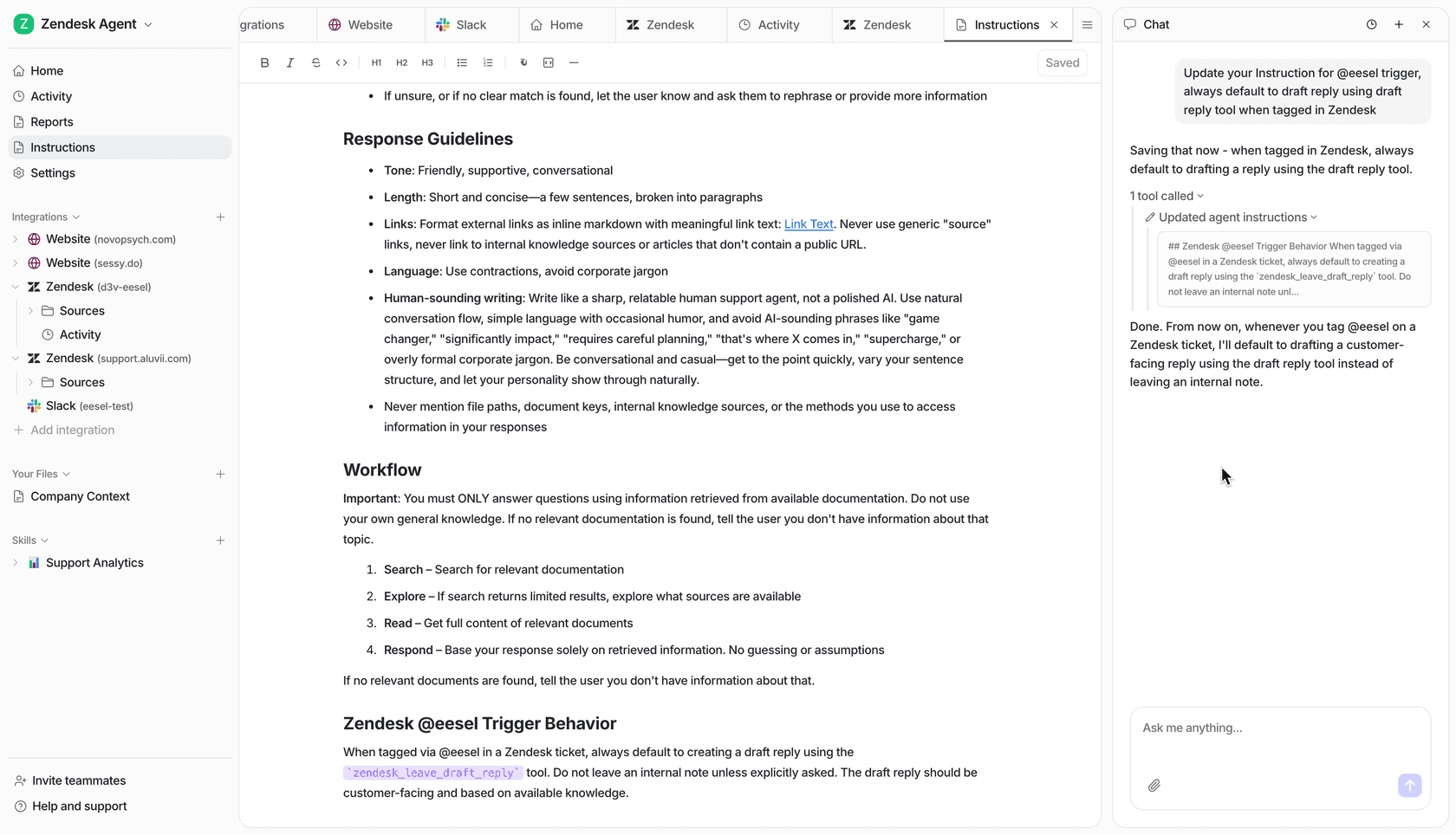
Here's how it differs from traditional help desks:
Progressive rollout. You don't flip a switch and hope for the best. Start with eesel drafting replies for agent review. Once you're confident it understands your policies and tone, let it send responses directly to routine inquiries. Eventually, it can handle full claims workflows autonomously, escalating only what you define.
Plain-English control. Define escalation rules in natural language: "If the refund request is over 30 days, politely decline and offer store credit." "Always escalate billing disputes to a human." No code, no complex workflows.
Learning from your data. eesel reads your past tickets, help center articles, and macros to understand your business context from day one. No manual training or documentation uploads required.
Pay-per-interaction pricing. Instead of per-seat fees, you pay for AI interactions (replies, actions). This means seasonal scaling doesn't break your budget, and you're not paying for seats that sit empty.
Pre-go-live testing. Before eesel touches real customers, run it on thousands of past tickets to see exactly how it would respond. Measure resolution rates, identify gaps, and tune instructions until you're confident.
The result is a system that feels less like software you configure and more like a teammate you hire and train.
Choosing the right insurance support solution
So which approach makes sense for your insurance team?
Zendesk is a good fit when:
- You have dedicated IT or operations staff to manage implementation
- You need extensive customization and complex workflows
- You want a platform that integrates with hundreds of other tools
- You prefer predictable per-seat pricing
- You're already invested in the Zendesk ecosystem
Consider AI-first alternatives like eesel AI when:
- You want to reduce implementation time from months to days
- You prefer to start with AI assistance and gradually increase autonomy
- Seasonal staffing makes per-seat pricing painful
- You want AI that learns from your existing data without manual configuration
- You need to test and validate AI performance before going live
Key decision factors:
- Team size: Small teams might find Zendesk's minimums expensive; AI alternatives often have lower entry points
- Ticket volume: High volume with repetitive questions benefits more from AI automation
- Technical resources: Limited IT staff favors solutions that require less configuration
- Regulatory requirements: Ensure any solution meets your compliance needs (HIPAA, SOC 2, etc.)
The bottom line? There's no one-size-fits-all answer. Zendesk is a proven platform with extensive capabilities, but it requires investment in setup and ongoing management. AI-native solutions offer faster time-to-value and different pricing models, but you'll want to evaluate them against your specific requirements.
If you're evaluating options, consider running a pilot. Many insurance companies find that a hybrid approach works best: using Zendesk (or another help desk) as the system of record while adding AI layers for automation and efficiency.


Frequently Asked Questions
Share this article

Article by
Stevia Putri
Stevia Putri is a marketing generalist at eesel AI, where she helps turn powerful AI tools into stories that resonate. She’s driven by curiosity, clarity, and the human side of technology.