When to hire support agent vs AI: A founder's decision framework

Stevia Putri
Last edited March 19, 2026
You're drowning in customer emails. Every founder hits this point, usually around 100-200 tickets per month. Support is eating 2-3 hours of your day, and you're starting to drop balls.
The obvious answer: hire someone.
But before you post that job description, consider this: you might be asking the wrong question. It's not "human or AI." It's "what can only humans do, and what should AI handle?"
At eesel AI, we see this dilemma constantly. Founders think they need to hire because "the AI can't handle this volume." But often, the real issue isn't capacity. It's that they haven't set up their AI teammate properly yet.
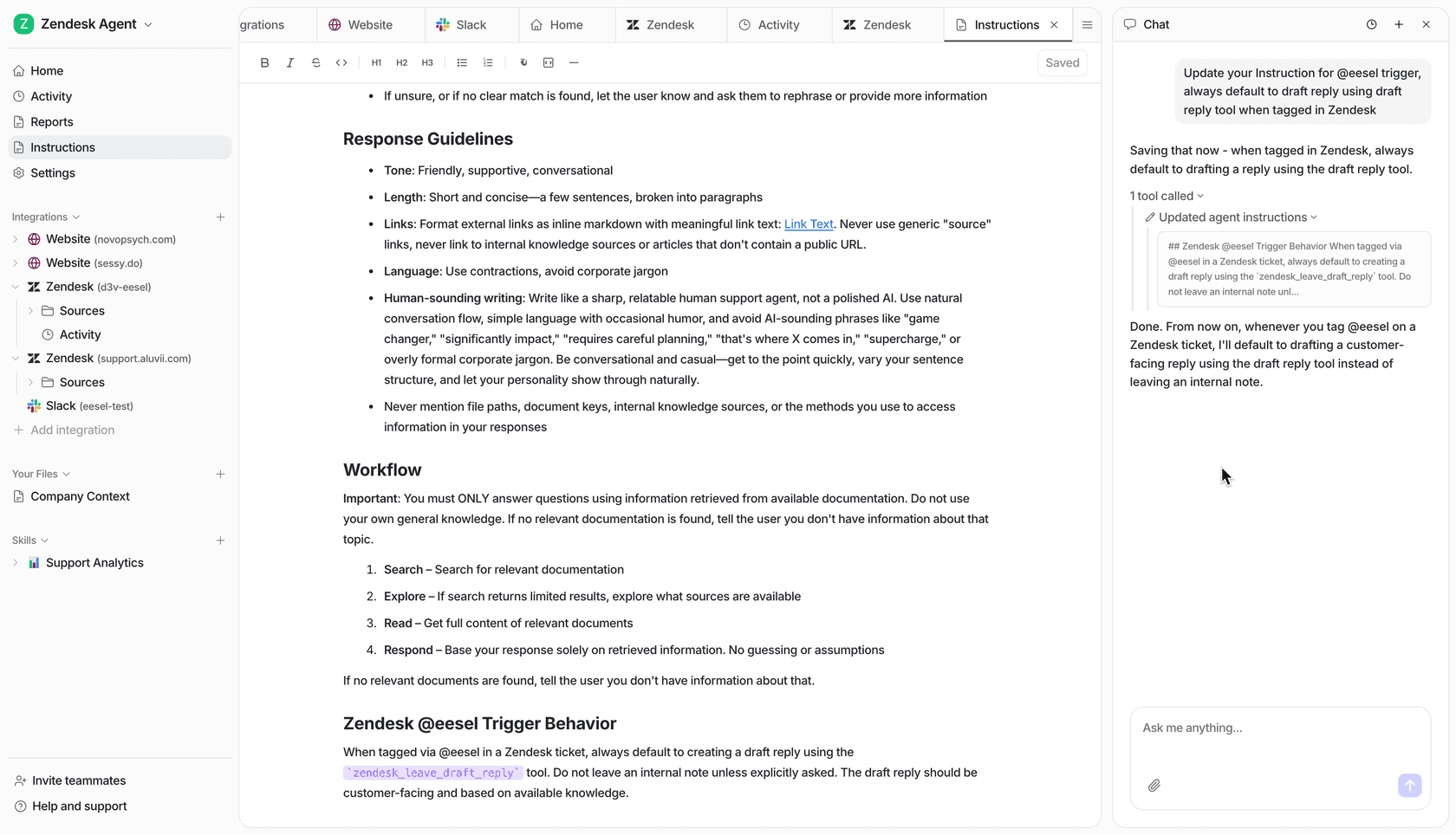
Let's break down when to hire a support agent versus when to bring on an AI teammate instead.
When to hire support agent vs AI: Volume thresholds that actually matter
Here's a simple framework based on real data from companies making this decision:
| Monthly Volume | Recommendation | Your Time Commitment |
|---|---|---|
| Under 100 tickets | Handle it yourself with templates | 30-60 minutes/day |
| 100-300 tickets | Decision point | 1-2 hours/day |
| 300-500 tickets | Start with AI-assisted | 3-4 hours/day (unsustainable) |
| 500-1,500 tickets | AI-assisted sweet spot | 1-2 hours review/day |
| 1,500+ tickets | Consider dedicated hire | Review becomes a full job |
Source: Aidly
These aren't rigid rules. They're starting points. The real question is what your tickets look like and how much of your time they're consuming.
Under 100 tickets per month, you're probably fine with batching and templates. But once you cross 300, you're looking at 3-4 hours daily just on support. That's when it starts affecting your actual job (building the business).
The 500-1,500 range is where AI-assisted support shines. You review drafts instead of writing from scratch, cutting your time to 1-2 hours daily while maintaining quality control.
Above 1,500 tickets monthly, the review workload becomes substantial enough that a dedicated person makes sense. But even then, you probably need fewer people than you think. More on that in a moment.
Check out our pricing to see how costs scale with your volume.
The true cost of hiring vs AI
Most founders budget $45,000 for their first support hire and call it done. Here's what that actually costs.
What a support agent really costs
The salary is just the beginning. Here's the full breakdown:
Direct costs (annual):
| Cost Component | Amount |
|---|---|
| Base salary (US, entry-level) | $42,000 - $52,000 |
| Payroll taxes (7.65% FICA) | $3,200 - $4,000 |
| Health insurance (employer portion) | $6,000 - $12,000 |
| PTO coverage | $1,600 - $3,000 |
| Equipment and setup | $1,500 - $2,500 |
| Software licenses | $1,200 - $2,400 |
| Subtotal: Direct costs | $55,500 - $75,900 |
Hidden costs (annual):
| Cost Component | Amount |
|---|---|
| Training time (2-4 weeks) | $2,000 - $5,000 |
| Your time managing (5 hrs/week) | $10,000 - $20,000 |
| Mistakes during ramp-up | $500 - $2,000 |
| Coverage gaps (sick days, vacation) | $1,500 - $3,000 |
| Turnover cost (30% annual rate) | $3,000 - $8,000 |
| Subtotal: Hidden costs | $17,000 - $38,000 |
Total true cost: $72,500 - $113,900 per year ($6,000 - $9,500 monthly)
Source: Aidly
That's roughly 30-50% more than most founders budget. And here's the kicker: unless you're at 750+ tickets monthly, that hire is underutilized. You're paying for capacity you don't need.
What AI-assisted support costs
| Cost Component | Amount |
|---|---|
| Software | $200 - $500/month |
| Your review time | 1-2 hours/day |
| Total monthly cost | $200 - $800 |
Cost per ticket: $0.60-$0.90 (AI-assisted) versus $12-19 (human agent).
Source: Aidly
The math is stark. At 500 tickets monthly, AI-assisted costs around $400. Hiring costs $6,000-9,500. That's a 90%+ difference.
Use our ROI calculator to run the numbers for your specific situation.
The break-even reality
Here's how cost per ticket looks at different volumes with a human agent:
| Monthly Volume | Agent Utilization | Cost Per Ticket |
|---|---|---|
| 300 tickets | 27-40% | $20-32 |
| 500 tickets | 45-67% | $12-19 |
| 750 tickets | 68-100% | $8-13 |
| 1,000 tickets | 91-133% | $6-9.50 |
Source: Aidly
You need serious volume before a dedicated hire makes financial sense. Until then, you're subsidizing idle capacity.
When AI excels (and when it doesn't)
AI isn't magic. It's really good at some things and genuinely terrible at others. Knowing the difference is key to deciding when to hire support agent vs AI.
Tasks where AI excels
- 24/7 availability: No shift schedules, no fatigue, no PTO coverage needed
- Infinite scale: Handle hundreds of concurrent conversations without quality dropping
- Consistency: Every response matches your tone and follows your policies
- Speed: Deploy in minutes versus 3-6 months to hire and train
- Cost efficiency: 85-90% cost reduction for routine interactions
Source: HireHumans.ai
AI excels at execution: repeatable, rule-based tasks with clear parameters. Order status lookups. Password resets. Return policy questions. The stuff that makes up 70-80% of most support queues.
Where humans remain essential
- Emotional situations: 93.4% of consumers prefer human support, and 86% specifically want humans for complaints
- Complex ambiguity: Context, subtext, and nuanced language
- Novel problems: Situations outside your training data
- High-stakes decisions: Refunds over $500, legal issues, VIP customers
- Relationship building: Turning frustrated customers into loyal advocates
Sources: Glean, HireHumans.ai
Humans excel at judgment: navigating ambiguity, reading emotional cues, and making calls with incomplete information.
The framework is simple: execution tasks go to AI, judgment tasks go to humans. Most companies need both.
For more on AI capabilities, check out our guide to top AI customer service tools.
The hybrid path most successful companies take
Here's the approach that actually works. Not AI-only. Not human-only. A progression that lets you scale intelligently.
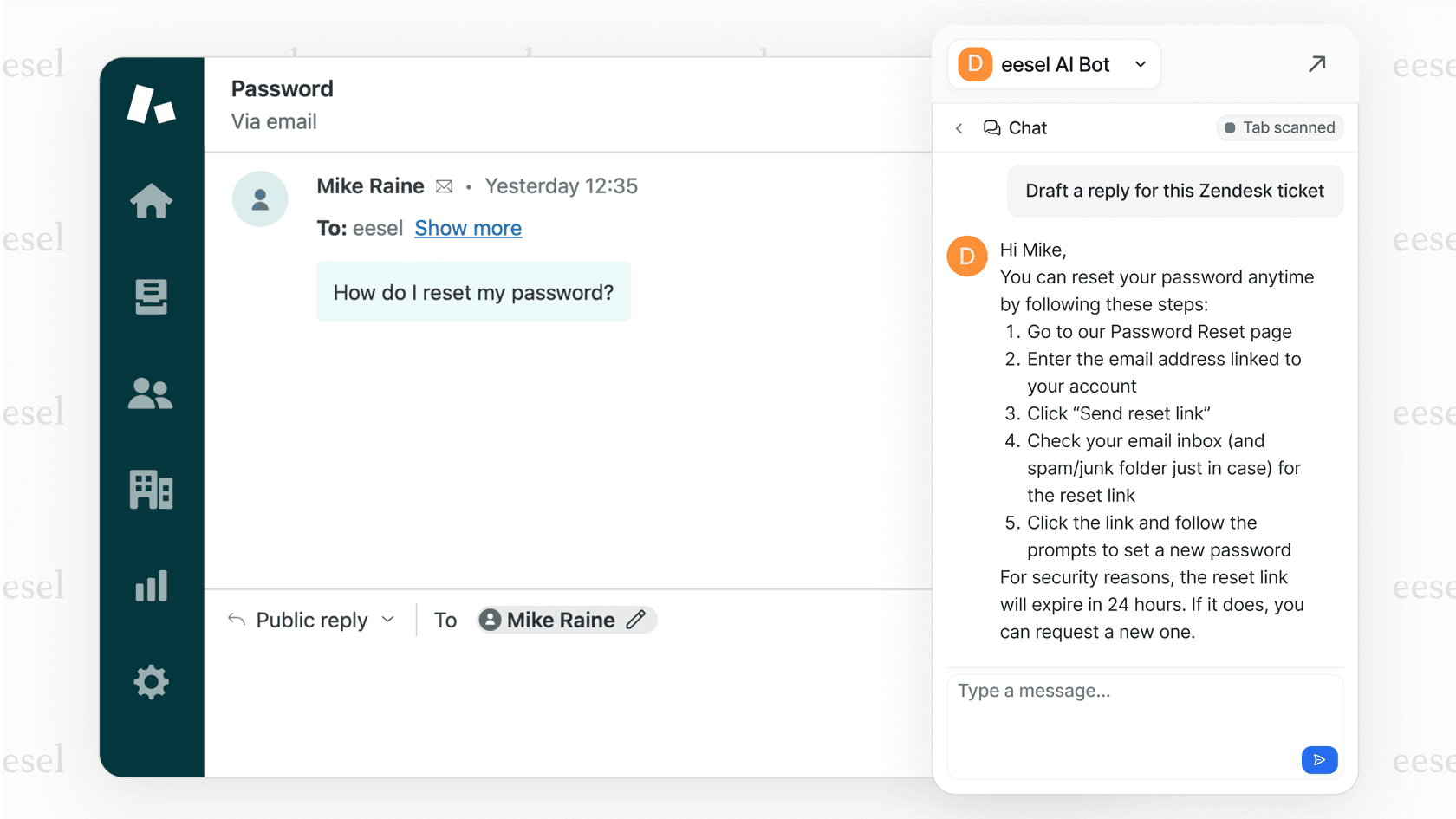
Stage 1: AI-assisted (100-1,000 tickets/month)
- Cost: $200-500/month
- Your time: 1-2 hours/day reviewing drafts
- Headcount: Zero
AI drafts responses, you review and approve. You maintain quality control while eliminating 80% of the writing work. This is where most founders should start.
Stage 2: AI-assisted plus part-time help (1,000-2,500/month)
- Cost: $500-2,000/month
- Part-timer: 15-20 hours/week reviewing AI drafts
- You: Handle escalations only
You've proven the volume justifies help. A part-timer reviewing AI drafts is 3-4x more productive than a traditional agent writing from scratch.
Stage 3: AI-assisted plus dedicated reviewer (2,500-5,000/month)
- Cost: $3,000-5,000/month
- One full-time person plus AI
- Output: Handles what used to need 3-4 traditional agents
AI is a force multiplier. Your hire reviews and approves, not writes from scratch. One person handles 3-4x the volume.
Stage 4: AI-assisted team (5,000+/month)
- Team of 2-4 people
- Traditional team of 10-15 becomes AI-assisted team of 3-5
Even at scale, you need fewer people than conventional wisdom suggests.
Source: Aidly
Our AI Copilot is designed for exactly this workflow: AI drafts, humans review, quality stays high, costs stay low.
Testing before you commit
Here's the legitimate concern with AI: hallucination. Chatbots can generate plausible-sounding but completely wrong answers. Glean's research found that up to 27% of chatbot responses may contain false information. That's not acceptable for customer-facing support.
The solution isn't avoiding AI. It's testing before you go live.
Run your AI on past tickets first. See exactly how it would have responded. Measure accuracy rates. Identify gaps in your knowledge base. Tune the thresholds for when it escalates to humans.
This is how you validate the decision before committing. You get real data on whether AI can handle your specific ticket types, written in your industry's language, following your actual policies.
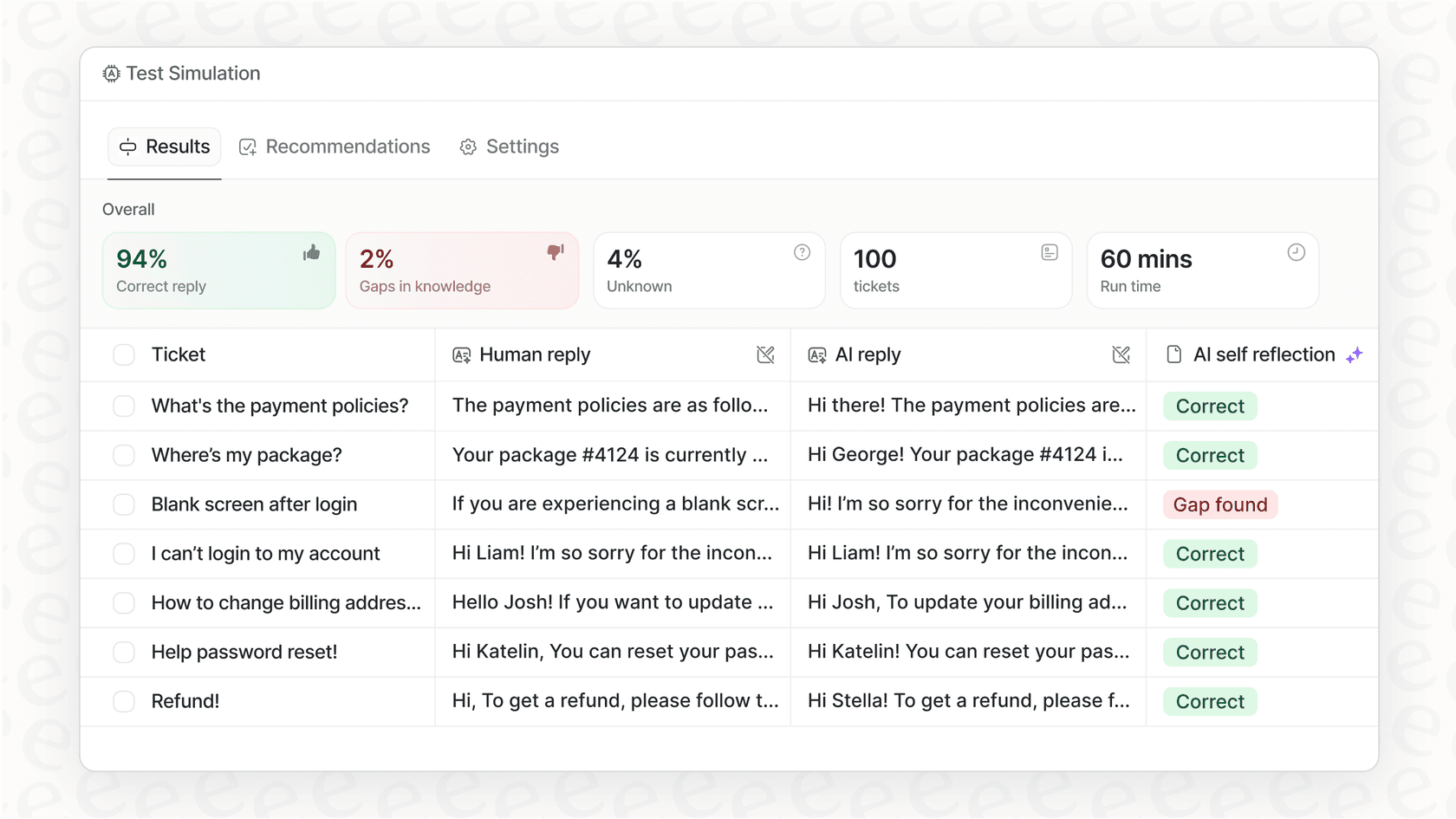
With eesel AI, you can simulate on thousands of past tickets before touching real customers. See resolution rates. Identify edge cases. Adjust your escalation rules. Only when you're confident do you flip the switch.
Think of it like hiring: you wouldn't bring someone on without an interview. Don't deploy AI without testing it first.
Making your decision: When to hire support agent vs AI
Here's a simple 3-point test:
- Is it repetitive and predictable? AI can handle it.
- Does it require empathy or judgment? Keep it human.
- Is your volume 500-1,500/month with mostly routine questions? Start with AI-assisted.
The worst outcome isn't choosing wrong. It's not choosing at all and continuing to spend 3 hours daily writing emails you could review in 30 minutes.
Most founders should start with AI-assisted support. It gives you data on what customers actually ask, maintains your quality control, and costs a fraction of hiring. You can always add humans later if the volume or complexity justifies it.
But you'll probably find you need fewer people than you thought. And the people you do hire will focus on the interesting, high-judgment work instead of typing the same responses repeatedly.
Ready to see how AI-assisted support would work for your tickets? Try eesel AI and run a simulation on your past conversations before making the hire versus AI decision.

Frequently Asked Questions
Share this article

Article by
Stevia Putri
Stevia Putri is a marketing generalist at eesel AI, where she helps turn powerful AI tools into stories that resonate. She’s driven by curiosity, clarity, and the human side of technology.