

Trying to get your travel business noticed online can be challenging. Most travel plans start with a Google search, but the results page is highly competitive. You're up against companies like Booking.com, Expedia, and TripAdvisor, all with massive budgets and marketing teams. So, how can you possibly compete?
You don't try to outspend them. You outsmart them. A focused travel SEO strategy is your best bet, helping you create targeted content that answers specific questions from potential customers. It's about finding the right travelers at the right time. And with tools like the eesel AI blog writer, you can ramp up your content creation without needing a huge budget to back you up.
What is travel SEO and why is it unique?
At its heart, travel SEO is all about tweaking your website to rank higher in search results for things travelers are looking for. But it's not just standard SEO with a travel sticker on it. It's a different animal for a few reasons.
- Hyper-seasonality: Travel demand is a rollercoaster. Searches for "ski resorts in Aspen" shoot up in the fall, while "beach houses in the Outer Banks" gets all the attention in the spring. Your SEO plan needs to anticipate these waves, with content planned months ahead to catch that peak interest.
- Complex user journey: People don't just wake up and book a trip to Peru on a whim. The process has multiple stages, from daydreaming about places to planning the details, booking, and then actually going. Each stage involves different search terms, and you need content for all of them.
- Location-based intent: Travel is all about place. People are searching for "things to do in Paris," "best coffee shops near me," or "hotels in downtown Austin." This makes local SEO a huge part of the strategy.
- Visual-heavy search results: Google gets that travelers want to see where they're going. Search results are full of images, maps, and rich snippets. Just look at the new carousel format. If your content isn't visually interesting and structured for these features, you're falling behind.
The key challenges of modern travel SEO
Before you can put together a winning strategy, you need to know what you're up against. Getting a handle on the biggest hurdles is the first step to figuring out how to clear them.
The challenge of OTAs
This is the big one. Online Travel Agencies (OTAs) are the giants of the industry. They invest significant amounts of money in advertising and SEO, and it pays off. Research shows that comparison sites like Booking.com and Expedia take up about 73% of the organic listings on the first page of Google for general hotel searches.
Impossible. When people search for 'miami hotels' Google is returning links to lists of hotels on OTA's and travel sites, which is what people expect when they make that search. You probably can't even buy the first position at any reasonable rate. I've seen hotel properties struggle to get first position for the name of their own property.

Ranking for a term like "hotels in New York" is challenging if you're an independent hotel or a small tour operator. But here's where you can pivot: the game changes when you get more specific. For niche, long-tail searches, OTA dominance is significantly reduced, opening up a huge opportunity for smaller businesses to get noticed.
Managing seasonal fluctuations
That demand rollercoaster we talked about makes content planning a real challenge. You can't just publish a post about "summer vacation ideas" in June and hope it ranks right away. SEO is a long game, so you need to be writing about summer destinations while people are still bundled up for winter. This means you need a calendar-driven approach to stay ahead of the curve and capture interest as it's building, not after it's already gone.
Addressing the traveler search journey
A single traveler might use dozens of different search queries before they book a trip. Your job is to be there with the right answer at every step.
- Dreaming: This is the top of the funnel, where people are looking for inspiration. They're using broad queries like "best tropical islands for families" or "underrated European cities."
- Planning: Here, things get more specific. Searches become more detailed, like "cost of a 1-week trip to Bali," "best time to visit Greece," or "packing list for Southeast Asia."
- Booking: Now we're talking business. The intent is transactional, and people are ready to buy. They're searching for "book flights from LAX to Bali" or "oceanfront hotels in Maui."
- Experiencing: The trip is underway, but the searches continue. Travelers on the ground are looking for things like "best restaurants in Ubud" or "how to use the Paris metro."
Creating different types of content for each of these stages is a lot of work, but it's how you build a relationship with a potential customer from their first spark of an idea all the way to their booking confirmation.
Core strategies for a winning travel SEO campaign
Having covered the challenges, let's explore the playbook that helps you compete effectively. These are the tactics that actually drive results in the travel industry.
Target long-tail keywords
Instead of competing for broad, highly competitive keywords, get specific. Long-tail keywords are longer, more detailed search phrases that signal a much clearer intent. Think "family-friendly all-inclusive resort in Cancun with a kids club" instead of just "Cancun resorts."
Long tail, my friend. It's all about the long tail.
These keywords might have lower search volume, but they convert really well because the person searching knows exactly what they're looking for. And as mentioned, research shows that OTAs are less dominant for these phrases. This is your chance.
Map out your content by matching specific, long-tail keywords to each stage of the traveler's journey. Build a content plan that answers every possible question someone might have, from the general to the very specific.
Create E-E-A-T content
Google is getting smarter about what makes content good. Its E-E-A-T guidelines (Experience, Expertise, Authoritativeness, and Trustworthiness) are a big deal, especially for topics like travel where people are spending their money and vacation time based on your advice. Google wants to see that you know your stuff.
E-E-A-T is Critical: Google looks heavily for the extra 'E' (Experience) in travel. You need to prove you’ve actually 'experienced the experience.' Generic content won't cut it anymore; you need unique angles, original photos, or local expert verification to build trust.
Here's the kind of content that builds trust and helps you rank:
- In-depth destination guides: Go beyond the generic top 10 lists. Share unique, local knowledge that an OTA's algorithm could never come up with. What's the best local coffee shop? Where's that hidden spot for the perfect sunset photo?
- Sample itineraries: Give people a plan they can use. A post like "A 3-Day Weekend in Rome for Food Lovers" is super helpful and easy to share.
- Travel tips and how-to guides: Solve common travel headaches. "How to Pack for a 10-Day European Trip in a Carry-On" or "Navigating the Tokyo Subway for the First Time" are practical posts that can bring in a lot of traffic.
- Reviews and comparisons: Help people make tough decisions. An honest comparison like "Marriott vs. Hilton in Downtown Chicago" offers real value.
And seriously, use your own photos and videos! High-quality, original visuals are the best way to show you've actually been there and done that.
Master local SEO
This is the single biggest advantage you have over the OTAs. They cannot appear in the local results (now known as the Google Business Profile local pack). That's the map with three business listings that pops up for local searches. It's prime digital real estate, and it's reserved for actual local businesses.
According to Google, local ranking comes down to three factors: relevance, distance, and prominence. You can't change your distance from the searcher, but you have total control over the other two.
Here’s how to get your Google Business Profile (GBP) in shape:
- Make sure all your information is complete and accurate. Your business name, address, phone number, and category need to be spot-on.
- Get your business verified. This is a must-do step that proves to Google you're a real business.
- Keep your hours updated, especially for holidays. Nothing is more frustrating for a customer than showing up to find you're closed.
- Encourage and respond to every single review. Reviews are a huge signal of trust and prominence.
- Add high-quality photos and videos often. Show off your property, your tours, and your happy customers—give people a reason to pick you.
Build authority with high-quality backlinks
In the SEO world, backlinks are like votes of confidence. When another reputable website links to yours, it signals to search engines that you're a trustworthy source.
Here are a few practical ways to earn good backlinks:
- Write guest posts for popular travel blogs.
- Partner with your local tourism board or travel influencers.
- Get listed in relevant local directories and travel-specific websites.
- Create amazing, shareable content that people naturally want to link to, like a unique data study on travel trends or a well-designed infographic.
The foundational role of technical travel SEO
You could have the most amazing content in the world, but if your website has technical issues, it won't matter. Technical SEO is the foundation for everything else. If Google can't easily crawl, understand, and index your site, your content is practically invisible.
Prioritize mobile-friendliness and page speed
This is not optional. Most travelers are researching and booking trips on their phones. If your site is slow or hard to use on a mobile device, they'll leave in a heartbeat. A high bounce rate tells search engines that your site isn't helpful, which hurts your rankings. Your site has to be fast, responsive, and easy to use on any screen.
Use structured data to win rich results
Structured data, or schema markup, is code you add to your site to help search engines understand your content better. It's what creates those fancy "rich results" in search listings—the ones with star ratings, images, prices, and event dates.
For travel sites, a few schema types are essential, and you can find the details in Google's own documentation:
- "VacationRental": This is a must for hotels, vacation rentals, and B&Bs. To qualify, you need to provide specifics like at least 8 photos, a list of amenities, and occupancy info.
- "Event": This is perfect for marking up tours, activities, or local festivals. You can specify dates, times, locations, and prices.
- Other useful types: Don't forget "Review" schema for testimonials, "FAQ" for your Q&A sections, and "LocalBusiness" for your general business info.
Getting this right can be the difference between a plain blue link and an eye-catching result that gets all the clicks.
How to scale your travel SEO content with the eesel AI blog writer
Let's be realistic: carrying out a solid content strategy is the most time-consuming part of travel SEO. Creating in-depth guides, itineraries, and local tips for every keyword you want to rank for can feel like a full-time job.
This is where a tool like the eesel AI blog writer can make a huge difference. It's designed to help you scale up high-quality content creation without hiring a team of writers.
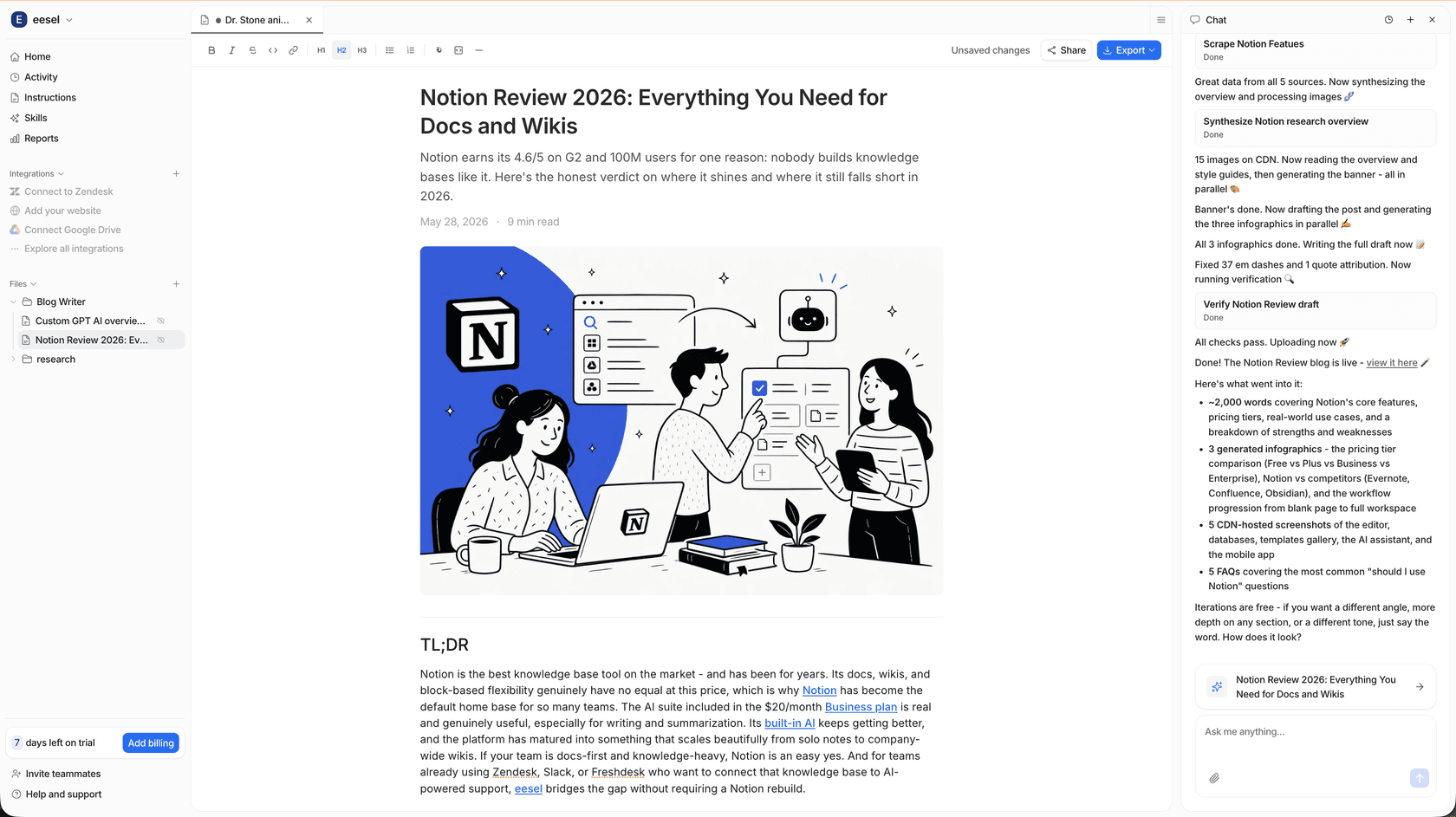
It's especially useful for the travel industry because of a few features:
- Deep Research: It doesn't just give you surface-level content. It can generate detailed destination guides, itineraries, and comparison posts that feel like they were written by a local expert.
- Automatic Assets: Visuals are key in travel. The tool automatically creates unique images, comparison tables for hotels or tours, and infographics that make your content more engaging.
- Authentic Social Proof: To satisfy those E-E-A-T guidelines, you need to show real-world experience. The eesel AI blog writer can find and embed relevant Reddit quotes and YouTube videos, adding authentic voices to your content.
- AEO Optimized: As search changes with things like Google's AI Overviews, content structure is more important than ever. This tool generates content formatted to do well in these new AI-powered answer engines.
- Proven Results: We use this exact tool for our own blog. It took us from 700 impressions a day to over 750,000 daily impressions in just three months by publishing over 1,000 optimized posts.
Instead of spending hours on research and writing, you can generate a complete, publish-ready blog post in a few minutes.
For a deeper dive into effective travel SEO strategies, the following video offers a complete guide that aligns with the principles we've discussed, covering everything from website structure to content creation.
Your journey to the top of the SERPs
Winning at travel SEO in 2026 isn't about who has the biggest budget. It's about who has the smartest strategy. It all comes down to a few key things: understanding the traveler's journey, creating great content for specific long-tail keywords, owning local search with an optimized Google Business Profile, and making sure your website is technically sound.
While competing with OTAs for broad terms can be difficult, a focused strategy can get you incredible results. By carving out your niche, showing your expertise, and meeting the specific needs of your target travelers, you can drive real organic growth and get those all-important direct bookings.
Ready to create travel content that ranks? Try the eesel AI blog writer for free and generate your first publish-ready destination guide in minutes.






