

Getting paid to travel the world and write about it sounds like the dream, right? It's definitely possible, but in a world flooded with travel blogs, you need more than a passport and a passion for adventure to make it work. The internet is overflowing with travel diaries, so you've got to have a game plan to stand out.
What is travel blog writing?
These days, travel blogging is a lot more than just keeping an online journal. It's about creating a platform for a specific audience by mixing two things readers really want.
Your blog basically has two jobs.
- Inspiration (The Story): This is where you come in. It’s your personal stories, your descriptions of a place, and the unique way you see things that makes a reader feel like they're on the trip with you. This is how you build a real connection and get people to stick around.
- Information (The Service): This is the practical stuff. We're talking actionable tips, detailed itineraries, budget guides, and real advice that helps your readers plan their own trips. This is what makes your blog truly useful.
The art of storytelling: Finding your voice
Before you can rank on Google, you need to connect with a human. The creative, personal side of your writing is what builds a loyal audience that trusts what you have to say and keeps coming back for more.
Your unique perspective is your greatest asset
You can't be everything to everyone, especially in a market as crowded as travel. The trick to standing out is to pick a niche and make it your own. Your unique point of view isn't a weakness; it's your biggest strength.
Instead of just writing about "travel," get specific. Here are a few examples of travel niches:
- Solo female travel
- Budget backpacking through Southeast Asia
- Luxury family travel
- Adventure and extreme sports travel
- Ecotourism and sustainable travel
- Food-focused travel in a specific region
Lean into what makes you, you. Are you a history nerd who loves ancient sites? A parent trying to travel with toddlers? A vegan on a mission to find the best plant-based food across the globe? That’s how you build a brand people remember.
How to write descriptively
The best travel writing makes the reader feel like they’re there. The classic advice is to write "in the moment" or take detailed notes while you're still at your destination. This helps you capture the sensory details that bring a place to life.
I've taken a travel writing course before. The best tip is to write while you're traveling, which worked for me. Don't write about your journey an hour after, or later in the evening — write in the moment. For this, you'll need a travel journal.
Here are a couple of pro tips to make your descriptions pop. First, use anecdotes. A quick story about a funny mix-up at a train station or a chat with a local shopkeeper is way more memorable than just describing a landmark. People connect with stories, not just a list of facts.
Second, focus on emotions. Before you even start writing, decide on the main feeling you want your reader to have. Is it the buzz of a big city, the calm of a quiet beach, or the wonder of exploring old ruins? If you write from that emotional space, your words will carry that feeling through to the reader.
When you sit down to write, think about what emotion you want your reader to feel when they read. Then get into that emotional state yourself before you start writing and it will flow more naturally
To really pull your reader in, try to engage all five senses. Don't just tell them what you saw. Describe the smell of street food on a corner, the sound of the local language around you, the taste of a regional coffee, and the feeling of the sun on your skin. These details make your story feel real.
Balancing personal narrative with practical advice
Pro tip
Here's a tough but important rule for writing content for others: 'Stop talking about yourself.'
Every story you tell should circle back to helping the reader.
For example, instead of writing: "I ate a croissant."
Try something more like this: "The flaky crunch of the croissant from the corner bakery on Rue Cler was the perfect fuel for a morning exploring the Louvre. It’s a tiny spot that’s easy to miss, so here's a map to find it and exactly what to order."
See the difference? The first is a diary entry. The second is a genuinely helpful recommendation wrapped in a personal story.
The science of success: SEO for travel blogs
Great storytelling gets people to stay on your site, but SEO (Search Engine Optimization) is what gets them there in the first place. This is the technical side of blogging that helps people find your content on search engines like Google.
Why E-E-A-T is non-negotiable
E-E-A-T is a term from Google that stands for Experience, Expertise, Authoritativeness, and Trustworthiness. It’s how Google decides which content is actually helpful and high-quality. For travel bloggers, this is everything.
Let's break it down:
- Experience: Google added the "E" for Experience in late 2022, and it was a big deal for travel content. It means they want to rank content from people who have actually been there. As Google’s guidelines suggest, readers want content that shows real, first-hand knowledge. This means using your own photos and videos, not stock images, and sharing details you could only know from being there yourself.
- Expertise: This is about showing you know your stuff in your niche. If you blog about hiking in Patagonia, your posts should be packed with detailed trail guides, gear advice, and safety tips that prove you're an expert on that topic.
- Authoritativeness: You build authority by becoming a go-to source. A clear author bio and a detailed "About" page are essential for explaining why you're qualified to write about your niche. Getting links or mentions from other respected travel sites also helps build your authority.
- Trustworthiness: According to Google's raters, trust is the most important part of E-E-A-T. This is all about being transparent. Clearly label any sponsored posts or affiliate links. Make sure your information (like opening hours, prices, and visa rules) is accurate. If you get something wrong, fix it.
An infographic detailing the E-E-A-T framework for high-quality travel blog writing.
A practical SEO workflow
SEO can feel like a lot, but you can break it down into a simple, repeatable process.
- Keyword Research: You need to write about topics people are actually searching for. Don't just guess. Use tools to find keywords related to your destination or niche. User-friendly tools like Keysearch are affordable and great for bloggers, and free options like the Google Keyword Planner are a decent place to start. Look for topics that get a good number of searches but aren't impossible to rank for.
- On-Page SEO: Once you have a target keyword (like "best things to do in kyoto"), use it naturally in your post's title, a few headings, and your meta description. Don't overdo it; just make it clear to both Google and your reader what the article is about.
- Content Updates: SEO is a long game. Travel information changes all the time. That post you wrote two years ago about the best cafes in Lisbon? Some of them might have closed. Set aside time to go back and update your old posts with new info to keep them relevant and ranking well. It takes time, but it's key for long-term success.
A workflow diagram showing the three steps of SEO for travel blog writing: keyword research, on-page SEO, and content updates.
Streamlining your workflow: The essential toolkit
Trying to balance traveling, writing, photography, and SEO is a huge juggling act. The right tools can help you simplify your process, stay consistent, and avoid burning out.
eesel AI blog writer: Go from keyword to publish-ready post in one click
Here's how it helps with the specific challenges of travel blogging:
- It automates the heavy lifting: You give it a keyword, and it handles the whole process, from doing the research and structuring the article to writing a full first draft. The content is automatically optimized for both SEO and Answer Engine Optimization (AEO), which helps you appear in Google's AI Overviews.
- It creates a complete post, not just text: Visuals are a massive part of travel blogging. The tool helps with this by automatically generating AI images, data tables (like price comparisons), and infographics. It even finds and embeds relevant YouTube videos and pulls in real quotes from Reddit to add social proof.
- It maintains an authentic voice: One of the biggest worries with AI writing is that it will sound like a robot. The eesel AI blog writer is designed to write in a "genuinely human tone," so you get a draft that actually sounds like something a person would want to read.
Definitely! The article can’t be sounding AI. People don’t like that. People tend to go to someone that has a relatable thing to connect with
 Reddit
 - It has proven results: We used this exact tool to grow our own blog at eesel AI from 700 to 750,000 daily impressions in just three months by publishing over 1,000 blogs. It’s built for serious content creation.
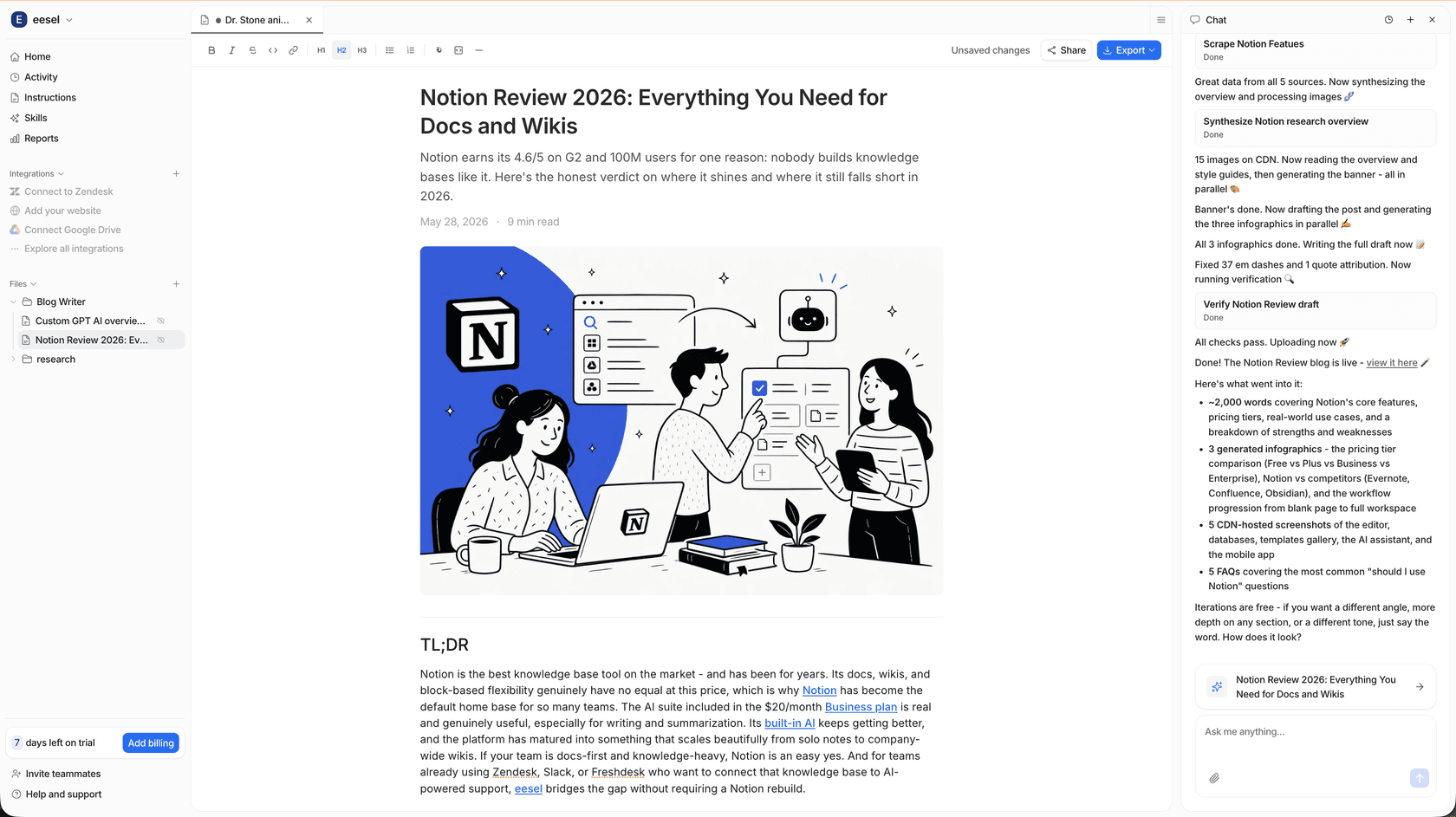
When you enter a topic like "best things to do in Kyoto," the tool doesn't just give you a block of text. It generates a complete outline with an intro, key attractions, food recommendations, and even a helpful FAQ at the end, all filled with well-researched content and visuals.
Other essential tools for your tech stack
Besides content generation, a few other tools are essential for any professional travel blogger.
- Website Platforms:
- Squarespace: This is a fantastic choice for beginners. It's an all-in-one platform that's incredibly easy to use. It has solid built-in SEO fundamentals, so you can focus on writing instead of dealing with technical maintenance.
- WordPress.org: This is the standard for bloggers who want total control and the ability to grow. It's endlessly customizable with plugins, but it does have a steeper learning curve. You'll be responsible for your own hosting, security, and updates.
- Photo & Graphics:
- Canva: You don't need to be a graphic designer to create great visuals. Canva is a super user-friendly (and mostly free) tool for making custom blog graphics, social media posts, and infographics with simple drag-and-drop templates.
Here's a quick look at how these tools fit together:
| Tool Category | Recommended Tools | Best For |
|---|---|---|
| Content Generation | eesel AI blog writer | Automating the creation of complete, SEO-optimized posts with visuals. |
| Website Platform | Squarespace, WordPress.org | Hosting your blog (Easy-to-use vs. highly flexible). |
| Keyword Research | Keysearch, Google Keyword Planner | Finding topics your audience is actively searching for. |
| Visuals & Graphics | Canva | Creating custom images, logos, and infographics quickly. |
| Performance Tracking | Google Analytics, Google Search Console | Monitoring traffic and understanding audience behavior. |
Hearing directly from experienced writers can provide a fresh perspective. For more expert advice on crafting compelling travel narratives, check out this video from National Geographic Traveler's Chief Researcher, who shares some foundational tips on what makes a travel blog truly stand out.
Your journey as a travel writer starts now
At the end of the day, successful travel blogging comes down to a mix of three things: authentic storytelling that connects with people, a smart SEO strategy that helps them find you, and an efficient workflow that lets you do it all over and over again.
Building a blog that gets traffic and makes money is a marathon. It takes persistence and a commitment to publishing regularly, even on the days you don't feel like it. The most important thing is to not get stuck on making everything perfect. Just start writing and hitting publish.
The eesel AI blog writer can be the partner that helps you publish faster and more consistently. It handles the tedious parts of content creation, so you can spend less time staring at a blank screen and more time having the adventures you want to write about.
Ready to turn your travel ideas into fully-formed, SEO-optimized blog posts in minutes? Generate your first blog for free with the eesel AI blog writer and see the difference for yourself.