

Scaling the production of high-quality, SEO-optimized content can be a significant bottleneck for growth. While AI writing tools offer a solution, many generate generic content that requires extensive editing and may not perform well in search rankings.
What are SEO writing AI tools?
First things first, let's clear something up. These tools aren't just your standard text generators like ChatGPT. They're specialized platforms designed to handle the entire content creation workflow, from the initial idea to the final published piece.
How we evaluated the best SEO writing AI tools
To make this a fair comparison, I judged each tool against the same set of criteria. I wasn't just looking for flashy features; I wanted to see what actually helps you get a great piece of content published faster.
- Quality of Output: This was the big one. Did the content sound like a human wrote it? Was it well-researched, or was it just shallow filler that needed a complete rewrite?
- SEO-Specific Features: I looked for tools with optimization built right in. This includes things like keyword suggestions, SERP analysis, and features that specifically help you optimize for AI search.
- Ease of Use & Workflow Efficiency: How quickly can you go from a single keyword to a publish-ready article? A clunky interface can kill your momentum, so an intuitive workflow was a must.
- Unique Capabilities: I gave extra points for features that solve real-world problems. Things like automatically creating images, pulling in real-time data, or having solid brand voice controls made a tool stand out.
The best SEO writing AI tools at a glance
If you're short on time, here's a quick rundown of the top contenders and what they do best.
| Tool | Best For | Key SEO Feature | Starting Price |
|---|---|---|---|
| eesel AI blog writer | Turning a keyword into a complete, publish-ready blog post | AEO (AI Engine Optimization) & automatic asset generation | Free to try, then $99 for 50 blogs |
| Surfer SEO | On-page optimization and content scoring | Real-time Content Score against top competitors | $99/month |
| Jasper AI | Versatile, on-brand content creation for marketing teams | Brand IQ for voice consistency & Content Pipelines | $69/month per seat |
| Frase.io | In-depth research and creating data-driven content briefs | Dual SEO & GEO (Generative Engine Optimization) scoring | $38/month (billed annually) |
| Koala AI | Affiliate content with real-time data integration | Amazon Product Roundups with live data | $9/month |
| Semrush | All-in-one SEO strategy and content workflow management | AI Visibility Toolkit to track brand mentions in LLMs | $199/month |
A deep dive into the top 6 SEO writing AI tools
Now for the fun part. Here’s a detailed breakdown of each tool, including where they really shine and where they have room for improvement, based on my hands-on testing.
1. eesel AI blog writer
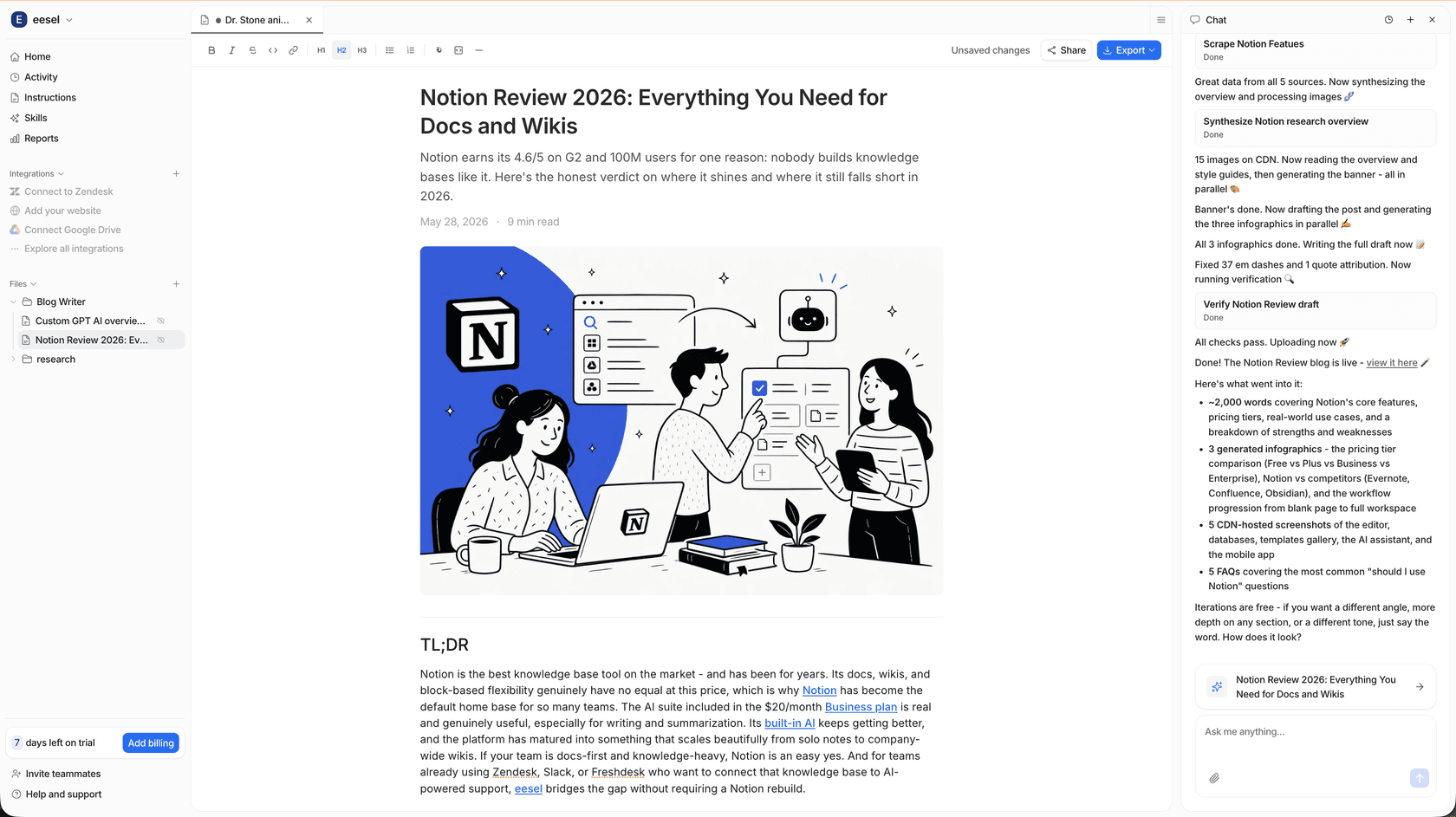
The eesel AI blog writer is a comprehensive content generation platform. You give it a keyword, and it gives you back a complete, media-rich article that’s ready to publish. It’s the tool we used to grow our own blog impressions from 700 to 750,000 per day in three months. It’s designed to handle the entire process, optimized for both traditional SEO and AEO (AI Engine Optimization) right out of the box.
Pros: The biggest difference with eesel is that it builds a complete post, not just a wall of text. It automatically generates headings, images, infographics, and tables. What really makes it stand out is how it pulls in relevant YouTube videos and actual Reddit quotes to add a layer of authenticity that most AI content is missing. Its research is context-aware, so if you're writing a comparison post, it pulls pricing data. If it's a review, it finds technical specs. This means the output is genuinely helpful, not just stuffed with keywords.
Cons: The eesel AI blog writer is laser-focused on creating comprehensive, long-form blog posts. If you're looking for a tool to whip up short-form copy for social media or ads, this probably isn't the right fit. It's built to produce articles that are ready to go live, so if you just need a tool to brainstorm a few ideas, you might find it’s more powerful than what you need.
Pricing:
- You can try it completely free to see the quality for yourself.
- $99 for 50 blog credits, which is a one-time purchase, not a recurring subscription.
2. Surfer SEO
Surfer SEO is a powerful tool when it comes to optimizing your content to rank. Its main feature is the Content Editor, which analyzes the top-ranking pages for your keyword and gives you real-time feedback as you write. It grades your work with a "Content Score," so you know exactly how well-optimized your article is before you even hit publish.
Pros: That real-time scoring system is a huge help for on-page SEO. It takes all the guesswork out of the process. You get a clear checklist of terms to include, questions to answer, and structural suggestions. Its AI assistant, "Surfy," helps you quickly add these suggestions to your draft, and it integrates smoothly with Google Docs and WordPress, which is super convenient for most workflows.
Cons: The key thing to remember is that Surfer is an optimization tool first and a writer second. While it does have AI writing features, its main job is to refine a draft you’ve already started. There can be a bit of a learning curve, and if you focus too much on hitting a perfect score, your writing can start to feel a little robotic. It's a balancing act.
Pricing:
- Essential: $99/month
- Scale: $219/month
3. Jasper AI
Jasper AI is one of the most well-known names in this space. It’s an AI content automation platform built for marketing teams who need to create a wide variety of on-brand content. Features like Brand IQ let you "teach" Jasper your brand voice and style, while Content Pipelines help automate entire workflows.
Pros: Jasper’s biggest strengths are its versatility and brand controls. With over 100 templates and intelligent "Agents" that you can customize, it can handle almost any marketing task you throw at it, from blog posts to ad copy to social media captions. It's also a trusted choice for bigger companies because of its enterprise-grade security, including SOC 2 compliance.
Cons: While Jasper is a versatile tool for many marketing tasks, its SEO features are not as specialized as those in dedicated SEO platforms. Most teams end up needing the Surfer SEO integration to handle the heavy lifting for optimization. The text it generates can also be a bit on the generic side, so you’ll definitely need to spend time editing to add your own unique insights.
Had a subscription for a long time when command mode was all the rage. Then ChatGPT came out and made it completely obsolete.

Pricing:
- Pro: Starts at $69/month per seat.
- Business: Custom pricing for larger teams that need API access and more advanced features.
4. Frase.io
Frase.io is highly effective for the research and planning phase of content creation. You feed it a keyword, and it analyzes the top search results to automatically generate a super-detailed content brief. A key differentiator is its focus on both SEO and GEO (Generative Engine Optimization), which helps you create content that not only ranks on Google but also gets cited by AI platforms like ChatGPT and Perplexity.
Pros: Frase can save you hours of manual research. It pulls in common questions from places like Reddit and Quora, which helps you nail user intent. Its unique AI Search Tracking feature is also a standout, letting you see how visible your brand is in AI search results, which is becoming more and more important.
Cons: While Frase does have an AI writer, its real value is in the research and outlining. The text it generates can feel a bit basic and almost always requires a good amount of rewriting to make it engaging. It’s best to think of Frase as the tool that prepares you for writing, not the tool that does the writing for you.
Pricing:
- Starter: $38/month (when billed annually).
- It offers a free trial, and you don’t need a credit card to sign up.
5. Koala AI
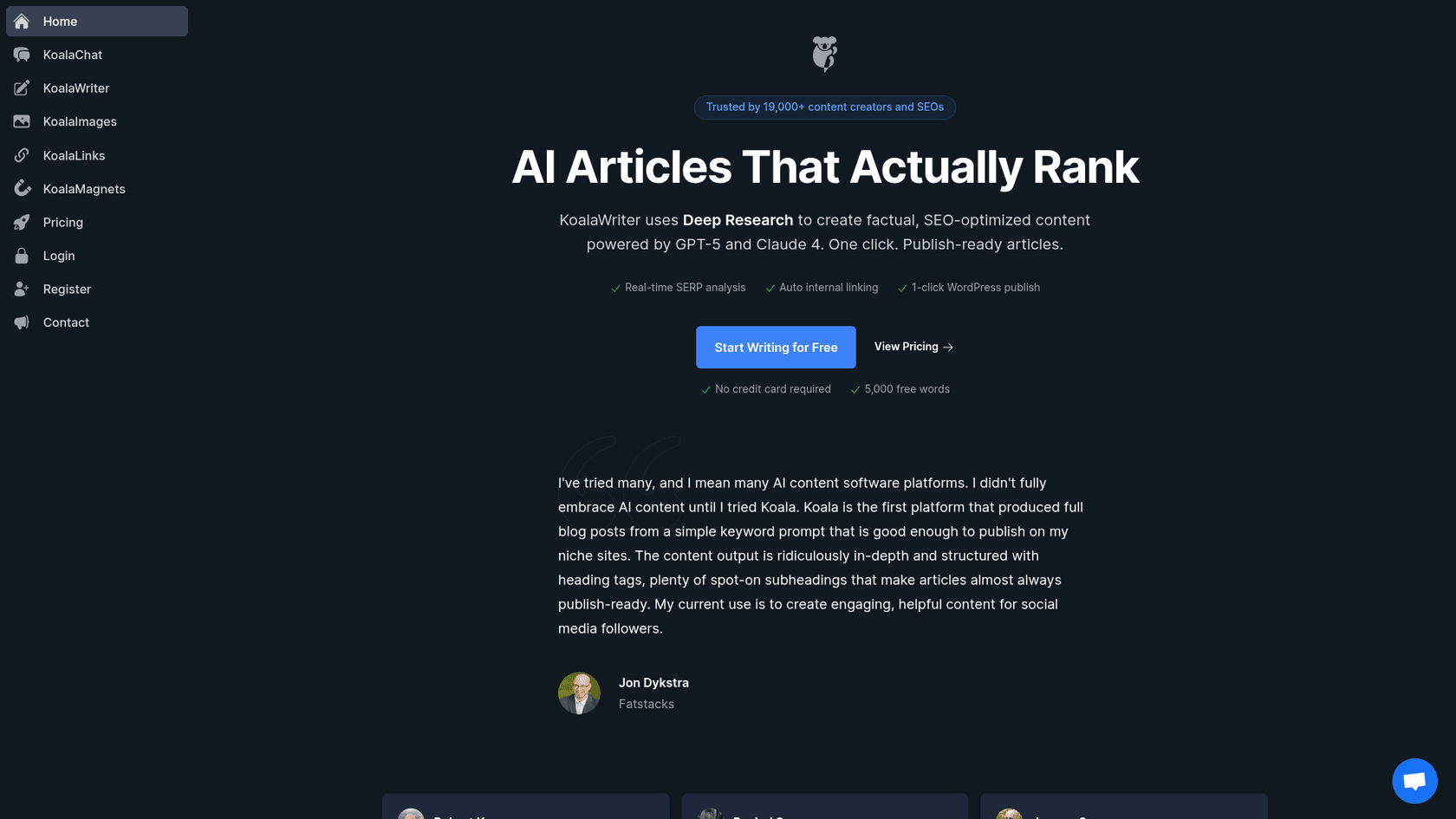
Koala AI has become a favorite among affiliate marketers and bloggers. It’s an AI writer designed for creating high-quality, long-form content, but its standout feature is its ability to pull real-time data from the web. This means its articles are way more current and factual than what you get from tools that rely on a static set of training data. It uses powerful models like GPT-5 and Claude 4 under the hood.
Pros: The real-time data integration is huge, especially for product reviews or any topic where things change quickly. Its Amazon Product Roundups feature is particularly useful for affiliate marketers, letting you generate detailed product comparisons with live data pulled directly from Amazon. It also has a neat automatic internal linking feature to help improve your site structure.
Cons: Koala is really good at what it does, which is blogs and affiliate content, but it's less focused on other types of marketing copy. Its SEO optimization is solid, but it’s not as granular or detailed as what you’d get from a dedicated tool like Surfer. Some of the advanced customization options are a bit limited compared to more established platforms.
Pricing:
- Starts at just $9/month for 15,000 words.
- There's also a free plan that gives you up to 5,000 words.
6. Semrush
Semrush is a well-known name in the world of SEO, and its platform now includes AI writing and content optimization tools as part of its comprehensive suite. This is the tool for teams that want to manage their entire SEO and content workflow—from keyword research with the Content Toolkit to writing and performance tracking—all in one place.
Pros: The biggest plus here is having everything under one roof. You can research keywords, create a data-driven content plan, write the content with AI, and then track your rankings without ever leaving the platform. Its AI Visibility Toolkit is a notable feature, as it helps you see how your brand is being mentioned in AI search results from different large language models.
Cons: Semrush is a professional-grade tool with a price tag to match, which can put it out of reach for solo bloggers or smaller businesses. And while its content creation tools are definitely capable, they are just one piece of a much larger, more complex platform. As a result, they may not feel as polished or focused as a standalone AI writer.
Pricing:
- Starts at $199/month for the Starter plan.
- The dedicated Content Toolkit is available for an additional $60/month.
For a more hands-on look at how these tools compare, check out this video review that tests several different AI writers.
Tips for getting the most out of your SEO writing AI tools
No matter which tool you choose, your results will only be as good as your process. Here are a few tips to get the best possible content.
The problem isn't the specific AI model you're using; it's the process. Most people treat these tools like a vending machine: put a prompt in, get a finished product out. That will always produce generic, soully garbage.
- Start with search intent, not just a keyword. Before you ask an AI to write anything, make sure you understand what a user is actually looking for. Are they trying to compare products, learn how to do something, or just get a quick definition?
- Use AI as your co-pilot, not on autopilot. The best content is a blend of AI's speed and your human expertise. Use the AI to handle the heavy lifting, but make sure you’re adding your own stories, experiences, and unique insights.
- Provide detailed context and outlines. Garbage in, garbage out. The more specific you are about your brand guidelines, the key points you want to cover, and your desired tone of voice, the better the AI's output will be.
- Fact-check everything. AI is amazing, but it can still make mistakes or "hallucinate" facts. Always take a minute to verify any important data, statistics, or claims before you hit publish.
Choosing the right SEO writing AI tool
The right SEO writing AI tool can help you create better, more complete content that is built to rank. The goal is to move from a rough draft that requires hours of work to a publish-ready article complete with visuals, quotes, and proper optimization. If you are looking for a tool that focuses on generating complete articles, you can try the eesel AI blog writer for free to generate an SEO-optimized article.