The 7 essential SEO KPIs to track for growth in 2026

Stevia Putri
Last edited February 2, 2026
So you're putting in the hours on SEO, writing content, building links, and tweaking your site. But how can you be sure any of it is actually working? Peeking at your overall website traffic just doesn't cut it. Real SEO success means driving business results, not just collecting eyeballs.
The only way to know what's working, justify your budget, and make decisions based on data instead of gut feelings is to track the right KPIs. This guide will walk you through the seven most important SEO KPIs to track in 2026. And since creating great content is what moves these numbers, we'll also touch on how to make that part of the job a lot less painful.
What are essential SEO KPIs?
First things first, let's clear this up. SEO KPIs (Key Performance Indicators) are the specific metrics you watch to see if your SEO work is actually helping you hit your business goals.
They're not the same as any old metric. For instance, "page views" is just a number. But "organic conversion rate"? That's a KPI. It connects your SEO traffic directly to a business goal, like getting leads or making sales. A KPI tells you if you're moving toward something that matters to the bottom line.
By focusing on the right KPIs, you can ignore vanity metrics, which are the numbers that look impressive but don't actually help the business grow. It helps you stay focused on what really works. To illustrate, here's a breakdown of the difference.
How we chose the top KPIs for this list
We didn't just pull these KPIs out of a hat. We chose them to give you a complete, 360-degree view of your SEO performance. A solid strategy needs more than just traffic; it needs visibility, engagement, and authority that all lead to a real impact on the business.
The KPIs on this list cover four key areas of SEO success:
- Visibility: How easy is it for your target audience to find you in search results?
- Engagement: What do people do once they land on your website?
- Authority: How much do search engines trust your site?
- Business Impact: How is your SEO performance actually helping the business grow?
This framework makes sure you’re looking at the entire journey, from the first time someone sees your brand in a search result to the moment they become a customer.
A quick comparison of top SEO KPIs
Here’s a quick rundown of the metrics we’re about to dive into. It's a handy cheat sheet you can come back to.
| KPI Name | What It Measures | Key Tool(s) for Tracking | Primary Goal |
|---|---|---|---|
| Organic Traffic | The number of visitors arriving from non-paid search results. | Google Analytics 4 | Increase brand reach and audience size. |
| Keyword Rankings | Your website's position in SERPs for specific keywords. | Google Search Console, Semrush, Ahrefs | Improve visibility for high-intent search terms. |
| Organic Conversions | Desired actions (e.g., sales, sign-ups) from organic visitors. | Google Analytics 4 | Prove business value and return on investment (ROI). |
| Click-Through Rate (CTR) | The percentage of users who click your link after seeing it in SERPs. | Google Search Console | Optimize SERP snippets to match user search intent. |
| Backlinks & Authority | The quantity and quality of links from other sites. | Semrush, Ahrefs, Moz | Build trust and credibility with search engines. |
| User Engagement | How users interact with your content (e.g., engagement time). | Google Analytics 4 | Measure content quality and user satisfaction. |
| Search Visibility | How often your site appears in search results (impressions). | Google Search Console | Gauge overall market presence and brand reach. |
The 7 most important SEO KPIs to track in 2026
Alright, let's get into the nitty-gritty. Here are the seven KPIs you absolutely need to be watching.
1. Organic traffic
- What it is: The total number of people who find your website through an unpaid search engine result. It's that simple.
- Why it matters: This is the foundation of your SEO health. If your organic traffic is growing, it means your content is hitting the mark and you're building a sustainable audience without paying for every click through ads.
- How to track it: Head over to Google Analytics 4 (GA4). In the left menu, go to Acquisition > Traffic acquisition. The report automatically shows data by channel. Just look for the "Organic Search" row to see how it's trending and which pages are bringing people in.
- What success looks like: A steady, consistent upward trend, both month-over-month and year-over-year. If you see a sudden, sharp drop, it could signal a technical issue or an algorithm penalty. A healthy climb means your strategy is working.
2. Keyword rankings
- What it is: Your website's exact position in the search engine results pages (SERPs) for a specific search term.
- Why it matters: Let's be honest, almost nobody clicks on page two of Google. Higher rankings mean more visibility and more traffic. Tracking your positions helps you see if your on-page SEO is working and helps you find new keywords to target.
- How to track it: Your GSC Performance report is a great free place to start. It shows your average position for all the keywords you're getting impressions for. But if you want to track a specific list of target keywords over time, you’ll want a dedicated tool like Semrush's Position Tracking or Ahrefs' Rank Tracker.
- What success looks like: The main goal is getting your high-intent keywords (the ones most likely to lead to a sale or sign-up) onto the first page, ideally in positions 1-10. Even a small jump from position 4 to position 2 can cause a huge spike in clicks.
3. Organic conversions
- What it is: This happens when a visitor from an organic search result does something you want them to do, like making a purchase, signing up for your newsletter, or filling out a contact form.
- Why it matters: This is the KPI that proves the value of SEO. It directly connects your work to real business results and shows your return on investment (ROI). If you have tons of traffic but zero conversions, you're probably attracting the wrong audience or something is off on your site.
- How to track it: First, you need to set up your important user actions as events in Google Analytics 4. Then, you mark them as key events. From there, Google's documentation shows you how to create conversions in Google Ads based on these events, which lets you see exactly how many conversions come from your organic search channel.
- What success looks like: A stable or increasing conversion rate, even as your organic traffic grows. It’s not just about getting more conversions; it’s about getting a higher rate of conversions, which tells you you’re attracting the right kind of visitors.
4. Click-through rate (CTR)
- What it is: The percentage of people who click on your link after seeing it in the search results. The formula is simple: (Total Clicks / Total Impressions) x 100.
- Why it matters: CTR is a huge opportunity. You can get more traffic without even improving your rankings. If you rank #5 for a keyword but have a terrible CTR, it means your page title and meta description aren't compelling enough or don't match what the searcher is looking for.
Rank per keyphrase tops the list. CTR, but this needs the rank to have any meaning to it. Impressions, but only as 'smoke', not fire. also, rank says when this starts to matter. Total number of Keyphrases < 100, <10

5. Backlinks and domain authority
- What it is: Backlinks are just links pointing to your site from other websites. Domain Authority (or Domain Rating/Authority Score) is a metric from third-party tools like Moz, Ahrefs, and Semrush that tries to predict how well a site will rank based on its backlink profile.
- Why it matters: Search engines see backlinks as votes of confidence. When a reputable site links to you, it’s like they’re vouching for your content. A strong profile of high-quality, relevant backlinks signals that your site is a credible authority, which makes it much easier to rank for competitive keywords. <quote text="I think the top 5 SEO metrics that must be in monthly reporting are:
Keyword Rankings. Organic Traffic. New and Lost Backlinks. Page Impressions. Conversions." sourceIcon="https://www.iconpacks.net/icons/2/free-reddit-logo-icon-2436-thumb.png" sourceName="Reddit" sourceLink="https://www.reddit.com/r/SEO/comments/w4zlci/comment/ih57c6x/">
- How to track it: You'll need a tool like Semrush's Backlink Analytics or Ahrefs' Site Explorer. These platforms let you monitor your total number of backlinks, see which unique websites (referring domains) are linking to you, and track your overall authority score over time.
- What success looks like: A steady increase in the number of referring domains. It's better to get links from many different high-quality sites than to get tons of links from just one or two. Always go for quality over quantity.
6. User engagement
- What it is: These are metrics that show how people are interacting with your site after they arrive. In GA4, the big ones are Average engagement time and Engaged sessions.
- Why it matters: Good engagement is a strong sign that your content is valuable and gives the user what they wanted. While it might not be a direct ranking factor, search engines are smart enough to use these as indirect signals of quality. If people land on your page and leave right away, it suggests your content isn't relevant or the user experience is poor.
- How to track it: In Google Analytics 4, go to the Reports > Engagement > Pages and screens report. This will show you the average engagement time for your top organic landing pages.
- What success looks like: An average engagement time that makes sense for the content. A long, detailed guide should have a high engagement time, while a quick answer page might have a shorter one. Keep an eye out for important pages with unusually low engagement times, as those are good candidates for an update.
7. Search visibility (impressions)
- What it is: The total number of times one of your site's URLs was shown in a search result that a user saw. As Google explains, it doesn't mean they clicked, just that your link appeared on their screen.
- Why it matters: Impressions measure your overall brand awareness in search results. It's a leading indicator. Your impressions will usually start to grow before your clicks and traffic do. It shows that your content is starting to rank for a wider range of search terms.
- How to track it: The Performance report in Google Search Console is the only place to get this data accurately. You can see your total impressions over time for your whole site, specific pages, or even individual keywords.
- What success looks like: A consistent upward trend in your total impressions. This tells you that your SEO strategy is expanding your reach and making your brand visible to more people for more relevant searches.
Connecting your content strategy to SEO KPIs
Okay, knowing your KPIs is half the battle. But what do you do with that information? The other half is creating high-quality content at scale that actually moves those numbers. This is often where things get tough.
That’s why we built the eesel AI blog writer. It’s a tool designed to take the heavy lifting out of creating SEO-optimized, publish-ready content that directly impacts the KPIs we just discussed. We used this exact tool to grow our daily impressions in just three months.
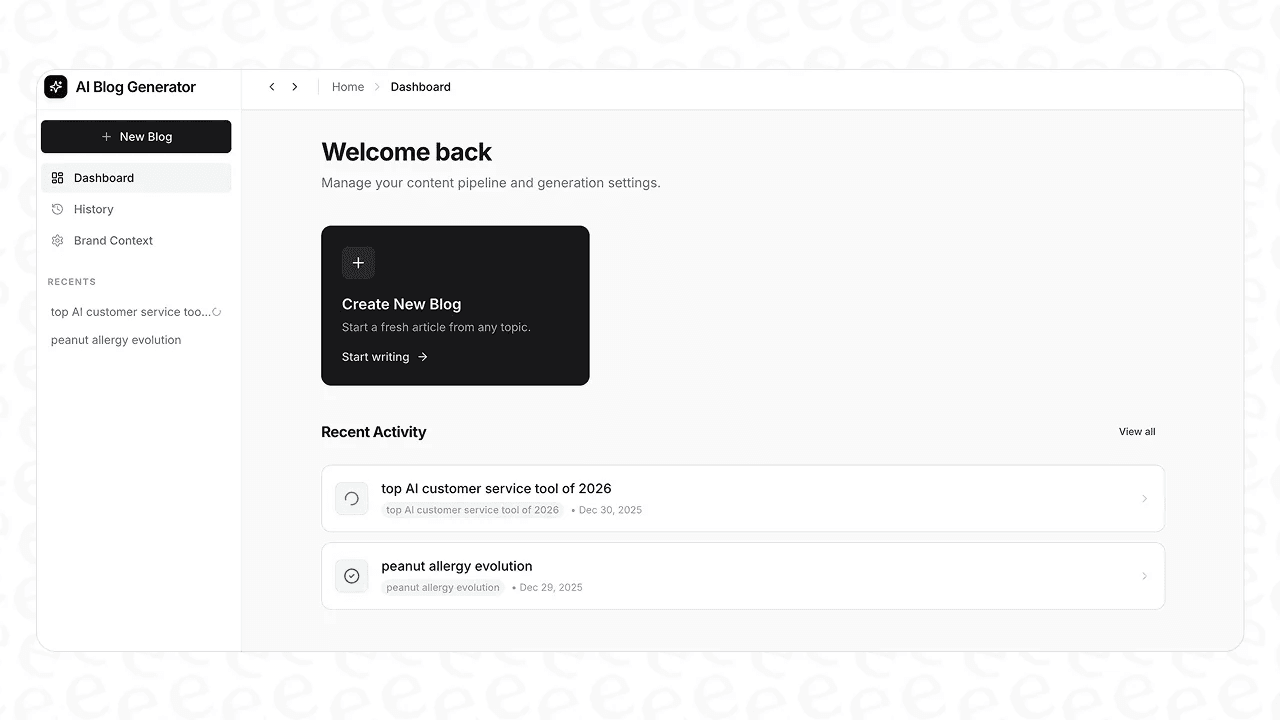
Here’s how it works: you give it a keyword and some context about your brand. It then generates a complete blog post, with a logical structure, headings, AI-generated assets, internal links, and a genuinely human-like tone.
Here's how that helps your KPIs:
- Keyword Rankings & Traffic: It builds the entire article around your target keyword, optimizing it to rank higher in the SERPs.
- CTR: It helps craft compelling titles and can include rich media like videos and infographics that make your search result more appealing.
- User Engagement: It produces well-structured, readable articles and even pulls in real Reddit quotes for social proof, keeping people on the page longer.
Pro tips for reporting on SEO KPIs
When it's time to show your work to your boss or clients, how you present the data matters just as much as the data itself.
Pro tip
Focus on trends, not snapshots: A single month's data doesn't tell a story. Show growth over time with month-over-month and year-over-year comparisons to provide context and demonstrate real progress.
Pro tip
Segment your data: Split your traffic into branded (people searching for your company name) and non-branded (people searching for what you do). This shows how you're both attracting new audiences and retaining your existing ones.
Pro tip
Connect SEO to business goals: Don't just show off a traffic graph. Show how that traffic led to organic conversions and revenue. That’s how you prove the ROI of your work.
Pro tip
Use visual dashboards: Tools like Looker Studio can pull data from Google Search Console and GA4 into a single, easy-to-read report. Visuals make it much easier to tell a compelling story with your data.
For more visual guidance on which metrics matter most, the following video provides a great overview of the key performance indicators that can help you refine your SEO strategy.
From tracking metrics to driving growth
A winning SEO strategy isn't about chasing one magic number. It's about consistently tracking a balanced set of KPIs that cover all your bases: visibility, engagement, authority, and most importantly, real business impact. Use the insights you gather from these metrics to build a smarter, more effective content strategy that drives sustainable growth.
Ready to create content that boosts your KPIs? Try the eesel AI blog writer and turn your next keyword into a publish-ready article.

Frequently Asked Questions
Share this article

Article by
Stevia Putri
Stevia Putri is a marketing generalist at eesel AI, where she helps turn powerful AI tools into stories that resonate. She’s driven by curiosity, clarity, and the human side of technology.