
Let's be honest, keeping up with content demands is a grind. Every content team is trying to crack the same code: how do you publish high-quality, SEO-optimized content that actually ranks, without completely draining your team and budget? It's a massive challenge, and that's why AI content platforms have become so popular.
Two of the biggest names you’ll come across are Scalenut and NeuronWriter. Both are built to help you create content that performs well in search engines, but they tackle the problem differently. Scalenut wants to be your all-in-one hub for content strategy, while NeuronWriter is all about digging into the fine details of on-page optimization.
This article is a head-to-head comparison to help you decide which tool fits your workflow best. We'll break down their features, strengths, pricing, and who each platform is really built for.
But what if you're looking to move past content assistance and into full-on content automation? For teams that want to skip the writing and optimizing steps, tools like the eesel AI blog writer offer a different way forward. Instead of just helping you write, it generates a complete, publish-ready blog post from a single keyword, letting you focus on the bigger picture.
What is Scalenut?
Scalenut calls itself an all-in-one Generative Engine Optimization (GEO) platform. That’s a fancy way of saying it’s designed to help your content not only rank in search engines but also get cited by AI engines like Google's AI Overviews. The whole idea is to bring everything you need for content: planning, writing, optimizing, and analyzing, into one place.
Instead of bouncing between a keyword tool, a Google Doc, and an optimization checker, Scalenut bundles it all together. Here are its main components:
- GEO Core: This is the engine of the platform. It includes tools for planning content, writing with their guided "Cruise Mode," and optimizing your articles for search.
- GEO Watchtower: A neat feature that monitors your brand's visibility and mentions on AI platforms like ChatGPT and Google AI Overviews.
- Social UpReach: This tool helps you keep an eye on Reddit for brand mentions and stay on top of relevant trends in your niche.
- Backlinks Marketplace: An interesting extra that lets you buy backlinks from vetted websites, which can take some of the pain out of manual outreach.
Look into scalenut - it’s like surferseo but way cheaper.

Scalenut is really made for SEO teams and businesses that want a single platform to manage their entire organic growth strategy, from clustering keywords to building backlinks.
What is NeuronWriter?
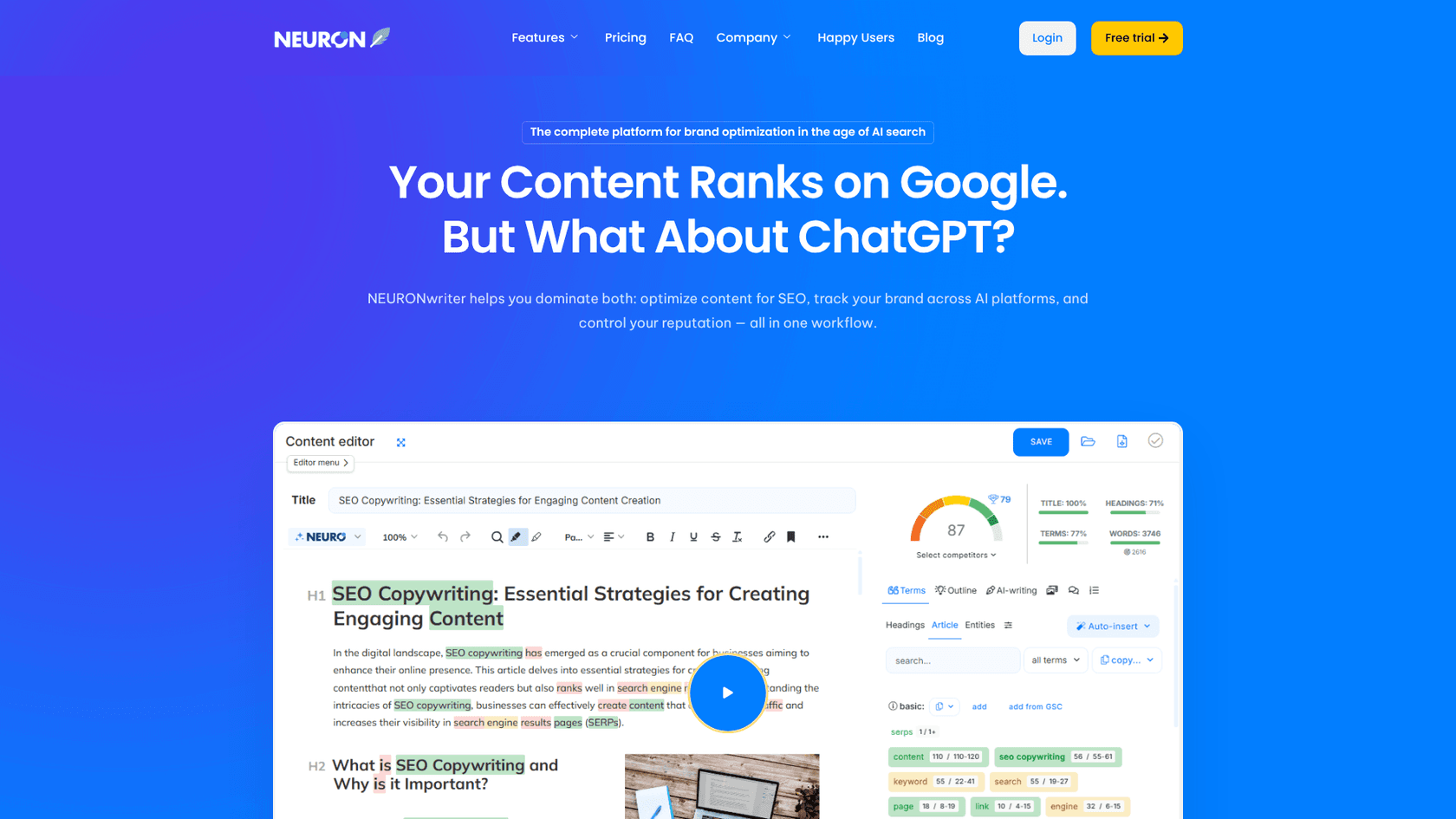
NeuronWriter, on the other hand, is a laser-focused content optimization tool. Its main purpose is to help your content rank on Google by providing incredibly detailed, data-driven guidance. It's less about managing the entire strategy and more about perfecting every single piece of content.
Its value comes from analyzing what’s already ranking for your keyword and using Natural Language Processing (NLP) to give you a clear path to follow. Here are its key features:
- Competitor Analysis: For any keyword you target, NeuronWriter analyzes the top-ranking pages to show you what's working for them.
- Content Editor: This is where the real work happens. It gives you a live content score and a list of NLP term suggestions, basically, all the related words and phrases Google expects to see in a top article on that topic.
- Content Designer: This feature can generate a "one-click" article draft based on its SERP analysis, giving you a strong starting point for optimization.
- Integrations: It connects with tools you probably already use, like Google Search Console, WordPress, and Shopify, to make your workflow smoother.
NeuronWriter is by far the top in class.
NeuronWriter is a tool for SEO writers, copywriters, and content agencies who enjoy digging into data and fine-tuning every article to get the highest possible optimization score.
Feature breakdown: Scalenut vs NeuronWriter
AI writing and content generation
How do these tools actually help you write? Both have capable AI generators, but their approaches are pretty different.
-
Scalenut: Scalenut’s main writing feature is Cruise Mode, a guided workflow that can generate a long-form article quickly. It’s an end-to-end process that feels like an AI assistant is walking you through each step. You give it a topic, it helps you choose a title, build an outline, and then generates a full draft. The process is geared toward creating "humanized" content that’s optimized for both traditional search and newer AI answer engines. It’s all about speed and structure, getting you from a blank page to a full draft as fast as possible.
-
NeuronWriter: NeuronWriter’s approach is its Content Designer, which also creates a "one-click article" based on its deep analysis of the search results. It also provides a library of AI templates for creating various types of content, from product descriptions to email copy. The key difference is that NeuronWriter's AI-generated draft feels more like a starting point for its powerful editor. The goal isn't just to hand you a finished article, but to give you a solid foundation that you can immediately start improving with its data-driven suggestions.
-
Verdict: Scalenut's Cruise Mode offers a guided experience for creating a first draft quickly. NeuronWriter's draft generator provides a foundation for deep, data-driven refinement within its editor.
SEO and content optimization
This is where you can really see the different philosophies of the two platforms.
-
Scalenut: Scalenut’s Content Optimizer and Content Audit features are built for efficiency at scale. You can paste in an existing URL, and it will analyze the page and provide actionable feedback. But its real strength is its auto-optimization feature. With a single click, Scalenut can instantly fix on-page issues like adding missing keywords to headings or generating meta tags. As you write, its real-time GEO Score tracks how well your content is optimized for both traditional search and AI engines, giving you a complete view of your content's health.
-
NeuronWriter: This is NeuronWriter's specialty. Its content editor is well-known for its real-time content scoring and NLP term suggestions. As you write, it constantly checks your text against the top-ranking competitors, telling you exactly which terms to add, how often to use them, and where they should go (in headings or the body). It offers an incredibly detailed, term-by-term guide for optimization. However, you have to do the work yourself. It tells you what to do, but you're the one doing the writing and editing.
-
Verdict: NeuronWriter provides detailed, real-time guidance for writers who manually optimize content with precision. For auditing and automatically fixing existing content at scale, Scalenut’s one-click features are designed for efficiency.
Keyword research and planning
A good content strategy starts with solid keyword research, and this is a major point of difference between the two.
-
Scalenut: This is a huge advantage for Scalenut. Its Keyword Planner uses SERP-based clustering to group thousands of related keywords into logical topics. Instead of just giving you a long list of keywords, it helps you build a full content plan designed to establish topical authority. This is a massive plus for modern SEO, where covering a subject in-depth is more important than just targeting individual keywords. It helps you see the big picture.
-
NeuronWriter: NeuronWriter’s keyword features, like Content Ideas, are more focused on generating topics for single articles. Its strength is taking one target keyword and analyzing it deeply to help you create one perfect piece of content. It doesn't really have the tools to help you map out a broad, multi-article strategy or build topic clusters.
-
Verdict: For strategic content planning and building topical authority, Scalenut provides comprehensive features. Its keyword clustering functionality is a notable asset for creating a long-term content strategy.
Pricing comparison for Scalenut vs NeuronWriter
Both platforms offer free trials and big discounts for annual billing, making their entry-level plans quite competitive. Here’s a look at how they compare.
Scalenut pricing
According to their official pricing page, Scalenut offers a 7-day free trial and a few different tiers if you pay annually:
- Essential Max: Starts at $235/year (which comes out to about $19.60/month).
- Growth Max: Starts at $494/year (about $41.17/month).
- Pro Max: Starts at $926/year (about $77.17/month).
NeuronWriter pricing
NeuronWriter also has a 7-day free trial, with annual plans that look like this:
- Bronze Plan: Starts at $19/month (when billed annually).
- Silver Plan: Starts at $37/month (when billed annually).
- Gold Plan: Starts at $57/month (when billed annually).
Here's a quick table comparing the entry-level plans to make it easier to see what you get for your money.
| Feature | Scalenut (Essential Max) | NeuronWriter (Bronze Plan) |
|---|---|---|
| Starting Price (Annual) | $235/year (~$19.60/mo) | $228/year ($19/mo) |
| Free Trial | Yes, 7-day trial | Yes, 7-day trial |
| Key Entry-Level Feature | Keyword Clustering (15 clusters/mo) | Content Optimization (25 analyses/mo) |
| AI Content Generation | 15 Articles/month | 15,000 AI credits/month |
An alternative approach: The eesel AI blog writer

Its value is simple: you give it a single keyword, and it gives you back a complete, publish-ready blog post in minutes. It's not about generating a rough draft; it's about automating the entire process.
Here’s what makes it different:
- Automatic Assets: It doesn’t just write text. It automatically generates images, infographics, and data tables to make the content more engaging right out of the box.
- Context-Aware Research: The AI is smart enough to understand the type of blog you need. If you ask for a comparison post, it will find specs and pricing. If you ask for a how-to guide, it finds the actual steps.
- Authentic Social Proof: To add credibility and a human touch, it automatically pulls in real Reddit quotes and embeds relevant YouTube videos directly into the article.
- AEO (Answer Engine Optimization): The content is structured from the start to be easily picked up and cited by AI answer engines like Google AI Overviews and Perplexity.
We used this exact tool at eesel AI to grow our blog from 700 to 750,000 daily impressions in just three months. It's completely free to try, so you can see the quality for yourself.
For a more visual breakdown, here's a detailed video that walks through both platforms, showing their user interfaces and core features in action. This can help you get a better feel for which tool's workflow you might prefer.
Making the final choice
So, after all that, who wins the Scalenut vs NeuronWriter matchup? The honest answer is: it depends entirely on what you need.
Scalenut is best for: Marketers and SEO teams who want an all-in-one GEO platform. If you need to manage the entire content lifecycle, from strategic keyword clustering and planning to writing, optimizing, and tracking, Scalenut has you covered.
NeuronWriter is best for: SEO-focused writers and content managers who live and breathe optimization. If you want deep, data-driven insights to meticulously refine every single piece of content for the highest possible score, NeuronWriter is one of the best tools on the market.
And if your main goal is pure efficiency and scale? The eesel AI blog writer is the ideal solution. It automates the whole creation process, turning a simple prompt into a complete, media-rich blog post. It frees up your time to focus on strategy, not just execution.
Stop stitching drafts together. Try the eesel AI blog writer for free and see what a publish-ready article looks like.