Scalenut vs NeuronWriter: Which AI SEO tool is right for you?

Stevia Putri
Last edited January 19, 2026
Trying to pump out high-quality, SEO-friendly content consistently feels like a never-ending task. You're trying to please your readers and Google's latest algorithm update, all while trying to actually grow your traffic. It's a lot.
AI tools like Scalenut and NeuronWriter were built to help with this, but they tackle the problem from completely different angles. Scalenut wants to be the single platform you use for everything content-related, from start to finish. NeuronWriter, however, is all about diving deep into the nitty-gritty of content optimization.
This guide will lay out what each one does, who it's best for, and what it'll cost you. We'll compare them directly to help you figure out which one fits your team's needs. It's also worth mentioning that while these tools are great co-pilots, a new type of AI is emerging that works more like a hands-off team member. The eesel AI blog writer, for instance, can take a single keyword and manage the entire blog creation process on its own, including research, writing, and even adding visuals.
What is Scalenut?
Scalenut calls itself an all-in-one Generative Engine Optimization (GEO) platform. In simple terms, it’s built to handle your entire content workflow, from coming up with ideas to seeing how they perform. The idea isn't just about ranking on Google anymore; it's also about getting your content picked up and cited by AI tools like ChatGPT and Google's AI Overviews.
It’s organized around a few main modules:
- GEO Core: This is the engine of the platform. It features "Cruise Mode", a 5-minute AI article writer that guides you through the process. It also includes a "Keyword Planner" for building topical authority by grouping keywords into clusters, along with tools for optimizing and auditing your existing pages.
- GEO Watchtower: This module tracks your brand's visibility on various AI platforms, helping you see if you're being mentioned in AI-generated answers, which is becoming increasingly important.
- Social UpReach: This feature keeps an eye on Reddit to find brand mentions and relevant discussions, giving you a direct pulse on what people are saying.
- Backlinks Marketplace: This is a fairly unique feature that lets you buy backlinks from pre-vetted websites right inside the platform, saving you the hassle of manual outreach.
Scalenut is designed for marketers and content teams who want one unified system to manage their entire content strategy. If you prefer having planning, creation, optimization, and AI visibility tracking all in one place, it’s a strong contender.
Look into scalenut - it’s like surferseo but way cheaper.

What is NeuronWriter?
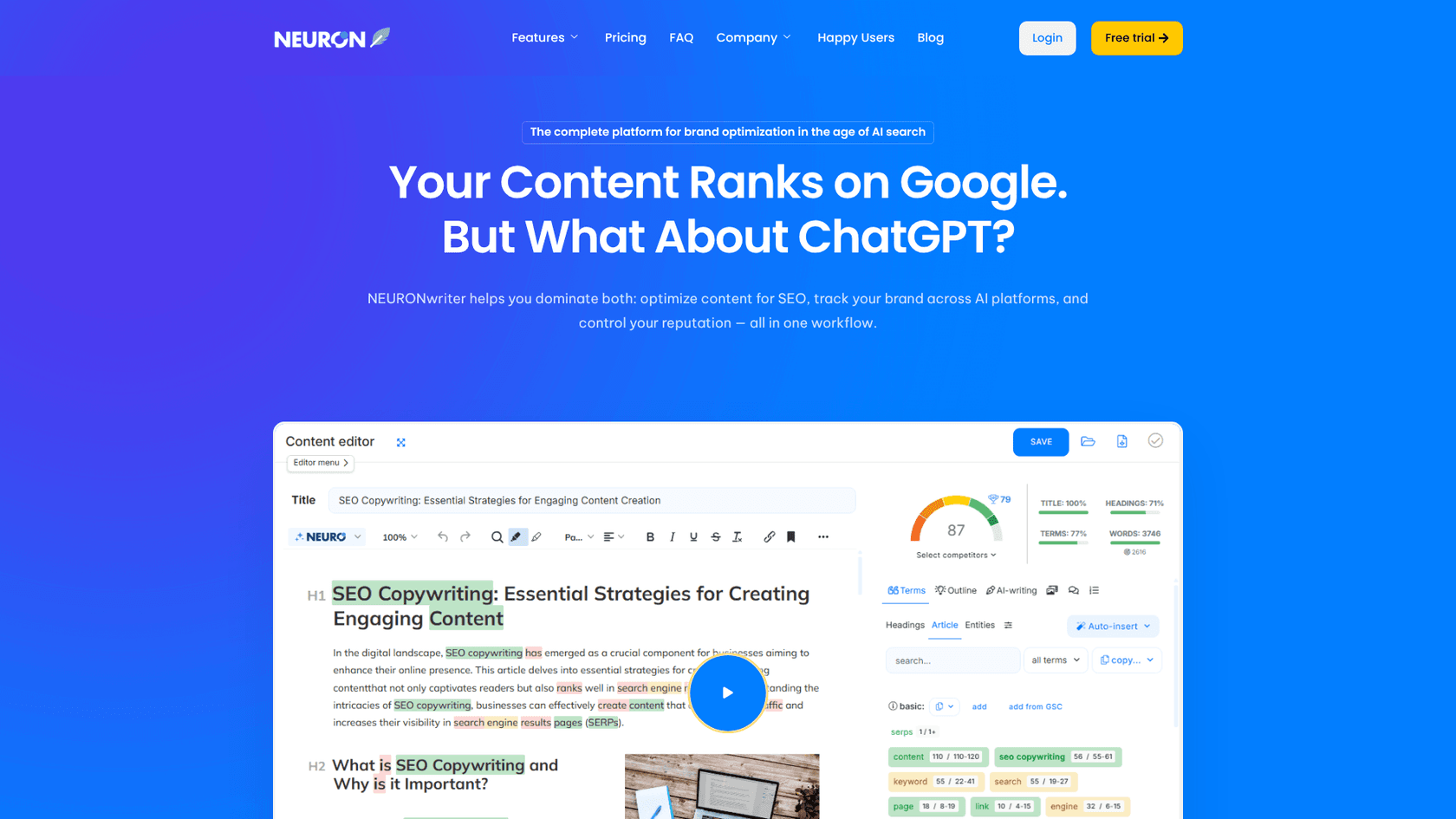
NeuronWriter is a content optimization tool that is intensely focused on semantic SEO. Its main job is to help you write highly optimized content that performs well in search results. It does this by analyzing what your competitors are doing and using Natural Language Processing (NLP) to give you a clear plan.
Here’s how it works:
- Content Scoring: At its heart, NeuronWriter is a real-time editor that scores your content as you write. It measures your draft against the top-ranking articles for your target keyword, giving you a clear number to aim for.
- NLP & Competitor Analysis: Before you write a word, it analyzes the SERPs and provides a list of recommended terms, topics, and questions to cover. This ensures your content aligns with what searchers are actually looking for.
- AI Content Generation: It includes a "Content Designer" that can generate a one-click article draft to get you started. It also has AI image generation built into the editor, which is convenient for adding visuals on the fly.
- Integrations: It connects with Google Search Console, WordPress, and Shopify to help smooth out the workflow from optimization to publishing.
NeuronWriter is the tool of choice for SEO specialists, freelance writers, and agencies who are all about data-driven, on-page optimization. If your primary objective is to get the highest content score possible and you enjoy digging into SERP analysis, this tool will feel right at home.
NeuronWriter is by far the top in class.
Scalenut vs NeuronWriter: Feature comparison
Content generation and AI writing
Both Scalenut and NeuronWriter have solid AI writing features, but they present them in different ways.
Scalenut's Approach: The main feature here is "Cruise Mode", a guided, five-step workflow that takes you from a keyword to a full first draft. It’s a structured process that prompts you for input on titles, outlines, and key points. Scalenut aims to create "human-first, AI-cited content" that works for both search engines and large language models (LLMs). It even has an "AI Humanizer" tool to make the text sound less robotic.
NeuronWriter's Approach: NeuronWriter's AI writing is centered around its "Content Designer". You can generate a one-click article based on its competitor analysis. The real advantage is how well the AI is integrated into the SEO editor. You can use an "Autoinsert terms" feature to add recommended NLP keywords, which helps boost your content score quickly. It also has built-in "AI image generation", so you can create visuals without switching tabs.
Key Difference & Limitation: The important thing to remember is that both tools produce good drafts. You will still need to handle the final editing, fact-checking, formatting, and sourcing of unique assets like infographics or real social proof. They are excellent assistants that speed things up, but you're still the one responsible for getting the article published.
| Feature | Scalenut | NeuronWriter |
|---|---|---|
| Guided Long-Form Writer | Yes ("Cruise Mode") | Yes ("Content Designer") |
| Real-time SEO Score | Yes (GEO Score) | Yes (Content Score) |
| Topic/Keyword Clustering | Yes (in "Keyword Planner") | No (offers "Next content ideas") |
| AI Visibility Tracking | Yes ("GEO Watchtower") | No |
| Reddit Trend Tracking | Yes ("Social UpReach") | No |
| AI Image Generation | Yes | Yes |
| Integrations | WordPress, Shopify | WordPress, Shopify, GSC |
SEO optimization and research
This is where the tools really show their differences. Scalenut focuses on broad strategy, while NeuronWriter gets into the on-page details.
Scalenut's Strengths: Scalenut is built for an end-to-end GEO strategy. You can start in the "Keyword Planner" to map out topic clusters, create content with "Cruise Mode", optimize existing pages with the "Content Optimizer", and track results with the "Traffic Analyzer".
Its biggest unique feature is the focus on AI engines. The "GEO Watchtower" monitors your brand’s visibility on platforms like ChatGPT and Google AI Overviews, a forward-looking feature that NeuronWriter lacks. When you add in the "Social UpReach" tool for Reddit insights and the "Backlinks Marketplace", you get a very comprehensive toolkit.
NeuronWriter's Strengths: NeuronWriter’s main strength is its detailed SERP analysis. It provides incredibly specific outlines based on what’s already ranking, plus a long list of semantic (NLP) terms to include in your text.
Its power is all in the editor. All its recommendations are available in real-time, letting you optimize for a high content score as you write. It’s a very direct and actionable workflow. Higher-tier plans also offer internal link suggestions and a plagiarism checker, keeping your on-page SEO needs in one spot.
The key difference is this: Scalenut is a broad platform for managing the entire content lifecycle, including the new world of AI visibility. NeuronWriter is a specialized tool for mastering on-page and semantic content optimization.
User interface and workflow
Scalenut: Its UI is a clean, all-in-one dashboard. Everything is laid out logically, and guided workflows like "Cruise Mode" make it simple for marketers who want a structured, step-by-step process. It essentially holds your hand from start to finish.
NeuronWriter: The interface is more minimalist and focused on data. The content editor is the main attraction, and it's packed with information. This is perfect for SEOs who want to get straight to the optimization data, but it might be a bit much for beginners who aren't used to seeing so many metrics at once.
Pricing breakdown
Of course, the price is a major factor. Both platforms have tiered plans that grow with your needs. We'll look at the monthly prices here, but both offer discounts for annual payments.
Scalenut pricing plans
Scalenut’s pricing is for its whole GEO platform, with tiers based on how much content you produce and which advanced features you need.
- Essential Max Plan: Starts at $49/month. This gives you 5 articles and 5 keyword clusters per month.
- Growth Max Plan: Starts at $103/month. This increases your limits to 30 articles and 30 clusters and adds access to the "GEO Watchtower" and "Social UpReach" modules.
- Pro Max Plan: Starts at $193/month. This plan is for high-volume users, offering up to 75 articles and extra features like cannibalization detection.
Essentially, you’re paying for an all-in-one subscription that covers the full content process.
NeuronWriter pricing plans
NeuronWriter’s pricing is based more on the number of projects and content analyses you run, which offers flexibility for freelancers and agencies with different client loads.
- Bronze Plan: Starts at $23/month. This includes 2 projects, 25 content analyses, and 15,000 AI writing credits.
- Silver Plan: Starts at $45/month, raising your limits to 5 projects and 50 analyses.
- Gold Plan: Starts at $69/month. This is often the best value, as it unlocks key features like the "Content Designer", integrations, and plagiarism checks.
- Higher Tiers: Platinum and Diamond plans are also available for large agencies needing a high volume of projects and analyses.
NeuronWriter also has a 7-day free trial for its Gold plan, so you can try out the main features before you buy.
An alternative: The autonomous AI blog writer
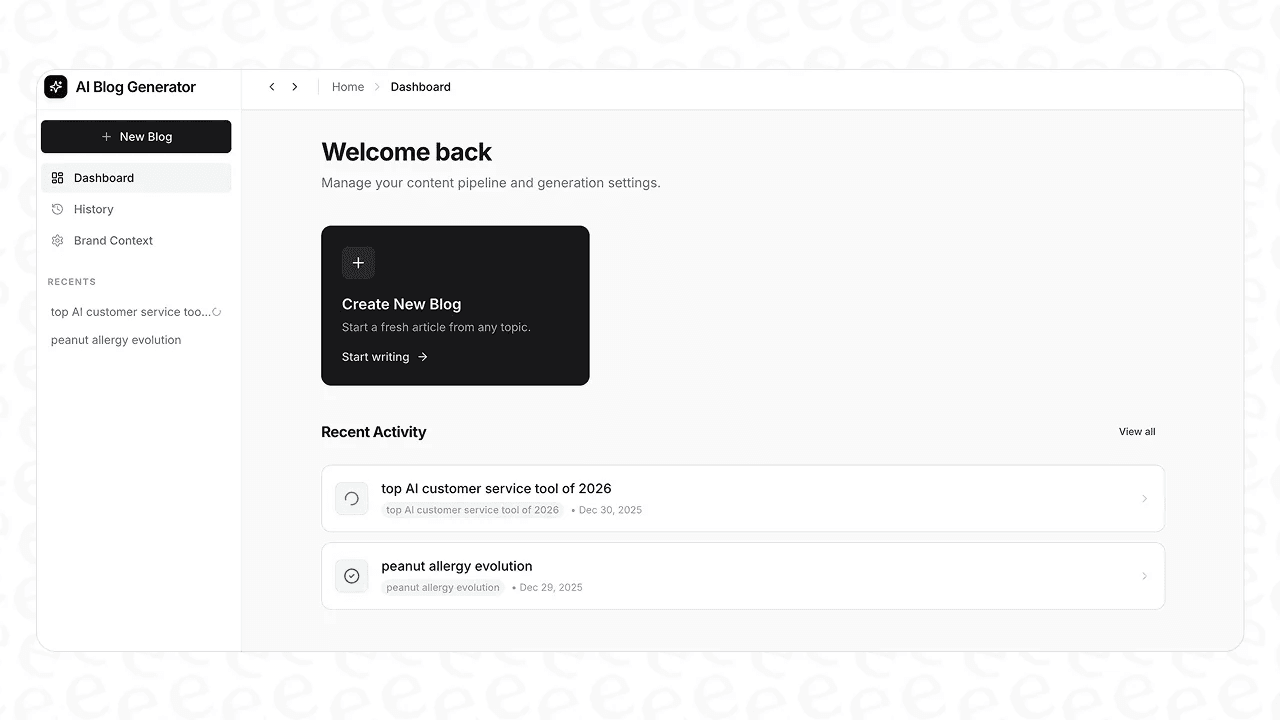
Here’s how it’s different:
- From Keyword to Complete Post: You just provide a keyword and your website URL. That's it. It takes care of the deep research, writing, SEO optimization, and asset creation all at once. You receive a complete, publish-ready blog post.
- Automatic Rich Media: It doesn't just write text. It generates and embeds AI images, infographics, and data tables directly into the post, which can save you hours of design work.
- Authentic Social Proof: It has a unique feature that finds and embeds relevant YouTube videos and real Reddit quotes from actual conversations. This adds a layer of credibility and human perspective that pure AI text can't replicate.
- Optimized for AI Answers (AEO): The content is structured for Answer Engine Optimization, helping it get cited in Google AI Overviews and other AI-powered search results.
This exact tool was used to grow the eesel AI blog from 70k to 750,000 daily impressions in just three months. The pricing is straightforward ($99 for 50 blogs), and it’s completely free to try.
Scalenut vs NeuronWriter: Which tool should you choose?
So, which one should you pick? It all comes down to your main goal.
Choose Scalenut if: You're a marketer or part of a content team that wants a single platform to manage everything. Your goal is to oversee the entire content lifecycle, from topic clustering and AI-assisted writing to tracking your brand's visibility in new AI search engines.
Choose NeuronWriter if: You're an SEO professional, agency owner, or content writer who is focused on on-page optimization. Your main goal is to analyze competitors in detail and get the highest possible content score using granular, NLP-driven feedback.
Choose the eesel AI blog writer if: Your primary goal is to scale high-quality content production as efficiently as possible. You want to go from a keyword to a fully-formatted, media-rich, publish-ready blog post in one step, minimizing manual work.
For those who prefer to see these tools in action, this video provides a direct comparison of how Scalenut and NeuronWriter work for content optimization.
Final thoughts
Both Scalenut and NeuronWriter are powerful tools that can significantly improve your content workflow. They just cater to different needs. Scalenut provides a broad, end-to-end platform for managing a complete GEO strategy, while NeuronWriter offers a specialized, deep-dive tool for perfecting on-page SEO.
The right choice depends on whether you want to assist your writing process or automate it. If you want to see what a fully autonomous AI teammate can do, generate your first blog post for free with the eesel AI blog writer.

Frequently Asked Questions
Share this article

Article by
Stevia Putri
Stevia Putri is a marketing generalist at eesel AI, where she helps turn powerful AI tools into stories that resonate. She’s driven by curiosity, clarity, and the human side of technology.