Choosing between Re:amaze and Crisp feels like comparing two solid cars from different manufacturers. Both will get you where you need to go, but one might fit your driving style better than the other.
Re:amaze and Crisp are both well-established customer support platforms with thousands of users. Re:amaze leans into e-commerce and multi-brand support, while Crisp emphasizes modern features like video chat and co-browsing. If you're considering either platform, you might also want to look at how we approach AI-powered support at eesel AI, where we focus on autonomous resolution rather than just chat tools.
Let's break down what each platform offers so you can make an informed decision.
What is Re:amaze?
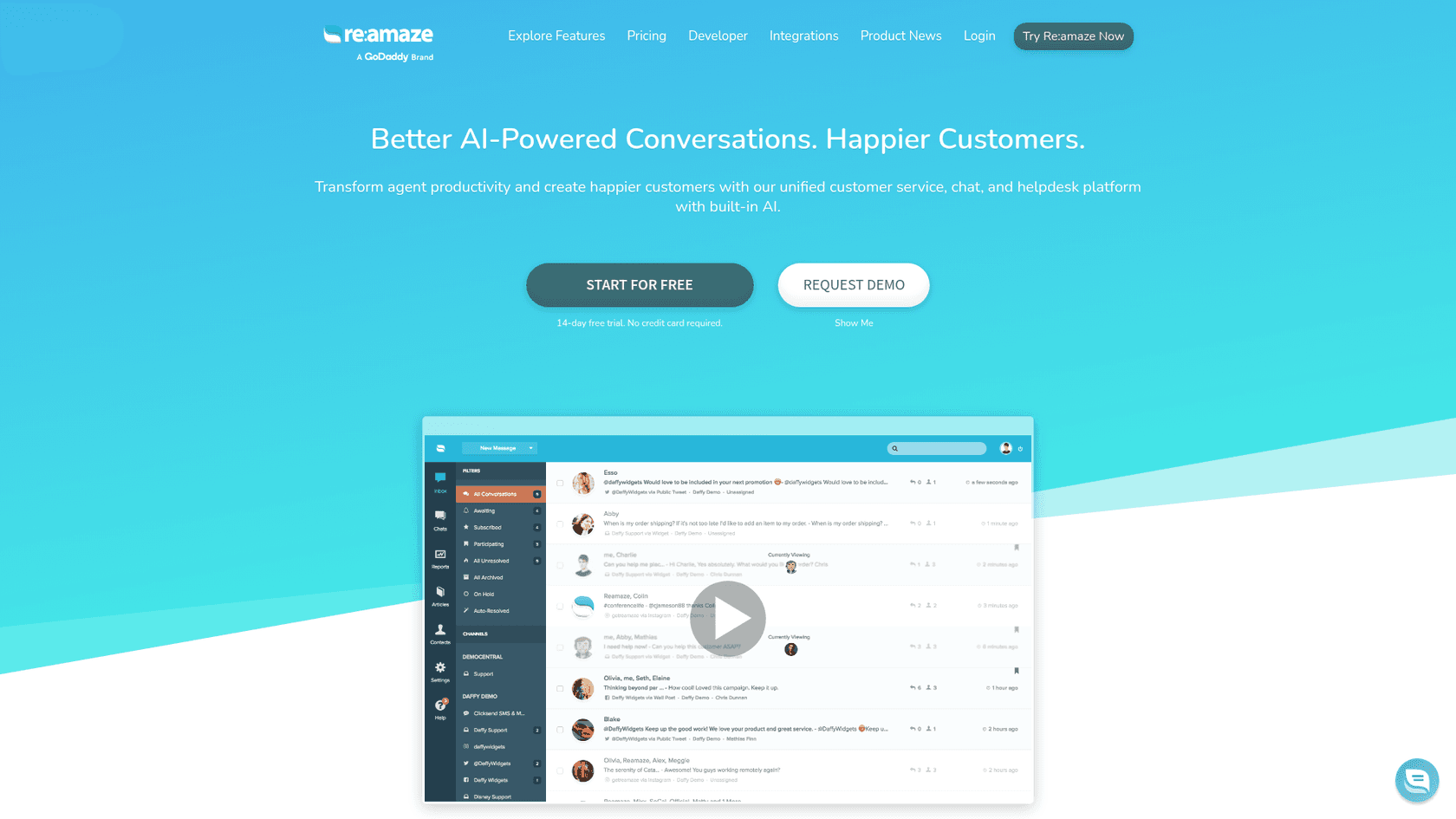
Re:amaze is a cloud-based help desk and customer messaging solution founded in 2012 by Lu Wang. The platform was built with e-commerce businesses in mind, offering deep integrations with platforms like Shopify, BigCommerce, and WooCommerce.
The core value proposition centers on multi-brand support. You can connect multiple websites to a single Re:amaze account, making it ideal if you manage several stores or brands. The platform combines helpdesk functionality, live chat, automated engagement, and a knowledge base into one system.
Re:amaze scores 4.6/5 on G2 and has earned G2 Crowd's Top Performer Award for three consecutive years. The company claims over 500 five-star reviews across Google, G2, Capterra, and other platforms.
Key strengths include advanced social media monitoring across Facebook, Twitter, and Instagram, plus a robust ticketing system that's included in all pricing tiers. If your support strategy heavily involves social channels and you need to track customer issues across multiple brands, Re:amaze was built with your situation in mind.
What is Crisp?
Crisp positions itself as a modern customer engagement platform for small to midsize businesses. With over 39,000 customers compared to Re:amaze's roughly 6,800, Crisp has significantly broader market penetration according to 6sense data.
The platform emphasizes real-time communication features that go beyond traditional chat. Crisp offers video chat and screen sharing without requiring additional plugins, plus co-browsing capabilities that let support agents take control of a customer's screen to guide them through issues.
Crisp's chat widget loads in 1.6 seconds, which matters for user experience and SEO. A faster widget means happier visitors and potentially better search rankings since page speed is a ranking factor.
The platform also includes Hugo, an AI agent designed to handle automated conversations. While not as advanced as dedicated AI support solutions, Hugo can suggest responses, categorize conversations, and provide conversation summaries.
Crisp scores 4.5/5 on G2 and offers a genuinely useful free tier with up to two seats, making it attractive for startups and small teams testing the waters.
Feature comparison
Live chat and messaging
Both platforms handle the basics well. You get unlimited conversations, live typing indicators, file sharing, and visitor tracking with either choice.
Re:amaze offers visitor browsing history and supports multilingual setups out of the box. The chat interface is straightforward and integrates tightly with the shared inbox.
Crisp differentiates with video chat capabilities and co-browsing. If you sell complex products where showing is easier than telling, the ability to start a video call or share screens directly from chat is valuable. The widget customization options are also more extensive.
Channels and integrations
Re:amaze connects to 45+ native integrations with particular strength in e-commerce. You get native Shopify, BigCommerce, WooCommerce, and Magento connections. Social media support includes Facebook, Twitter, Instagram, WhatsApp, SMS, and VOIP. Notably missing is Telegram support.
Crisp offers 57+ native integrations, including HubSpot and Salesforce CRM connections that Re:amaze lacks. The platform supports Telegram and has broader CRM integration options. E-commerce support covers Shopify, WooCommerce, Magento, and Prestashop, though the integrations aren't as deep as Re:amaze's.
AI and automation
Re:amaze offers AI features in beta, including response suggestions and conversation summarization. The FAQ chatbot can answer common questions using your knowledge base content. Automation workflows handle tagging, assigning, and routing based on triggers.
Crisp's Hugo AI provides more developed capabilities: conversation categorization, speech-to-text, instant summaries, and multilingual AI responses. However, AI usage is capped at 50-500 uses per month on lower-tier plans, which could be limiting for high-volume teams.
Neither platform offers true autonomous ticket resolution. Both focus on assisting human agents rather than handling tickets from start to finish. For teams wanting AI that actually resolves issues without human intervention, modern alternatives like eesel AI offer a different approach entirely.
Ticketing and help center
Here's where the pricing models create real differences. Re:amaze includes a full ticketing system in all plans, plus a customizable help center and FAQ system. You can host your knowledge base on your own domain and embed it in chat widgets.
Crisp locks ticketing and the customer portal behind the $295 per month Plus plan. On lower tiers, you're limited to chat-based support without formal ticket tracking. For teams that need structured issue management, this pushes you toward Crisp's higher pricing tier.
Pricing breakdown
Re:amaze pricing
| Plan | Monthly Price | Annual Price | Key Features |
|---|---|---|---|
| Basic | $29/agent | $24/agent | Unlimited inboxes, live chat, basic automations, 1,000 contacts |
| Pro | $49/agent | $41/agent | Advanced workflows, custom roles, 10,000 contacts |
| Plus | $69/agent | $57/agent | Priority support, custom branding, unlimited contacts |
| Enterprise | Custom | Custom | Custom integrations, dedicated support |
Re:amaze also offers conversation volume pricing as an alternative to per-agent billing, which might work better for seasonal businesses.
Source: Re:amaze Pricing
Crisp pricing
| Plan | Monthly Price | Seats | Key Features |
|---|---|---|---|
| Free | $0 | 2 | Basic live chat, 30-day history, basic customization |
| Pro | $25 | 4 | Unlimited history, advanced customization, basic automations |
| Business | $95 | 20 | Video calls, co-browsing, AI features, advanced chatbots |
| Plus | $295 | Unlimited | Ticketing, customer portal, advanced AI, priority support |
Additional seats on Pro and Business plans cost $10 per month each.
Source: Crisp Pricing
Real cost comparison
For a 5-person team:
- Re:amaze: $145-345 per month
- Crisp: $25-95 per month (Pro or Business)
For a 10-person team:
- Re:amaze: $290-690 per month
- Crisp: $95-295 per month (Business or Plus)
For a 20-person team:
- Re:amaze: $580-1,380 per month
- Crisp: $295 per month (Plus with unlimited seats)
The math is clear: Crisp becomes significantly more cost-effective as your team grows beyond 5 people. Re:amaze's per-agent model scales linearly, while Crisp's workspace pricing flattens out.
AI capabilities comparison
Both platforms are adding AI features, but neither approaches true autonomous support.
Re:amaze's AI is currently in beta and focuses on assisting agents: suggesting responses, summarizing conversations, and helping create content. It's helpful but not transformative.
Crisp's Hugo AI is more developed, offering conversation categorization, speech-to-text, and multilingual capabilities. The AI can suggest responses and help route conversations. However, usage limits on lower tiers mean you need to upgrade to use AI meaningfully.
The fundamental limitation of both platforms is that they still need human agents to handle most interactions. The AI assists rather than resolves. For teams looking to reduce headcount through automation rather than just make agents more efficient, neither platform delivers fully autonomous support.
This is where the landscape has shifted. Modern AI-native solutions can achieve 81% autonomous resolution rates, handling tickets end-to-end while escalating only complex edge cases. The difference between "AI-assisted" and "AI-autonomous" is significant for scaling support operations.
Use case recommendations
Choose Re:amaze if:
- You run an e-commerce business with deep Shopify, BigCommerce, or WooCommerce integration needs
- You manage multiple brands or websites from one account
- Social media support (Facebook, Twitter, Instagram) is central to your strategy
- You want ticketing included without paying for a top-tier plan
- You need WhatsApp, SMS, or VOIP support channels
Choose Crisp if:
- Your team has 5 or more people (workspace pricing saves money)
- You want modern features like video chat and co-browsing
- You use HubSpot or Salesforce and need CRM integration
- You want a free tier to test before committing
- You need Telegram support
- Widget loading speed matters for your SEO
Considering an AI-native alternative?
While Re:amaze and Crisp both add AI features to traditional support workflows, some teams need something fundamentally different. If you're looking for AI that actually resolves tickets rather than just assisting agents, eesel AI takes a different approach.
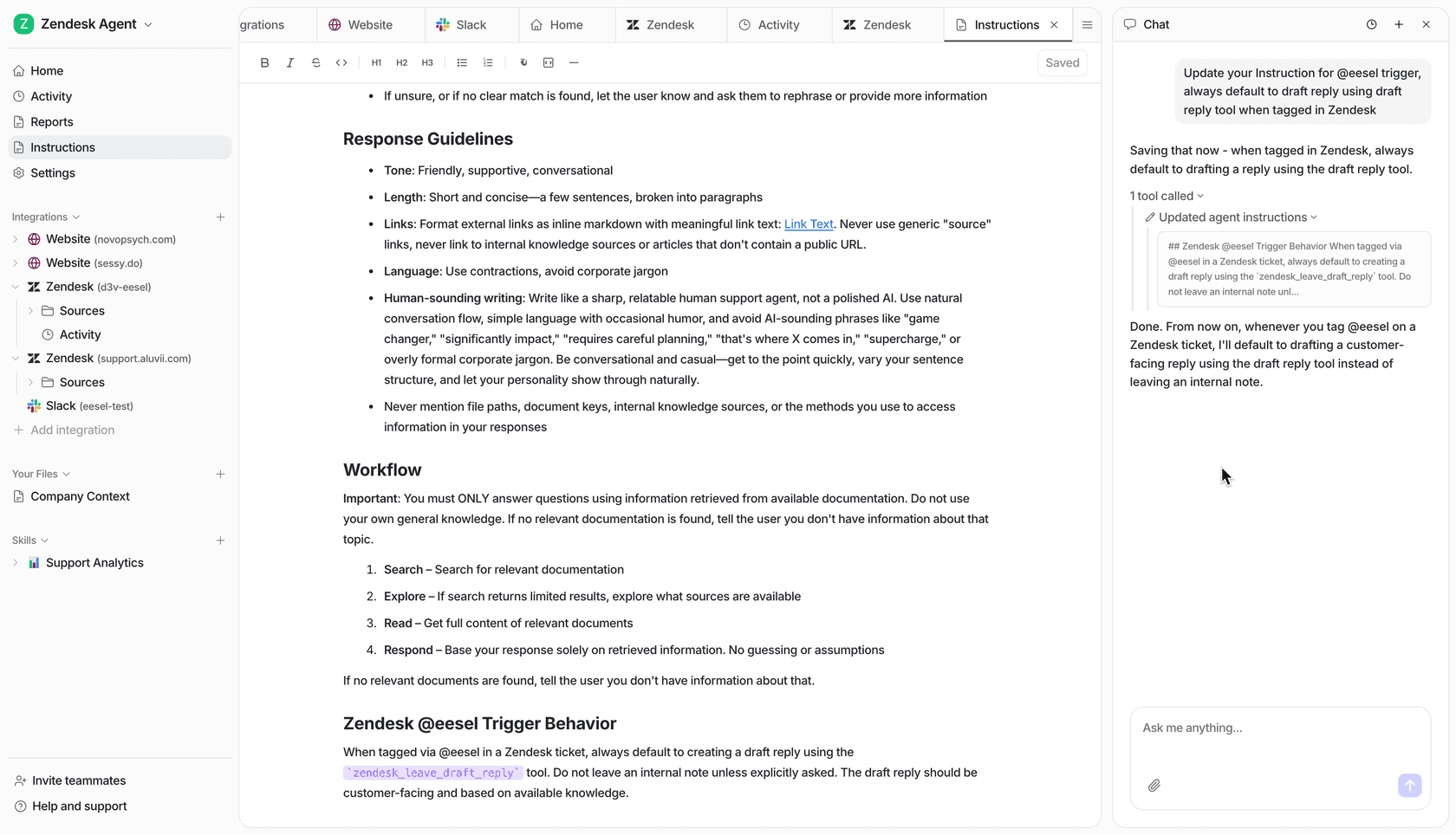
Instead of configuring another tool, you hire eesel as an AI teammate. It connects to your existing help desk (including Re:amaze, Zendesk, Freshdesk, and others), learns from your past tickets and help center, and starts handling frontline support autonomously.
The key difference is the progression from assisted to autonomous. You start with eesel drafting replies for review, then expand to direct responses as it demonstrates accuracy. Mature deployments achieve up to 81% autonomous resolution with payback periods under two months.
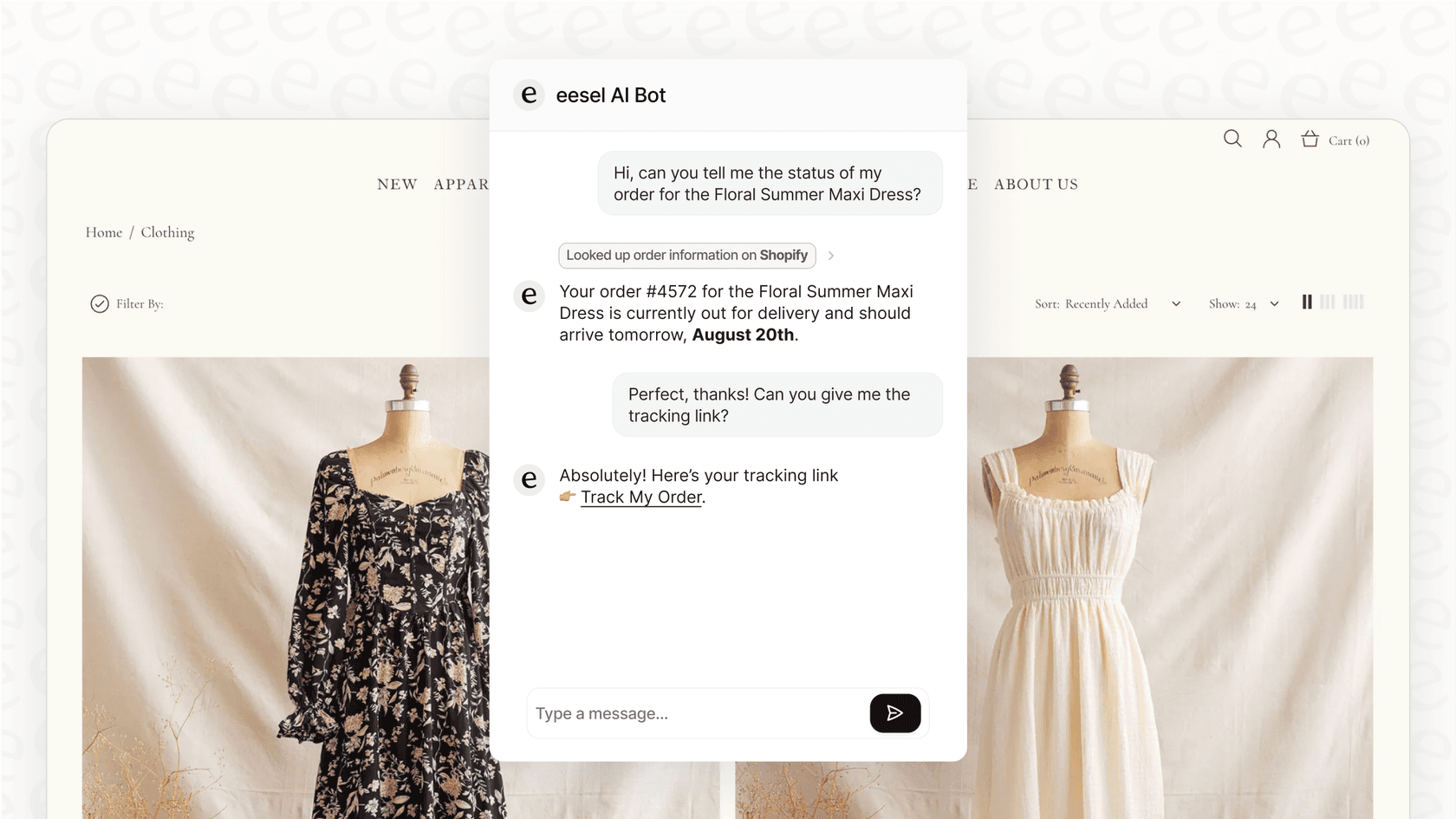
For e-commerce specifically, our AI Sales Rep handles both support and sales, integrating with Shopify to look up orders, process refunds, and recommend products directly in chat.
Making your decision
Both Re:amaze and Crisp are solid choices. Your decision comes down to your specific needs:
- E-commerce focus with multi-brand needs? Re:amaze's deeper integrations and included ticketing make sense.
- Growing team wanting modern features? Crisp's workspace pricing and video capabilities offer better value.
Neither platform is perfect. Re:amaze gets expensive as you scale. Crisp reserves key features like ticketing for higher tiers. Both offer AI assistance but fall short of true autonomous resolution.
If you've outgrown basic chat tools and need AI that actually handles tickets, it's worth exploring what modern AI-native support looks like. The gap between "AI-assisted" and "AI-autonomous" is where the real efficiency gains live.
Ready to see how AI-native support compares? Book a demo or try eesel free and see what autonomous resolution looks like in practice.

Frequently Asked Questions
Share this article

Article by
Stevia Putri
Stevia Putri is a marketing generalist at eesel AI, where she helps turn powerful AI tools into stories that resonate. She’s driven by curiosity, clarity, and the human side of technology.