
AI writing assistants are common tools for marketers, students, and many professionals. However, they are not all interchangeable. Choosing the right one depends on your specific goal. Two popular tools, Quillbot and ChatGPT, are built for different tasks.
Quillbot is designed to refine and rewrite existing text, functioning as an intelligent editor. ChatGPT excels at generating new, original content from scratch. This guide provides a straightforward comparison of their features, pricing, and best uses to help you decide.
I understand that QuillBot is a paraphrasing tool and ChatGPT is better for generating ideas, but I'm looking for a tool that helps me write more clearly while also checking my spelling and grammar. I like how QuillBot can be integrated with my browser and will underline words or phrases that can be improved. Is this something ChatGPT can do within a browser?
While both are helpful, they are designed for specific tasks in the writing process. For a tool that handles the entire blog creation workflow from keyword to a publish-ready post, you might consider an end-to-end solution like the eesel AI blog writer.
What is Quillbot?
Quillbot is an AI writing platform built to improve text you have already written. Its primary function is not to create content from a prompt, but to assist with the clarity, tone, and style of your writing. It works like an advanced editing assistant, making it popular with students, academics, and professionals who need to polish their work.
Quillbot has a full set of tools to help with the writing process:
- Paraphraser: Rewrites text in different modes, like Standard, Fluency, and Creative, to provide options for tone.
- Grammar Checker: Fixes grammar, spelling, and punctuation mistakes.
- Plagiarism Checker: Scans your text to help ensure it is original (this is a Premium feature).
- Summarizer: Shortens long documents or articles into key points.
- Citation Generator: Creates citations in academic styles like APA and MLA.
- AI Detector: Checks text to see if it was likely written by an AI model.
- AI Humanizer: Rewrites AI-generated text to make it sound more natural.
- Translator: Translates text into over 50 different languages.
What is ChatGPT?
ChatGPT is an AI chatbot from OpenAI. Its main job is to create new, human-like text from a simple prompt. Unlike Quillbot, its primary purpose is to generate original content. You can use it for a wide range of tasks, from answering questions and brainstorming ideas to writing articles, emails, or even code.
It acts as a creative partner, helping you overcome writer's block or produce a first draft quickly. A paid subscription provides access to more advanced models like GPT-4, which offers faster responses and better performance on difficult tasks. It is a tool for creation, not just refinement.
Key features and use cases: Quillbot vs ChatGPT
Content rewriting and humanizing
- Quillbot: This is Quillbot's main strength. It has multiple paraphrasing modes (Standard, Fluency, Formal, Creative, etc.) that give you fine-tuned control over the final tone. Its dedicated AI Humanizer tool is specifically made to rewrite robotic-sounding text from models like ChatGPT, making it sound more authentic. If you are starting with a piece of text that needs work, Quillbot has the specialized tools for it.
- ChatGPT: You can ask ChatGPT to paraphrase text, but it does not have the specific controls and modes that Quillbot does. The results can be inconsistent, and it might not always capture the nuance you are looking for. A 2024 study found that text paraphrased by ChatGPT had an average plagiarism rate of 45%. This highlights the importance of verifying originality for professional or academic work.
Original content generation
- ChatGPT: This is what it is built for. It can generate entire articles, scripts, social media posts, and more from a simple text prompt. It is a powerful tool for creating first drafts, brainstorming outlines, or getting something on a blank page. If you need to produce a lot of new text quickly, ChatGPT is the tool to use.
I totally agree! ChatGPT often goes well beyond Grammarly or Quillbot for proofreading and editing. It not only corrects basic grammar or style errors, it can also spot inconsistencies in content, rephrase sentences for clarity, and even suggest improvements in tone or structure. It has a more 'human' understanding of context, which helps correct nuances that other tools often miss.
 Reddit
 - Quillbot: Quillbot cannot generate new content from a prompt. You have to give it existing text to work with. This is its main limitation as a content creation tool. It is designed to improve what you already have, not to create something new.
Academic and integrity tools
- Quillbot: This platform offers a set of tools that are useful for academic and professional writing. It includes a Plagiarism Checker to ensure originality, a free Citation Generator to format sources correctly, and an AI Detector trained on models like GPT-4 and Gemini. This makes it a solid choice for students and researchers who need to meet academic standards.
- ChatGPT: ChatGPT does not have a built-in plagiarism checker or AI detector. A key consideration for academic use is source reliability. According to Black Hawk College, it cannot cite its sources and can often provide wrong information or "hallucinate" facts. This makes it untrustworthy as a primary source for any content that needs to be factually accurate.
Research and summarization features
- Quillbot: Quillbot has a dedicated Summarizer tool that can condense articles or papers into a list of key points or a short paragraph. The free version can summarize up to 1,200 words at a time, while Premium users can go up to 6,000 words. It is a simple tool for quickly understanding the main ideas of a long text.
- ChatGPT: ChatGPT can also work as a research assistant. You can ask it to summarize information or explain topics, and it will pull information from its training data. Its strength is explaining concepts in a conversational way, which is useful for learning and initial research.
Feature comparison table
| Feature | Quillbot | ChatGPT |
|---|---|---|
| Primary Function | Rewriting and refining existing text | Generating new text from prompts |
| Original Content Generation | No | Yes (core feature) |
| Paraphrasing Tool | Yes (specialized with multiple modes) | Yes (via general prompting) |
| AI Humanizer | Yes (dedicated tool) | No |
| Grammar Checker | Yes (dedicated tool) | Yes (via general prompting) |
| Plagiarism Checker | Yes (Premium feature) | No |
| AI Content Detector | Yes (built-in) | No |
| Citation Generator | Yes (built-in) | No |
| Summarizer | Yes (dedicated tool) | Yes |
Pricing: A breakdown of plans
Both platforms have a free and a paid version, but they are aimed at different needs and budgets.
Quillbot pricing plans
Quillbot's pricing is simple: you pay to unlock more powerful editing features.
- Free Plan: Offers limited features for casual use. The Paraphraser has a 125-word limit, the Summarizer is capped at 1,200 words, and you only get two writing modes (Standard and Fluency).
- Premium Plan: Unlocks everything, with unlimited words in the Paraphraser, all writing modes, the Plagiarism Checker, and higher limits on other tools.
- Monthly: $19.95 per month
- Semi-Annual: $79.95 billed every 6 months (about $13.33 per month)
- Annual: $99.95 billed annually (about $8.33 per month)
ChatGPT pricing plans
ChatGPT's pricing gives you access to more advanced AI models.
- Free Plan: Gives you access to the base model (GPT-3.5). It is capable, but it can be slower during busy times and lacks the advanced reasoning of newer models.
- ChatGPT Plus: Costs $20 per month and gives you access to the most advanced models (like GPT-4), which provide faster responses and better performance. It also includes features like data analysis, image generation with DALL-E, and the ability to create custom GPTs.
Which tool offers better value?
The better value depends on how you work. If you mostly write and edit your own content and need a strong set of tools for polishing it, Quillbot's Premium plan is a good deal, especially the annual subscription. If you need an assistant for brainstorming, research, and generating first drafts, ChatGPT Plus is a better investment.
My Grammarly Premium is about to expire and I'm thinking of just using ChatGPT Pro moving forward for this type of work. I don't want to resubscribe to another year if ChatGPT can do what grammarly does, especially if its better.
Considerations for content marketing workflows
While both tools are useful, they typically address specific parts of the content creation process rather than the entire workflow from start to finish.
- Quillbot: It functions primarily as an editor. You need to provide existing text, which means the initial research, outlining, and drafting are done separately. For a content marketer who needs to produce several articles a week, this does not solve the main bottleneck.
- ChatGPT: It generates a text-only first draft. This output often requires significant editing to align with a specific brand voice, add media assets like images or tables, and ensure it is fully optimized for SEO. This underscores the need for human oversight and editing when using generative AI for important content.
An alternative for complete blog posts: eesel AI blog writer
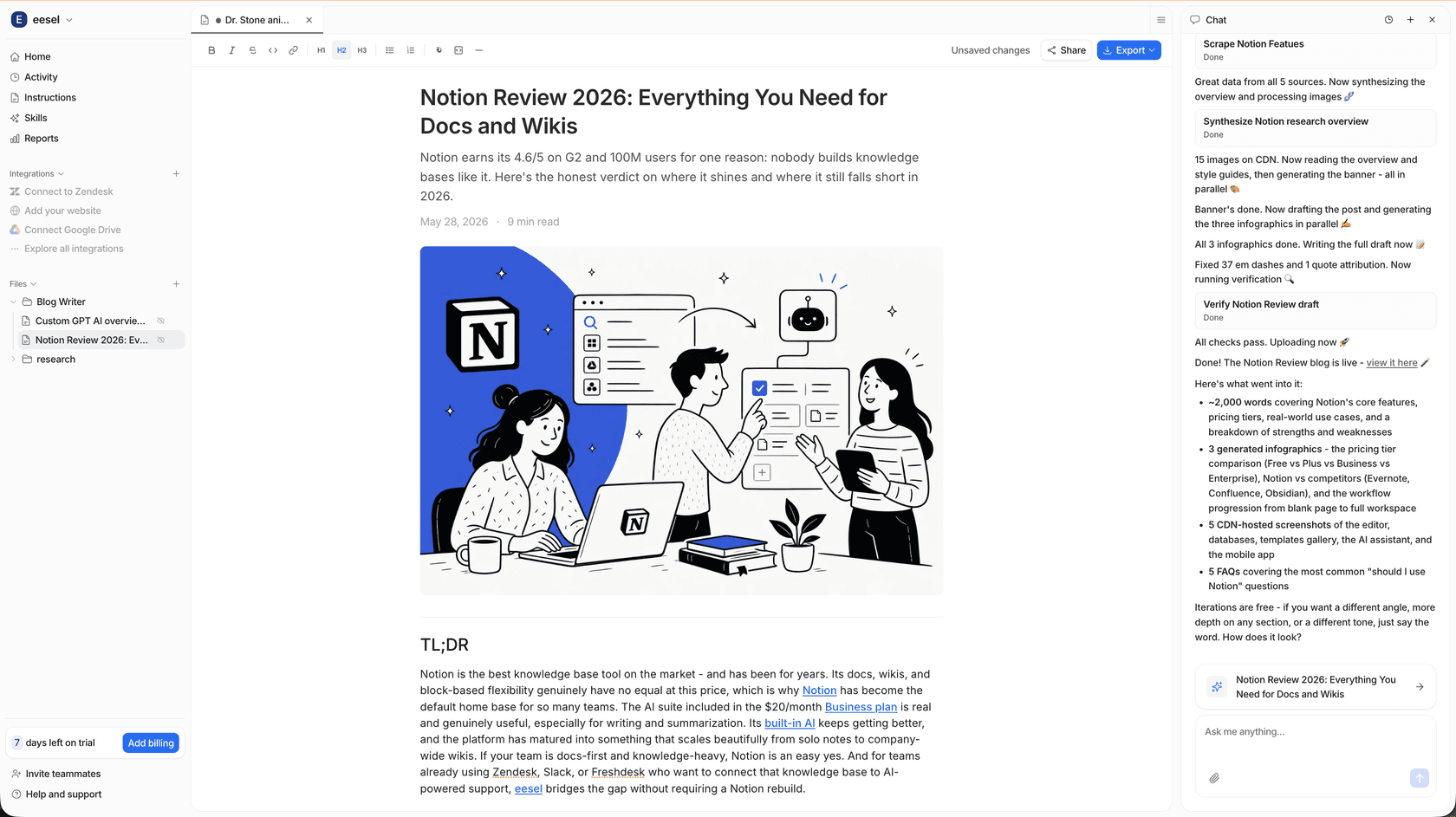
It bridges the gap between raw text and a finished article by including features that marketers need:
- Automatic asset creation: It generates relevant images, infographics, and tables right in the article, which saves hours of manual work.
- Social proof and media integration: It finds and embeds relevant Reddit quotes and YouTube videos to make the content more engaging and add authentic voices.
- Built-in SEO and AEO: The content is structured with optimized headings, keywords, and meta descriptions. It is also optimized for AI Answer Engines like Google AI Overviews.
- Context-aware research: Unlike the generic output of other tools, it produces well-researched content that matches what people are searching for. It is the same tool we used at eesel to grow our organic impressions from 700 to over 750,000 per day.
The eesel AI blog writer is free to try and uses a simple credit-based system, making it a practical solution for producing content at scale.
For a more hands-on look at how these tools compare, the video below offers a detailed walkthrough, showing how each platform handles tasks like improving tone, grammar, and professionalism in a piece of writing.
Choosing the right tool for your task
So, which one should you use? It depends on what you need to do. There is no single "winner," as they are designed for different things.
- Quillbot is the right choice if you need to refine, rephrase, and proofread your own writing. It is an editor's toolkit.
- ChatGPT is best for brainstorming, generating ideas, and creating first drafts. It is a creative assistant.
- eesel AI blog writer is an option for marketers and founders who need to produce complete, optimized, and engaging blog content at scale.
For those looking to scale content marketing with full, optimized articles, a purpose-built tool like the eesel AI blog writer may be a suitable option.