Trying to pick the right AI writing tool can feel like a huge decision. The market is packed with platforms promising to change your content workflow. Choosing the right tool is crucial for optimizing time and resources to avoid generating generic AI content. It’s a high-stakes choice for any marketing team.
Two of the biggest names you’ll run into are Jasper AI and Anyword. Jasper has positioned itself as an AI content platform for the entire marketing lifecycle. Anyword, on the other hand, has carved out its space by focusing on data-driven copy that converts. So, which one is suitable for your needs?
I just looked into these tools and they seem pretty useful to generate ideas, but ultimately need refining. My company spends a good amount of time doing guest articles, case studies, Q&As, and we want to increase our on-site content as well. I figured this might help develop some content that starts out pretty technical from our engineering team.

This guide will give you a straight-up, no-fluff breakdown of the Jasper AI vs Anyword comparison. We’ll look at their main features, who they’re for, and what they cost. We'll also explore their workflows and introduce another solution designed to address a different part of the content creation process: turning a simple draft into a blog post that’s ready to publish.
What is Jasper AI?
Jasper AI has grown beyond being a simple writing assistant. It’s now framed as an AI content platform meant to automate the entire marketing content process. The goal isn't just about writing faster, but about creating a single system that handles everything from the initial idea to the final publication using what they call "Content Pipelines."
Its main strength is in creating a unified system for marketing teams. At its core is Jasper IQ, a proprietary context layer that mixes marketing best practices with your company's unique brand voice, audience details, and product info. This lets teams build a central brain that guides all content generation, making sure everything is consistent, no matter who's doing the writing.
Jasper is designed for marketing teams at larger companies that need to produce a lot of content across different channels. The ideal user is a "Content Engineer," someone who builds and oversees marketing systems to make sure every tweet, email, and whitepaper is on-brand and fits into the bigger picture.
Here are some of its key features:
-
Content Pipelines: Automates the content process from idea to publication.
-
Jasper IQ: A context layer that learns your brand voice, audience, and knowledge base.
-
Studio: A no-code tool for creating custom AI apps and workflows.
-
Agents: AI helpers for specific marketing jobs like personalization and research.
-
Integrations: Connects with SurferSEO (as a paid add-on), Copyscape, Zapier, Webflow, and Google Sheets.
What is Anyword?
Anyword is an AI performance writing platform made for marketers who focus on conversions. Its whole model is built around closing the loop between what the AI writes and how that content actually performs. It’s less about brand-wide automation and more about encouraging a click, a sign-up, or a sale.
The platform’s standout feature is its Predictive Performance Score. This tool scans your copy and predicts how well it will convert with up to 82% accuracy, all before you hit publish. This helps turn content optimization into a more data-informed process, letting you test and tweak your message without spending on ads first.
Anyword is a useful tool for performance marketers, demand gen teams, and social media managers who are focused on optimizing ads, landing pages, and emails for the best possible return on ad spend (ROAS). If your success is measured in conversion rates, Anyword may be a suitable option.
Its key features include:
-
Predictive Performance Score: Grades copy on its potential to engage a specific audience.
-
Data-driven Editor: A workspace with over 100 marketing templates to generate and score copy.
-
Blog Wizard: A tool for creating plagiarism-free blog posts with a built-in SEO score and optimization panel.
-
Audience Targeting: Lets you customize content based on defined customer personas.
Jasper AI vs Anyword: A direct feature comparison
Let's put these two platforms side-by-side and see how they stack up on the things that matter most to marketing teams.
Best use cases
Jasper AI is at its best when you use it to build an automated, on-brand content system across a large marketing department. It’s effective at generating all sorts of assets, from blog posts and social media campaigns to product descriptions, all while keeping a consistent brand voice thanks to its Jasper IQ layer. You pick this tool when you want to build marketing workflows that run smoothly and at scale.
Anyword shines with short-form, conversion-focused copy where every word counts. Its strength is in writing ads for Meta and Google, snappy email subject lines, and persuasive landing page headlines. The Predictive Performance Score makes it a strong choice for A/B testing copy variations before you commit any budget.
SEO and content optimization
Jasper AI has some powerful SEO features, but they come through a paid, third-party integration with Surfer SEO. While this combination is a popular choice for ranking long-form content, it means you need a separate subscription to make it work. Without Surfer, the built-in SEO tools are more basic.
Anyword, however, includes a Blog Wizard with an integrated SEO score and insights panel. This lets you optimize for target keywords and readability right inside the platform. It's a simpler approach for teams that don't want the extra cost or hassle of managing another SEO tool.
Integrations and workflow
Jasper AI is designed to connect to a wider marketing and development ecosystem. With integrations for tools like Zapier, Webflow, and Google Sheets, it’s made to fit into complex, automated workflows where content needs to be created and published in bulk across different platforms.
Anyword keeps its integrations focused on the performance marketing stack. It connects directly to ad platforms like Meta Ads and Google Ads, plus CRMs like HubSpot and Salesforce. This allows it to pull in performance data and train its AI on what has worked for your brand, making its predictions more accurate over time.
Pricing models
Jasper AI's Pro plan kicks off at $59 per month when billed annually ($69/month if you pay monthly). This plan only gives you one user seat and has limited access to its key Brand Voice and Knowledge Base features. For more advanced features, you’ll need the Business plan, which has custom pricing.
Anyword is a bit easier to get into, offering a free plan for new users to try it out. Paid plans start with the Starter tier at $39 per month when billed annually ($49/month billed monthly). The more popular Data-Driven plan, which gives you more predictive scores, is $79 per month when paid annually.
Just remember, the real cost of using Jasper for serious SEO includes that extra Surfer SEO subscription, which is a big deal when you're comparing the total cost. This infographic breaks down the key differences between the two platforms.
| Feature | Jasper AI | Anyword |
|---|---|---|
| Primary Use Case | AI Content Automation & Workflows | Performance-Driven Copywriting |
| Key Differentiator | Jasper IQ context layer & Content Pipelines | Predictive Performance Score (82% accuracy) |
| SEO Approach | Requires separate, paid Surfer SEO integration | Built-in Blog Wizard with SEO scoring |
| Integrations | Zapier, Webflow, Google Sheets, Make | Meta Ads, Google Ads, HubSpot, Salesforce |
| Pricing Model | Starts at $59/month (billed annually) | Starts with a free plan; paid plans from $39/month |
| Target User | Marketing teams building scalable systems | Performance marketers optimizing conversions |
Key limitations of Jasper AI and Anyword
Both tools are effective for their primary functions, but it's important to understand their workflow to see if they fit your needs.
A key consideration is the "Draft vs. Done" workflow. Both Jasper and Anyword are effective at generating drafts. They give you a solid chunk of text to start with. However, users are still responsible for the final stages of content production: turning that text into a publish-ready blog post. This can involve finding images, researching stats, sourcing videos, formatting everything, and adding real-world credibility. They provide text, not a finished asset.
Here are a few other specific considerations:
-
Jasper's Cost and Complexity: To leverage Jasper's full SEO capabilities, a separate subscription to Surfer SEO is required. This increases the total cost and adds another tool to the workflow. The platform's move toward complex automation with "Content Pipelines" and "Agents" can also be a learning curve for teams who primarily need to write blog posts.
-
Anyword's Specialization: Anyword is a fantastic tool for ad copy and short-form content. While it includes a long-form blog generator, its primary strength lies in performance marketing, not necessarily in creating in-depth, well-researched articles designed to rank for competitive SEO keywords.
-
AI-Generated Tone: Even with their "brand voice" features, both platforms can sometimes produce content that requires further editing to add a human touch, nuance, and real-world examples from community forums or social media that builds trust with readers.
They are great when I have writers block or need different title ideas. For full articles... Nah.
eesel AI: An alternative for scaling blog content
Another approach to AI content generation focuses on producing more complete, publish-ready assets.
The eesel AI blog writer is designed to address the "draft vs. done" workflow. The idea is to deliver a more complete, SEO-optimized blog post to reduce editing time.
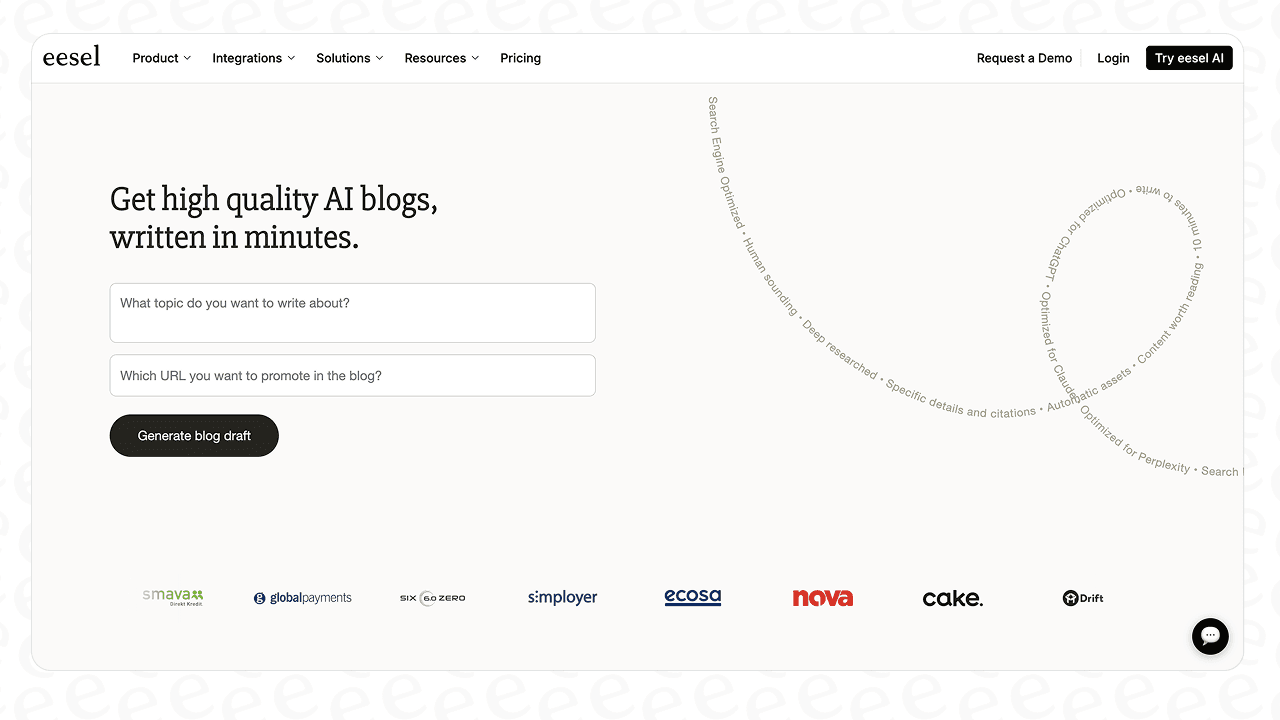
The workflow is straightforward. You give it a keyword or a topic, and the eesel AI blog writer handles the creation process. This isn't just about writing paragraphs; it's a process that includes research, writing, and asset creation.
Key features of this approach include:
-
Automatic Asset Generation: The eesel AI blog writer includes AI-generated images, infographics, charts, and tables right in the post. This can save time in finding or creating visuals to make an article more readable and engaging.
-
Rich Media & Social Proof Integration: It automatically embeds relevant YouTube videos and can pull quotes and insights from Reddit discussions. This adds a layer of social proof and credibility to the content.
-
True SEO & AEO Optimization: The eesel AI blog writer is built to create content that ranks. It optimizes everything for your target keywords, from headings and meta descriptions to the overall structure. It's also optimized for AI Answer Engines (AEO), getting your content ready for the future of search, like Google's AI Overviews.
-
Proven Results: This is the tool we used to go from 700 to 750,000 impressions per day in just 3 months by publishing over 1,000 optimized blogs.
And the pricing is simple and transparent, with no hidden fees or required add-ons. You can get 50 complete, publish-ready blog posts for just $99.
Best of all, you can see the quality for yourself without spending a dime. It's completely free to try, so you can generate your first blog and see the difference.
For those who want to see these tools in action, this video provides a helpful side-by-side look at how Jasper AI and Anyword handle content creation.
Choosing between Jasper AI and Anyword
So, how do you choose? If you need to build a massive content automation system for a large, enterprise marketing team, Jasper is a powerful choice. If your main goal is to optimize ad copy with predictive data to get more conversions, Anyword was made for you.
Both tools represent powerful solutions for specific marketing needs. They focus primarily on text generation, leaving the final asset creation to the user. For businesses focused on scaling blog content efficiently, it's worth considering tools that automate more of the post-drafting process. Evaluating the entire workflow, from draft to publication, is key to selecting the right tool.
To explore a tool that automates asset creation, generate your first blog for free with the eesel AI blog writer today.
Frequently asked questions
What's the main difference in the Jasper AI vs Anyword comparison for marketers?
The biggest difference comes down to focus. Jasper is built for creating a whole content system for your brand, while Anyword is all about writing copy that converts, like for ads and landing pages.
When considering Jasper AI vs Anyword, which is better for SEO?
It's a trade-off. Anyword has built-in SEO tools which is convenient. Jasper can be powerful for SEO through its integration with Surfer SEO, but this requires an additional subscription and adds an extra tool to your workflow.
For a small business, which tool is more budget-friendly in the Jasper AI vs Anyword debate?
Anyword generally has a lower entry price, with a free plan to start and paid plans from $39/month. Jasper's plans start at $59/month, and you'll need to factor in the extra cost of Surfer SEO for full optimization, making Anyword the more budget-friendly option upfront.
Can I use both tools? How would that work in a Jasper AI vs Anyword strategy?
You could, but it might be inefficient. A better approach is to identify your primary need. If it's scaling blog content, it's worth evaluating tools that handle the entire process. For instance, a tool like eesel AI, which produces a more complete post, could be considered as an alternative to juggling both.
Why is the "draft vs. done" problem so important when looking at Jasper AI vs Anyword?
It's important because the process of turning a text draft into a complete, formatted blog post with visuals can be time-consuming. This final stage of the workflow is a key consideration when evaluating these tools, as it's a part of the process that neither Jasper nor Anyword fully automates.
In the Jasper AI vs Anyword matchup, which is better for creating a consistent brand voice?
Jasper AI puts a bigger emphasis on this with its "Jasper IQ" feature, which is designed to learn your brand's specific tone, style, and product knowledge. While Anyword has brand voice features, Jasper's are more central to its platform, making it a stronger choice for maintaining consistency across a large team.