7 best IT automation tools in 2026

Stevia Putri

Katelin Teen
Last edited May 20, 2026
Your IT team is probably handling the same hundred requests it handled last quarter. Password resets. Software access requests. VPN troubleshooting. New hire provisioning. Printer issues. These tickets are predictable, high-volume, and - increasingly - a waste of human time.
The average IT ticket costs $15-$17 to handle manually. Multiply that by a few thousand tickets a month and you're looking at a meaningful chunk of your IT budget going toward work a machine could handle. According to Ivanti's 2025 research, 85% of IT professionals believe AI can proactively reduce ticket volume - but adoption varies widely depending on which tool you're using and how you've set it up.
This post covers seven IT automation tools worth knowing in 2026: what each one automates, what it costs, and which team it actually fits.
What counts as IT automation
The category spans a wide range - from basic rules that route tickets to the right queue, to AI agents that resolve incidents end-to-end with no human involved. Before comparing tools, it helps to know which layer you're buying.
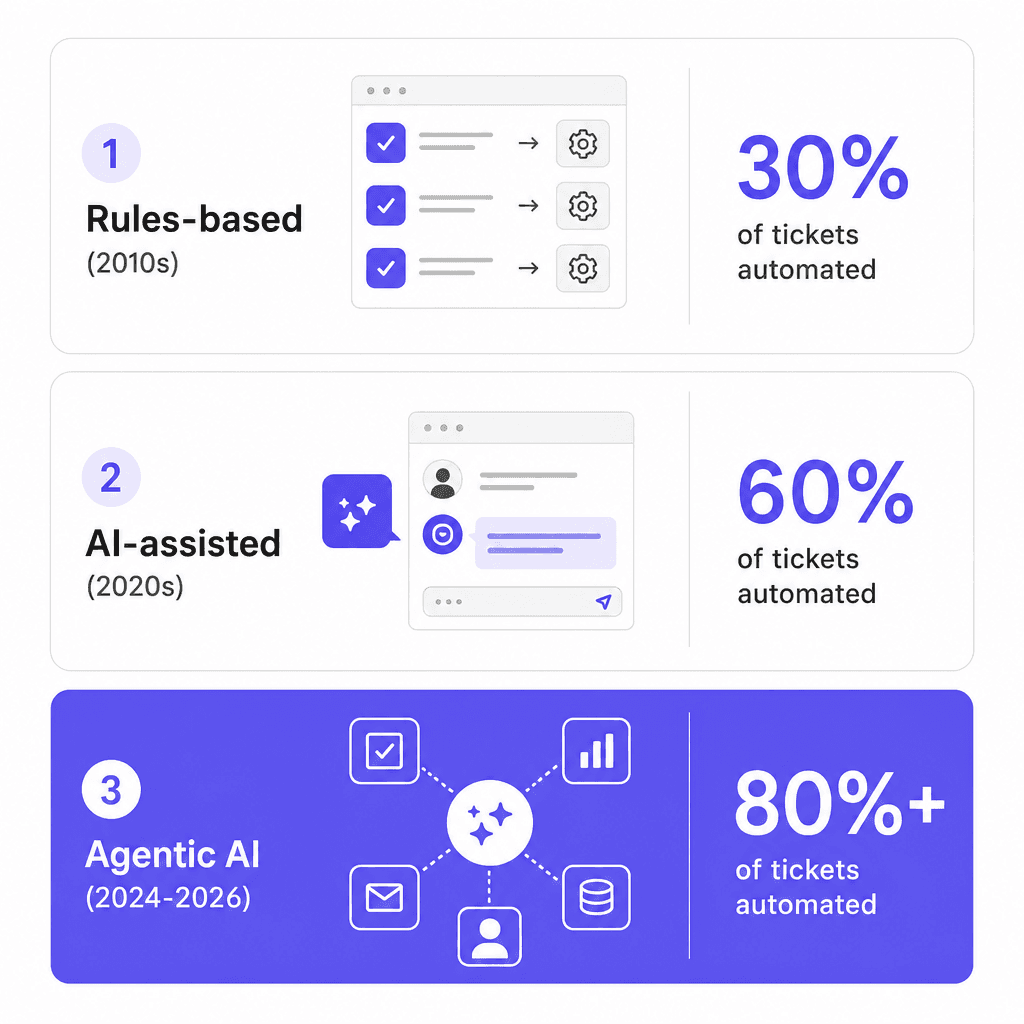
Rules-based automation is where most teams start. Set a condition, trigger an action: a ticket tagged "password reset" gets routed to the self-service portal; a new hire request triggers an account provisioning workflow. No AI involved - just logic trees. Effective for repeatable, predictable processes with low variance.
AI-assisted automation adds machine learning and NLP on top of the rules layer. The system can classify tickets based on natural language, suggest responses to agents, find relevant knowledge base articles, and flag anomalies. Humans still act, but they're working from better context.
Agentic automation - where most leading platforms are heading in 2026 - means AI that can observe, decide, and act end-to-end on a ticket without human involvement. It resolves password resets at 2am, escalates anomalous patterns to a problem manager, and generates post-incident reports automatically. According to the ITSM.tools 2025 report, early agentic rollouts are showing 60% reductions in ticket volume.
The tools below span all three layers. Which layer you need depends on your team's size, budget, and existing toolstack.
Quick comparison
| Tool | Starting price | Best for | AI tier |
|---|---|---|---|
| ServiceNow | Custom / $100-200+/fulfiller/mo | Large enterprise | Agentic (Prime tier) |
| Freshservice | $19/agent/mo (annual) | Mid-market, fast deployment | AI-assisted + Agentic |
| Jira Service Management | Free (3 agents) | Atlassian ecosystem teams | AI-assisted (Premium+) |
| ManageEngine ServiceDesk Plus | $13/tech/mo | Cost-conscious mid-market | AI-assisted |
| SolarWinds Service Desk | $39/tech/mo | SMB + mid-market ITSM + ITAM | AI-assisted (Advanced+) |
| Ivanti Neurons for ITSM | Custom | Enterprise endpoint + ITSM | AI-assisted + Agentic |
| eesel AI | $0.40/ticket | Teams adding AI to existing helpdesk | Agentic |
1. ServiceNow
ServiceNow is the market leader in enterprise ITSM - 85% of the Fortune 500 run on it, and it holds the top spot in Gartner's Magic Quadrant for AI IT Service Management (2026). If your organization has hundreds of IT fulfillers, complex change management requirements, and a long implementation runway, it's the highest-ceiling platform available.
ServiceNow's ITSM platform is sold in three tiers: Foundation, Advanced, and Prime. All three include Now Assist (generative AI for incident summarization, response drafting, and solution suggestions) and Predictive Intelligence (ML-based ticket classification and routing). The Prime tier adds the L1 Service Desk AI Specialist - an autonomous agent that handles routine requests end-to-end across any channel, moving ServiceNow into true agentic territory.
Customer results back up the ceiling: Ernst & Young reports a 75% reduction in service ticket volume, Khan Bank went from 70% to 99.3% user satisfaction, and Griffith University achieved an 87% increase in self-service rate after deployment.
Pricing: Custom only. Third-party benchmarks put fulfiller licenses at $100-$200+ per fulfiller per month, with large enterprises commonly exceeding $10M annually before implementation. Average implementation time is 5 months per G2 buyer data; average ROI timeline is 13 months.
Best for: Organizations with 500+ IT staff, existing infrastructure complexity, and budget for multi-year enterprise contracts. Not the right fit for teams that need to show results in 90 days.
Watch out for: The gap between the platform's capability ceiling and what an average deployment actually delivers. ServiceNow is powerful when deeply configured; underinvested deployments often deliver less than competitors at half the cost.
2. Freshservice
Freshservice by Freshworks is the go-to for mid-market IT teams that want real automation results without a multi-month professional services engagement. Trusted by 74,000+ businesses, it leads on time-to-value: their Benchmark Report 2025 shows a 356% ROI in under 6 months with a payback period under 3 months for top-performing customers.
The automation story centers on Freddy AI. The Freddy AI Agent handles end-user requests via Slack, Microsoft Teams, email, and the self-service portal - resolving questions, routing tickets, and escalating what it can't handle. The Freddy AI Agent Studio lets IT teams build, deploy, and iterate custom AI agents without code. Freshservice benchmark data shows 66% ticket deflection and a 77% decrease in Average Resolution Time for teams using AI-powered self-service.
Beyond helpdesk, Freshservice combines ITSM, ITAM, ITOM, and Enterprise Service Management in a single platform - useful when IT wants to extend service management to HR or facilities without a separate tool.
Pricing: Starter at $19/agent/month (annual) covers incident management, workflow automation, and the self-service portal. Growth at $49/agent includes asset management and employee onboarding. Pro at $99/agent adds change management, problem management, and Freddy AI Copilot as an add-on (~$29/agent extra). Freddy AI Agent (the agentic tier) is included in Enterprise plans only. A 14-day free trial is available.
Best for: Mid-market IT teams (50-2,000 employees) that want a single platform for ticketing, ITAM, and AI automation, and need to show ROI in a quarter rather than a year.
Watch out for: Freddy AI Agent's full capability requires the Enterprise tier. Teams on Pro or below get Freddy AI Copilot (agent-assist) rather than autonomous ticket resolution.
3. Jira Service Management
Jira Service Management (JSM) makes the most sense if your organization already lives in the Atlassian ecosystem - Jira, Confluence, Loom, Trello. Its differentiator isn't just the native integration between development and IT; it's the Teamwork Graph, Atlassian's cross-product AI layer that draws on organizational context (who owns what, what's related to what) rather than requiring a human to wire it up.
JSM has 60,000+ customers and a Forrester TEI study citing 275% ROI over three years. The virtual service agent (Premium and Enterprise) handles 24/7 support interactions, answers from the knowledge base, and routes tickets. AIOps features on Premium include alert grouping, AI-generated post-incident reviews, and AI-scored change risk assessment.
Pricing: JSM is sold as part of the Service Collection. Free plan covers 3 agents with no AI features. Standard at ~$20/agent/month adds 25 Rovo AI credits per user and basic CMDB via Assets (5,000 objects). Premium at ~$51.42/agent/month adds the virtual service agent (1,000 conversations/month included, then $0.30/conversation), full AIOps, change management, and a 99.9% uptime SLA. Enterprise is contact-sales-only.
Best for: Dev and engineering teams already on Atlassian, IT teams that need change management and incident management wired directly to CI/CD pipelines, and teams evaluating ITSM on a budget (the free and Standard tiers are genuinely usable).
Watch out for: The virtual service agent - the feature most teams want for automation - only appears at Premium ($51.42/agent/month). Teams on Standard get AI assistance for agents, not autonomous resolution. Also worth noting: JSM is bundled into the Service Collection, which adds cost if you only need the ITSM piece.
4. ManageEngine ServiceDesk Plus
ManageEngine ServiceDesk Plus is the cost-effective choice for mid-market and enterprise IT teams that need a comprehensive ITSM platform without the price tag of ServiceNow or Freshservice Enterprise. It's used by 100,000+ organizations and 750,000+ technicians across 185 countries, and holds a Gartner Magic Quadrant Leader position for AI IT Service Management.
The platform covers incident management, problem management, change management, CMDB, asset management, and project management across three editions. AI features - Predictive Intelligence (ML-based ticket triage, routing, and sentiment analysis), the Zia virtual support agent, and GenAI integration with ChatGPT and Microsoft Copilot - are included across all editions at no additional cost. That's notable: most competitors gate AI features behind their top-tier plans.
On G2 (4.2/5 stars, 248 reviews), reviewers consistently praise the customization depth and cost advantage over ServiceNow and Freshservice. The consistent critique is the setup complexity - the configuration surface is wide, and initial implementation can take time without professional services help.
Pricing: Standard at $13/tech/month (cloud) covers ticketing, self-service, and SLA management. Professional at $27/tech adds IT asset management. Enterprise at $67/tech adds problem, change, and project management. On-premises pricing starts at $1,195/year for 10 technicians. A free forever plan covers up to 5 technicians on the Standard edition.
Best for: IT teams that need a full ITSM stack with ITAM and CMDB at mid-market prices, and organizations that prefer on-premises deployment options alongside cloud.
Watch out for: The interface is functional but dated compared to Freshservice or JSM. G2 reviewers note it "feels like very old web apps." If user adoption is a concern, factor in the UI refresh investment.
5. SolarWinds Service Desk
SolarWinds Service Desk (formerly Samanage) combines ITSM and IT asset management in a single cloud-based platform, with a particular strength in making that combination approachable. On G2 (4.3/5 stars, 778 reviews), reviewers most consistently praise the intuitive interface and the bundled asset tracking - two things that often require separate tools with competitors.
The automation suite covers incident management with AI-assisted response, sentiment analysis, auto-assignment, and multi-channel intake (web, email, Teams, Slack). AI features - including generative AI summarization, solution suggestions, incident linking, and response drafting - are available from the Advanced tier ($79/tech/month). The Premier tier adds a virtual agent and higher API limits. SolarWinds claims 52% faster issue resolution with AI features enabled.
The platform also covers change management with structured approval workflows and change templates, CMDB with dependency mapping, and ESM for extending service management to HR and facilities.
Pricing: Essentials at $39/tech/month (annual) covers core ticketing, asset tracking, knowledge base, self-service portal, and SLA management. Advanced at $79/tech adds custom fields, automations, and the virtual agent. Premier at $99/tech adds advanced AI and full CMDB visualization. All plans include unlimited end users.
Best for: SMB and mid-market IT teams that want ITSM and ITAM in one tool without heavy implementation overhead, and teams that value ease of use over deep customization.
Watch out for: Several G2 reviewers note that features "most teams expect" - like custom fields and advanced API access - are gated behind the Advanced and Premier tiers. The mobile app is also consistently flagged as limited compared to the desktop experience.
6. Ivanti Neurons for ITSM
Ivanti Neurons for ITSM is Atlassian for the enterprise endpoint world - it sits inside a broader IT and security ecosystem that covers unified endpoint management, patch management, digital experience monitoring, and security operations. If your IT team's charter extends into device management, compliance, and security alongside the service desk, Ivanti's integrated approach removes friction that point solutions introduce.
Ivanti's ITSM platform is sold in four tiers: Professional (core ITSM), Enterprise (ITSM + HR/Facilities/GRC modules), Premium (ITSM + AI-guided automation + self-healing), and Enterprise Premium (everything). AI features - incident correlation, ticket classification, intelligent summarization, and self-healing that proactively resolves known issues before users escalate - require the Premium tiers. According to G2 data (3.9/5 stars, 213 reviews), automation is the most praised feature, with users reporting significant time savings on ticket routing and classification.
The platform integrates natively with Microsoft 365, Entra ID, Splunk, and ServiceNow, which matters for enterprises consolidating a complex toolstack.
Pricing: Custom quote only. G2 data shows an average negotiated discount of 12% and a payback period of 23 months - longer than most alternatives, reflecting the higher implementation complexity.
Best for: Enterprise IT teams that manage both the service desk and endpoint security/management, and organizations that want to consolidate ITSM, UEM, and security operations onto one platform.
Watch out for: G2 reviewers flag a 23-month average payback period, steep learning curve, and a "disjointed module design" where different feature areas were built by separate teams. Implementation typically requires consulting support at additional cost.
7. eesel AI
The six tools above are all ITSM platforms - comprehensive systems that want to replace or become your service desk. eesel AI takes a different approach: it's an AI agent that layers on top of your existing helpdesk (Zendesk, Freshdesk, Jira Service Management, HubSpot, or others) and adds autonomous ticket resolution without requiring you to replace anything.
Setup follows a three-step flow: connect eesel to your helpdesk, run simulations on historical tickets to see how the agent handles each support theme and identify knowledge gaps, then go live. The agent starts in supervised mode - drafting replies for human review - and you let it go autonomous as confidence builds. Jason Loyola, Head of IT at InDebted, described it as: "We use it to be the first responder to our Helpdesk tickets in Jira. It essentially acts just like an agent would."
On speed: Kim Simpson at Gridwise reports eesel resolving 73% of tier-1 requests in the first month. Global Payments reports up to 80% time savings finding answers across documentation. The agent handles multilingual tickets natively (80+ languages) - Smava processes 100,000+ German-language support tickets per month through eesel without human translation overhead.
The simulation tool is a practical differentiator: before going live, eesel runs your historical tickets through the AI, produces a gap report (which topics have weak coverage, which are high-confidence), and lets you fill knowledge gaps before the agent handles real requests. That significantly reduces the "it gave a wrong answer" risk of cold-start AI deployments.
Pricing: Task-based at $0.40 per resolved ticket, with $50 free credit to start (no credit card required). Annual subscriptions for teams with predictable volume start at $300/month with a 25% discount. Enterprise plans at $1,000/month flat include a dedicated engineer, SSO, HIPAA compliance, and BAA.
Best for: IT teams that want to add AI automation to a helpdesk they already use, without a platform migration. Also a strong fit for organizations where the IT team is small (under 15 agents) and full ITSM platform pricing doesn't make economic sense per seat.
Watch out for: eesel is not a full ITSM platform - it won't replace ServiceNow's change management or Freshservice's ITAM. If you need those capabilities, you'll still want a platform. But for teams whose primary pain point is ticket volume and resolution time, it's often the fastest path to measurable automation gains.
How to pick the right tool
Most teams overthink the tool selection and underthink the scope. Before shortlisting vendors, settle two questions:
Do you need a full ITSM platform, or do you need an automation layer?
If your team lacks structured incident management, change management, asset tracking, and a service catalog, you need a platform - ServiceNow, Freshservice, JSM, ManageEngine, or SolarWinds. These tools solve the workflow infrastructure problem, and automation comes as part of the package.
If you already have a helpdesk that works - your team has workflows, SLAs, and a ticket history - but you're drowning in Tier-1 volume, an automation layer like eesel is faster and cheaper to deploy. You're not replacing infrastructure; you're adding an AI agent on top of it.
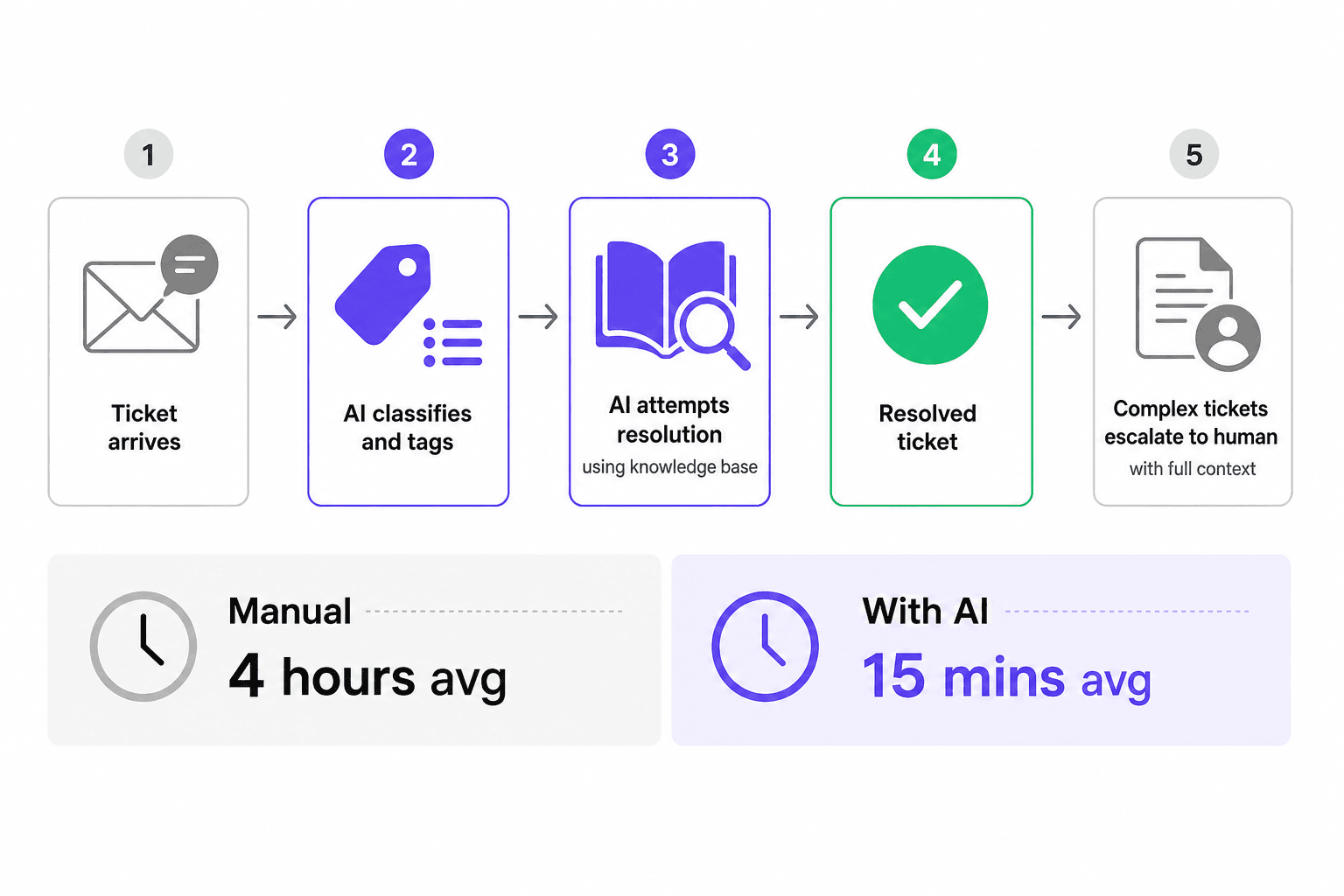
What does your team look like in 12 months?
Automation ROI compounds with ticket volume. ServiceNow's 13-month payback is fine if you're a 500-person IT department handling 10,000 tickets monthly. It's a bad deal if you're a 20-person team handling 800 tickets. Freshservice's sub-3-month payback reflects a different deployment model with a different cost structure.
The ITSM.tools 2026 community poll is a useful corrective here: GenAI as a priority topic dropped from #2 to #21 in one year. Practitioners want governance and proven value now, not platform promises. The best IT automation tool is the one your team will actually configure, maintain, and act on.
For a deeper look at selection criteria, our ITSM automation tools guide covers the evaluation framework in more detail. And if you're specifically evaluating Freshservice, the best Freshservice alternatives post compares the mid-market shortlist.
Choosing by team size
The maturity of your IT team and the scale of your ticket volume should drive the shortlist more than any feature comparison matrix.
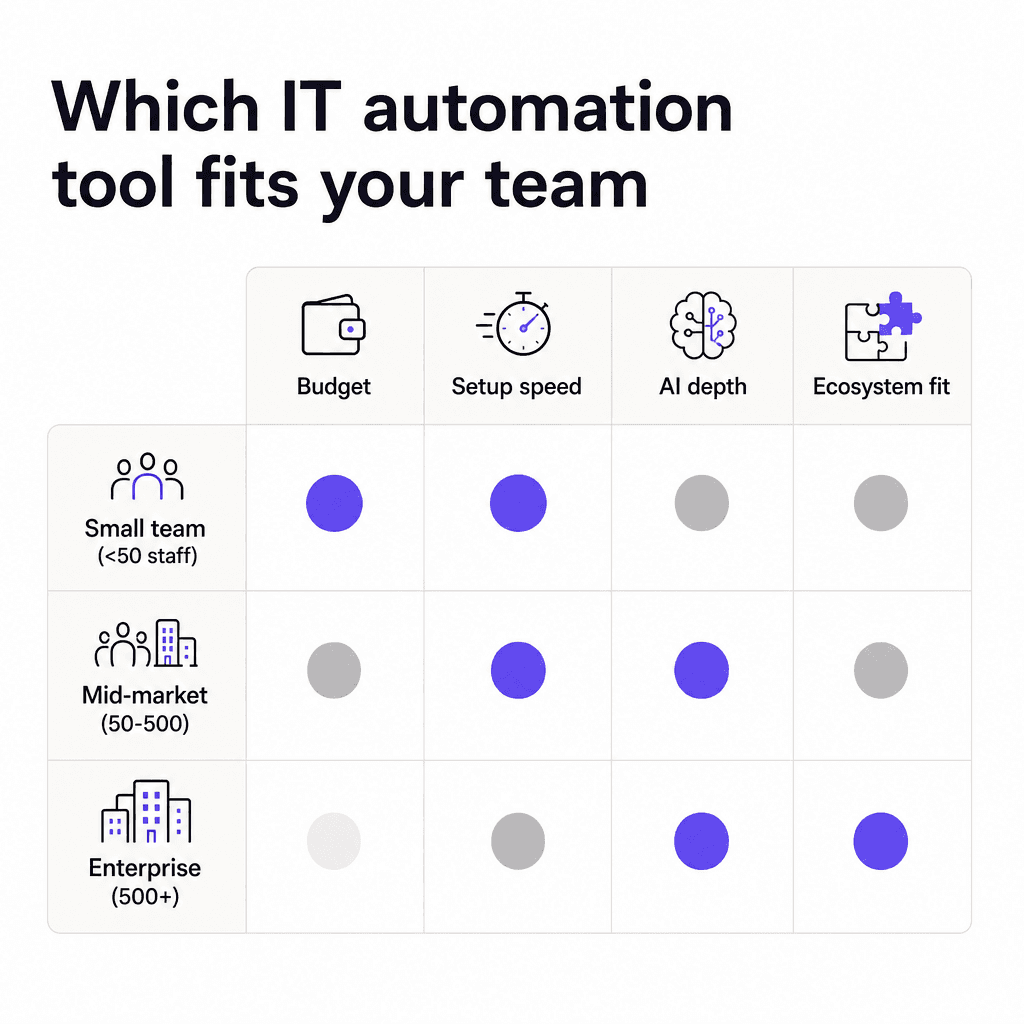
Small teams (under 50 employees): ManageEngine's free plan (up to 5 technicians) and Jira Service Management's free tier (up to 3 agents) are both genuinely usable starting points. eesel AI at $0.40/ticket is often the most economical option for teams with moderate ticket volume who just need AI triage and response drafting on top of an existing helpdesk.
Mid-market (50-500 employees): Freshservice's Growth and Pro tiers deliver the strongest time-to-value ratio in this bracket. SolarWinds is a strong alternative if ITAM is a priority and you want a simpler interface. If you're already using Jira and Confluence, JSM Premium is the natural fit.
Enterprise (500+ employees): ServiceNow is the ceiling for automation depth and process coverage, but the cost and implementation timeline matter. Ivanti makes sense if you're managing unified endpoint management alongside ITSM. ManageEngine Enterprise at $67/tech/month is worth evaluating if budget is constrained but you need full ITIL coverage.
For a step-by-step walkthrough of building automation into your existing IT setup, see the IT ticket automation guide and our breakdown of ITSM best practices in 2026.
Try eesel AI
If your primary problem is ticket volume rather than missing service management infrastructure, eesel AI is the fastest path to measurable automation. It connects to your existing helpdesk in minutes, runs a simulation on your historical tickets to identify gaps before going live, and starts drafting or resolving responses from day one - without migrating to a new platform.
Teams like InDebted run eesel as the first responder inside Jira Service Management. Design.com processes 50,000 tickets per month on Freshdesk with eesel. The pricing model ($0.40/ticket, $50 free to start) means you pay for what gets resolved, not for seats. Try it on your existing helpdesk and see the resolution rate inside a week.

Frequently Asked Questions
Share this article

Article by
Stevia Putri
Stevia Putri is a marketing generalist at eesel AI, where she helps turn powerful AI tools into stories that resonate. She’s driven by curiosity, clarity, and the human side of technology.