AI for IT compliance: automate audit prep, access reviews, and policy enforcement in 2026

Stevia Putri

Katelin Teen
Last edited May 20, 2026
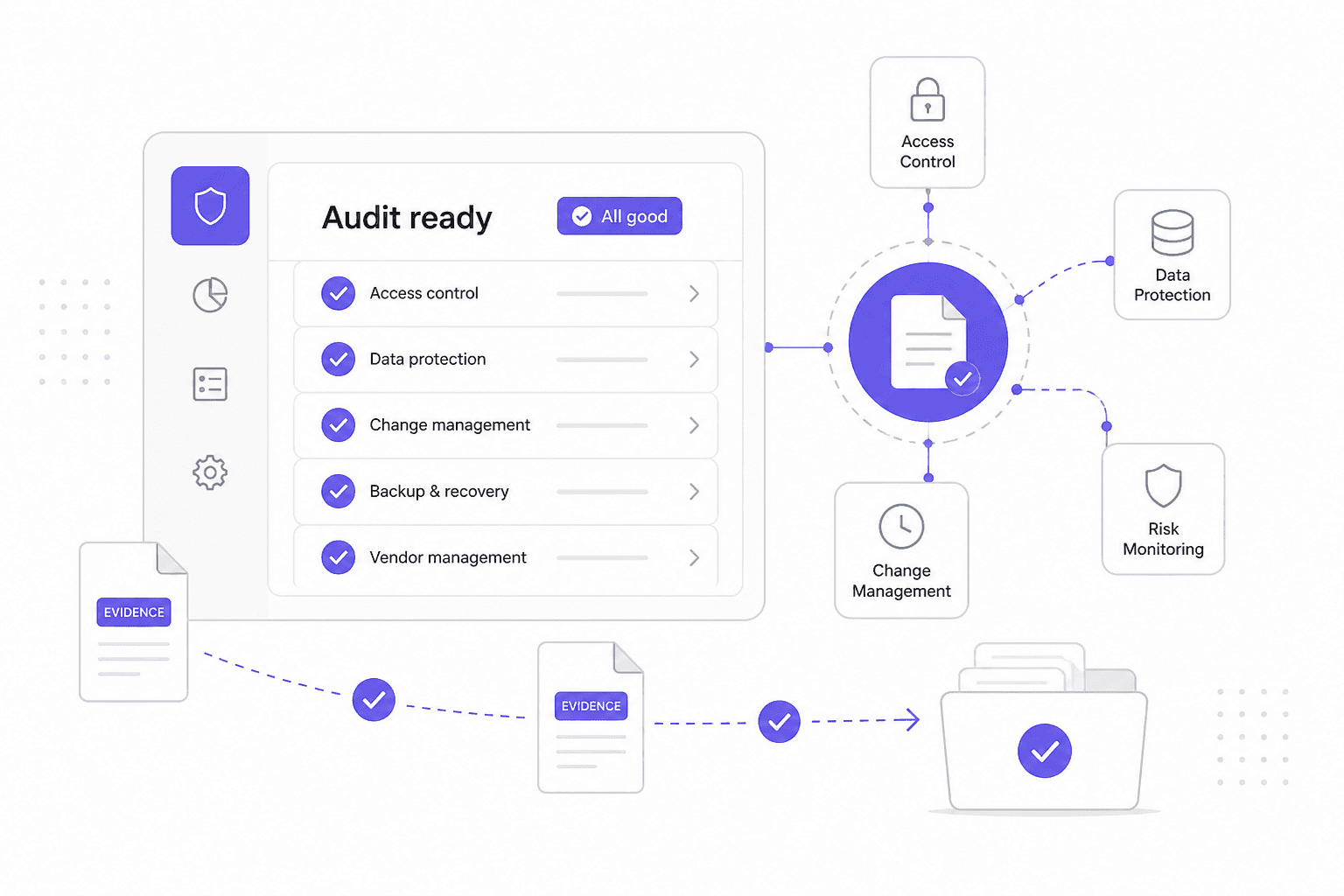
Most IT compliance programs run the same pattern every year. Months of normal operations, then a sprint of panic as audit season approaches. Evidence gets pulled from a dozen systems. Access reviews get rushed. The team spends three weeks chasing down logs instead of doing actual security work.
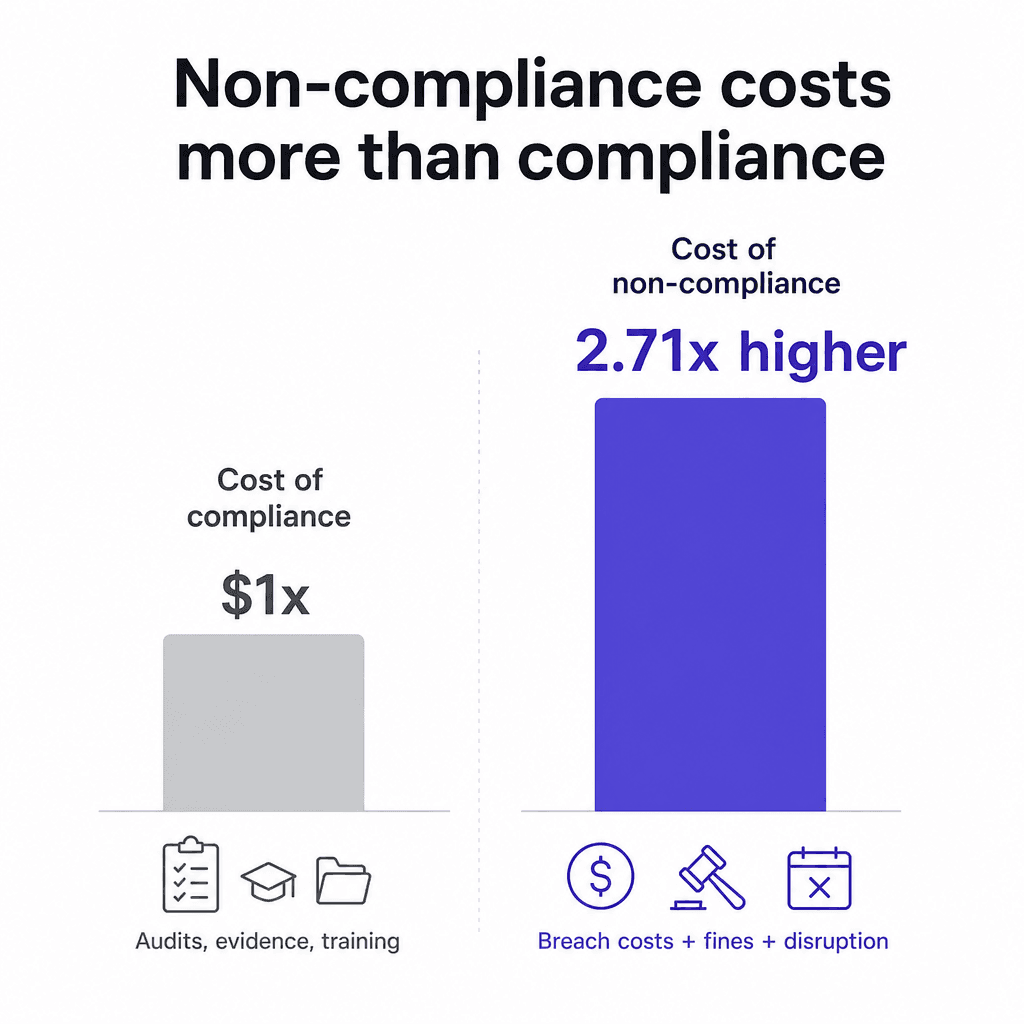
According to IBM breach cost data, non-compliance costs organizations 2.71 times more than maintaining compliance. The global average breach cost is $4.44 million - and in the US it reaches $10.22 million. Those numbers are driven partly by regulatory fines, but mostly by the operational disruption, slower detection, and inadequate response that non-compliant organizations experience.
AI won't make compliance regulations disappear. But it can absorb the manual work that makes compliance so exhausting - the evidence collection, the access reviews, the policy question triage, the audit prep scramble - and run those workflows continuously in the background.
What IT compliance actually requires
IT compliance is not a once-a-year project. It's an ongoing operational responsibility. For IT teams, it looks like:
Evidence collection and documentation. Auditors require proof that controls are working continuously, not just at audit time. That means gathering logs, access records, change documentation, and security configuration snapshots across cloud platforms, identity systems, and applications - then organizing them in a format auditors can verify. Without automation, a single SOC 2 Type II audit can consume three or more weeks of IT staff time just collecting evidence.
Access management and reviews. Quarterly access reviews mean auditing who has what permissions across cloud environments (AWS, Azure, GCP), identity systems (Okta, Entra ID), and applications - then documenting that inactive accounts are disabled and only necessary access exists. At 500+ employees, that's thousands of user-to-resource mappings to review manually.
Change control and configuration management. Every infrastructure change needs documentation, approval, and evidence that it followed approved processes. Configuration drift - a firewall rule left open after troubleshooting, MFA temporarily disabled - is a compliance violation waiting to happen.
Patch and vulnerability management. Frameworks like NIST CSF and CIS Controls require critical vulnerabilities to be patched within defined windows, typically 15-30 days. Proving timely patching across thousands of servers and cloud instances is its own documentation challenge.
Incident response. GDPR requires breach notification within 72 hours. HIPAA gives 60 days for some notifications. Hitting those deadlines requires fast detection and documented response procedures - the kind that come from running a well-maintained compliance program year-round, not a reactive one. Organizations that used AI and automation for security extensively detected and contained breaches 80 days faster than those that didn't.
Policy enforcement. IT teams must configure systems to enforce security policies continuously: MFA requirements, encryption in transit and at rest, blocking unauthorized software, monitoring for deviations. The challenge is that configuration drift is normal - and most teams only discover it during audit prep.
The frameworks IT teams are managing
Most IT teams aren't managing one compliance framework - they're managing several simultaneously. Here's what each actually demands at the operational level:
| Framework | Applies to | Core IT requirements | Audit cadence |
|---|---|---|---|
| SOC 2 | SaaS, cloud services | Access controls, change management, incident response | Annual (Type II: 6-12 month audit window) |
| ISO 27001 | Any industry | 93 Annex A controls, formal ISMS | 3-year cert + annual surveillance audits |
| HIPAA | Healthcare orgs, business associates | PHI protection, technical/admin/physical safeguards | Ongoing; breach notification within 60 days |
| GDPR | Any org processing EU resident data | Data subject rights, breach notification under 72 hours, DPIAs | Ongoing; fines up to 4% of global revenue |
| PCI DSS | Any org handling card payments | Card data encryption, network segmentation, access logging | Annual (Level 1 requires QSA audit) |
| NIST CSF | Federal contractors, critical infrastructure | Identify, Protect, Detect, Respond, Recover | Continuous |
SOC 2 and ISO 27001 have roughly 80% overlapping requirements, but most organizations still run them as separate programs - duplicating evidence collection, documentation, and review work that AI can consolidate across both frameworks simultaneously.
Why compliance stays manual without AI
The core problem is that compliance requires proof, not just behavior. Behaving securely is not enough - you have to demonstrate it continuously, with documentation that auditors can verify. That proof-generation work is what consumes teams.
Sysadmins describe it directly:
"We are basically a... Good lord that sounds manual and time consuming." -- r/sysadmin, "Are SysAdmins in charge of compliance reporting?"
A separate thread titled "Anyone actually satisfied with their automated compliance..." generated 10+ comments, the title itself implying dissatisfaction is the default. Tools often solve the evidence vault problem while leaving the workflow problem untouched - teams still have employees flooding the IT queue with access requests, policy questions, and audit prep tasks.
That compliance penalty for doing things manually is steep. Non-compliance costs 2.71 times more than maintaining compliance. But the cost of compliance itself can be controlled with AI.
According to KPMG, 56% of compliance experts were using AI in 2024, up from 41% the year before. Gartner projects that 65% of compliance tasks will be automated by 2028, reducing audit preparation time by 70%. Teams using Vanta's compliance platform save 82% less time per framework and attestation, with 129% increased team productivity per IDC research.
Five compliance workflows AI handles today
The strongest results come from applying AI to compliance workflows with high volume, clear rules, and a documented audit trail requirement. These five have the most consistent ROI.
Access request and review automation
Access and identity requests account for 35-40% of IT ticket volume, and every one needs compliance documentation: who requested, who approved, when, and why.
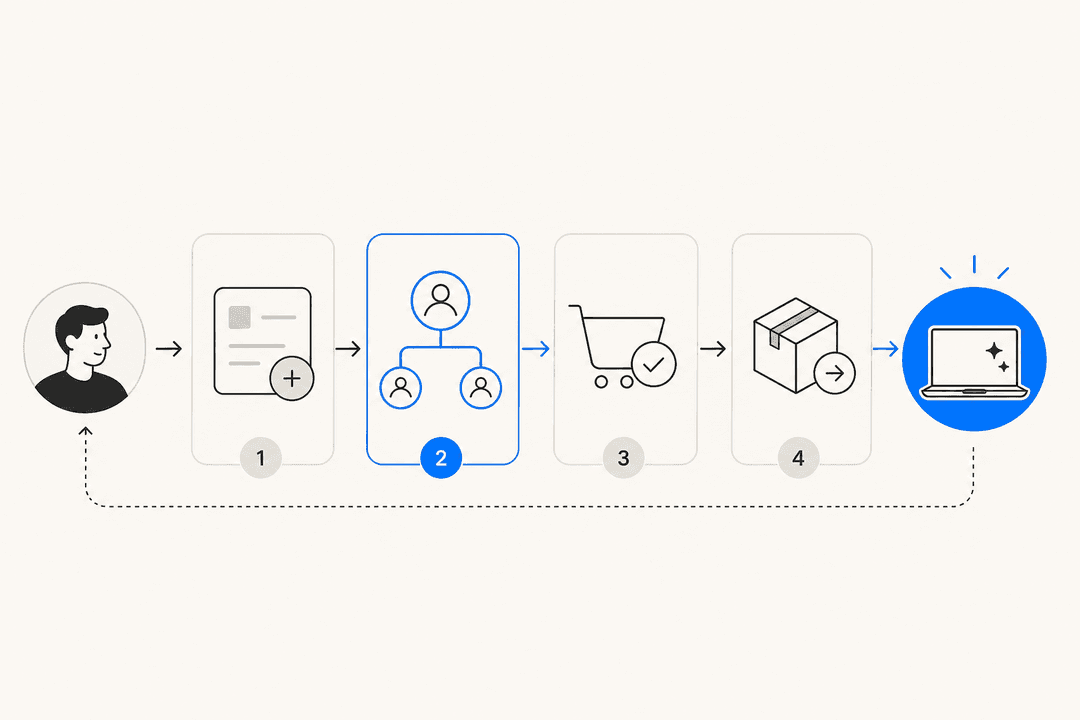
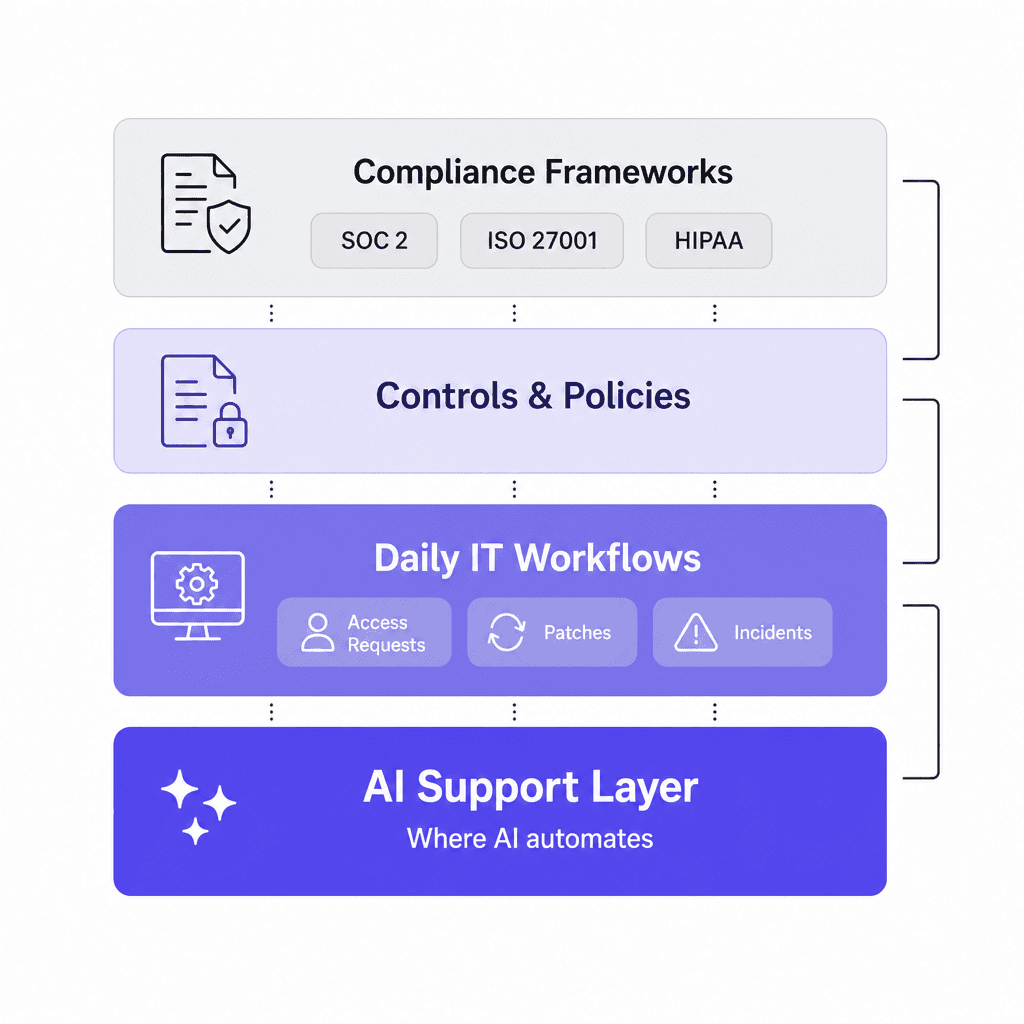
AI handles triage first - classifying requests by system sensitivity (HIPAA-covered, SOC 2 scope, PCI DSS environment) - then routes to the appropriate approver. The approval, the audit log, and the documentation happen automatically. When departing employees need access revoked, AI catches lifecycle events from HR systems and queues deprovisioning without manual intervention.
The quarterly access review challenge shifts from a manual sprint to a continuous process: AI flags anomalies and teams review exceptions rather than auditing every assignment from scratch.
Continuous audit trail logging
Traditional compliance programs collect evidence before audits. AI-driven programs collect it continuously. Vanta runs 1,400+ automated tests hourly across 400+ integrations, checking cloud configurations, identity systems, and application settings against compliance requirements.
When an auditor asks for 12 months of evidence that MFA was enforced on all production system access, an AI-backed compliance program retrieves it in minutes. Without continuous collection, that same request means days of manual log pulling from AWS CloudTrail, Azure Activity Log, Okta, and GitHub - then cross-referencing them by hand.
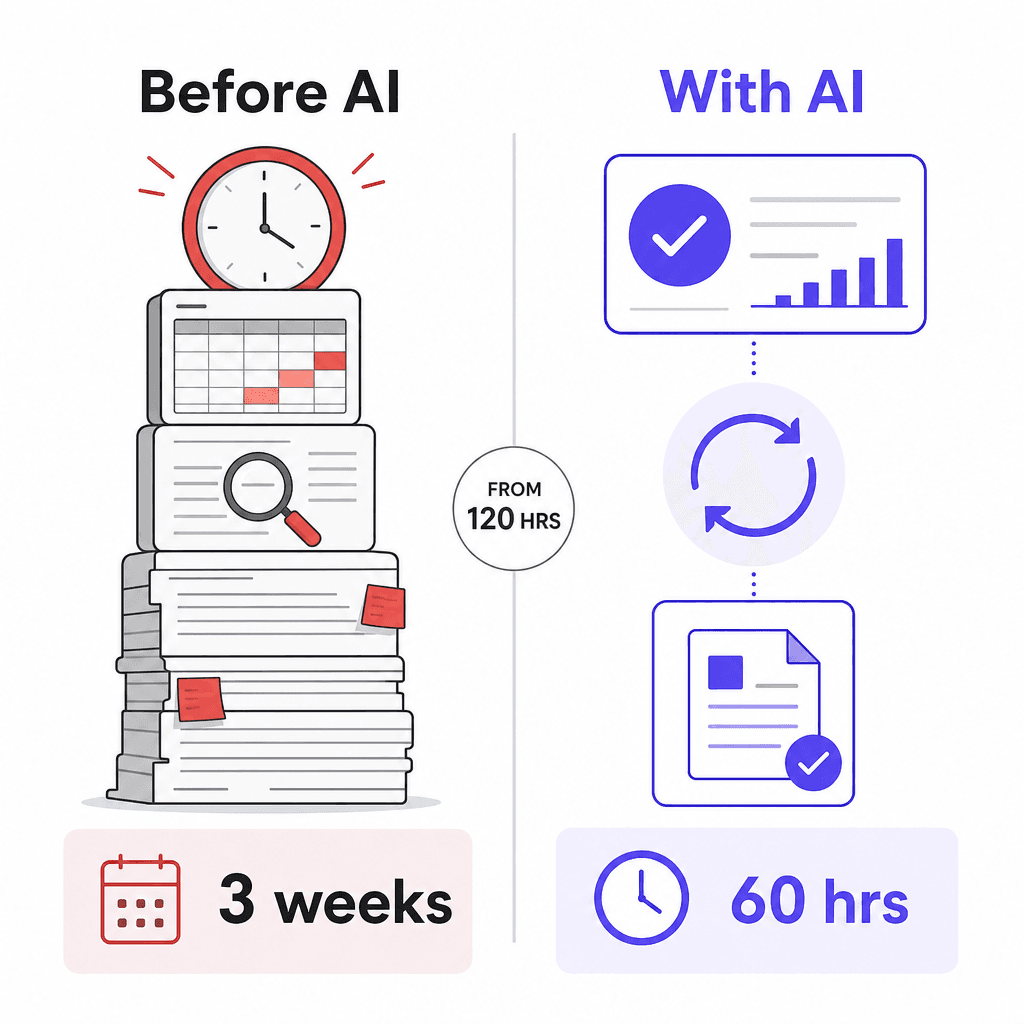
Research from Gruve found that AI-powered audit systems cut audit duration from 120 hours to 60 hours - a 50% reduction - while improving accuracy from 88% to 96%.
Configuration drift detection
Compliance drift is almost always unintentional. An engineer troubleshoots a database issue by temporarily disabling encryption, then forgets to re-enable it. A firewall rule gets opened to diagnose a connectivity problem and never gets closed. AI detects these changes immediately rather than three months later during audit prep.
Some platforms auto-remediate: if an S3 bucket gets set to public, the AI reverts it. Others alert and assign to a ticket. Either way, the violation is caught in hours rather than quarters.
Policy question handling at the helpdesk
Employees ask compliance questions constantly: "Is this tool approved for HIPAA?" "How long should I retain these logs?" "Do I need to encrypt data before sending to our vendor?" Without AI, these land in the IT queue and wait for a human response.
With AI trained on your actual policy documentation - from Confluence, SharePoint, Notion, or Google Drive - they get answered in seconds with the exact policy section cited. Edge cases and ambiguous interpretations escalate to compliance officers automatically. See how this plays out across AI for IT service management deployments.
Evidence collection at audit time
Even with continuous monitoring, audits require presenting evidence in a format auditors can verify. AI-backed compliance platforms maintain a living evidence library, mapping each control to its proof automatically: which CloudTrail log satisfies SOC 2 CC7.2, which access review record satisfies ISO 27001 A.9.2.1.
Before audit season starts, AI scans for gaps. "Q2 2026 security training records are missing for 12 employees." Teams fix the gaps before the audit rather than discovering them during it. One customer using Vanta reported a 50-hour per month reduction in manual compliance tasks.
The compliance helpdesk problem nobody talks about
Dedicated compliance automation platforms like Vanta, Drata, and Secureframe address the evidence vault problem well. What they don't address is the day-to-day employee requests that compliance teams field through their IT helpdesk: access requests that need approval and documentation, policy questions that need accurate answers fast, audit evidence requests from auditors, and security incident reports that need immediate triage.
These aren't captured in evidence vaults - they're tickets in Jira, Slack messages, and emails to the compliance alias. And they're a meaningful share of total IT ticket volume.
Gartner data shows 70% of Tier-1 IT tickets are automatable, and the access/identity category (35-40% of volume) directly intersects with compliance requirements. When AI handles initial triage, drafts responses, routes to approvers, and generates audit logs - all within the existing ticketing system - it closes the gap between the compliance platform and the daily workflow.
A community member on r/Information_Security asked the question directly:
"Is there a way to automate SOC2 evidence collection...?" -- r/Information_Security
The answer is yes - but the bigger win comes from automating the underlying requests before they even reach the evidence stage.
How to implement AI for IT compliance
The setup that produces results fastest follows the same pattern regardless of team size:
1. Connect to existing ITSM infrastructure. Don't rebuild your ticketing system. Connect AI to where compliance tickets already land - Jira Service Management, Zendesk, Freshdesk, or ServiceNow. The AI learns from your ticket history without migration.
2. Load your policy documentation. Connect Confluence spaces, SharePoint libraries, Google Drive folders, or Notion databases where compliance policies live. The AI references these when answering employee questions and drafting responses to compliance requests.
3. Train on historical tickets. Six to twelve months of resolved compliance tickets teaches the AI your specific environment: which requests are routine, which need escalation, and which approvers handle what system. Teams that maintain a weekly correction review cadence reach 85-95% triage accuracy within 60-90 days.
4. Start in draft-first mode. Every response goes through human review before sending. For compliance work, where accuracy matters and documentation is permanent, this is non-negotiable. As the AI proves itself on lower-risk requests, scope expands to autonomous handling.
5. Complement your compliance platform. Tools like Vanta or Drata handle evidence collection; an AI helpdesk layer handles the workflow of daily compliance requests. They address different problems and work together rather than competing.
What AI should not own
The hybrid model isn't just a best practice - it's a regulatory necessity. AI handles routine work; humans own everything requiring judgment or accountability.
AI should handle: evidence sorting and collection, access request triage and routing, policy document lookup and response drafting, anomaly flagging, configuration drift detection, and draft audit documentation.
Humans must own: defining audit scope, accepting risk exceptions, approving control exceptions, all representations to auditors and regulators, final compliance claims, incident response decisions, and interpreting new regulatory requirements.
This boundary is explicit in Thomson Reuters' guidance on AI for compliance and echoed in KPMG's compliance AI research. The goal is an AI-augmented compliance team.
There's also a newer risk to account for: shadow AI. Cyberhaven found that data uploads to external AI tools increased 485% globally between March 2023 and March 2024. Employees pasting compliance documentation, PHI, or cardholder data into public AI tools creates the exact violations you're trying to prevent. An internal AI system - trained on your own data and operating within your data governance policies - is part of the compliance answer, not separate from it.
As JumpCloud SVP Joel Rennich put it: "Organizations with strong governance in place are actually three times more likely to scale without limits, while those that fail to consolidate find that their most powerful tools become their greatest liabilities."
Try eesel
eesel is an AI helpdesk agent that sits inside your existing IT infrastructure - Zendesk, Freshdesk, Jira Service Management, Slack, or Microsoft Teams - and handles compliance ticket workflows without requiring platform migration. It reads your compliance policies from Confluence, SharePoint, or Google Drive, then automatically triages access requests, answers policy questions, routes compliance-sensitive tickets to the right specialists, and generates audit trail documentation within each resolved ticket.
For compliance-grade deployments, eesel's Enterprise plan at $1,000/month includes HIPAA support, Business Associate Agreements, EU data residency, and signed Data Processing Agreements. Your compliance ticket data is never used to train external models - each organization's data stays isolated. Standard plans are $0.40 per resolved ticket: a compliance team handling 500 access requests and policy questions monthly pays $200/month while deflecting 50-70% of Tier-1 volume.

Frequently Asked Questions
Share this article

Article by
Stevia Putri
Stevia Putri is a marketing generalist at eesel AI, where she helps turn powerful AI tools into stories that resonate. She’s driven by curiosity, clarity, and the human side of technology.