HyperWrite vs Semrush: AI writer or SEO toolkit?

Kenneth Pangan

Katelin Teen
Last edited January 19, 2026
Expert Verified

Trying to create content that people enjoy reading and that Google decides to rank can feel like a tightrope walk. You need solid writing skills, but you also need to understand what people are actually looking for. This is where AI content tools can help.
You've likely come across HyperWrite, an AI assistant designed to speed up your writing, and Semrush, the go-to toolkit for all things digital marketing. Both use AI to help with content, but they are fundamentally different. One is a writing assistant, while the other is a data-driven marketing platform.
This article compares HyperWrite and Semrush, looking at what each tool does, who should use it, and what it costs. We will also explore an alternative for those who need to turn a keyword into a blog post. Tools like the eesel AI blog writer are built to solve this specific problem, focusing on one task.
What is HyperWrite?
Think of HyperWrite as an AI co-writer that plugs right into your browser. Its primary goal is to help you get words on the page more quickly, whether you're dealing with a blank screen or trying to refine a first draft. It's not designed to tell you what to write for SEO; it's about helping you write anything more efficiently.
This makes it a popular choice for copywriters, marketers, students, and anyone who writes for a living. If you find yourself drafting the same email repeatedly or just need a creative push to start a blog post, HyperWrite is built to be that assistant.
Here's a quick rundown of what it offers:
- Core Writing Tools: It’s built around an AI Writer for generating new text, AutoWrite for fleshing out your ideas into full paragraphs, and TypeAhead, which suggests context-aware sentence completions as you type. It can feel a little like magic when it correctly finishes your thoughts.
- Productivity Features: It's loaded with tools for everyday tasks. An Email Responder works within Gmail, a Summarizer can condense long reads, and a Rewriter helps you rephrase sentences without losing the original meaning.
- Research Capabilities: This feature is pretty handy. Its Scholar AI tool can sift through peer-reviewed academic articles and extract key information, complete with citations. It's a big help for students or anyone working on research-heavy content.
- Customization: You can set up Custom Personas (up to 10 on the Ultra plan) to teach the AI to write in a specific style, which is useful for keeping a consistent brand voice.

It's obvious that users feel it helps their creative flow. As one copywriter, Lauren, mentioned: "With HyperWrite fueling my writer's brain... I've unlocked a whole new level of creative potential I never knew existed within myself."
What is Semrush?
Now for something completely different. Semrush is an all-in-one digital marketing platform. To call it just a writing tool would be like calling a spaceship a car. Sure, it moves, but you're missing the bigger picture. Semrush is made for SEO specialists, marketing agencies, and large teams who need deep, data-driven insights to win at search rankings.
Its AI capabilities are just one piece of a much larger system for managing your entire online footprint. The core idea is to use data on keywords, competitors, and market trends to shape every piece of content you produce.
For content creation, you'll primarily use their Content Toolkit:
- AI Article Generator: This tool can generate a full, SEO-focused article using keyword and topic data pulled straight from Semrush's extensive database.
- AI Search Optimizer: Once you have a draft, this tool analyzes it and provides concrete tips to improve its ranking potential on Google and even in AI answer engines like ChatGPT.
- Topic Finder & SEO Brief Generator: This is the strategic component. It helps you discover content ideas with high traffic potential and then builds a structured outline, or "brief," for your writers, filled with all the necessary keywords and topics.
- Broad Platform: It’s important to remember this is just one section of Semrush. The platform also includes toolkits for SEO, Advertising, Social Media, and AI Visibility, making it a central hub for marketers.
Users appreciate how it weaves data directly into the writing workflow. Chiara Brancato, Founder at the Museum Creative, noted, "The Semrush Content Toolkit creates a long-form piece right away! It’s trustworthy and simple to use for content marketing, which makes it much better than ChatGPT.”
A head-to-head comparison of HyperWrite vs Semrush
These tools serve different primary functions and are not direct competitors. While both use AI for content, HyperWrite focuses on the craft of writing, while Semrush centers on marketing strategy. Let's dig into the key differences.
Core functionality
HyperWrite is a specialist. It’s focused entirely on the act of writing. All of its features are there to help you create, rewrite, summarize, or polish text. It’s a tool for content production. It helps you construct sentences and paragraphs faster.
Semrush is a generalist. It's a massive platform for marketing strategy. Its AI writing tools exist to support the main objective of ranking higher in search results. The writer is just one instrument in a huge orchestra of keyword analyzers, backlink trackers, and competitor research dashboards. It provides the strategic blueprint for the content.
This specialization means each tool excels in different areas. HyperWrite is a powerful writing tool but does not include SEO data to inform topic selection. Semrush's writing tools are backed by extensive data, but its comprehensive platform may include more features than a user focused solely on blog writing would need.
Target audience
The ideal user for each tool couldn't be more different. HyperWrite is designed for individuals looking to increase their daily writing output. Semrush is built for teams that operate on digital marketing data.
| HyperWrite is for... | Semrush is for... |
|---|---|
| Individual Writers & Students | SEO Professionals & Agencies |
| Quick daily writing tasks (emails, reports) | In-depth strategic planning |
| Overcoming writer's block | Competitor and market analysis |
| Academic research with citations | Managing full SEO & PPC campaigns |
| General content production | Data-driven content strategy |
Approach to SEO
This is where the two diverge completely.
With HyperWrite, you're on your own for SEO strategy. You have to do your keyword research elsewhere, decide on topics, and then use HyperWrite to write the actual content. It’s a capable writing tool, but it operates in an SEO bubble.
With Semrush, the whole content workflow is powered by SEO data from the very beginning. Its AI Search Optimizer provides real-time feedback on your writing based on what's already performing well for your target keyword. It suggests keywords to add, an ideal word count, and the right tone of voice, all based on a thorough analysis of the top-ranking content.
Pricing comparison for HyperWrite vs Semrush
The pricing models for these tools tell you exactly who they're for. HyperWrite is priced for individuals and small teams, while Semrush is a serious investment for businesses building out their marketing technology stack.
HyperWrite pricing
HyperWrite offers a few simple tiers:
- Free Plan: Gives you a limited taste of the basic AI features.
- Premium Plan: $19.99/month (or $16/month billed annually). This provides 250 AI messages per month, 3 custom personas, and access to the citation feature.
- Ultra Plan: $44.99/month (or $29/month billed annually). This gives you unlimited AI messages, 10 custom personas, and early access to new features.
Semrush pricing
Semrush has a modular pricing structure that reflects its all-in-one nature.
- Semrush One (SEO + AI Visibility): Plans for their primary marketing suite begin at $165.17/month when billed annually.
- Content Toolkit (Add-on): The tools most comparable to HyperWrite are in this toolkit, which costs an extra $60/month.
The takeaway is straightforward: HyperWrite is an affordable tool for writers. Semrush's content features are an add-on to a much larger, more expensive platform intended for businesses making a major investment in their marketing.
An alternative to consider beyond HyperWrite vs Semrush
What if you need a tool that bridges the gap between focused writing assistance and a full marketing suite? HyperWrite helps with the writing process, while Semrush provides a comprehensive, data-rich environment for marketing strategy. For users whose primary goal is to generate SEO-optimized articles, a specialized tool can be a good fit.
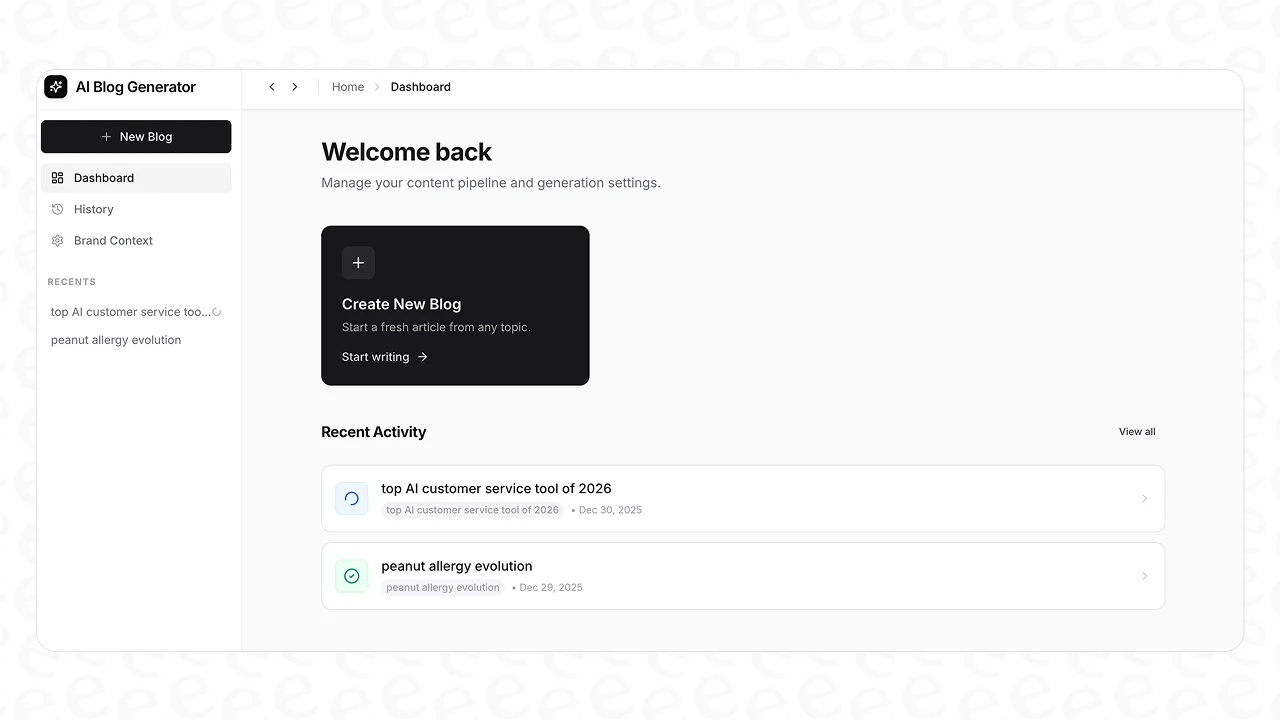
The eesel AI blog writer is a solution designed for one clear purpose: turning a keyword into a complete blog post.
It’s the same tool we use here at eesel AI, and it’s how we grew our site from 700 to 750,000 impressions a day in just three months. It's not a generic writer or a massive marketing suite; it's a blog-generating engine.
Here’s how it stands apart:
- SEO-Native Workflow: You don't begin with a blank page; you begin with a target keyword. The entire process is built around search intent from the start. Unlike Semrush, its only job is to generate a publish-ready blog post, not to help you manage a dozen other marketing campaigns.
- Automatic Assets & Social Proof: This is a huge time-saver. It doesn't just produce text. It automatically generates and adds images, infographics, and comparison tables directly into the article. It even searches the web to embed relevant YouTube videos and pull real quotes from Reddit forums, adding a layer of human credibility that most AI-generated content is missing.
- AEO (AI Engine Optimization): Your content needs to be optimized for AI answer engines like Google AI Overviews. The eesel AI blog writer is designed with this in mind, structuring content so it's easily understood and featured by these new systems.
- Simple, Transparent Pricing: It offers a straightforward pay-as-you-go model: $99 for 50 complete blog generations. This allows users to scale content production without a monthly subscription.
HyperWrite vs Semrush: Which tool should you choose?
Ultimately, the right tool comes down to the job you need to get done. Here’s a simple breakdown:
- Choose HyperWrite if: You're a writer, student, or marketer who needs a flexible AI assistant for various daily writing tasks. If you just need help with emails, reports, or social media posts and handle your SEO strategy separately, it's a great, budget-friendly option.
- Choose Semrush if: You're a marketing professional, an agency, or part of a team that needs a single, powerful platform for in-depth SEO analysis, competitor research, and campaign management. If content is just one part of your larger marketing strategy, Semrush is the industry standard.
- Try the eesel AI blog writer if: Your primary goal is to grow your blog and increase organic traffic. If you want to go from a keyword to a complete, high-quality, SEO-optimized article quickly and affordably, without the steep learning curve of a full marketing suite, this is the tool for you.
The best way to see the difference is to try it yourself. You can generate your first blog post for free with the eesel AI blog writer today and see the publish-ready quality firsthand.
Frequently Asked Questions

Share this post
Article by
Kenneth Pangan
Writer and marketer for over ten years, Kenneth Pangan splits his time between history, politics, and art with plenty of interruptions from his dogs demanding attention.