HyperWrite vs MarketMuse: A detailed comparison for content teams

Stevia Putri

Katelin Teen
Last edited January 19, 2026
Content teams today are looking at a market of AI tools that's split into two camps. You have AI writing assistants that help you draft content faster, and then you have content intelligence platforms for strategic planning. This split means teams often have to choose between speed and strategy.
HyperWrite is a well-known AI writing assistant built to speed up content creation, while MarketMuse is a content intelligence platform that helps you build a solid SEO strategy. This post will compare HyperWrite vs MarketMuse, looking at their functions, features, workflows, and pricing to help you decide which is right for you.
While these tools are strong in their own areas, some platforms are now merging SEO strategy with automated writing. The eesel AI blog writer, for instance, is built to turn a single keyword into a complete, publish-ready article, connecting the dots between planning and writing.
What is HyperWrite?
HyperWrite is a versatile AI writing assistant that acts as a "Personal Assistant" for many digital writing tasks. It's designed to improve productivity by helping with everything from generating paragraphs and drafting emails to refining existing text.
Its main features include:
- Flexible AutoWrite: Generates paragraphs or entire articles on almost any subject you provide.
- TypeAhead: Offers context-aware sentence completions and suggestions as you type, which can help you get past writer's block and draft faster.
- Email Responder: Drafts quick and effective replies, often working directly inside email clients like Gmail.
- HyperChat: A conversational AI you can use for brainstorming ideas, conducting research, and solving problems.
- Hundreds of AI Tools: Gives you access to a large library of specialized tools like an AI Summarizer and AI Text Editor to polish your content.
- Academic Research: Uses real-time search to find scholarly articles and provide accurate, citation-backed results.
HyperWrite is best for professionals, students, and marketers who need to be more efficient with daily writing tasks like social media posts, reports, and emails. It usually works as a browser extension, making its tools available across different websites and platforms.
What is MarketMuse?
MarketMuse is an AI-powered content intelligence and strategy platform. Its primary goal isn't to generate text, but to help teams build topical authority and create content that is designed to rank in search engines. It answers the question of what content you should write to rank higher, particularly in areas where your competitors are weak.
Its core features are built around strategic planning:
- Topic Authority Analysis: Looks at your website's entire content library to find areas of expertise, content gaps, and opportunities for quick wins.
- Competitive Gap Analysis: Uses heatmaps to find content opportunities and topics that your competitors have missed, giving you a strategic advantage.
- Personalized Difficulty: A patented metric that calculates how hard it will be for your site to rank for a topic, offering a more accurate assessment than generic keyword difficulty scores.
- Content Planning & Briefs: Generates data-driven outlines and detailed briefs that guide writers on structure, subtopics, questions to answer, and important internal links.
- Content Optimization: Provides specific recommendations to improve existing content based on depth, comprehensiveness, and signals related to Experience, Expertise, Authoritativeness, and Trustworthiness (E-E-A-T).
The main thing you get from MarketMuse is a strategic roadmap or a detailed brief for a writer, not a finished article. While it does have a generative AI component in its Optimize application, its main value is in the data and strategy it provides upfront.
An alternative to consider: eesel AI blog writer
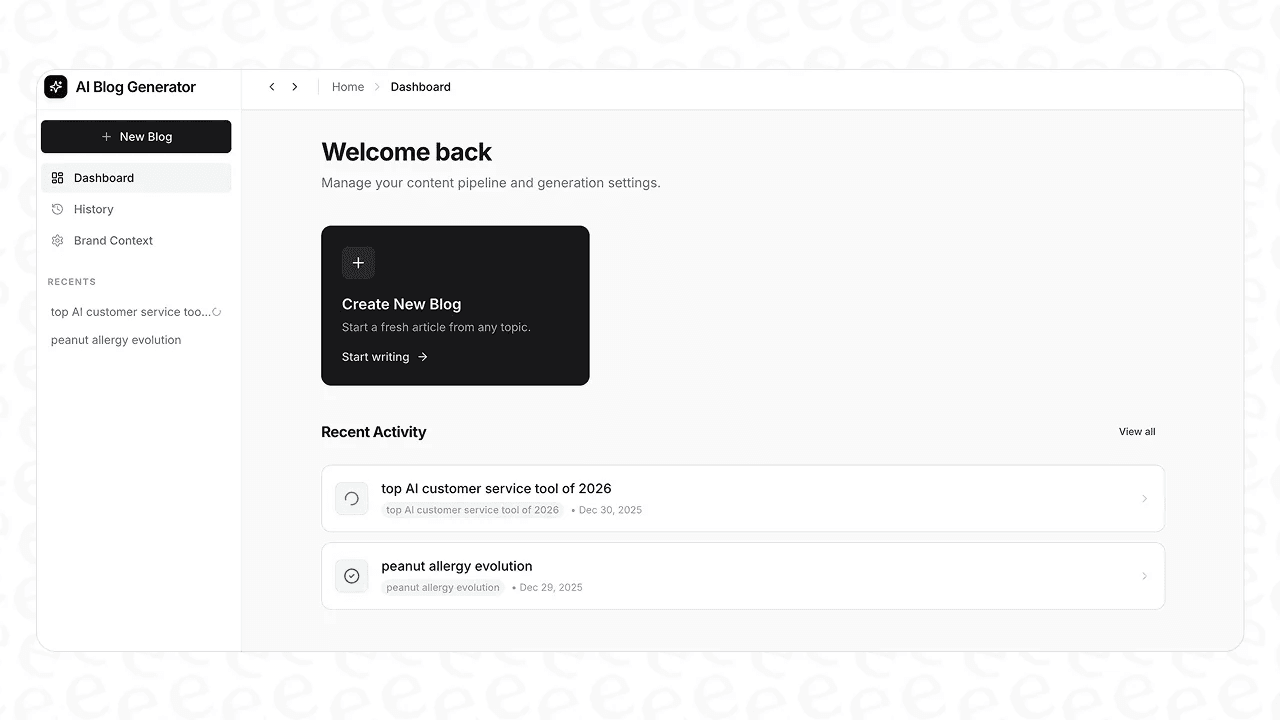
This approach connects planning and execution, offering a more streamlined solution for content teams.
Here are its key differentiators:
- Produces a Complete Article, Not a Draft: The output isn't just a block of text. It's a fully structured post with an introduction, H2s, H3s, a conclusion, and an FAQ section, all ready to be published.
- Includes Automatic Assets: The AI generates and embeds relevant images, tables, and infographics directly into the article. It also finds and integrates relevant YouTube videos and real quotes from Reddit forums to add authority and social proof.
- Uses Context-Aware Research: The AI understands the intent behind a keyword. For comparison posts, it pulls pricing data. For product reviews, it finds technical specifications. This ensures the content is well-researched and not just surface-level.
- Optimized for SEO and AEO: Content is structured not only for traditional search engines but also for newer Answer Engines like Google's AI Overviews and Perplexity.
Using this tool internally, the eesel AI team grew its organic traffic from 700 to 750,000 daily impressions in just three months after publishing over 1,000 optimized blog posts. It’s made for teams that want to scale content production without losing quality or SEO performance.
Key differences: HyperWrite vs MarketMuse
Core function
The biggest difference is their fundamental purpose.
- HyperWrite: Focuses on the act of writing. Its goal is to make a human writer more efficient at immediate tasks like drafting paragraphs, rephrasing sentences, summarizing text, and completing thoughts. It speeds up the "how" of writing.
- MarketMuse: Focuses on the strategy behind the writing. It answers questions like, "What should we write about next to build our authority?" and "How do we create an article that's comprehensive enough to rank?" It defines the "what" and "why."
SEO capabilities
Their approaches to SEO are completely different.
- HyperWrite: Lacks deep, native SEO functionality. You can use it to write about a keyword, but it doesn't provide the strategic data that SEO professionals need, such as keyword difficulty, competitor analysis, topic depth recommendations, or internal linking opportunities. SEO is still a manual task for the user.
- MarketMuse: Is an SEO tool at its core. Every feature is built to improve search performance. Its patented Personalized Difficulty metric and its topic modeling for content briefs are all designed to help you establish topical authority and outrank competitors.
Workflow and output
The user experience and the final product from each platform are distinct.
- HyperWrite: The workflow is based on prompts. A user gives an instruction ("write a paragraph about X"), and the output is a piece of text. This text then needs manual research, structuring, SEO optimization, and media before it can become a complete article.
- MarketMuse: The workflow is based on analysis. It starts by auditing your domain or a specific topic and ends with a strategic plan or a detailed Content Brief. The main output is a set of data-backed instructions for a writer, not the content itself.
Ideal user
Each tool is built for a different type of user with different goals.
- HyperWrite: Best for individuals who need AI help with a wide variety of daily writing tasks. This includes copywriters, social media managers, students, and professionals who often draft emails or reports.
- MarketMuse: Built for dedicated content and SEO professionals. This includes content strategists, SEO managers, and agencies that manage large-scale content programs that require long-term strategic planning and data.
Pricing comparison for HyperWrite vs MarketMuse
The pricing models for each tool reflect their different functions and target users. Here's a quick side-by-side look.
| Tool | Free Plan | Starting Price (Paid) | Pricing Model | Best For |
|---|---|---|---|---|
| HyperWrite | Limited free account | Premium: $19.99/month | Subscription (monthly/annual) | Individuals needing a versatile writing assistant. |
| MarketMuse | Yes, 1 user, 10 queries/month | Optimize: $99/month | Subscription (monthly/annual) | SEO teams needing a content strategy platform. |
| eesel AI blog writer | Yes, first blog is free | $99 for 50 blog posts | Credit-based (pay-as-you-go) | Teams wanting to scale publish-ready content. |
Which tool should you choose in the HyperWrite vs MarketMuse debate?
The choice between HyperWrite and MarketMuse really depends on the problem you're trying to solve. They aren't direct competitors; they're tools for different parts of the content process.
- Choose HyperWrite if your main need is to speed up day-to-day writing tasks. It’s a productivity tool for getting words on the page faster, whether for an email, a social media update, or an initial draft.
- Choose MarketMuse if your goal is to build a data-driven, long-term content strategy. It’s a key tool for teams focused on building topical authority and winning in competitive search markets.
Ultimately, the best tool depends on the job. One speeds up the manual act of writing, while the other designs the entire content strategy.
For teams that want to turn strategy directly into execution, the eesel AI blog writer offers a unified solution. It’s for those who already know what they need to write about and want to generate high-quality, fully-realized blog posts at scale without juggling separate tools for research, writing, optimization, and asset creation.
Stop juggling tools. Try the eesel AI blog writer for free and generate your first publish-ready article in minutes.

Frequently Asked Questions
Share this article

Article by
Stevia Putri
Stevia Putri is a marketing generalist at eesel AI, where she helps turn powerful AI tools into stories that resonate. She’s driven by curiosity, clarity, and the human side of technology.