How to optimize content for zero click searches: A complete guide

Stevia Putri
Last edited January 15, 2026
Here’s a stat that might make you wince: in 2026, 58.5% of American Google searches ended without a click to any website. It's a clear sign that the way people use search is changing in a big way.
For a long time, SEO was all about getting people to click on your link. Now, with AI Overviews and featured snippets, Google just gives people the answer directly on the results page. You could be ranking number one and still watch your traffic numbers drop.
60% of searches now result in ZERO clicks. While everyone's still obsessing over keyword rankings and backlink profiles, the entire game has changed. If you're only doing traditional SEO, you're optimizing for a system that's actively being dismantled. With AI Overviews hitting 1.5 billion users monthly and Gen Z basically treating ChatGPT as their default search engine, we need to wake up.

This calls for a different way of thinking. Clicks aren't the only goal anymore; visibility is. The new way to win is to become the go-to source that Google and AI engines use to build their answers.
In this guide, we'll break down what zero-click searches are, why they're so important now, and what you can actually do to adapt. We'll also touch on how tools like the eesel AI blog writer can help you create content that's ready for this new search landscape.
What are zero click searches?
A zero-click search is just any search that gets answered right on the results page, meaning the user doesn't need to click through to a website. They get what they need and move on.
You've probably done this dozens of times. You search for "weather in London," see the little forecast box, and you're done. That's a zero-click search in action.
They’re becoming more common for a couple of reasons:
- User Convenience: Google's mission has always been about speed and helpfulness. Showing the answer directly is the fastest way to check that box.
- AI Integration: AI Overviews are a huge part of this. They pull information from various websites and combine it into a single summary at the top of the page.
- The Google Ecosystem: People are just spending more time within Google's universe. In the US, almost two-thirds of all searches end with the user staying on a Google-owned property.
This all contributes to what some people call the "Great Decoupling," which is when your search impressions are steady or climbing, but your clicks are falling. It's a big indicator that your brand is getting seen on the results page, even if it's not leading to direct traffic.
The different types of zero-click search results
Let's look at the common SERP features that answer questions before a user ever has to click on a link.
AI Overviews
These are the latest addition. AI Overviews are AI-generated summaries that appear at the very top of the search results. They're meant to give you a quick summary of a topic and serve as a launchpad for more research. Google often pulls information from several websites to create one comprehensive answer.
Featured snippets
These are the classic answer boxes. Featured snippets show up above the normal organic results and pull content directly from a webpage to answer a question. You'll see them as a paragraph, a bulleted list, or a simple table.
People Also Ask (PAA) boxes
You've seen these for sure. They are the dropdown boxes with related questions. When you click one, it expands to show a brief answer and a link to the source. They're a fantastic way to understand what else users are curious about.
Knowledge panels
These info boxes typically appear on the right side of the page for searches about well-known things like people, companies, or places. They pull quick facts from sources like Wikipedia for an at-a-glance overview.
Local packs
When you search for something like "pizza near me," the local pack is the map and business listing that shows up. It provides all the key details like hours and phone numbers, often making a click to the website unnecessary.
How to optimize your content for zero-click searches
So, how do you actually change your content strategy to fit this new reality? It's not about fighting the change, but figuring out how to succeed within it. Here are a few practical strategies.
<quote text="Additional strategies that are working for us:
- Entity-First Content: Build your brand as a recognized entity with schema markup, consistent NAP data, and Wikipedia/Wikidata presence. AI systems prioritize authoritative entities.
- Citation Optimization: Structure content with clear attribution. Use statistics, original research, case studies. Make it EASY for AI to cite you with credible data points.
- Conversational Long-Tail: Optimize for how people actually ask AI questions. 'What's the best strategy for...' not 'best strategy SEO.'
- Strategic Social Signals: While traditional SEO backlinks still matter, social credibility is becoming equally important for AI trust.
- Multi-Platform Presence: Don't just optimize for Google. Get your content syndicated to Medium, LinkedIn Articles, Industry Publications. More places = more chances for AI to find and cite you." sourceIcon="https://www.iconpacks.net/icons/2/free-reddit-logo-icon-2436-thumb.png" sourceName="Reddit" sourceLink="https://www.reddit.com/r/DigitalMarketing/comments/1o13os9/comment/nidwlgk/">
Structure your content to be snippet-friendly
First off, you have to make it as easy as possible for search engines to find and feature your answers.
- Answer questions directly: If you use a question for a heading (like "What are zero-click searches?"), provide a clear, concise answer of about 40-60 words immediately after it. Think of it as spoon-feeding the answer to Google.
- Use smart formatting: Search engines appreciate organized information. Use bullet points, numbered lists, and tables where they make sense. This helps them break down your content and repurpose it for snippets and AI answers.
- Create dedicated FAQ sections: Adding an FAQ section to your blog posts or building a standalone FAQ page is a great way to target those "People Also Ask" boxes.
Implement schema markup
Schema markup, or structured data, is like a special language you can use to communicate with search engines. It's code you add to your site's HTML to give them more context about your content.
It helps search engines know if a block of text is a recipe, a review, an event, or an FAQ. This, in turn, helps you show up in "rich results," like those star ratings or event calendars you see on the results page. As Google notes, just be sure your structured data matches the text on the page to maintain accuracy.
Target conversational long-tail keywords
The way people search is getting more natural. We're shifting from short keywords ("SEO tips") to asking full questions ("what are the best SEO tips for a small business").
Your strategy should be to use these conversational questions as headings and subheadings in your content. This does two things: it lines up with what real people are searching for, and it mimics how AI models look for information to create their answers.
Build authority to become a citable source
At the end of the day, it all comes down to trust. You want your site to be the one that AI engines and Google consistently rely on.
- Embrace Answer Engine Optimization (AEO): This is the next step beyond traditional SEO. It's less about technical tricks and more about being the most helpful and authoritative source on a topic for AI answer engines.
- Key tactics:
- Focus on creating high-quality, people-first content with original research, unique data, and real insights.
- Mix up your content formats by including videos, infographics, and interactive tools. This makes your content more engaging and visible on different platforms.
- Build your brand by publishing consistently and participating in trusted industry communities.
Using AI to streamline zero-click optimization
Trying to manually apply all these strategies to every blog post is a huge task. It takes a lot of time and expertise, and it's tough to scale, especially for smaller teams.
This is where an AI content platform like the eesel AI blog writer can make a real difference. It’s built to create publish-ready content that is already set up for zero-click searches.
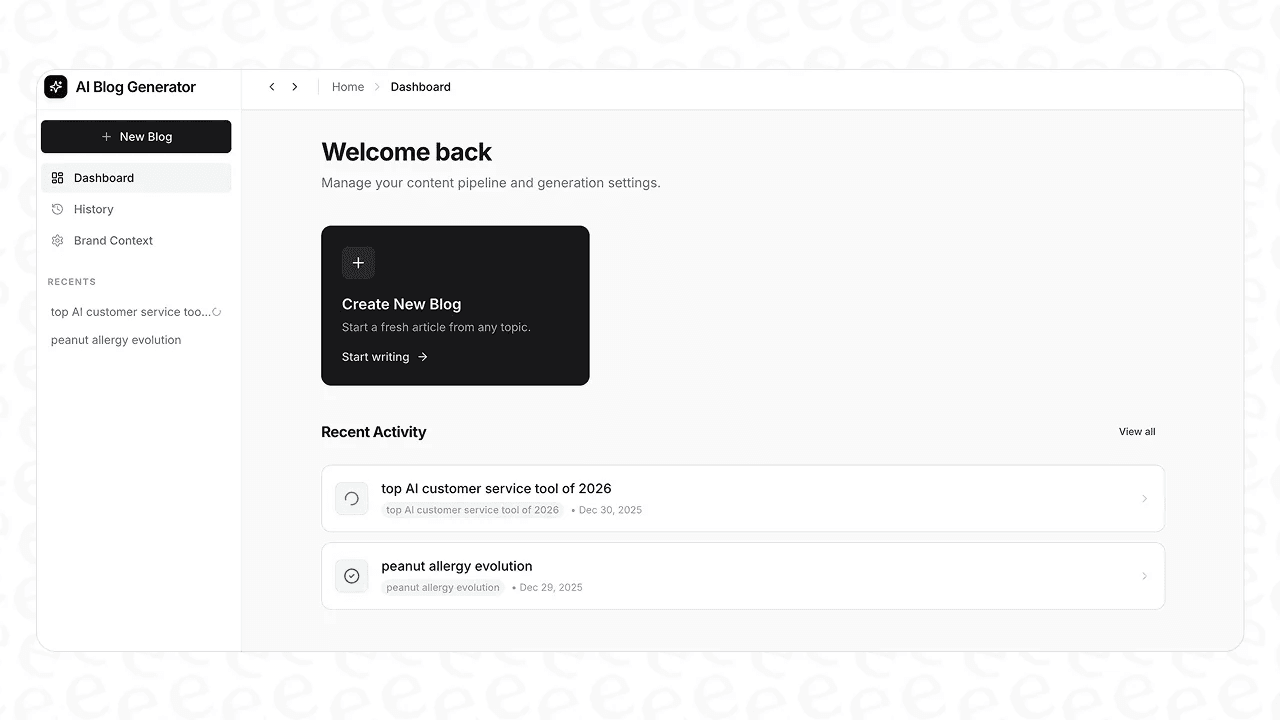
Here's how it helps you adapt:
- Optimized for AI answer engines: eesel AI produces content that’s structured for AEO from the start. This makes it much easier for engines like Google AI Overviews and ChatGPT to use and cite your work.
- Snippet-ready structure: It automatically creates well-organized posts with clear headings, lists, tables, and FAQ sections, the exact formats needed to win featured snippets and appear in PAA boxes.
- Automatic assets and social proof: The platform adds relevant YouTube videos and pulls in real Reddit quotes to your content. This adds depth and social proof, which signals trustworthiness to search engines.
- Deep research and citations: Instead of generic filler, the eesel AI blog writer performs in-depth research to create factual content. It also adds internal and external links automatically, helping you satisfy user intent without them needing to leave the SERP.
This isn't just a theory. It's the same tool we used at eesel AI to grow our daily impressions from 700 to over 750,000 in just three months. We achieved this by consistently publishing content designed for modern search.
Measuring success in a zero-click world
If clicks aren't the primary metric, what should you be looking at? It's time to shift your focus to a different set of KPIs.
Impressions are actually going up, but clicks are dipping hard. I know the content is solid, but people are just getting their answers straight from the SERP. I even tried explaining to my team that we’re showing up in AI citations, but that doesn’t change the fact that revenue from organic is dipping. And honestly, that’s the only number management really cares about. Not gonna lie, I’m stressed about my job right now.
Track SERP visibility and impressions
- Google Search Console: Your most important reports in GSC are now "Total Impressions" and "Average Position." Remember the "Great Decoupling"? An increase in impressions with flat or declining clicks is a strong sign that your SERP visibility is growing.
- SEO Tools: Use a tool like Ahrefs to monitor your rankings for specific SERP features. You can track whether you’re winning featured snippets, PAA boxes, or getting cited in AI Overviews.
Measure brand recall and assisted conversions
- Direct Traffic (GA4): An increase in direct traffic can be a good indicator of brand recall. Someone might see your brand in a zero-click result, remember the name, and visit your site directly later.
- Assisted Conversions (GA4): Check out the Key event attribution paths report. This report shows you every touchpoint a user had before converting. If you see organic search appearing early in their journey, it's proof that it’s building awareness, even if it wasn't the final click.
- Branded Search Volume: Keep an eye on how many people are searching for your brand name. A steady increase here is one of the best signals that your brand authority is on the rise.
Adapting your strategy for the future of search
Zero-click searches aren't something to be afraid of; they're just the next phase in how people find information. The goal is shifting from chasing clicks to building brand authority and owning visibility directly on the search results page.
The way forward is to create well-structured content that answers questions, use schema markup to provide context, and build enough topical authority to become a go-to source for AI.
For a deeper dive into the practical strategies you can implement today, the following video offers a masterclass on how to adapt your SEO for an AI-driven, zero-click world.
Adapting to this new environment is essential if you want to stay competitive. To scale a content strategy that wins in a zero-click world, you need the right tools. The eesel AI blog writer is a highly efficient way to generate quality, optimized content at scale. Give it a try for free and see for yourself.

Frequently Asked Questions
Share this article

Article by
Stevia Putri
Stevia Putri is a marketing generalist at eesel AI, where she helps turn powerful AI tools into stories that resonate. She’s driven by curiosity, clarity, and the human side of technology.
