How to improve your AI Overview visibility: A complete guide

Katelin Teen
Katelin Teen
Last edited January 19, 2026
Google Search is changing in a big way, maybe the biggest in years. You've likely seen it: "AI Overviews" are now sitting at the top of search results for a lot of people. It's a massive shift, and nobody can seem to agree on what it means for website traffic.
Google claims it's sending more clicks to publishers. Meanwhile, some independent studies suggest clicks are dropping. So, who's right?
The reality is probably somewhere in between. Instead of getting lost in the debate, let's talk about what you can actually do about it. This guide will cut through the noise and give you a straightforward plan to get your content featured in those AI summaries.
We're going to get into something called Answer Engine Optimization (AEO), which is all about making content that works in this new AI-first search environment. And as we'll see, tools like the eesel AI blog writer are being built specifically to tackle this challenge.
What are AI Overviews and what is their real impact on traffic?
First off, what are these AI Overviews? They're basically AI-generated summaries that combine info from several web pages to answer your question directly in the search results. The goal is to save you from clicking five different links just to get a complete picture.
And this isn't some small experiment. Google has already pushed it out to hundreds of millions of users in the U.S. and is aiming for over a billion by the end of 2026. This is just how search works now.
But the big question is, what's the impact on website traffic? This is where things get a little murky.
- Google's Take: Google insists that links within AI Overviews get more clicks than if the page was just a standard blue link for that search.
- Independent Research: A July 2025 Pew Research Center study tells a different story. They found people were almost twice as likely to click a traditional link when there was no AI summary (15% vs. 8%). Clicks on links inside the AI summary were even less common, happening only 1% of the time.
- The Real World: If you spend any time in SEO communities on Reddit, you'll see this debated endlessly. The general feeling is that while click-through rates for purely informational searches are down, the traffic that does make it through tends to be higher quality. For searches with buying intent, a user who clicks after reading an AI summary is usually better informed and closer to making a purchase.
I'm seeing between a 10% - 30% decrease in clicks for pages that still rank, just due to the added presence of the AIO. For example, one high traffic article that was and still is #1 for its main KWs got 25% less clicks since ~a month ago when I first saw AIOs appear on those queries. And this page is often the #1 or #2 source linked in the AIOs. That said, to one of your points - the overall quality hasn't dropped much. Leads are still there. Down a bit, but not as much as we'd expect based on the total loss of traffic.

So, you might see fewer raw clicks for some keywords, but the traffic you get could be more valuable. The goal isn't just to get a click anymore; it's to be the source the AI trusts.
Key factors for AI Overview visibility
Google keeps its exact algorithm under wraps, but the recipe for getting featured in AI Overviews isn't some big secret. It lines up with what Google has been preaching for years: make helpful, people-first content. Let's look at what the answer engines are looking for.
Content quality and authority (E-E-A-T)
AI models are designed to find and prioritize content that's high-quality, thorough, and accurate. The best way to approach this is with Google's E-E-A-T framework: Experience, Expertise, Authoritativeness, and Trustworthiness. This isn't just a friendly tip; it's the foundation of their quality rater guidelines. Your content has to prove you know your stuff because you've actually done it.
Content structure and clarity
An AI doesn't "read" like a person. It needs to process your content logically. That's why structure is so important. Using clear headings (H2s, H3s), writing short, focused paragraphs, and using lists or tables to simplify complex information are all key. This makes your content easy for both people and machines to digest.
User intent and relevance
It's time to think beyond single keywords and focus on building topical authority. That same Pew Research data showed that AI Overviews appear much more often for longer, more complex questions. In fact, 60% of question-based searches triggered an AI summary. This tells you that your content needs to answer a user's entire question, not just one piece of it. Try to anticipate follow-up questions and answer those as well.
External trust signals
Brand mentions, citations from other websites, and backlinks from good sources are like positive reviews. They signal to the AI that other people trust your content. It's not a coincidence that the most cited sources in AI Overviews are huge, authoritative platforms like Wikipedia, YouTube, and Reddit. Building your brand's authority is a bigger deal than ever.
Content strategies for AI Overview visibility
Alright, enough theory. Let's get practical. How do you actually create content that gets picked up by these answer engines? This is what Answer Engine Optimization (AEO) is all about.
Create unique, people-first content
If your content is just a rehash of what's already ranking, you're not going to get featured. AI is getting smarter about detecting generic filler. You need to focus on what Google calls people-first content. This means sharing your own experiences, presenting new data or research, using real examples, and offering insights that can't be found elsewhere. It's the "Experience" part of E-E-A-T in practice.
Structure your content for machine-reading
Organizing your content well is a win-win. It's easier for your readers to skim and for AI crawlers to understand.
- Use clear H2s and H3s that work like headlines for each section.
- Keep paragraphs short and focused on a single point.
- Use a Q&A format when it fits. If your heading is a question, the first sentence below it should be a direct answer.
This kind of clear structure makes it simple for an AI model to find a specific fact, pull it out, and use it in a summary.
Support claims with evidence and authority
In this new AI world, credibility is king. You can't just make statements; you have to prove them. Here are a few straightforward ways to build trust right into your content:
- Link out: Cite credible sources like studies, official reports, and expert websites.
- Quote experts: Include quotes from subject-matter experts to give your points more weight.
- Use stats: Back up what you're saying with specific data.
Pro tip
Use callout boxes or blockquotes to make important stats or expert quotes stand out. This visual cue helps both humans and AI models spot key information that might be perfect for a summary.
Go beyond text with rich media and social proof
Google is leaning into a more visual, multi-format search experience, and your content should too. Images, charts, infographics, and embedded videos give important context that an AI can understand and reference.
Real social proof is also a huge trust signal. Seeing actual conversations from people adds a layer of authenticity that AI-written content just can't match. This is where modern content tools can really help. For instance, the eesel AI blog writer doesn't just write text. It automatically creates relevant charts and images, and even finds and embeds YouTube videos and real Reddit quotes into your article. It saves you a ton of time while helping you build the kind of media-rich, trustworthy content that answer engines are looking for.
Technical strategies for AI Overview visibility
You can have the greatest content on the planet, but if AI crawlers can't find or understand it, it's like it doesn't exist. A solid technical setup is not optional.
Ensure your technical SEO is solid
Let's start with the basics. Your site has to be fast, mobile-friendly, and easy for Googlebot to crawl. If you have technical problems that stop Google from seeing your pages correctly, none of the other strategies will matter. Good technical health is the ticket to the game.
Leverage structured data (Schema markup) correctly
Structured data, or Schema markup, is a way to give search engines clear context about your page's content. It takes the guesswork out of it for them.
There's a recent change to be aware of here. Google announced that FAQPage rich results are now limited to authoritative government and health websites. For most of us, that schema type is no longer useful. Instead, focus on more relevant types like Article, HowTo (for tutorials), or QAPage (if you run a forum). This helps the AI understand the purpose of your page.
Build authority with brand mentions and links
We mentioned this before, but it's important enough to repeat: off-page signals are a massive indicator of trust for AI. This goes beyond just getting backlinks. Building your authority through digital PR, guest posting on respected sites, partnering with others in your industry, and creating genuinely useful resources (like free tools or original research) is how you build a brand reputation that both traditional search and AI Overviews will reward.
Measuring your AEO efforts
This is the tricky part. The old method of just tracking keyword rankings is becoming less useful. The new goal is to be mentioned or cited in AI-generated answers.
Tracking this right now is difficult. The results are often personalized, and users can type in an endless variety of prompts. It's almost impossible to track this manually at any kind of scale.
While some specialized Answer Engine Optimization (AEO) tools are starting to pop up, they're still new. For now, Google Search Console doesn't have a dedicated report for this. The best you can do is consistently create optimized content using the strategies we've covered and watch your traffic for queries that you know are likely to bring up an AI Overview.
For a deeper dive into how you can adapt your SEO strategy for this new landscape, the following video offers some excellent, actionable advice on protecting your brand and improving your visibility in AI Overviews.
How to scale AEO-optimized content with the eesel AI blog writer
Here's the main problem: creating deeply researched, perfectly structured, media-rich, and authoritative content is tough. Doing it over and over again at scale is even tougher. It can be a huge drain on time and resources.
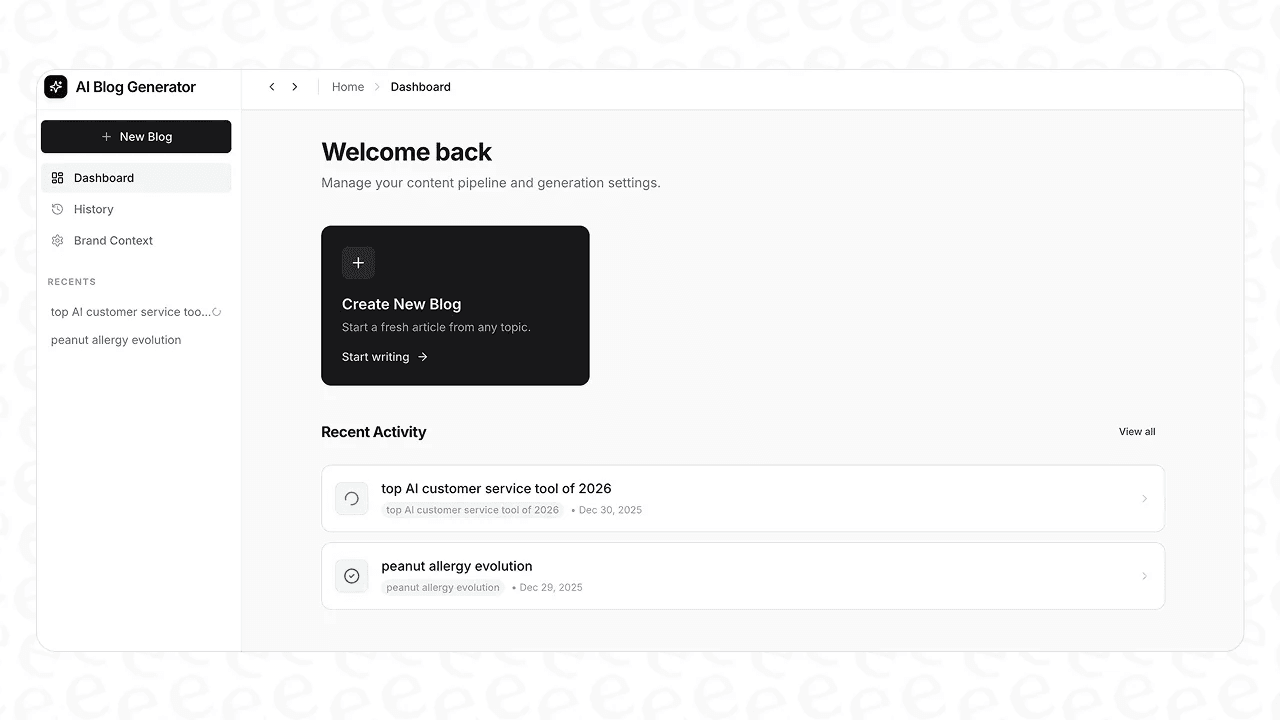
This is the exact reason we built the eesel AI blog writer. It's a tool designed for this new era of search. It helps you execute the strategies we've just discussed:
- AEO-Optimized Structure: It doesn't just spit out a wall of text. It generates content with the clear headings, short paragraphs, and logical flow that answer engines need to understand information.
- Automatic Assets & Social Proof: It creates tables, charts, and images, and embeds relevant YouTube videos and Reddit quotes. This adds the rich media and social proof that signals trustworthiness to an AI.
- Context-Aware Research: It does more than just surface-level writing. It automatically pulls in relevant data and citations, giving your content the depth and authority it needs to be a trusted source.
It's all about working smarter, not harder, to create content that's designed to win in an AI-first search world.
Thriving in the age of AI Overviews
Winning in the age of AI Overviews isn't about learning a bunch of new, complicated hacks. It's about getting back to the fundamentals and doing them exceptionally well. It's about doubling down on creating genuinely helpful, authoritative, and human-focused content that is also structured perfectly for a machine to read.
Your goal should be to become the most definitive, helpful, and trustworthy source of information in your field. When you do that, your content becomes the most logical choice for an AI to cite. The search world is definitely changing, but by sticking to these principles (and using the right tools to help you scale), you can set your business up to not just survive, but thrive.

Frequently Asked Questions
Share this article

Article by
Katelin Teen
Katelin is an operations specialist at eesel where she uses her psychology training and education experience to optimize B2B SaaS processes. Outside of work, she unwinds with story-driven games, writing, and keeping up with latest tech innovations.