
You’ve spent hours, maybe even days, writing a brilliant article packed with amazing insights. You hit publish, feeling proud, but when you check your analytics, you see visitors are bouncing after just a few seconds. What gives? The problem probably isn’t your content, but how it’s presented.
In a world where everyone skims, the way you present your content is what holds their attention. It’s not just about making things look pretty; formatting has a real effect on readability, user engagement, and, you guessed it, your search engine ranking. A well-structured post invites people to stay, read, and actually absorb what you have to say.
This guide will walk you through everything you need to know to format your blog posts effectively. We’ll cover the basic structure, tricks for engagement, and the technical SEO bits that work behind the scenes.
While these principles are good to know, modern tools can handle most of the heavy lifting. AI content generation platforms like the eesel AI blog writer are designed to create complete, publish-ready blog posts with formatting included.
Understanding blog post formatting
Blog post formatting is simply how you organize and style your content to make it easy for both people and search engines to read and understand. It’s the difference between a welcoming, easy-to-navigate article and an intimidating wall of text that can deter readers.
You’re really formatting for two very different audiences:
- Human Readers: You want to give them a good experience. Good formatting makes your message clear, encourages them to stick around longer, and helps them remember your key points.
- Search Engine Crawlers: These are the bots from Google and other search engines that scan your content. Proper formatting helps them understand your content's hierarchy and what it's about, which is a huge factor in SEO and ranking.
The main goal is to make your best ideas the most obvious and accessible parts of your article. When you do that, you turn casual scanners into engaged readers.
The foundational structure of a blog post
Before you start adding flashy visuals or bolding text, your post needs a solid, logical skeleton. This structure is what guides your reader from one point to the next without any confusion, creating a smooth reading experience.
A clear beginning, middle, and end
Every piece of content, from a short story to a blog post, needs a clear narrative arc. It’s what makes the information stick.
- The Introduction: This is your hook. Its job is to grab the reader's attention, clearly state the post's purpose, and set expectations for what they're about to learn. No surprises, just a clear promise of value.
- The Body: This is where you deliver on that promise. The body contains the meat of your article, and it should be broken down into logical sections and sub-sections to present your core information in digestible chunks.
- The Conclusion: This is where you wrap it all up. Summarize the key takeaways from the post and give the reader a clear next step or a call to action. You want to leave them feeling like they’ve learned something and know what to do with that new knowledge.
Using headings and subheadings
Headings are like signposts for your readers and for search engines. They break up your content into scannable sections and signal what’s most important.
- H1: This is your main title. You should only ever have one H1 per post. It’s the big sign that tells everyone what the entire article is about.
- H2s: These are for the major sections of your post. Think of them as the main chapters of your article, each one tackling a major component of your topic.
- H3s: These are used to break down the points within an H2 section. If your H2 is a chapter, your H3s are the sub-points that add more detail.
Pro tip
A quick tip: use sentence case for your headings. It feels more conversational and less like you’re shouting at your readers with aggressive marketing copy. For example, 'How to format a blog post' is much friendlier than 'HOW TO FORMAT A BLOG POST.'
Keeping paragraphs short
Ever landed on a page and been greeted by a massive block of text that looks like a novel? It’s intimidating, right? Most people won’t even bother trying to read it.
On the main page, the preview of each featured or blog post just puts the text and doesn’t show the line breaks. Looks very wonky for poetry since it’s suppose to be spaced out but it’s all crammed into one space, until you hit read more and then the full page version is fixed.

Large blocks of text are a huge turn-off for online readers. The solution is simple: keep your paragraphs and sentences short.
Aim for paragraphs of just two to four sentences. This creates plenty of whitespace on the page, which makes your content feel more approachable and actually increases reading speed and comprehension. Varying your sentence length also helps create a nice rhythm, making your writing more engaging.
Advanced formatting techniques for scannability
Once your foundational structure is in place, it’s time to add layers that make your content easy to skim. Most people online are scanners. They’ll glance over your article before they commit to a full read-through. Your job is to make your key points jump off the page to catch their eye and pull them in.
Using lists to draw the eye
Lists are a scanner's best friend. They break up long stretches of text and signal to the reader that they're about to get concise, important information.
- Numbered lists: These are perfect for outlining sequential steps, a process, or ranked items. If the order matters, use a numbered list.
- Bulleted lists: These work best for non-sequential items, like a list of features, benefits, or tips. The order doesn’t matter, but the points are all related.
Lists also have some nice SEO value. Google often pulls well-formatted lists directly into its search results as featured snippets or "answer snippets," which can give your content a huge visibility boost.
Emphasizing key takeaways
Not all words are created equal. Some phrases or sentences are more important than others, and you can use simple text formatting to make them stand out.
- Bold text: Use bolding strategically for key phrases or full sentences that you want a skimmer to catch. This shouldn't be random; it should highlight a main takeaway or a crucial piece of information.
- Italic text: Italics are best used for more subtle emphasis, like on a single word. They’re also great for things like book titles or foreign phrases.
- Blockquotes: If you’re including a powerful quote from an expert or want to make a critical point from your own text really stand out, use a blockquote. It visually separates the text from the rest of the paragraph, telling the reader, "Hey, pay attention to this!"
Incorporating visuals
Humans are visual creatures. A post with only text is not only boring but also harder to understand. Images, charts, and videos make your content far more engaging and can help illustrate complex points that are difficult to explain with words alone.
Visuals act as welcome breaks in the text, giving the reader's eyes a rest. They can also significantly increase the time a visitor spends on your page. People are much more likely to scroll through an entire article if it's peppered with relevant, interesting visuals.
Finding or creating these assets can be a manual, time-consuming task. That's why some teams use tools that offer automating asset generation to scale their content production.
Automating blog post formatting with eesel AI
Applying all these formatting rules manually to every single blog post is tedious, time-consuming, and hard to do consistently, especially when you're trying to publish content at scale. It's one of the main reasons so much great content research ends up sitting in a document, never to be published.
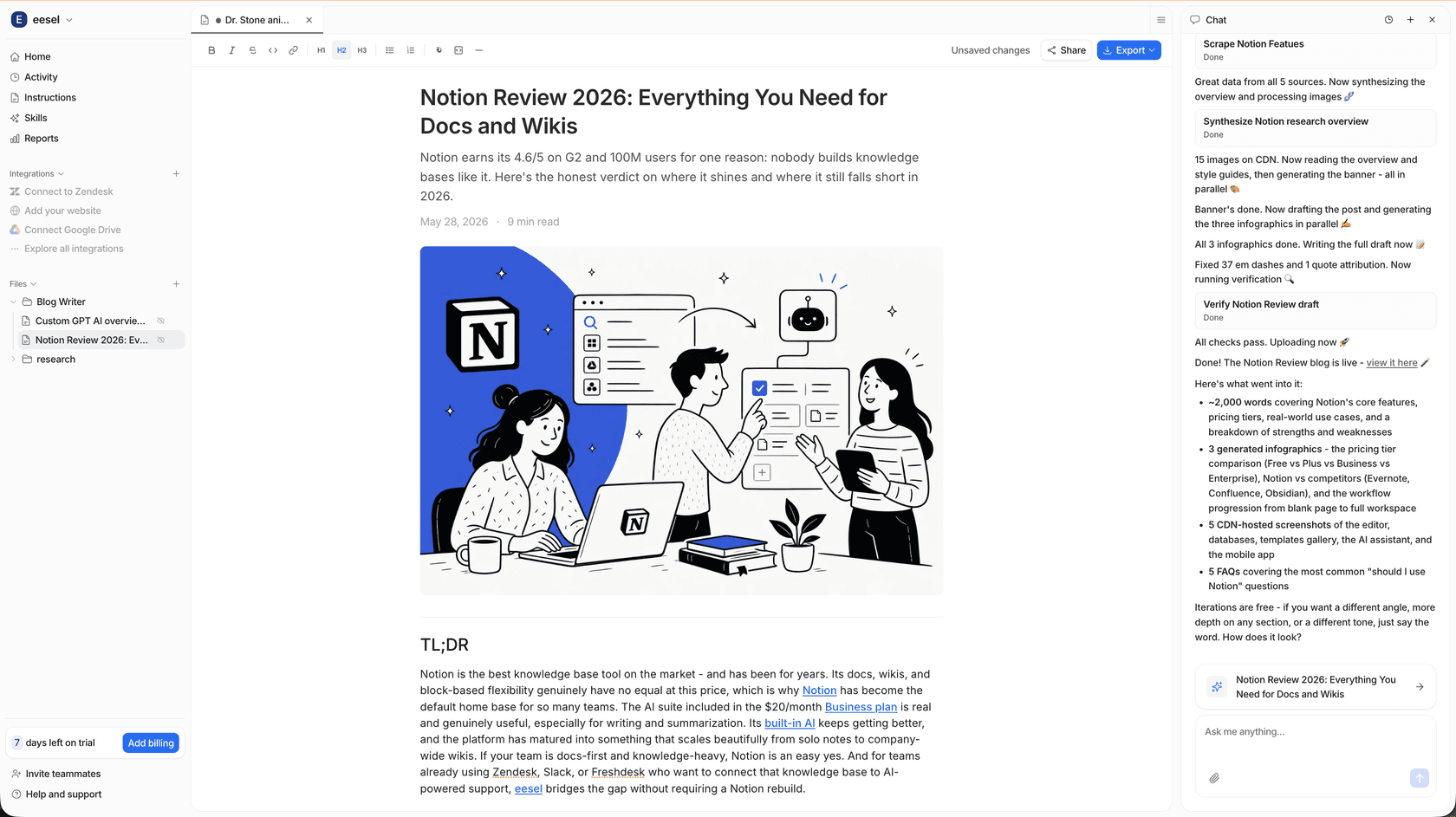
This is where automation can help. The eesel AI blog writer is an AI content generation platform designed to handle the entire process. It takes a keyword and turns it into a formatted, media-rich, and publish-ready blog post, including a complete article structure with headings, visuals, and more.
We used this tool to grow our own blog from 70k to 750k impressions in just three months. Here’s how it handles formatting for you:
- Automatic Structure: It generates a logical outline with SEO-optimized H1, H2, and H3 headings.
- Built-in Visuals: The platform creates and inserts relevant assets like AI-generated images, infographics, and data tables directly into the post.
- Media Embeds: It finds relevant YouTube videos and authentic Reddit quotes to embed in your article, boosting engagement and adding social proof to your content.
- Optimized for AEO: The content is structured with clear, concise answers designed to perform well in new AI answer engines like Google AI Overviews.
Instead of spending your time on the tedious mechanics of formatting, you can focus on strategy and ideas, letting AI handle execution.
Technical formatting for SEO success
Some of the most important formatting happens behind the scenes in your content management system. These technical elements are invisible to most readers, but they’re crucial for telling search engines what your content is about and helping it rank higher.
Formatting the URL slug
The URL slug is the part of the URL that comes after the ".com/". It should be short, descriptive, and clean. Ideally, it should contain your main keyword without any extra fluff words.
For example, a clean URL for this post would be: /how-to-format-blog-post
A messy one would be: /blog/2026/10/our-complete-guide-on-how-you-can-format-a-blog-post-for-seo
Keep it simple.
Writing meta titles and descriptions
The meta title and meta description are what show up on the Google search results page. Think of this as your content's advertisement. It's your one chance to convince someone to click on your link instead of someone else's. This is also a key part of Answer Engine Optimization (AEO), as these snippets are often used to generate AI-powered answers.
Make your meta title compelling and your description a clear, concise summary of what the reader will get from your post.
Using descriptive alt text
Alt text (alternative text) is a short description you add to your images. It serves two important purposes:
- Accessibility: It makes your site accessible to visually impaired users who use screen readers. The screen reader will read the alt text aloud so they know what the image is.
- SEO: It helps search engines understand the context of your images, which can help your images rank in Google Images and adds to the overall SEO value of your page.
For a deeper dive into the visual side of blog post formatting, this video offers some great tips on how to structure your content so people will actually read it.
Final thoughts on blog post formatting
Formatting isn't just an afterthought you tack on at the end of the writing process; it's a core part of creating successful blog content. A well-formatted post respects your reader's time, clarifies your message, and gives you a much better shot at ranking on search engines.
To recap, great formatting stands on three pillars: a logical structure for flow, scannable elements for engagement, and technical optimization for SEO. Getting all three right is the key to creating content that people actually want to read.
To apply these principles efficiently, you can use content automation tools. For example, you can generate a free blog post with the eesel AI blog writer to see how it works.