How to create evergreen SEO content that drives traffic for years

Katelin Teen
Katelin Teen
Last edited January 15, 2026
Ever feel like you’re on a content treadmill? You pour hours into an article, it gets a nice little traffic spike for a week, and then… crickets. It just disappears into the internet void, and you’re back to square one, trying to come up with the next big thing. It's a tiring cycle.
Now, what if you could write one post that keeps pulling in steady, reliable traffic for months, or even years? That’s the magic of evergreen content.
The trouble with most content strategies is they focus on short-term wins. Chasing trending topics feels productive in the moment, but it’s a high-effort game with returns that quickly fade. It's just not a sustainable way to grow. The real key to long-term organic growth is building a solid base of evergreen content that establishes your authority and delivers value over time.
What is evergreen SEO content?
So, what exactly are we talking about? Evergreen content is like an evergreen tree: it stays fresh and relevant no matter the season. In the world of content marketing, it’s stuff that remains useful to readers for a long time, only needing small tweaks here and there to keep providing value. As the team at Semrush explains, it’s the kind of content that has serious staying power.
Here’s what makes a piece of content evergreen:
- It’s all about foundational, timeless topics, not fleeting news.
- It answers the common, fundamental questions people in your niche always have.
- Its traffic usually stays stable or even grows over time, like a compounding asset.
- It builds your authority on a topic and attracts backlinks naturally because people link to resources that are consistently helpful.
- Trending Content: This is news-driven content that gets a huge spike in interest and then quickly fades. Think articles about a specific software update, a quarterly earnings report, or a viral meme. A post about "COVID," for instance, had a massive peak and then a steady decline.
- Seasonal Content: This content is only relevant during certain times of the year. Posts like "Black Friday marketing ideas" or "best holiday gift guides" are incredibly valuable for a short window but gather dust for the other ten months.
The most effective evergreen formats are the ones that address fundamental needs. Here are a few classics that always work:
- How-to articles and tutorials: "How to Write a Resume"
- Ultimate guides: "On-Page SEO: The Definitive Guide"
- “What is” explainers: "What Is Venture Capital?"
These formats are built to last because the core questions people have about these topics don't really change.
Step 1: Finding evergreen topics
Finding the right topic is probably the most important part of this whole process. Get this right, and you're already halfway there. The goal is to find subjects that have consistent, long-term search demand and also align with what your business actually does.
Start with your audience's core problems
Before you open any keyword research tool, just think about your customers. What are the fundamental questions they’re always asking? What are the timeless challenges they run into in your industry? These are the goldmines for evergreen ideas.
Brainstorm some foundational topics that tackle these needs directly. Think about the "how-to" guides or "what is" explainers that would be the perfect resource for someone new to your field or trying to solve a nagging problem.
Use keyword research to validate demand
Once you have a list of ideas, it's time to check if people are actually searching for them. This is where keyword research is essential. You’re looking for keywords with stable, non-seasonal search volume.
A tool like Semrush’s Keyword Magic Tool is great for this. When you analyze a keyword, look closely at the "Trends" graph. You want to see a line that’s relatively flat or maybe even creeping upward over the last 12 months. That’s the sign of a steady, evergreen topic. Pay special attention to informational keywords that start with phrases like "what is," "how to," or "a guide to," as these are naturally evergreen.
Analyze your competitors' top pages
There's no need to reinvent the wheel. A great way to find proven evergreen topics is to see what’s already working for your competitors.
Step 2: Creating high-quality evergreen content
A great topic is a fantastic start, but that's only half the job. Now you have to create a piece of content that’s so thorough and helpful that it deserves to rank for years. This is where most teams get stuck because it requires significant effort.
The traditional approach: A manual, multi-step process
The traditional way of doing this involves several steps.
First, you have the research and writing. This means spending hours gathering information, finding credible stats, outlining the article from scratch, and then carefully writing it all out. You have to make it easy enough for beginners to understand without being too simple, and you need to avoid any confusing jargon.
Then you have to create assets. A giant wall of text just doesn't work anymore. You need visuals like infographics, charts, or custom images to break up the content and keep people engaged. This is often a separate, time-consuming task that requires designers or another tool.
This manual workflow can be time-consuming and challenging to scale. This is exactly why so many businesses struggle to build a real library of evergreen content. They publish one great piece and then run out of energy.
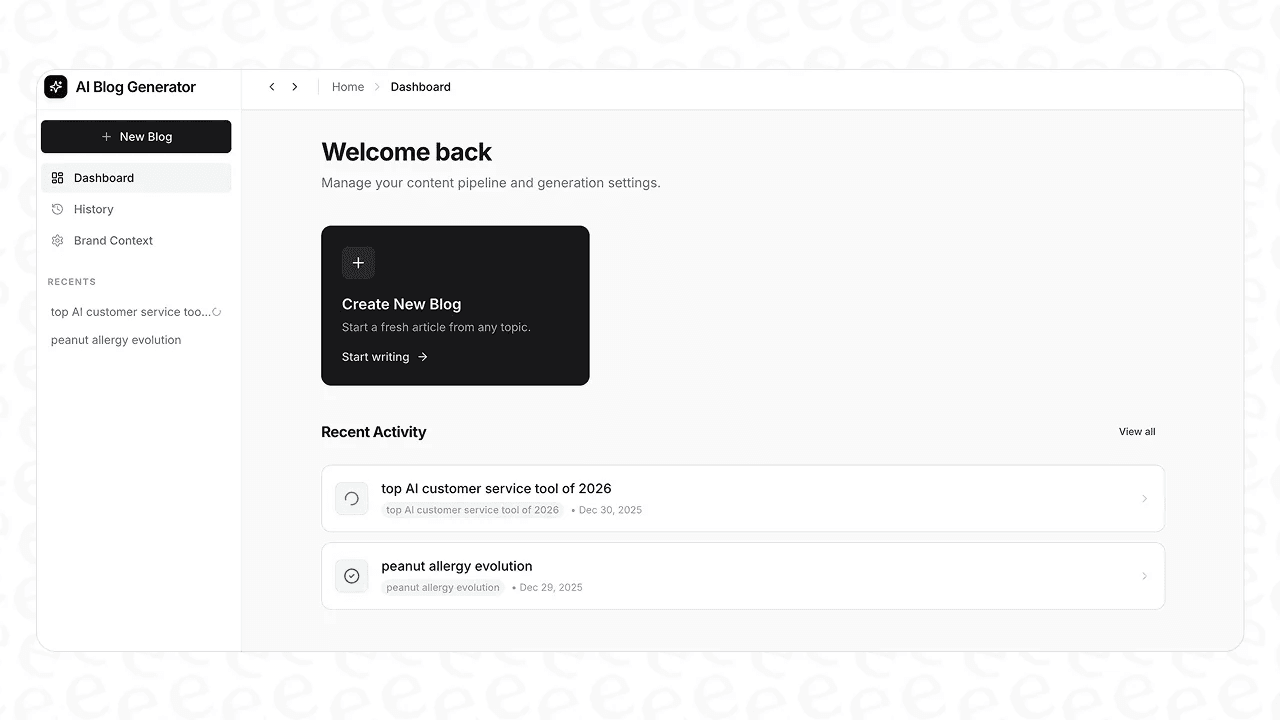
Automating content creation with the eesel AI blog writer
We ran into this exact problem ourselves, which is why we built the eesel AI blog writer. It’s the tool we used to grow our own organic traffic from 700 to over 750,000 impressions in just three months. It’s designed to automate the entire process of creating evergreen content.
Here’s how it works:
- Context-Aware Research: This isn't just generic AI fluff. When you give it a topic, it understands the intent behind it. If you’re writing a comparison post, it pulls in pricing data. If it’s a product review, it finds the technical specs. It does the heavy lifting on research for you.
- Automatic Asset Generation: The eesel AI blog writer produces a complete blog post, not just a text draft. It automatically generates AI images and tables, and even embeds relevant YouTube videos and real Reddit quotes to add social proof and texture.
- Built-in SEO and AEO: Every article is structured for traditional SEO best practices from the start. But it also optimizes for Answer Engine Optimization (AEO). AEO is about making your content show up in AI-powered answer engines like Google AI Overviews and ChatGPT. With Gartner predicting that 25% of organic traffic will shift to these platforms by 2026, this is something you can't ignore.
This approach can reduce a week-long manual process to just a few minutes, making it possible to scale high-quality evergreen content. You can generate your first blog for free and see for yourself.
Step 3: Promoting your evergreen content
Hitting "publish" is the beginning, not the end. Even the best piece of evergreen content needs an initial push to get some momentum, start ranking, and attract backlinks.
On-site promotion
Don't let your new masterpiece get buried on your own site.
- Homepage Feature: Showcase your latest and greatest evergreen posts on your homepage or in a dedicated "Resources" or "Guides" section. Make it easy for visitors to find your best work.
- Internal Linking: This is a big one for SEO. Go back to older, relevant blog posts and add links that point to your new evergreen article. This helps pass authority and guides both readers and search engines to your new content.
Off-site promotion
Now it's time to spread the word beyond your own website.
- Social Media: Share your new post across all your social channels. Since the content is timeless, you can easily repurpose and reshare it every few months to reach new followers.
- Email Newsletters: Your email list is a huge asset. Share the article with your subscribers. You can also add it to automated onboarding emails for new subscribers to show them value from day one.
- Online Communities: Look for chances to share your content in places like Reddit, Quora, or industry forums. But don't just spam the link. Find relevant conversations where your article genuinely helps answer a question, and share it as a helpful resource.
Step 4: Keeping your content fresh
"Evergreen" doesn’t mean "set it and forget it." While the core topic is timeless, the details inside can get stale over time. Regular maintenance is the key to keeping and even improving your rankings.
Hey r/semrush, trends come and go, but evergreen content is still one of the most reliable ways to bring in consistent traffic without needing constant updates. The problem is, a lot of what gets called “evergreen” doesn’t actually perform like it.

How to know when to update
You don't have to guess. There are clear signs that a post could use a little love.
- Set a Schedule: Put a reminder on your calendar to review your top-performing evergreen posts every 6-12 months. A quick check-in can catch issues before they become real problems.
- Monitor Rankings: Use a tool like Semrush Position Tracking to keep an eye on your keywords. If you see a noticeable and sustained drop in rankings, that’s a big hint that your content is probably getting outdated and needs a refresh.
What to update for a refresh
When it’s time for an update, focus on these key areas:
- Refresh Outdated Information: This is the most obvious one. Swap out old statistics, replace broken links, and update any mentions of outdated tools or processes with current info.
- Expand the Content: Is there a new angle to the topic you missed? Have new questions popped up since you first published? Add new sections to make your article even more comprehensive than what your competitors have.
- Improve On-Page SEO: Tweak the title tag, meta description, and image alt text to better match the current search intent for your target keyword.
- Add New Media and Expertise: Embed a new video, add fresh images, or include quotes from industry experts. This not only makes the content more engaging but also helps align it with Google’s E-E-A-T guidelines, which value experience, expertise, authoritativeness, and trustworthiness.
Pro tip
After you’ve updated the post, change the 'last updated' date and re-promote it across all your channels. Treat it like a brand-new piece of content to give it another boost.
For a deeper dive into the practical steps of finding and creating content that stands the test of time, this video from Rank Math SEO offers a great visual walkthrough of the entire process.
Building your evergreen content foundation
A content strategy built on chasing trends is a recipe for burnout. Focusing on evergreen SEO content is how you build a reliable, long-term asset that consistently beats the short-lived hype cycle.
It's about creating a library of value that works for you around the clock, attracting traffic and building authority while you sleep.Evergreen is the way for consistent $$$. You won’t get insane viral growth though which is the trade off. I have about 150 videos (about half evergreen tutorial, how tos, reviews.). And almost always make over $800 a month from them. I could stop posting today and make probably $500 a month for 5-10 years if I do nothing.
The path is pretty clear: find timeless topics people are searching for, create the most helpful content you can, promote it to get things moving, and keep it fresh over time.
While the strategy itself is powerful, the manual creation process has always been the biggest hurdle. The eesel AI blog writer was built to solve that exact problem by generating a complete, SEO-optimized, and media-rich post from a single keyword.
Why not give it a shot? Generate your first blog for free and see the difference for yourself.

Frequently Asked Questions
Share this article

Article by
Katelin Teen
Katelin is an operations specialist at eesel where she uses her psychology training and education experience to optimize B2B SaaS processes. Outside of work, she unwinds with story-driven games, writing, and keeping up with latest tech innovations.