HappyFox vs Kayako: Which helpdesk should you choose in 2026?

Amogh Sarda
Last edited April 30, 2026

If your team prioritizes a modern UI and fast setup, HappyFox wins on time-to-value with its intuitive automation. For enterprise teams requiring on-premise deployment or extreme database-level customization, Kayako remains one of the few legacy options that still delivers. This 2026 breakdown compares the core differentiators between both platforms.
Choosing the right support platform often feels like a choice between ease of use and total control. You want a system that makes your agents faster, not one that adds administrative overhead. At the same time, you cannot afford to outgrow your software as your ticket volume scales. Both HappyFox and Kayako have spent years refining their approaches to these problems, yet they have landed in very different places in 2026.
HappyFox has doubled down on being the "ridiculously easy to use" cloud solution that works for CS, IT, and HR alike. Kayako, meanwhile, has pivoted toward an AI-first resolution model that seeks to eliminate the very concept of a "ticket backlog." Whether you are looking for a traditional per-seat helpdesk or a usage-based AI engine, one of these platforms likely fits your roadmap. Let's break it down.
What is HappyFox?
HappyFox is a cloud-based help desk and ticketing system designed to simplify support workflows for teams of all sizes. Unlike legacy enterprise tools that require months of professional services to configure, HappyFox positions itself as a modern, easy-to-use alternative that delivers advanced functionality without unnecessary complexity.
The platform is built around an intuitive user interface that allows agents to manage conversations across multiple channels from a single screen. This omnichannel ticketing approach ensures that whether a customer reaches out via email, live chat, social media, or phone, the context remains in one place. For organizations managing several different products or subsidiaries, the multi-brand support feature is a standout, allowing you to run distinct support centers with unique branding from one central account.
Beyond simple ticket management, HappyFox includes integrated task management and asset tracking. This makes it particularly popular for IT support teams who need to link hardware assets directly to service requests. By combining these capabilities, HappyFox moves beyond being just a customer service tool and becomes a versatile operational platform for the entire company.
Automation is another core pillar. The system uses a powerful "Smart Rules" engine to handle repetitive tasks like ticket routing, prioritization, and status updates. This focus on efficiency is backed by integration capabilities with popular business tools like Slack, Microsoft Teams, and Jira, ensuring your support data flows seamlessly into the rest of your tech stack.
What is Kayako?
Kayako is a veteran in the customer service software space, known for providing a deeply customizable platform that caters to enterprise needs. While it has a long history as a traditional helpdesk, Kayako has recently undergone a significant transformation, positioning itself as an AI-native resolution engine that helps teams scale without necessarily adding more headcount.
At its core, Kayako offers a unified inbox that consolidates interactions from every conceivable channel, including WhatsApp and social media reviews. One of its most distinctive features is the SingleView™ customer journey tracking. This provides agents with a 360-degree timeline of every customer interaction, purchase, and event. Instead of asking customers to repeat themselves, agents can see exactly what happened before the ticket was even opened.
For teams with unique reporting requirements, Kayako offers the Kayako Query Language (KQL). This allows for extreme database-level customization of reports and dashboards, making it a favorite for data-driven support leaders who find standard reporting templates too restrictive. Additionally, Kayako remains one of the few providers that continues to support on-premise deployments for teams with strict data residency or security requirements, though its primary focus in 2026 is its cloud-based AI platform.
The current version of the platform is designed to be a "cost reset" for support operations. By treating AI as a core resolution engine rather than a bolted-on feature, Kayako seeks to automate the routine so that human agents only handle high-value edge cases. This shift from "managing tickets" to "resolving issues" is the defining characteristic of the platform today.
HappyFox vs Kayako: Core features and ease of use compared
When you compare the daily workflows of these two platforms, the difference in philosophy becomes clear. HappyFox focuses on the ticket as the unit of work, while Kayako focuses on the customer conversation.
Ticketing and conversation management
The HappyFox ticketing workflow is built for speed and clarity. It uses a familiar grid-based view that agents can customize to see the most relevant data points first. Features like "proactive agent collision" prevent two people from working on the same ticket at once, which is essential for busy teams. Reviewers on G2 frequently cite the HappyFox UI as one of its biggest advantages, noting that the setup process is remarkably fast.
Kayako's approach is more narrative. The unified inbox feels more like a modern messaging app than a traditional database. The SingleView™ timeline means agents spend less time switching tabs to find order history or previous chat logs. While this provides more context, it can sometimes have a steeper learning curve for teams coming from a traditional ticketing background.
Automation and customization
HappyFox uses "Smart Rules" which are event or time-based triggers. For example, if a ticket from a "VIP" customer is not answered within one hour, HappyFox can automatically escalate it and notify a manager via Slack. This is incredibly easy to set up and does not require any technical knowledge.
Kayako uses "triggers" and "monitors" to achieve similar results, but it adds a layer of depth through its no-code automation builder. You can model complex ticket relationships, such as parent/child tickets for major incidents, which is a bit more robust than HappyFox’s task management for enterprise-scale problem management.
Deployment and scalability
Deployment flexibility is a major fork in the road. HappyFox is a pure cloud-only model. This ensures you are always on the latest version and never have to worry about server maintenance. Kayako, through its heritage, still offers options for teams that need to host their own data. For most modern startups, cloud is the obvious choice, but for regulated industries like finance or government, Kayako’s flexibility remains a key differentiator.
How we conducted this comparison
To make this happyfox-vs-kayako evaluation as useful as possible, we looked at both platforms through the lens of a support leader in 2026. We evaluated each based on four specific criteria:
- Time-to-Value: How quickly can a new team get the software running and start resolving tickets?
- AI Integration: How deeply is generative AI woven into the product to actually solve customer problems?
- Cost Predictability: Is the pricing transparent, or are there "AI taxes" and hidden fees?
- Operational Depth: Does the tool handle complex needs like asset management or custom database queries?
The AI support battle: HappyFox Copilot vs Kayako’s automated future
In 2026, a helpdesk without AI is just a database. Both companies have invested heavily in generative AI, but they approach the "agent assist" problem differently.
HappyFox AI and Copilot
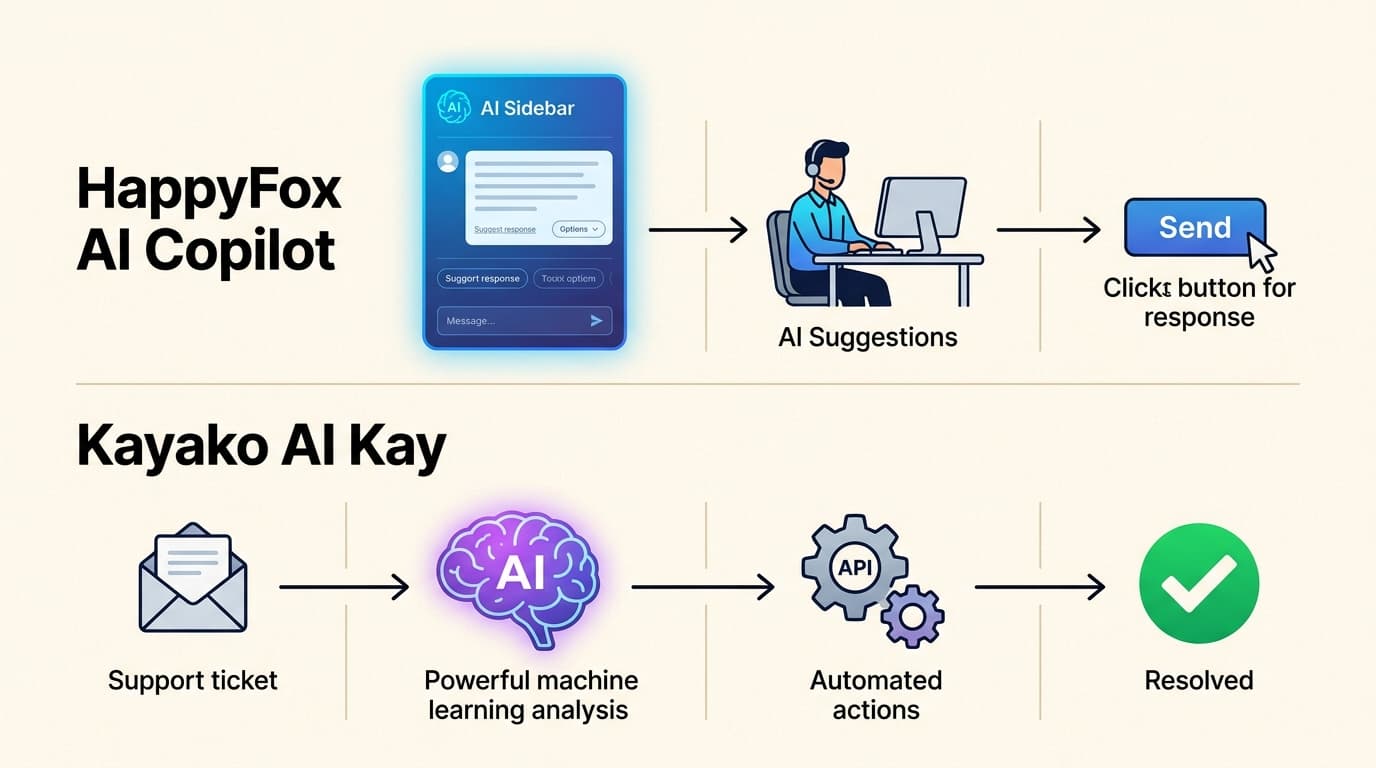
HappyFox AI is designed to make your existing human agents 10x more productive. The AI Copilot acts as a writing assistant, drafting responses based on the context of the ticket and your knowledge base. It can also summarize long ticket threads, which is a massive time-saver for managers during escalations.
One of its most impressive features is the AI Knowledge Base creation tool. It can look at your resolved tickets and automatically suggest new help center articles to fill content gaps. This creates a virtuous cycle where your support team's work naturally builds your self-service portal.
Kayako AI and "Kay"
Kayako has taken a more autonomous approach with its AI agent named "Kay." Instead of just helping an agent write a better email, Kay is built to perform actions end-to-end. Because Kay connects to your business APIs, it can process refunds, reset passwords, or update shipping addresses without a human ever seeing the ticket.
Kayako’s AI triage and routing also goes deeper into intent recognition. It doesn't just look for keywords; it understands the sentiment and urgency of the message to route it to the agent with the best "skill match" for that specific problem.
Comparative Productivity
If your goal is to help your human agents do better work, HappyFox’s Copilot feels more natural and requires less technical setup. If your goal is to "kill tickets" entirely through autonomous resolution, Kayako’s architecture is built for that future. Both platforms have seen significant improvements in First Contact Resolution (FCR) and Average Handle Time (AHT) for their users.
Pricing and value for money in 2026
The pricing models for these two tools have diverged significantly, reflecting their different views on how support should scale.
HappyFox pricing
HappyFox offers two distinct ways to pay. You can choose agent-based pricing if you have a small, fixed team, or unlimited agent pricing if you have a high headcount but predictable ticket volume.
Agent-Based Plans (Billed Annually):
| Plan | Price | Agents | Key Features |
|---|---|---|---|
| Basic | $24/agent/mo | Max 5 | Unlimited tickets, Knowledge base, SSO |
| Team | $49/agent/mo | Unlimited | Multi-brand helpdesk, Custom roles |
| Pro | $99/agent/mo | Unlimited | Asset/Task management, SLA live timer |
| Enterprise Pro | Custom | Unlimited | Agent scripting, 24/7 Phone support |
Unlimited Agent Plans (Annual Only):
| Plan | Monthly Equivalent | Ticket Limit |
|---|---|---|
| Growth | $1,999/mo | 150,000 /yr |
| Scale | $3,999/mo | 200,000 /yr |
| Scale Plus | $5,999/mo | 250,000 /yr |
For larger teams, the unlimited agent model can save thousands of dollars per month compared to traditional per-seat competitors.
Kayako pricing
Kayako has moved toward a much simpler but usage-dependent model. They have eliminated seat fees for their AI agent, charging instead for actual results.
| Component | Price | Inclusions |
|---|---|---|
| Kayako One Platform | Talk to sales | Full helpdesk, Unified inbox, KB, Live chat |
| AI Resolution (Kay) | $1 /resolved ticket | Only pay when the AI solves the issue |
This resolution-based pricing aligns Kayako’s incentives with yours: they only make money if their AI actually works. There are no setup fees, and white-glove onboarding is included to get your APIs connected.
Which is better value?
Small teams on a budget will find HappyFox Basic hard to beat. However, mid-sized companies that want to leverage AI heavily might find Kayako’s $1/resolution model more predictable than paying for expensive AI add-ons on top of high per-seat fees elsewhere.
eesel AI: The modern teammate for your helpdesk
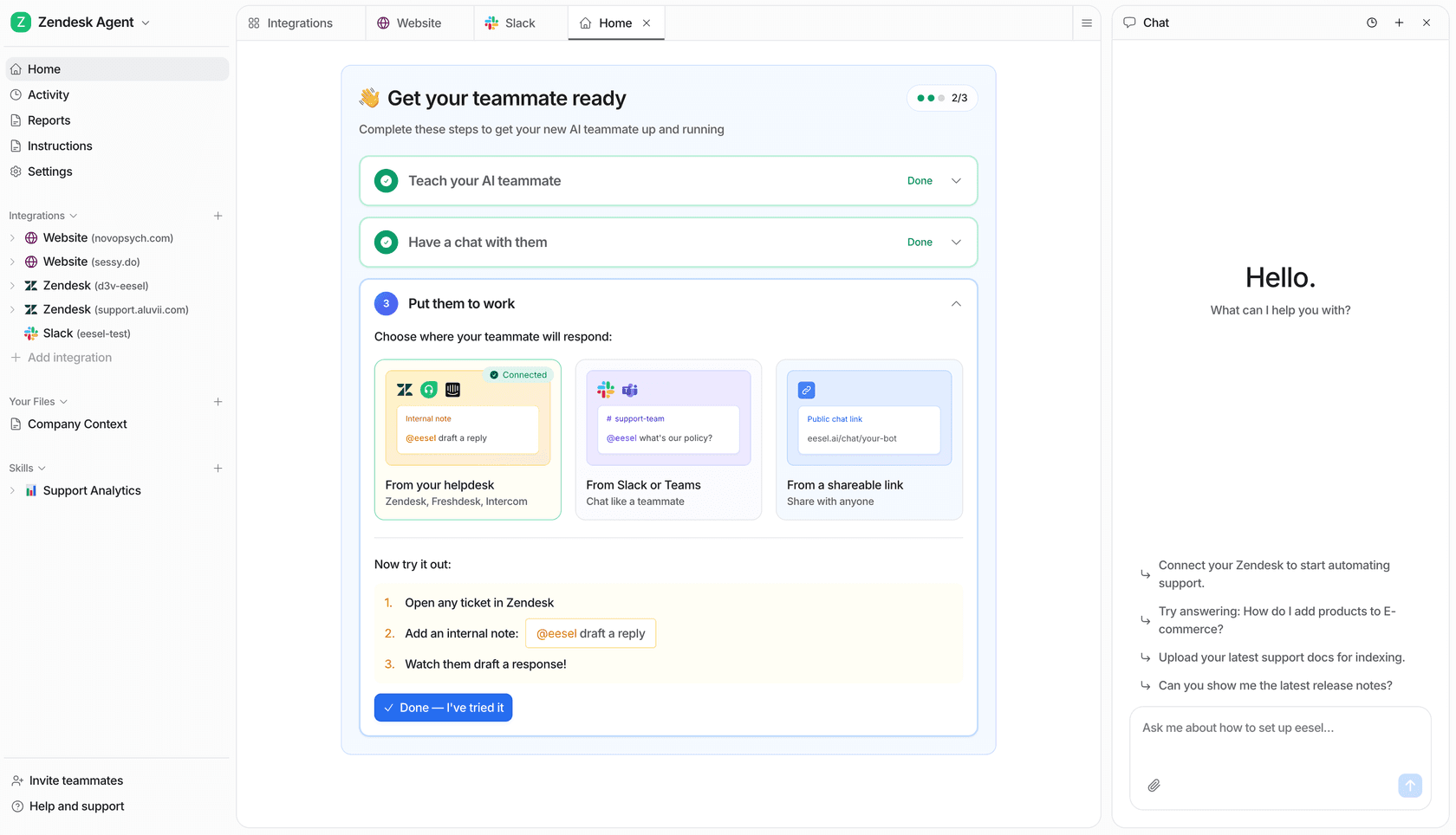
While choosing between HappyFox and Kayako is a big decision, you don't have to rely solely on their built-in AI features. We built eesel AI to be the teammate you "hire" to work inside the tools you already use.
Our AI helpdesk agent doesn't require a long configuration process. Instead, we learn your business in minutes by reading your past tickets, internal docs, and help center articles. Whether you choose HappyFox or Kayako, we can plug into your workspace and start handling frontline support autonomously.
Here is why teams are hiring us:
- True Autonomy: We don't just draft replies; we take real actions like processing refunds or updating ticket fields in your helpdesk.
- Instant Expertise: We support over 80 languages and maintain consistent quality 24/7, without breaks or PTO.
- Simple Pricing: We believe in transparency. Our pricing is just $0.40 per ticket or chat session and $4.00 per blog post generated.
- Risk-Free Trial: You can start with a $50 free trial to see the results for yourself, with no monthly minimums or platform fees.
By hiring us as a teammate, you get the best of both worlds: the robust ticketing infrastructure of a tool like HappyFox or Kayako, combined with the cutting-edge autonomous capabilities of eesel AI.
Verdict: Choosing the right helpdesk for your team
The choice in this happyfox-vs-kayako comparison comes down to your operational priorities.
Choose HappyFox if:
- You want an intuitive UI that your team can master in hours.
- You need integrated asset management for IT support.
- You have a large team and want to save money with an unlimited agent plan.
- You prefer a cloud-only, low-maintenance solution.
Choose Kayako if:
- You want to pivot to an AI-first model where you pay for resolutions, not seats.
- You need the deep customer context provided by SingleView™.
- You require extreme customization through KQL or on-premise deployment.
- Your primary goal is eliminating repetitive tickets through autonomous AI actions.
Bottom line? Both platforms are excellent choices that have successfully navigated the shift to AI-powered support. If you're still undecided, we recommend starting a trial of HappyFox for its ease of use, or booking a strategy session with Kayako to explore their resolution model. And regardless of which path you take, you can always hire eesel AI to handle the frontline work so your human agents can focus on the relationships that matter.

Frequently Asked Questions
Share this article

Article by
Amogh Sarda
CEO of eesel AI. Amogh Sarda is obsessed with making the ultimate AI for customer service teams. He lives in Sydney, Australia and has previously worked at Atlassian and Intercom. Outside of work he’s usually surfing or on stage doing improv.