Groove vs Help Scout: Which help desk fits your team in 2026

Amogh Sarda
Last edited April 1, 2026
Choosing help desk software feels a bit like choosing a car. You want something reliable that gets you where you need to go, but you also don't want to pay for features you'll never use. For small to mid-sized teams, Groove and Help Scout are two names that come up constantly. Both promise simplicity over enterprise complexity, but they approach customer support from slightly different angles.
This comparison breaks down exactly how they differ across features, pricing, and real-world use cases. By the end, you'll know which one fits your team (and when it's worth looking at an AI-native alternative like eesel AI).
What is Groove?
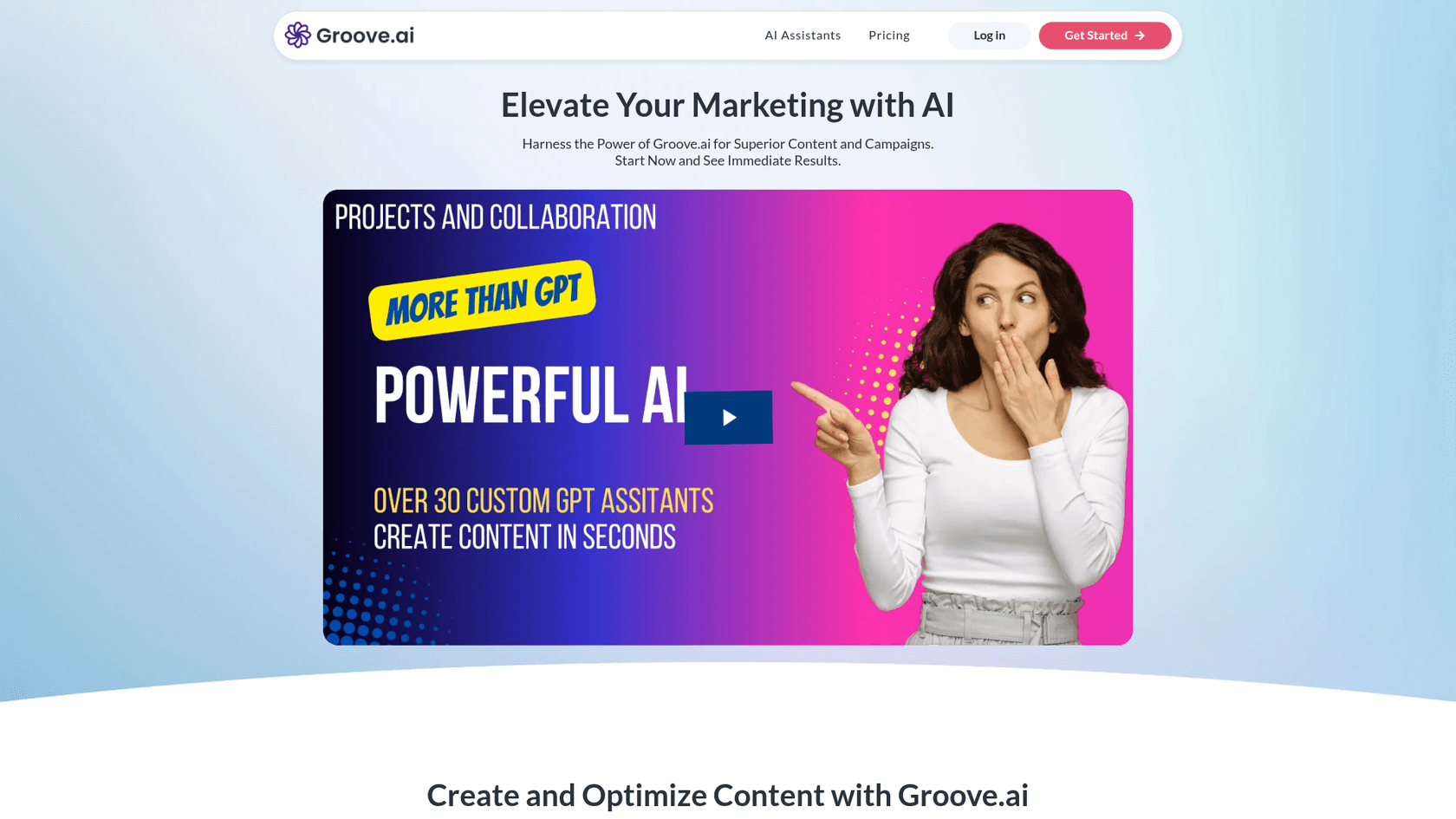
Groove is a help desk platform built for growing teams who want power without the bloat. The company's tagline says it all: "Everything you need. Nothing you don't."
At its core, Groove offers a shared inbox that works like Gmail but is built for teams. Customer emails, live chats, and social messages flow into one place where your team can collaborate, assign tickets, and respond without stepping on each other. The platform includes ticket management with Smart Folders and tags, automation rules for repetitive tasks, and a knowledge base for self-service support.
What sets Groove apart is its philosophy. It's designed for teams that find enterprise tools like Zendesk or Salesforce Service Cloud unnecessarily complex. The interface is clean, the learning curve is minimal, and you can get started quickly without weeks of configuration.
Groove includes AI features in its Plus and Pro plans: AI summarization, sentiment detection, automatic tagging, and writing assistance. The Standard plan does not include AI capabilities. For teams wanting more advanced AI, Groove offers Helply, a separate AI agent product that handles autonomous customer support.
The platform serves 130,000+ support experts and maintains a 4.6-star rating on G2. It's particularly popular among SaaS startups and ecommerce brands that need straightforward support workflows without enterprise overhead. For more on Groove's pricing structure, check out our detailed Groove pricing guide.
What is Help Scout?
Help Scout positions itself as a customer support platform for growing businesses that want to scale without losing the personal touch. The company emphasizes "the right blend of AI and people-powered tools."
The platform centers around a shared inbox that handles email, live chat, phone, and social conversations in one place. But Help Scout goes beyond basic ticketing with Beacon, an embeddable support widget that combines AI-powered answers, live chat, and help articles. Beacon can suggest relevant content, offer proactive messaging, and give customers instant access to their support history.
Help Scout includes AI features like AI Drafts (which writes replies based on past conversations), AI Summarize (for recapping long threads), and AI Assist (for editing and translating text). The AI Answers chatbot is available as an add-on at $0.75 per resolution, with a 3-month free trial to test its impact.
With 12,000+ companies using the platform, Help Scout has built a reputation for ease of use. The company reports that 80% of customers stay for at least 4 years, suggesting teams don't outgrow it quickly.
Help Scout integrates with AI tools like eesel AI, making it a solid choice for teams looking to add intelligent automation to their existing workflow.
Groove vs Help Scout: Feature comparison
Both platforms cover the basics well. Here's where they overlap and where they diverge.
Shared capabilities
- Shared inbox with collision detection to prevent duplicate replies
- Knowledge base for self-service support and FAQs
- Live chat integrated with the main inbox
- Automation rules for routing, tagging, and prioritizing tickets
- Internal notes and @mentions for team collaboration
- Mobile apps for iOS and Android
- API access for custom integrations
- Reporting and analytics on team performance and customer satisfaction
Where Groove stands out
- AI in Plus and Pro plans: Unlike Help Scout, which charges per resolution for its AI chatbot, Groove includes AI summarization, sentiment analysis, and writing assistance in Plus and Pro plans.
- Simpler pricing structure: Groove's plans are straightforward with fewer add-ons and usage limits to track.
- Modern UI: Users consistently praise Groove's clean, intuitive interface that feels familiar to anyone who has used Gmail.
- Helply integration: For teams ready for autonomous support, Groove's sister company Helply offers dedicated AI agents (separate from the main product).
Where Help Scout stands out
- Beacon widget: This embeddable support hub is more advanced than Groove's equivalent, offering proactive messaging, targeted surveys, and seamless escalation from AI to human agents.
- Free plan: Help Scout offers a genuine free tier for up to 5 users, making it accessible for very small teams or those just starting out.
- More integrations: With 100+ integrations compared to Groove's 40+, Help Scout connects to a broader ecosystem of tools.
- Company management: Help Scout organizes conversations by company, not just individual contacts, which is valuable for B2B teams managing account-level relationships.
- Proactive messaging: Send targeted messages, NPS surveys, and announcements to customers based on behavior or page context.
Pricing breakdown
Pricing is often the deciding factor. Here's how the two compare.
Groove pricing
| Plan | Annual Price | Key Features |
|---|---|---|
| Standard | ~$20/user/mo | 2 shared inboxes, unlimited help widgets, round robin assignments, standard rules, 40+ integrations, AI features |
| Plus | ~$35/user/mo | 5 shared inboxes, 10 free lite users, advanced rules, SLA management, premium integrations (HubSpot, Jira, Salesforce) |
| Pro | ~$55/user/mo | 25 shared inboxes, 50 free lite users, enterprise security, advanced API, dedicated account manager |
Groove bills annually by default, though monthly options are available. AI features are included in Plus and Pro plans. There's no free plan, but you get a 30-day free trial.
Source: Groove Pricing
Help Scout pricing
| Plan | Monthly Price | Annual Price | Key Features |
|---|---|---|---|
| Free | $0 | $0 | Up to 5 users, 1 inbox, 1 docs site, 100 contacts/mo |
| Standard | $25/user/mo | ~$21/user/mo | Up to 25 users, 2 inboxes, AI inbox assistant, basic workflows |
| Plus | $45/user/mo | ~$38/user/mo | Up to 50 users, 5 inboxes, WhatsApp, unlimited AI drafts, Salesforce/Jira/HubSpot |
| Pro | $75/user/mo | ~$63/user/mo | Unlimited users, 10 inboxes, SSO/SAML, HIPAA compliance, dedicated onboarding |
Help Scout offers both monthly and annual billing (16% discount for annual). The AI Answers chatbot is an additional $0.75 per resolution with a 3-month free trial.
Source: Help Scout Pricing
Key pricing differences
- Free plan: Help Scout has one; Groove doesn't.
- AI costs: Groove includes AI in Plus and Pro plans; Help Scout charges per resolution for AI Answers.
- Billing flexibility: Help Scout offers monthly billing without penalties; Groove defaults to annual.
- Entry point: Groove's Standard plan is slightly cheaper than Help Scout's paid Standard plan, but Help Scout's free tier makes it more accessible for tiny teams.
For a broader look at help desk pricing across the market, see our guide to the best AI help desk tools.
Ease of use and user experience
Both platforms prioritize simplicity, but they achieve it differently.
Groove feels like Gmail evolved for support teams. The interface is clean, with minimal clutter. New users can get oriented within minutes, and the learning curve is shallow. Teams switching from basic email often find Groove immediately familiar.
Help Scout takes a similar approach but adds more structure around company and account management. The interface is intuitive, though slightly more feature-dense than Groove. Independent research shows Help Scout's NPS is 7x higher than competitors, suggesting users genuinely enjoy the experience.
For mobile use, both offer iOS and Android apps that let agents respond to tickets, view customer history, and manage assignments on the go.
Integrations and ecosystem
| Category | Groove | Help Scout |
|---|---|---|
| Total integrations | 40+ | 100+ |
| CRM | HubSpot, Salesforce | HubSpot, Salesforce |
| Project management | Trello, Jira | Jira, Linear |
| Communication | Slack, Messenger, Instagram | Slack, Aircall |
| E-commerce | Shopify, Recharge | Shopify |
| Payments | Stripe | |
| Marketing | MailChimp | |
| Automation | Zapier | Zapier |
Help Scout clearly wins on breadth of integrations, with 100+ available connections, particularly for teams using Linear, Aircall, or a wide variety of niche tools. Groove covers the essentials well but has fewer options overall.
Who should choose Groove?
Groove fits best for:
- SaaS startups and small teams that want a modern, simple help desk without enterprise complexity
- Teams prioritizing AI features who don't want to pay per resolution or manage usage caps
- Budget-conscious teams looking for straightforward annual pricing without surprise add-ons
- Teams already considering Helply for autonomous AI support and wanting a seamless upgrade path
Choose Groove if you value simplicity above all else and want AI capabilities included in your base price.
Who should choose Help Scout?
Help Scout fits best for:
- Very small teams (1-5 users) who can use the free plan indefinitely
- B2B companies managing account-level relationships and needing company-based conversation grouping
- Teams wanting proactive support with Beacon's messaging, surveys, and targeted outreach
- Organizations with diverse tool stacks that need the broadest possible integration ecosystem
- Teams scaling gradually who want to add AI capabilities via AI Answers as they grow
Choose Help Scout if you need a free starting point, want the most advanced embeddable support widget, or manage complex B2B relationships.
A modern alternative: eesel AI
While Groove and Help Scout represent the evolution of traditional help desks, eesel AI takes a different approach entirely. Instead of adding AI to a ticketing system, eesel AI is built as an AI teammate from the ground up.
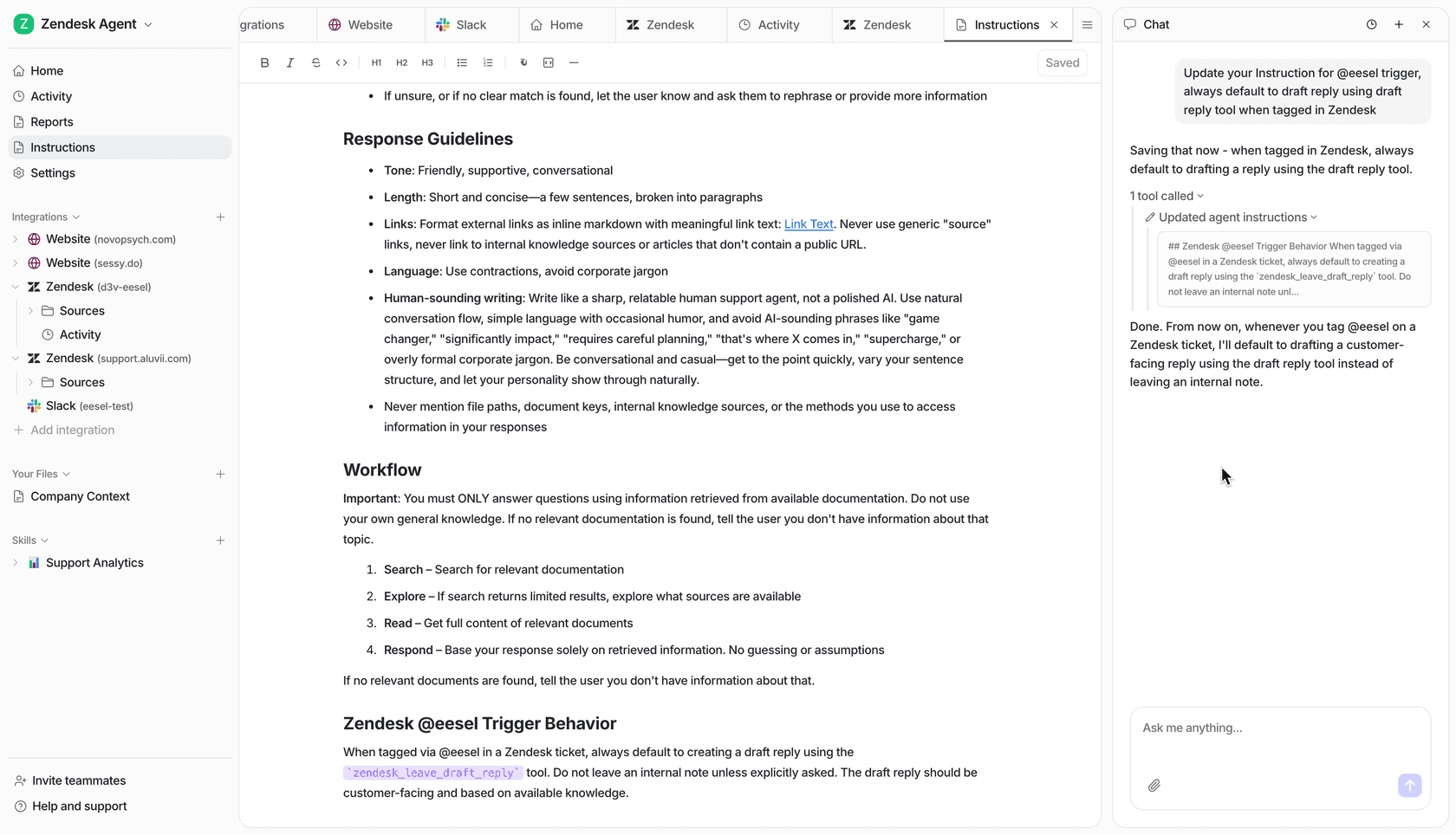
Here's how it differs:
- Learns from your existing data: Connect eesel AI to your help desk, and it immediately learns from past tickets, help center articles, and macros. No manual training or documentation uploads required.
- Progressive autonomy: Start with AI drafting replies for human review, then gradually expand to autonomous responses as the AI proves itself. Teams can achieve up to 81% autonomous resolution in mature deployments.
- Plain-English control: Define escalation rules and behavior in natural language ("Always escalate billing disputes to a human") rather than rigid workflow builders.
- Pre-go-live testing: Run simulations on thousands of past tickets before going live to verify quality and measure resolution rates.
For teams finding that traditional help desks (even AI-enhanced ones) still require too much manual work, eesel AI offers a fundamentally different model. You don't configure it; you hire it, train it, and level it up like any new team member.
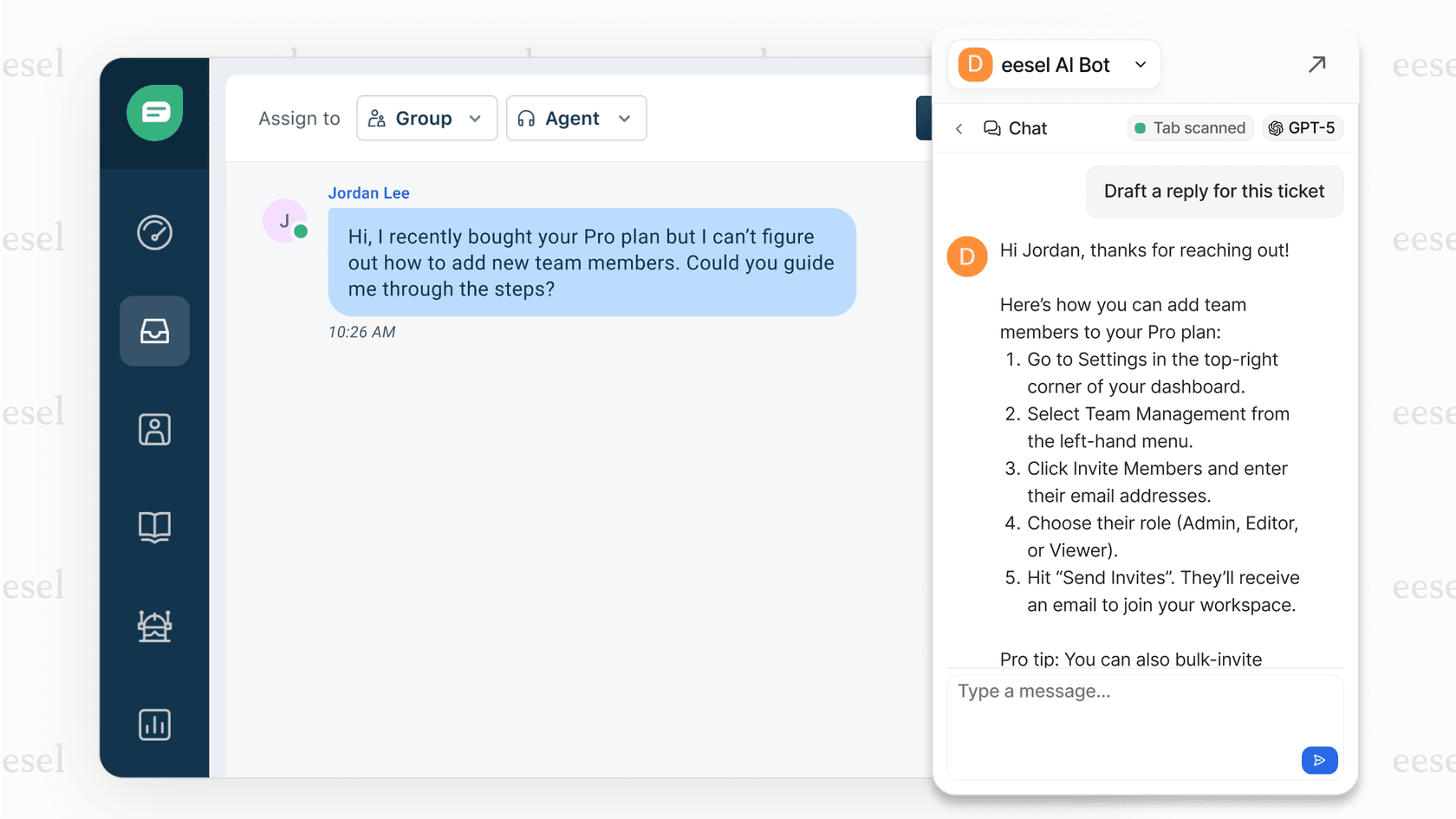
Explore eesel AI's AI Agent for autonomous support, or the AI Copilot if you prefer starting with human oversight. For a complete overview, see our eesel AI products.
Making your decision
Both Groove and Help Scout are solid choices for small to mid-sized teams moving beyond email-based support. The right choice depends on your specific situation:
| Factor | Choose Groove | Choose Help Scout |
|---|---|---|
| Team size | 5-50 agents | 1-50+ agents (free for 1-5) |
| Budget priority | Lower total cost, AI included | Free entry point, pay-as-you-grow AI |
| AI needs | Included features, no usage caps | Advanced AI chatbot with pay-per-resolution |
| Widget needs | Basic embeddable form/chat | Advanced Beacon with proactive messaging |
| B2B focus | Individual customer focus | Company/account-level management |
| Integrations | Core tools covered | Broadest ecosystem (100+) |
If you're still unsure, take advantage of both free trials. Groove offers 30 days; Help Scout offers 15 days on paid plans or unlimited free use for up to 5 users. Test them with your actual workflow before committing.
And if you find that neither quite solves the problem of scaling support without scaling headcount, it's worth exploring what an AI-native approach looks like with eesel AI.

Frequently Asked Questions
Share this article

Article by
Amogh Sarda
CEO of eesel AI. Amogh Sarda is obsessed with making the ultimate AI for customer service teams. He lives in Sydney, Australia and has previously worked at Atlassian and Intercom. Outside of work he’s usually surfing or on stage doing improv.