AI writing assistants are popping up everywhere, and honestly, they're pretty useful. They’ve become a go-to for marketers drafting copy, students polishing term papers, and just about everyone in between. They catch our typos, smooth out clunky sentences, and help us sound a bit more put-together. Two of the heavy hitters in this space are Grammarly and HyperWrite. If you're stuck trying to decide between them, you're in the right place.
This article is a head-to-head comparison of Grammarly vs HyperWrite, designed to help you figure out which tool is the right fit for your work.
It's good to remember that while both tools are great for helping you write, they're different from platforms built to create content from the ground up. If your main goal is to scale your blog and pull in serious organic traffic, you’ll probably want something that handles the whole process. For that, a dedicated AI content generation platform like the eesel AI blog writer can take you from a single keyword to a fully optimized, ready-to-publish post in just a few minutes. But we'll get to that later.
First, let's meet the contenders.
What is Grammarly?
Think of Grammarly as that one English teacher who always knew how to make your writing click. It's a cloud-based assistant that’s been helping people clean up their writing for years. Its main job is to check your text for the usual stuff: spelling mistakes, grammar errors, punctuation problems, and awkward phrasing.
It works in real-time, underlining potential issues and offering suggestions to improve clarity and tone. Recently, Grammarly also added GrammarlyGO, its generative AI feature, which can help you brainstorm, write text from scratch, or rewrite sentences on the fly. It's a solid choice for students, professionals, and anyone who wants their writing to be polished and error-free.
What is HyperWrite?
HyperWrite, on the other hand, is all about getting things done fast. It’s an AI writing assistant designed to help you create content more quickly. While it does spot errors, its real strength is in generating and rewriting content for you.
Its key features are "TypeAhead," which is basically autocomplete on steroids, suggesting entire phrases as you type, and the "Magic Editor," which can take a piece of your text and rewrite it, shorten it, or expand on it with a simple command. It's a favorite among marketers, copywriters, and anyone who needs to produce a lot of content, from emails to social media updates, without getting bogged down.
Comparing core features
Alright, let's dig into the details. Both tools are good, but they excel in different areas.
Grammarly's approach: Polish and refinement
Grammarly is your editor. It’s at its best when it's taking something you've already written and making it better. It’s less about creating from a blank page and more about perfecting what’s already there.
Here are its key features:
- Comprehensive Corrections: This is Grammarly’s core function. It catches everything from simple typos to tricky grammatical errors you might have missed.
- Style and Tone Suggestions: Is your email sounding a little too casual? Or maybe your report isn't confident enough? Grammarly gives you feedback to help you strike the right tone.
- Plagiarism Checker: A huge help for students and content creators, this premium feature scans billions of web pages to make sure your work is original.
- GrammarlyGO: This is its generative AI feature. You can ask it to brainstorm ideas, write a quick email, or rephrase a difficult sentence to sound more professional.
HyperWrite's approach: Speed and generation
HyperWrite is more like a creative partner. It’s built to get words on the page quickly and help you push past writer's block. The focus is more on generation than correction.
Here’s what it offers:
- AI Autocomplete (TypeAhead): As you type, HyperWrite predicts what you’re trying to say and offers suggestions. It can really speed up the drafting process.
- Magic Editor: Just highlight some text and tell the Magic Editor what to do. You can ask it to "make this more persuasive," "shorten this paragraph," or "expand on this idea."
- Content Generation: It can whip up initial drafts for all sorts of things, like emails, social media posts, or short articles, giving you a solid place to start.
- Contextual Chrome Extension: This is where HyperWrite really shines. Its extension understands the context of the webpage you're on, so it gives different suggestions in Gmail than it does in Google Docs.
Feature comparison at a glance
For a quick summary, here's how they stack up side-by-side:
| Feature | Grammarly | HyperWrite |
|---|---|---|
| Primary Use Case | Writing correction & polish | Content generation & acceleration |
| Generative AI | Yes (GrammarlyGO) | Yes (core functionality) |
| Plagiarism Detection | Yes (Premium) | No |
| Browser Extension | Yes | Yes (more deeply integrated) |
| Tone Detection | Yes | Limited |
| Best For | Error-free, polished writing | Quickly drafting and rewriting content |
User experience and workflow
How a tool fits into your daily routine is just as important as its features.
How Grammarly fits into your workflow
Grammarly is designed to be everywhere. You can get it as a browser extension for Chrome, Safari, and Firefox, use its web editor, install a desktop app for Windows or Mac, or use the Grammarly Keyboard on your phone.
The interface is incredibly simple. It underlines potential issues in your text, and you can hover over them to see a suggestion. You can accept the change with a click or ignore it. It’s helpful without getting in your way.
How HyperWrite fits into your workflow
HyperWrite lives mainly in its powerful Chrome extension. This is how most people use it. It integrates directly into the websites you use every day. When you're writing an email in Gmail or a post on LinkedIn, HyperWrite is right there with you, offering suggestions and ready to rewrite text on command. It feels more like an active collaborator working alongside you.
Pricing breakdown
Let's talk about the cost. Both tools have free plans, but the paid tiers are where you'll find the most powerful features.
Grammarly pricing plans
Grammarly keeps its pricing simple with three main tiers:
- Free: This plan covers the basics, like essential grammar, spelling, and punctuation checks. It's great for catching simple mistakes.
- Premium: This is where you get the advanced stuff. It includes everything in the Free plan plus suggestions for clarity, tone adjustments, a plagiarism detector, and more powerful generative AI capabilities with GrammarlyGO.
- Business: This plan is for teams. It has everything in Premium, plus features like a centralized style guide, an analytics dashboard, and advanced security.
HyperWrite pricing plans
HyperWrite's pricing is based on usage, with different plans offering a certain number of credits for its AI features.
- Free: The free plan gives you a limited number of credits each month. It's a good way to try out the basic features and see if you like the workflow.
- Premium: This plan gives you a much higher credit limit and access to more advanced AI models for better-quality suggestions.
- Ultra: This plan is for heavy users. It offers unlimited credits and access to HyperWrite's most powerful AI models.
Limitations for scaling SEO
Here are a few gaps you'll notice:
- They don't have built-in SEO research tools to help you optimize for keywords.
- They can't automatically generate a complete blog structure with headings and subheadings.
- They don't create visual assets like images, tables, or infographics, which are important for engagement.
- They can't pull in social proof like real Reddit quotes or embed relevant YouTube videos to add authority.
They help you write better sentences, but they don't help with the strategy, structure, or extra elements needed to rank on Google.
An alternative for scaling SEO: eesel AI blog writer
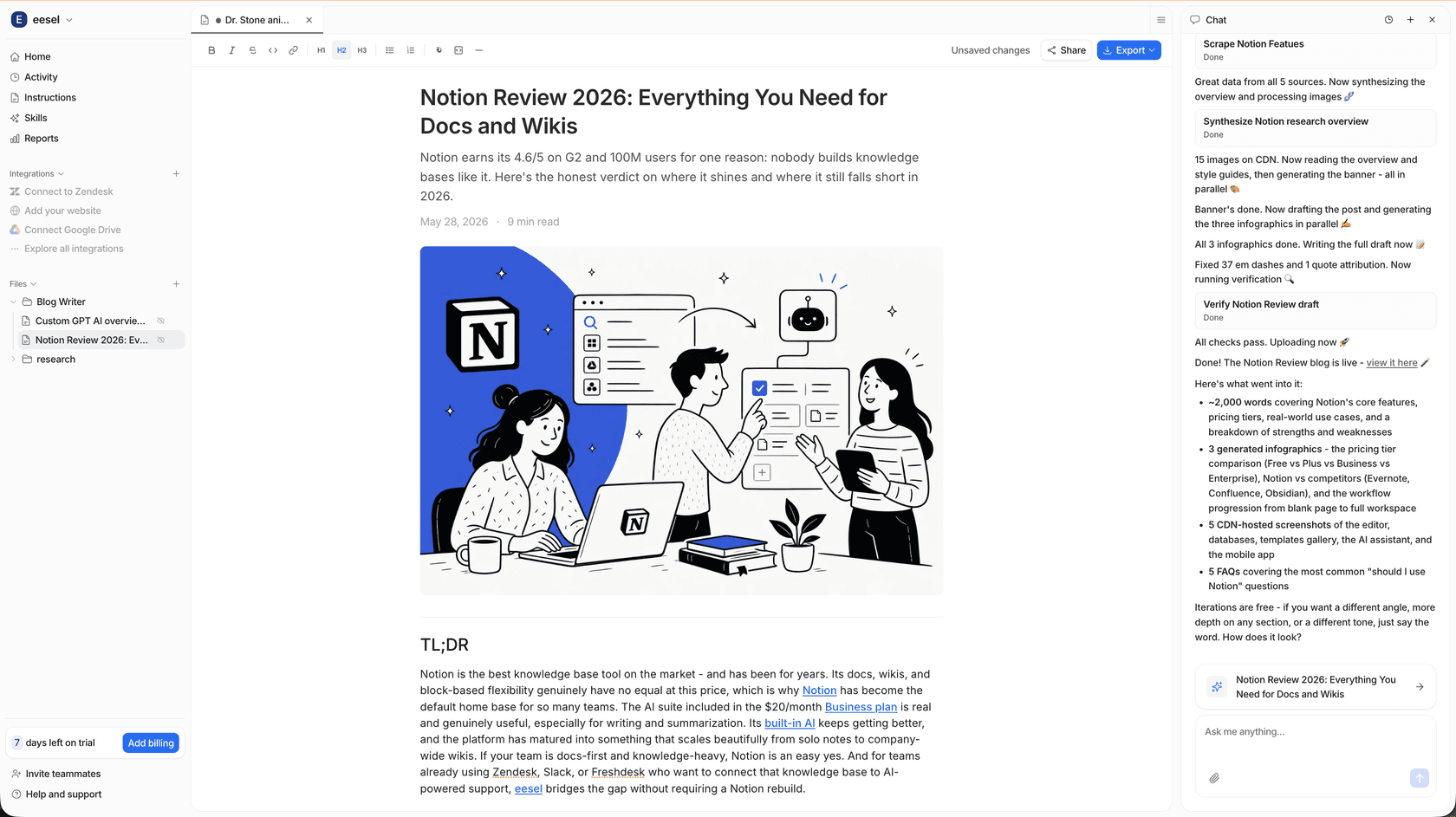
We know it works because it's the same tool we used here at eesel AI to grow our own traffic from 700 to 750,000 daily impressions in just three months.
It's built to fill the gaps left by standard writing assistants:
- Complete Blog Generation: It doesn't just write paragraphs; it creates a fully structured post with an introduction, H2s, H3s, a conclusion, and an FAQ section.
- Automatic Assets: It generates relevant images, infographics, and tables to make your content more engaging.
- Social Proof Integration: It automatically finds and embeds real Reddit quotes and relevant YouTube videos to add credibility to your posts.
- AEO Optimization: The content is built to rank in AI Answer Engines like Google AI Overviews and Perplexity, not just traditional search.
- Context-Aware Research: The AI researches your topic, pulling in pricing data for comparison posts or technical specs for reviews, making sure your content is thorough.
Making the right choice
So, which tool should you pick? It really depends on your specific needs and goals.
I have been writing blog posts recently and was looking for an AI tool with ideas. Thanks for the this!

- Choose Grammarly if your main goal is to make sure your writing is polished, professional, and error-free. It's the best editor around.
- Choose HyperWrite if you need to speed up your drafting process for short-form content like emails, ad copy, and social media posts. It's a great accelerator.
But if you're a marketer or business owner focused on scaling organic traffic, you'll need more than just a writing assistant. Consistently publishing high-quality, SEO-optimized blog posts calls for a dedicated content generation platform.
Ready to see what a purpose-built tool can do? Give the eesel AI blog writer a try for free and generate your first complete article in minutes.
Frequently Asked Questions
What's the main difference between Grammarly and HyperWrite?
For a student, which is better: Grammarly or HyperWrite?
How do the free plans of Grammarly and HyperWrite compare?


Article by
Alicia Kirana Utomo
Kira is a writer at eesel AI with a Computer Science background and over a year of hands-on experience evaluating AI-powered customer service tools. She focuses on breaking down how helpdesk platforms and AI agents actually work so that support teams can make better buying decisions.