Choosing the right documentation platform is a decision that sticks with you. Pick the wrong one and you'll be wrestling with workflows that don't fit your team, paying for features you don't use, or hitting scaling limits just as your documentation needs grow.
The good news? Both GitBook and Confluence are solid choices. They just solve different problems. This guide will help you figure out which one matches how your team actually works.
What is GitBook?
GitBook is an AI-native documentation platform built primarily for technical teams. It started in 2014 as an open-source book publishing tool but has evolved into a platform purpose-built for developer documentation, API docs, and public-facing knowledge bases.
The core philosophy behind GitBook is docs-as-code. It treats documentation like software: versioned, reviewable, and synchronized with your codebase. If your team already lives in GitHub or GitLab, GitBook feels like a natural extension of that workflow.
Key strengths include:
- Git-native workflows: Bi-directional sync with GitHub and GitLab means changes in either system stay synchronized
- Developer-focused features: Built-in OpenAPI support, code blocks, and technical formatting
- Clean publishing: Documentation sites look polished and professional out of the box
- AI capabilities: GitBook Agent proactively suggests improvements, and the platform is optimized for LLM discovery
GitBook works best when your documentation is primarily technical, customer-facing, and maintained by developers or technical writers who are comfortable with Git workflows.
What is Confluence?
Confluence is Atlassian's enterprise workspace for knowledge management and team collaboration. It has been on the market for over 20 years and serves more than 60,000 customers worldwide. As part of the Atlassian ecosystem, it integrates deeply with Jira, Trello, Loom, and the newer Rovo AI platform.
Unlike GitBook's narrow focus on technical documentation, Confluence aims to be a general-purpose workspace where any team can create, share, and collaborate on content. Product managers write requirements. Marketing teams plan campaigns. HR publishes policies. Engineering maintains runbooks. All in one place.
Key strengths include:
- Cross-functional collaboration: Real-time editing, commenting, and @mentions work across departments
- Content variety: Pages, whiteboards, databases, and embedded video (via Loom) all live together
- Atlassian ecosystem: Deep native integration with Jira for linking documentation to development work
- Enterprise scale: Supports up to 150,000 users per site with advanced permissions and governance
Confluence shines when you need a central knowledge hub for your entire organization, not just your engineering team.
GitBook vs Confluence: Feature comparison
Editing experience
GitBook offers a block-based editor that supports both visual editing and Markdown. Technical users can write in Markdown or their IDE, while non-technical contributors get a clean WYSIWYG interface. The editor includes AI-powered linting and suggestions through GitBook Agent.
Confluence uses a more traditional rich text editor with extensive formatting options, templates, and macros. It supports real-time collaborative editing where multiple users can work on the same page simultaneously. The learning curve is steeper, but the feature set is broader.
Bottom line: GitBook wins for technical writers who prefer Markdown and Git workflows. Confluence wins for teams that need rich formatting and real-time collaboration across diverse skill levels.
Version control and workflows
This is where the two platforms diverge most significantly.
GitBook is built on Git. Every change creates a commit. Documentation updates follow the same review process as code: branch, edit, open a change request, review, merge. This is ideal when documentation should version alongside your product releases.
Confluence uses page history and versioning, but it is not Git-based. Changes are tracked, and you can revert to previous versions, but the workflow is more document-centric than code-centric.
Bottom line: If your docs should evolve with your codebase, GitBook's Git-native approach is architecturally superior. If docs evolve with business processes and team discussions, Confluence fits better.
Search and discovery
GitBook provides fast, focused search within published documentation. The AI-powered search understands context and can surface relevant content quickly.
Confluence offers AI-powered search through Rovo, which can find answers across Confluence, Jira, and other connected tools. However, user reviews frequently mention that Confluence search can be hit-or-miss, especially in large instances with thousands of pages.
Bottom line: GitBook search is more reliable for focused documentation sites. Confluence search is more powerful when integrated across the Atlassian ecosystem, but can frustrate users in large deployments.
Integrations
GitBook integrates with developer tools: GitHub, GitLab, Linear, Sentry, and various analytics platforms. It also offers authenticated access through Auth0, Okta, and Azure AD. The integration philosophy is documentation-first: connect the tools that help you create and maintain docs.
Confluence offers over 1,000 apps through the Atlassian Marketplace, plus native integrations with the entire Atlassian suite. You can embed Jira issues, Trello boards, Figma designs, Google Docs, and much more directly into pages.
Bottom line: GitBook integrates with the tools developers use to build products. Confluence integrates with the tools teams use to run businesses.
GitBook vs Confluence: Pricing comparison
| Plan | GitBook | Confluence |
|---|---|---|
| Free | $0/site (1 user, unlimited public sites) | $0 (up to 10 users, 2GB storage) |
| Standard | $65/site/month + $12/user/month | $5.42/user/month |
| Premium | $249/site/month + $12/user/month | $10.44/user/month |
| Enterprise | Custom pricing | Custom pricing |
Key pricing differences:
GitBook charges per site plus per user. This means if you manage documentation for multiple products or API versions, costs scale with the number of sites, not just users. A team of 10 engineers managing 5 documentation sites would pay $65 × 5 + $12 × 10 = $445/month on GitBook Premium.
Confluence charges purely per user. That same team of 10 would pay $5.42 × 10 = $54.20/month on Confluence Standard, or $10.44 × 10 = $104.40/month on Premium.
Bottom line: For small teams with one documentation site, GitBook can be cost-competitive. For larger teams or organizations managing multiple knowledge bases, Confluence's per-user pricing is typically more economical.
Use case recommendations
Choose GitBook if:
- You're building API documentation or developer portals
- Your team uses Git workflows and thinks in Markdown
- You need documentation to version alongside code releases
- You want custom domains and branded public documentation
- Your documentation is primarily technical and customer-facing
Choose Confluence if:
- You need an internal wiki for cross-functional teams
- Your organization uses Jira or other Atlassian tools
- You want real-time collaboration on living documents
- You need to support thousands of users with enterprise governance
- Your documentation includes diverse content types (meeting notes, project plans, policies)
User feedback and ratings
Both platforms rate similarly on Capterra, with GitBook scoring 4.5/5 and Confluence scoring 4.5/5.
What GitBook users praise:
- Clean, modern interface that makes documentation look professional
- Excellent Markdown and GitHub integration
- Easy custom domain setup
- Fast publishing workflow
What GitBook users criticize:
- Limited customization options compared to competitors
- Per-site pricing gets expensive when managing multiple docs
- Less suitable for internal wiki use cases
What Confluence users praise:
- Feature-rich platform with extensive capabilities
- Excellent Jira integration for development teams
- Templates and macros speed up content creation
- Scales to support large organizations
What Confluence users criticize:
- Steep learning curve for new users
- Search functionality can be frustrating
- Interface feels dated compared to newer tools
- Performance issues with large pages or complex diagrams
GitBook makes it super easy to spin up a tech doc site for any coding project whilst making the end result look really good. I really like being able to write the docs in markdown and host the docs on GitHub.

Confluence is the industry standard for technical knowledge management. It has been used extensively by engineering teams for many years. There are a ton of features and functionalities, but it could benefit from better UX for non-technical users.
Making the right choice for your documentation strategy
The decision between GitBook and Confluence comes down to a few key questions:
Who creates your documentation? If it is primarily developers and technical writers, GitBook's Git-native workflow will feel natural. If it is cross-functional teams with varying technical skills, Confluence's approachable editor is the better fit.
Who reads your documentation? For customer-facing technical documentation, GitBook's publishing capabilities and custom domains are hard to beat. For internal knowledge sharing across departments, Confluence's collaboration features win.
How does documentation get updated? If updates happen through code releases and pull requests, GitBook is designed for that flow. If updates happen through meetings, discussions, and ongoing collaboration, Confluence supports that better.
What is your budget? For small teams with simple needs, both offer free tiers. For larger teams, Confluence's per-user pricing generally scales more affordably than GitBook's per-site model.
A third option to consider
What if your documentation needs go beyond what either platform offers? Many teams find they need both internal knowledge management (where Confluence excels) and AI-powered customer-facing support (where neither platform is purpose-built).
This is where eesel AI comes in. While GitBook and Confluence focus on documentation creation and organization, eesel AI focuses on turning that documentation into automated customer support. It integrates with both platforms (plus Zendesk, Freshdesk, and others) to train AI agents on your existing knowledge base.
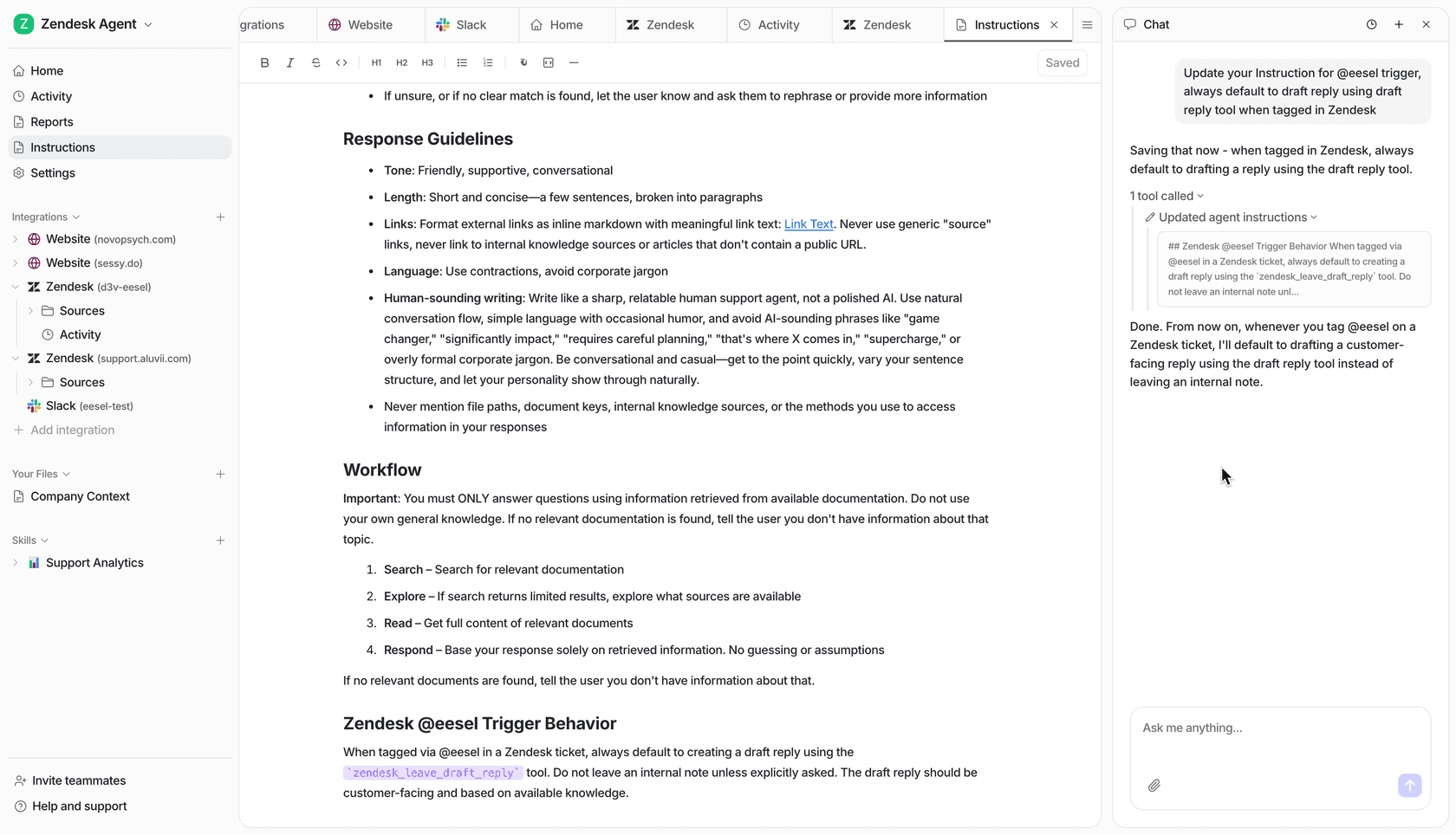
The workflow looks like this: use Confluence or GitBook for creating and organizing your documentation, then use eesel AI to turn that documentation into instant answers for customer questions. The AI agent learns from your docs, past tickets, and help center articles to resolve tickets autonomously.
For teams already invested in either documentation platform, adding an AI layer for customer-facing support can be more practical than migrating to an all-in-one solution that does neither job particularly well.