FullStory vs Adora: Complete 2026 Comparison

Stevia Putri
Last edited April 29, 2026
If your team handles over 10,000 sessions a month, FullStory's Fullcapture ensures you never miss a click, but the price tag can be prohibitive. For agile teams who need to keep documentation in sync with live screens, Adora offers a unique visualization layer at a lower entry point. Full breakdown below.
When you're trying to figure out why users aren't converting, numbers only tell half the story. You might see a high bounce rate on your checkout page, but you don't know if users are hitting a bug, getting confused by the UI, or simply losing interest. This is where digital experience platforms come in. Both FullStory and Adora aim to close that gap, yet they approach the problem from completely different angles.
FullStory is the established giant in behavioral data, known for its ability to index every single interaction a user makes. It's built for scale and deep technical analysis. Adora, a newer entry founded in 2023, focuses on visualization and "living" documentation. It treats your product like a visual library rather than just a stream of data points.
Choosing between them isn't just about comparing feature lists; it's about deciding whether you need a data powerhouse or a visual source of truth. We've spent time digging into both platforms to see how they stack up in 2026.
What is FullStory?
FullStory describes its mission as "revealing the untold story behind consumer behavior." It isn't just a session replay tool; it's a comprehensive behavioral data platform that captures every click, scroll, and page transition on both web and mobile sites.
The core of their offering is a technology called Fullcapture. Unlike traditional analytics tools that require you to manually tag every event you want to track, Fullcapture records everything automatically. This means you can ask questions about your data retroactively. If you decide today that you want to see how many people clicked a specific "Help" button six months ago, the data is already there waiting for you.
FullStory is primarily built for enterprise product teams, engineers, and data scientists. It provides high-fidelity session replays that show exactly what a user saw, even accounting for complex tabbed browsing. For teams at companies like Duolingo or Chipotle, it provides the massive scale needed to handle millions of sessions while surfacing "friction signals" like rage clicks and dead clicks that indicate user frustration.
What is Adora?
Adora takes a more visual approach with a mission to "visualize your entire product experience." While FullStory focuses on the data stream, Adora focuses on the screens themselves. It automatically maps every journey and screen in your product as they appear in production, creating a live, auto-updating product library.
Instead of just showing you a list of sessions, Adora builds automated journey maps. It aggregates every page, dialog, and dropdown you serve to your users into a searchable design library. This makes it a powerful tool for UX designers and product managers who need to see the "big picture" of how their product is actually built and navigated.
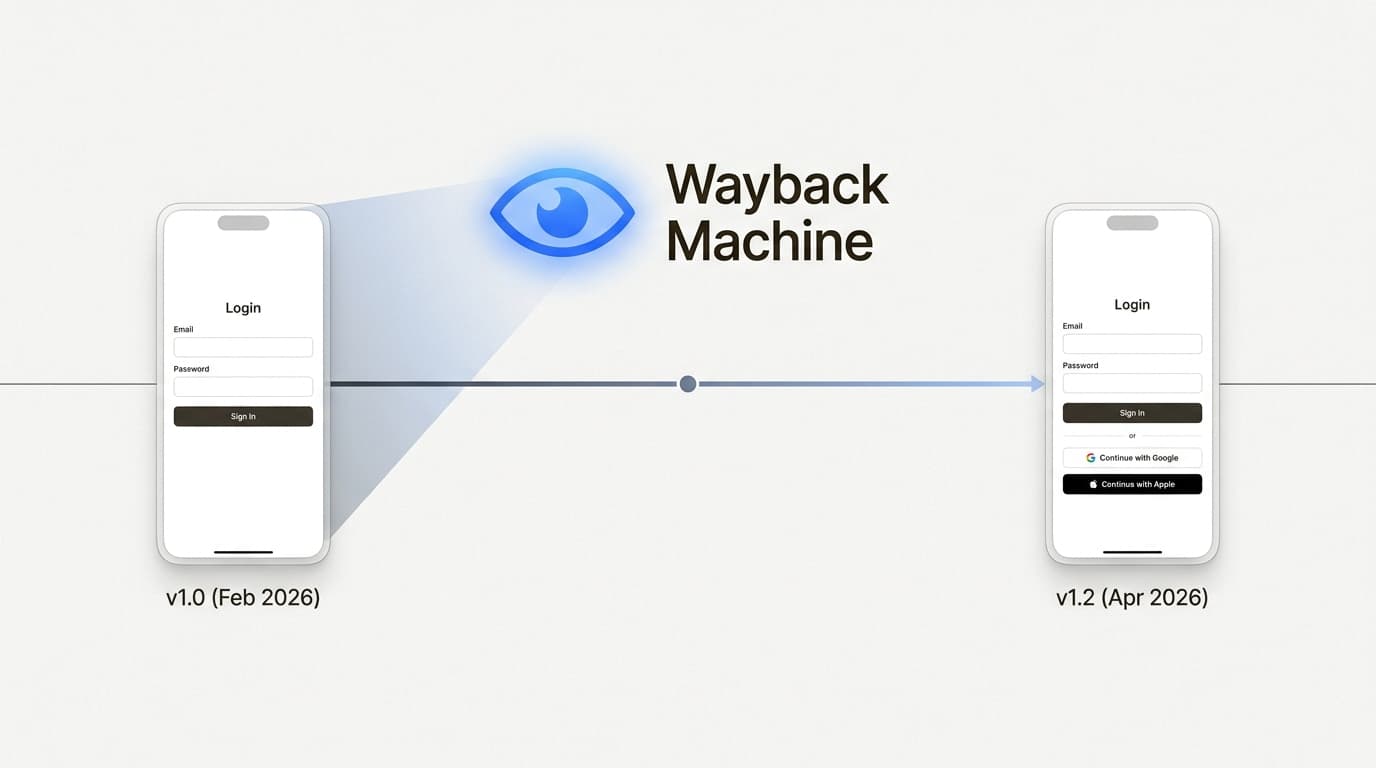
One of its most unique features is the Wayback Machine, which allows you to look back at how your product evolved over time. You can trace issues back to their source by seeing exactly what a screen looked like weeks or months ago.
Adora also leans heavily into documentation, offering integrations with Notion and Confluence to create living product docs that stay in sync with your live production environment.
Key features comparison: Behavioral data vs. product maps
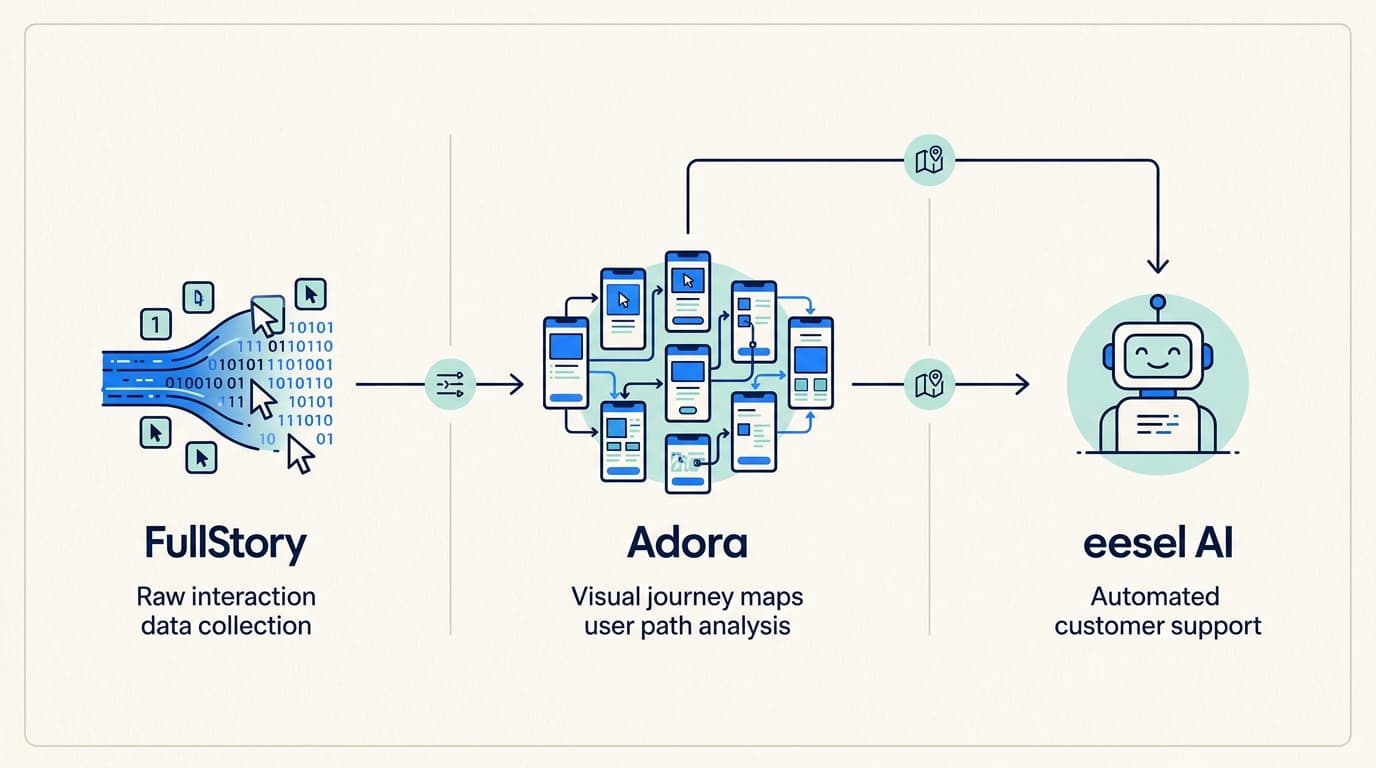
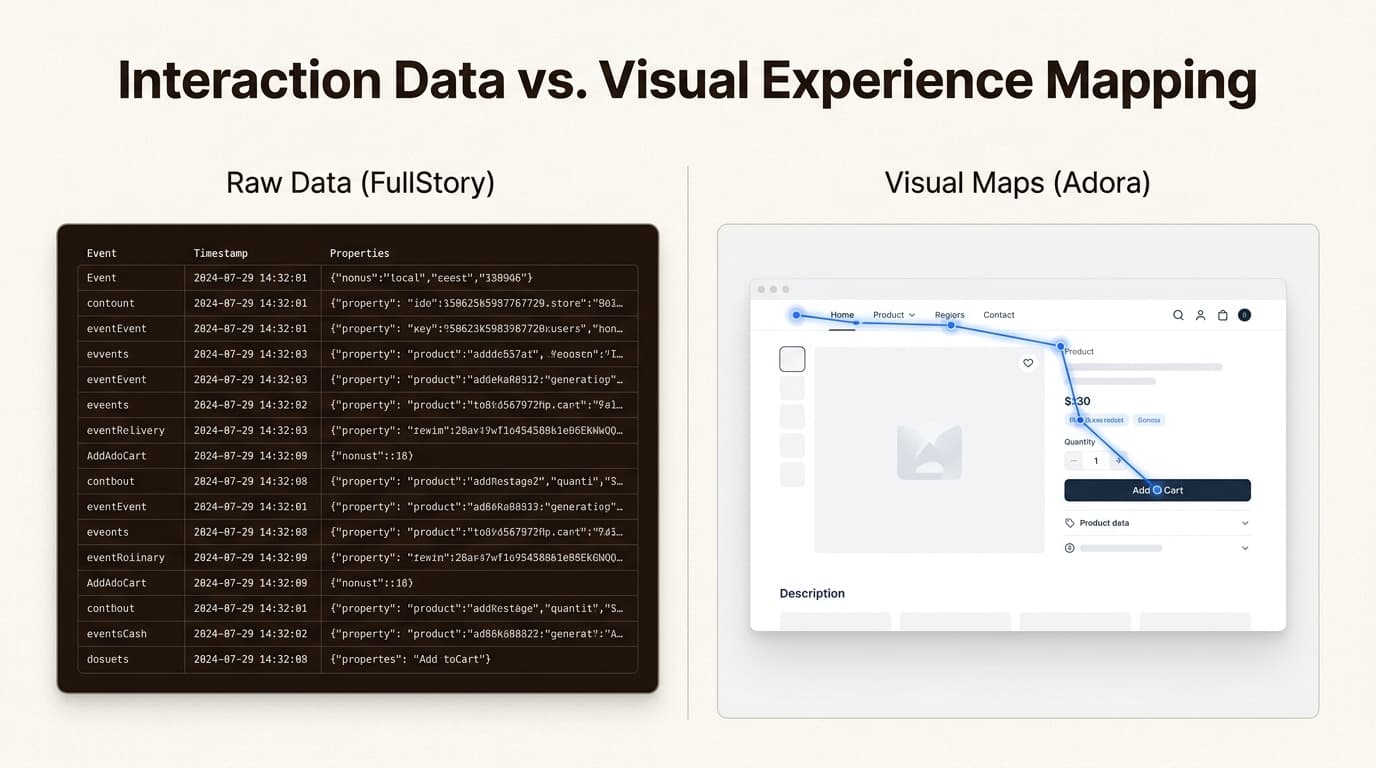
The main difference between FullStory vs Adora lies in how they organize information. FullStory is a database of actions, while Adora is a library of experiences. Let's break down how that impacts your daily workflow.
Session replay and insights
Both tools offer session replays, but they use them differently. FullStory uses replays as the evidence behind its product analytics. When you see a drop-off in a conversion funnel, you can click through to watch the specific sessions where users struggled. Its AI identifies sentiment signals like rage clicks (clicking the same element repeatedly) and thrashed cursors.
Adora uses replays to give visual context to its journey maps. Because Adora understands the structure of your product's screens, its replays feel more like watching a user move through a blueprint. Its "Visual Analytics" layers conversion data directly onto the real product screens, so you see the numbers in the context of the UI they belong to, rather than on an abstracted dashboard.
Data capture vs. journey mapping
FullStory is the king of tagless autocapture. Its engine is constantly indexing every interaction, which is a massive advantage for data teams who need to build predictive models or export raw event data to a warehouse like Snowflake. It provides a level of technical depth that's hard to beat when you're trying to debug a complex JavaScript error or quantify the exact dollar value of a bug.
Adora's journey mapping is designed for alignment. It automatically maps the actual paths users take, showing you the "spaghetti" of real usage. This is perfect for identifying where users are taking unintended shortcuts or getting lost in loops. Since it aggregates all variations (different languages, experiments, and devices), it serves as a single source of truth for what your product actually looks like in the wild.
Documentation and workflow
This is where the two platforms truly diverge. Adora is built to be a part of your design and documentation workflow. Its ability to embed live screens and journeys directly into Notion or Confluence means your product specs never go out of date. If a developer changes a modal in production, that change is reflected in your documentation automatically.
FullStory is built to integrate with your support and engineering stack. It connects with helpdesks like Zendesk and Jira, allowing support agents to see a replay of exactly what a customer did before they submitted a ticket. This reduces the back and forth of "can you send me a screenshot?" and helps engineering teams reproduce bugs in minutes.
AI capabilities
AI is a major focus for both in 2026. FullStory offers StoryAI, which can generate one-click text summaries of user sessions. Instead of watching a 10-minute replay, you can read a paragraph that explains exactly what the user was trying to do and where they failed. You can also "Ask StoryAI" questions about your data in natural language.
Adora's AI focuses on insight analysis and automated mapping. It has AI agents that watch your product 24/7, flagging friction points as they happen. Its "Ask Adora" interface allows you to query your product library with questions like "which countries have the highest retention?" and get answers with live screens and journeys attached.
Pricing and scalability: Which fits your budget?
Pricing for FullStory vs Adora follows the "enterprise vs. self-serve" divide. FullStory uses an interaction-based pricing model that is notoriously opaque. While they offer FullstoryFree, which includes 30,000 sessions a month and 12 months of data retention, most of their "modern" features like StoryAI, native mobile support, and Surveys are sold as add-ons.
Adora is much more accessible for startups and scaling teams. They offer a 14-day free trial with no credit card required. Their plans are tiered based on session volume, with clear, transparent pricing for their Explorer and Business plans.
| Plan | Monthly Price | Annual Price | Key Limits |
|---|---|---|---|
| FullstoryFree | $0 | $0 | 30K sessions, 10 users |
| FullStory Business | Contact Sales | Contact Sales | Custom session limits |
| Adora Explorer | $330 | $264 (20% off) | 50K sessions, 10 members |
| Adora Business | $950 | $760 (20% off) | 50K sessions, unlimited members |
FullStory's cost often includes the "hidden" expense of engineering time for setup and data management, whereas Adora is designed for fast, no-code integration. However, Adora's data retention is quite short (30 days on Explorer, 90 days on Business), which might be a dealbreaker if you need to look back at trends over a whole year.
Use cases: Who should choose which platform?
The decision between FullStory vs Adora often comes down to your team's role and the size of your company.
Choose FullStory if:
- You are a large enterprise: Brands that need to manage thousands of users and connect behavioral data to a massive data warehouse will benefit from FullStory's infrastructure.
- You need deep technical intelligence: If your primary goal is debugging complex technical issues or quantifying the financial impact of every user interaction, FullStory is the better choice.
- You require long-term data history: With retention options extending up to a year or more, FullStory is better for analyzing seasonal trends.
Choose Adora if:
- You are an agile product team: If you need to move fast and keep your UI/UX documentation up to date without manual effort, Adora's visual approach is a major time-saver.
- You prioritize visualization over data tables: If your team finds traditional analytics dashboards too abstracted, seeing data layered on live screens will be much more intuitive.
- You are a startup on a budget: Adora's transparent pricing and lower entry point for significant session volume make it more accessible than FullStory's enterprise-heavy model.
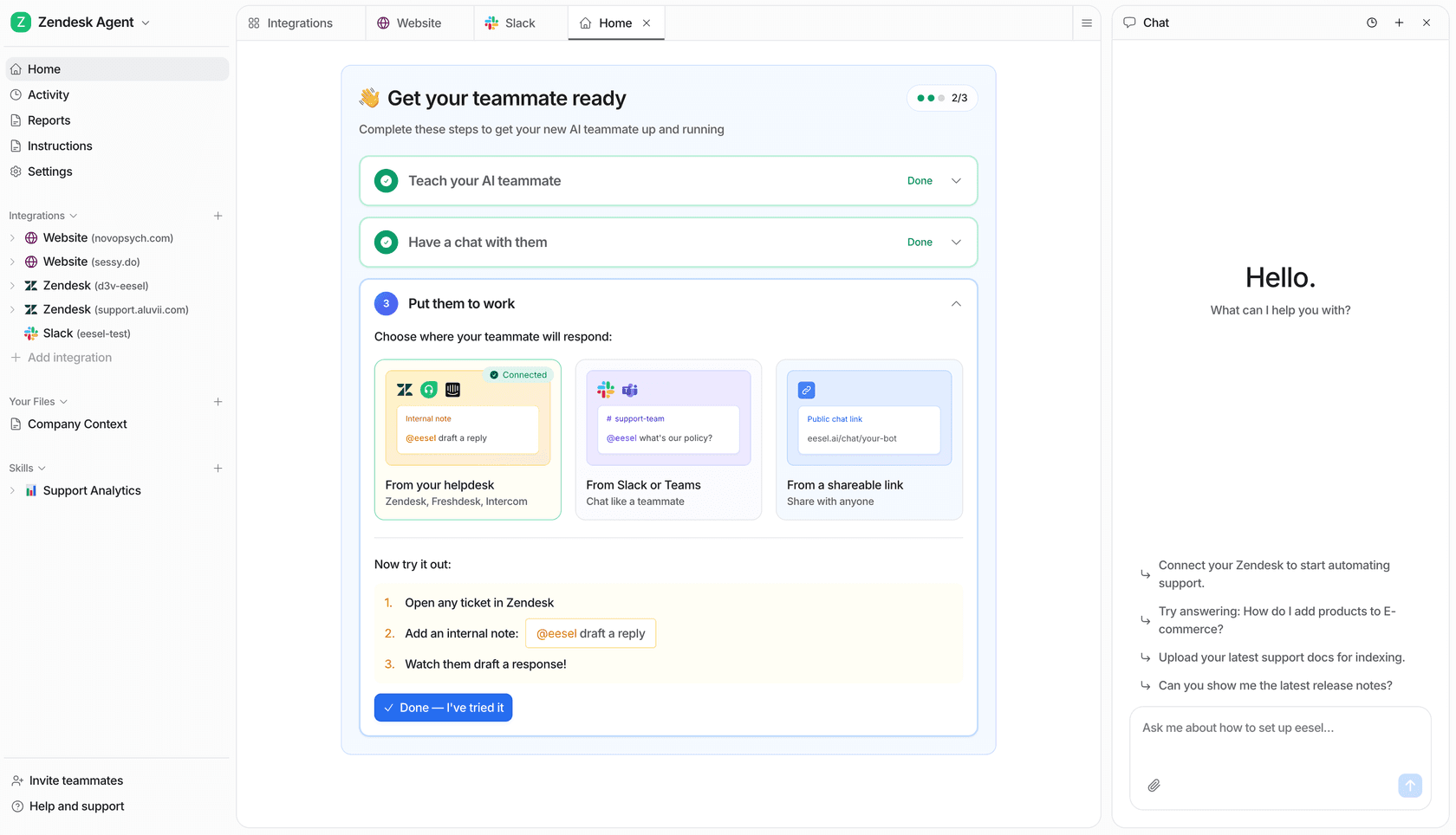
It's also worth noting that these tools don't have to exist in a vacuum. For support teams using FullStory to identify bugs, we've found that adding an AI agent can close the loop on automation. While FullStory identifies where users are struggling, our eesel AI agents can actually jump in to resolve those tickets autonomously, using the same knowledge from your documentation that Adora helps keep organized.
Choosing the right tool for your product team
FullStory is a powerhouse for teams that live in their data. It's the right move if you have the resources to manage it and the need for deep, technical behavioral analysis. It captures everything, but it requires you to know what questions to ask.
Adora is the choice for teams that live in their product. It prioritizes clarity and alignment, turning your live screens into a searchable library that everyone from designers to product managers can understand. It's about seeing your product as your users see it, end-to-end.
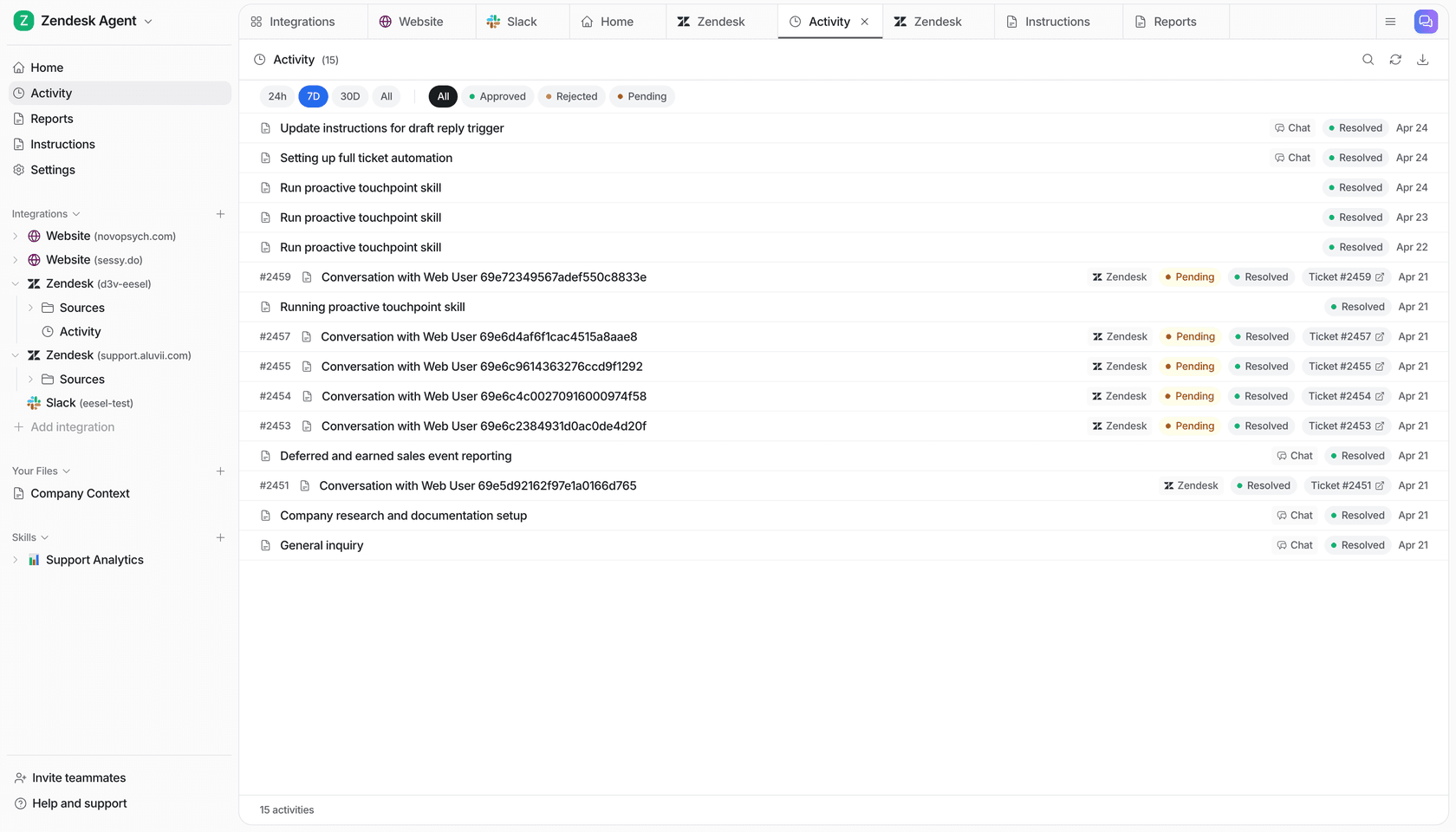
Bottom line? If you want to index every action, go with FullStory. If you want to map every journey, Adora is the way to go. To see how AI can further take the heavy lifting off your team's plate, check out how we handle support automation at eesel AI.

Frequently Asked Questions
Share this article

Article by
Stevia Putri
Stevia Putri is a marketing generalist at eesel AI, where she helps turn powerful AI tools into stories that resonate. She’s driven by curiosity, clarity, and the human side of technology.