7 Best Kayako Alternatives in 2026: I Tested the Top Options

Stevia Putri
Last edited April 28, 2026
Most help desks promise "AI" that ends up being a glorified search bar or a complex bot that takes weeks to train. We tested 7 Kayako alternatives to see which ones actually deliver on autonomous resolution. The winner set itself apart by learning from existing docs in minutes, not months.
The customer support landscape has shifted. In 2026, the goal is no longer just "managing tickets." It is about resolving them. While Kayako was a pioneer in the shared inbox space, teams are finding that legacy architectures often struggle to keep up with the demands of modern, AI-driven support. Whether you are looking for more automation, better pricing transparency, or a tool that actually feels like a member of your team, there is a better way to handle your customer conversations.
Why teams are moving beyond Kayako in 2026
Kayako was once the gold standard for help desk software, but time has not been kind to its legacy architecture. One of the biggest frustrations for teams in 2026 is data siloing. Kayako's structure often leads to conversational data being trapped in different modules, making it difficult for agents to get a unified view of the customer journey.
Beyond the data issues, Kayako's native AI capabilities remain limited. Many teams find themselves stuck between expensive add-ons or complex third-party integrations just to get basic automation working. In an era where customers expect instant, intelligent responses, having to "bolt on" AI is a significant disadvantage.
Frustration with pricing is another major driver for the migration. The traditional per-seat model often penalizes growth. As your team expands, your bill skyrockets, regardless of how many tickets are actually being resolved. Combined with slow setup times that can stretch into weeks, it is clear why many organizations are looking for a more agile, modern alternative.
How we chose the best Kayako alternatives
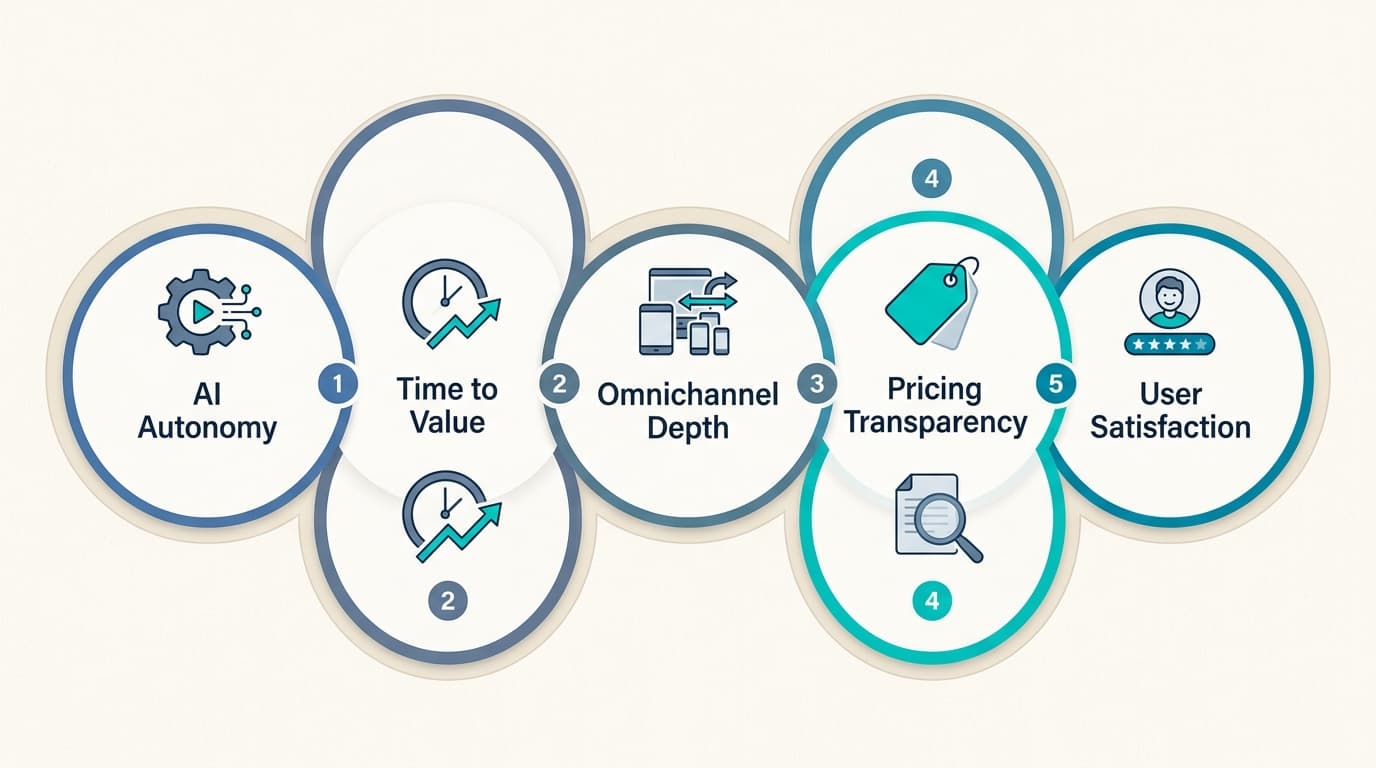
Selecting a replacement for a foundational tool like Kayako requires a rigorous approach. We evaluated dozens of platforms, focusing on five key criteria that define the next generation of support.
- AI Autonomy: We looked for tools that do more than just draft replies. The best alternatives can actually resolve tickets end-to-end, taking real actions in your connected apps.
- Time to Value: How quickly can you go from "signed up" to "live"? We prioritized tools that offer modern implementations measured in days or hours, not months.
- Omnichannel Depth: A true alternative must unify all channels, including email, live chat, social media, and even internal documentation, into a single workspace.
- Pricing Transparency: We avoided tools with hidden AI fees or seat-based traps that make your costs unpredictable.
- User Satisfaction: Our rankings incorporate G2 ratings and direct hands-on testing to ensure each tool delivers on its marketing promises.
Comparison of the top 7 Kayako alternatives in 2026
| Tool | Best For | Starting Price | AI Strength |
|---|---|---|---|
| eesel AI | Autonomous Resolution | $0.40/resolution | Deep Knowledge Learning |
| Zendesk | Large Enterprises | $19/agent/mo | Intent Detection |
| Freshdesk | Mid-Market SMBs | Free / $15/agent/mo | Self-Service Bots |
| Help Scout | Human-Centric Teams | $20/user/mo | AI Summaries |
| Supportbench | B2B Account Management | $32/agent/mo | Sentiment & Health |
| Crisp | Product-Led Startups | Free / $45/workspace | Real-Time AI Agent |
| Zoho Desk | Zoho Ecosystem Users | Free / $7/user/mo | Zia Assistant |
The 7 best Kayako alternatives compared
1. eesel AI
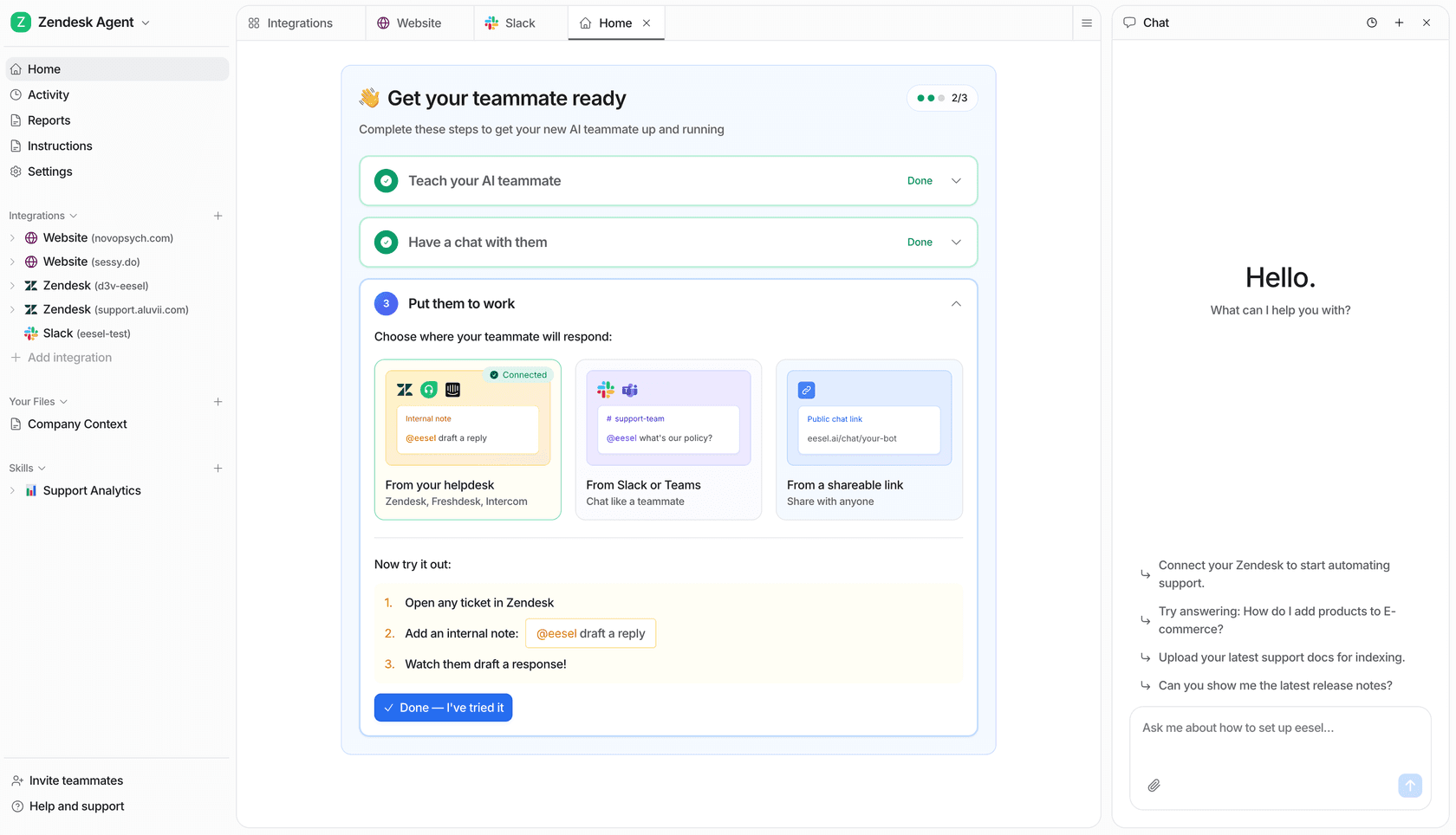
We believe the best way to handle support is to stop "managing" tickets and start resolving them. eesel AI is not just a bot you configure; it is an AI teammate you hire. Unlike legacy systems that require manual Q&A training, our AI learns instantly from your help centers, past tickets, and internal docs like Notion or Google Docs.
The eesel AI agent handles frontline support autonomously. It does not just draft a reply for an agent to check; it understands your business context and resolves the issue end-to-end. If a task is too complex, it seamlessly escalates to a human, ensuring your customers always get the right answer.
| Criteria | Details |
|---|---|
| Pros | Easiest setup, no engineering required, multilingual support. |
| Cons | Newer player compared to some legacy giants. |
| Pricing | Pay-per-task: $0.40 for regular resolutions; $2.00 for heavy tasks. |
| Best For | Teams wanting an autonomous agent that works out of the box. |
We focused on building a transparent ROI model. You only pay for what the AI actually solves, which means your costs stay perfectly aligned with your volume.
2. Zendesk
Zendesk is the incumbent giant in the customer service space. It is a comprehensive platform built for deep scalability, offering a massive marketplace of over 1,500 apps. For large enterprises with highly complex workflows, Zendesk provides the robust reporting and case management features that Kayako often lacks.
Their AI suite focuses on intent detection and agent assistance. While powerful, it often requires significant administrative overhead to manage. It is a tool for companies that have dedicated staff to maintain their help desk infrastructure.
| Plan | Price | Key Features |
|---|---|---|
| Support Team | $19/agent/mo (annual) | Basic ticketing, social channels |
| Suite Team | $55/agent/mo (annual) | Omnichannel, Zendesk AI |
| Suite Professional | $115/agent/mo (annual) | Advanced reporting, SLA management |
One major drawback is the cost. Zendesk's advanced AI features often require a $50 per agent monthly add-on, making it one of the most expensive options on the list.
3. Freshdesk
Freshdesk is often cited as the more user-friendly alternative to Zendesk. It strikes a great balance between enterprise power and SMB usability. Its Freddy AI suite handles everything from automated ticket routing to "next-best-action" suggestions for agents.
For teams moving from Kayako, Freshdesk offers a familiar ticketing experience but with better automation and reporting. It is particularly strong for teams that need to support customers across multiple channels without getting bogged down in complex configurations.
| Plan | Price | Key Features |
|---|---|---|
| Free | $0 (up to 10 agents) | Knowledge base, basic reporting |
| Growth | $15/agent/mo (annual) | Automation, custom SSL |
| Pro | $49/agent/mo (annual) | SLA management, multilingual support |
While it is more affordable than Zendesk, some of its most advanced AI features are locked behind the higher-tier Enterprise plans, which can be a hurdle for smaller teams.
4. Help Scout
Help Scout is designed for teams that hate "ticket numbers." It prioritizes a human-centric experience, with a shared inbox that looks and feels like personal email. It is a favorite for B2B companies that value long-term customer relationships over high-volume ticket deflection.
Their AI approach is assistive rather than fully autonomous. Features like AI Summarize help agents catch up on long threads quickly, while AI Drafts suggest starting points for replies. It is about making your humans faster, not replacing them.
| Plan | Price | Key Features |
|---|---|---|
| Standard | $20/user/mo (annual) | 2 mailboxes, Beacon, Docs |
| Plus | $40/user/mo (annual) | 5 mailboxes, custom fields, SSO |
| Pro | $65/user/mo (annual) | 25 mailboxes, HIPAA compliance |
Help Scout is incredibly easy to configure, but it may lack the deep enterprise features (like native voice support or complex SLA management) that larger organizations require.
5. Supportbench
Supportbench is a specialist tool built specifically for B2B support teams. It moves away from the individual ticket model toward an account-centric data model. This allows you to track the "health" of an entire customer contract rather than just isolated issues.
Its AI capabilities are uniquely focused on churn prediction and sentiment analysis. It can notify your success team if a high-value account is showing signs of frustration, even if their tickets are technically being resolved within SLA.
| Plan | Price | Key Features |
|---|---|---|
| Professional | $32/agent/mo (annual) | Core ticketing, account management |
| Enterprise | $100/agent/mo (annual) | Advanced automation, CRM sync |
Supportbench is built for complex B2B cases, but its niche focus might be overkill for a standard B2C support operation.
6. Crisp
Crisp is the most modern, "chat-first" option on this list. It is built for product-led startups that need to engage with users in real-time. Features like MagicBrowse (co-browsing) and built-in video chat allow agents to see exactly what a user is seeing and help them resolve issues instantly.
Their AI bot, Hugo, is designed for fast resolution of repetitive questions. Crisp also uses a unique flat-pricing model per workspace, which makes your costs very predictable as you scale your team.
| Plan | Price | Key Features |
|---|---|---|
| Free | $0 | 2 seats, basic live chat |
| Mini | $45/workspace/mo | 4 seats, shortcuts, private notes |
| Essentials | $95/workspace/mo | 10 seats, Knowledge base, Hugo AI |
While Crisp is excellent for real-time engagement, it may lack some of the deep, traditional ticketing features found in legacy systems like Kayako or Zendesk.
7. Zoho Desk
For teams already using the Zoho ecosystem, Zoho Desk is the logical choice. It offers deep integration with Zoho CRM, allowing agents to see full customer profiles and sales history directly within the ticketing interface.
Their AI assistant, Zia, helps with everything from auto-tagging tickets to analyzing sentiment. It is a cost-effective workhorse that provides enterprise-level features at a fraction of the price of Zendesk or Freshdesk.
| Plan | Price | Key Features |
|---|---|---|
| Free | $0 (up to 3 users) | Email ticketing, knowledge base |
| Express | $7/user/mo (annual) | Multichannel, direct assignment |
| Standard | $14/user/mo (annual) | Work modes, generative AI |
| Professional | $23/user/mo (annual) | Round-robin, AI agents |
Zoho Desk is highly affordable, but the interface can feel cluttered and some of the more advanced AI features are restricted to the higher Enterprise tiers.
Choosing the right Kayako alternative for your team
Switching your help desk is a major decision. To pick the right path, you need to look beyond just the feature list and assess how the tool will actually function within your team.
Start by assessing your team size and budget. If you are a small team that values personal connections, a human-centric tool like Help Scout might be perfect. However, if you are struggling with high volumes of repetitive questions, you should prioritize AI autonomy above all else.
You should also look at the total cost of ownership. Per-seat fees can look manageable at first but often become a "success tax" that makes growth painful. A resolution-centric pricing model is usually more predictable and easier to justify to leadership because you are paying for outcomes, not just software access.
Finally, do not take the marketing at face value. We recommend starting with a pilot or simulation to verify AI quality before you go live. At eesel AI, we allow you to run our agent on your past tickets to see exactly how it would have responded. It is the only way to gain true confidence in an autonomous teammate.
Start your journey to autonomous support today
The era of the "reactive" help desk is over. In 2026, the best teams are moving away from managing a never-ending queue of tickets and toward a proactive, AI-driven model that resolves issues before they even reach an agent.
Kayako served its purpose for many years, but the future of support belongs to autonomous teammates that learn, adapt, and resolve. Whether you choose the enterprise depth of Zendesk or the agile autonomy of our platform, the most important step is to start.
Are you ready to see what an AI teammate can do for your team? Try eesel AI for free today and see your resolution rates climb.

Frequently Asked Questions
Share this article

Article by
Stevia Putri
Stevia Putri is a marketing generalist at eesel AI, where she helps turn powerful AI tools into stories that resonate. She’s driven by curiosity, clarity, and the human side of technology.