

Modern content strategy involves two key goals. The first is familiar: Search Engine Optimization (SEO), which is all about ranking on Google. The second is Generative Engine Optimization (GEO), a newer field focused on getting your content cited by AI answer engines like ChatGPT and Perplexity. Succeeding at both requires a smart approach to how you create content.
Frase and MarketMuse are two popular platforms designed to tackle this. While both use AI to boost content performance, they operate on different principles. Frase is more tactical, analyzing top search results to help you build content that reflects what's already successful. MarketMuse is more strategic, using its own topic modeling to help you build deep expertise across your entire website.
This article offers a straightforward comparison of their methods, features, and pricing. We'll look at how each tool functions to help you decide which one is a better fit. It's also useful to know that while these tools focus on optimizing content, the industry is also moving toward full automation. For instance, platforms like the eesel AI blog writer can now handle the entire content generation process, turning a keyword into a finished article.
What is Frase AI?
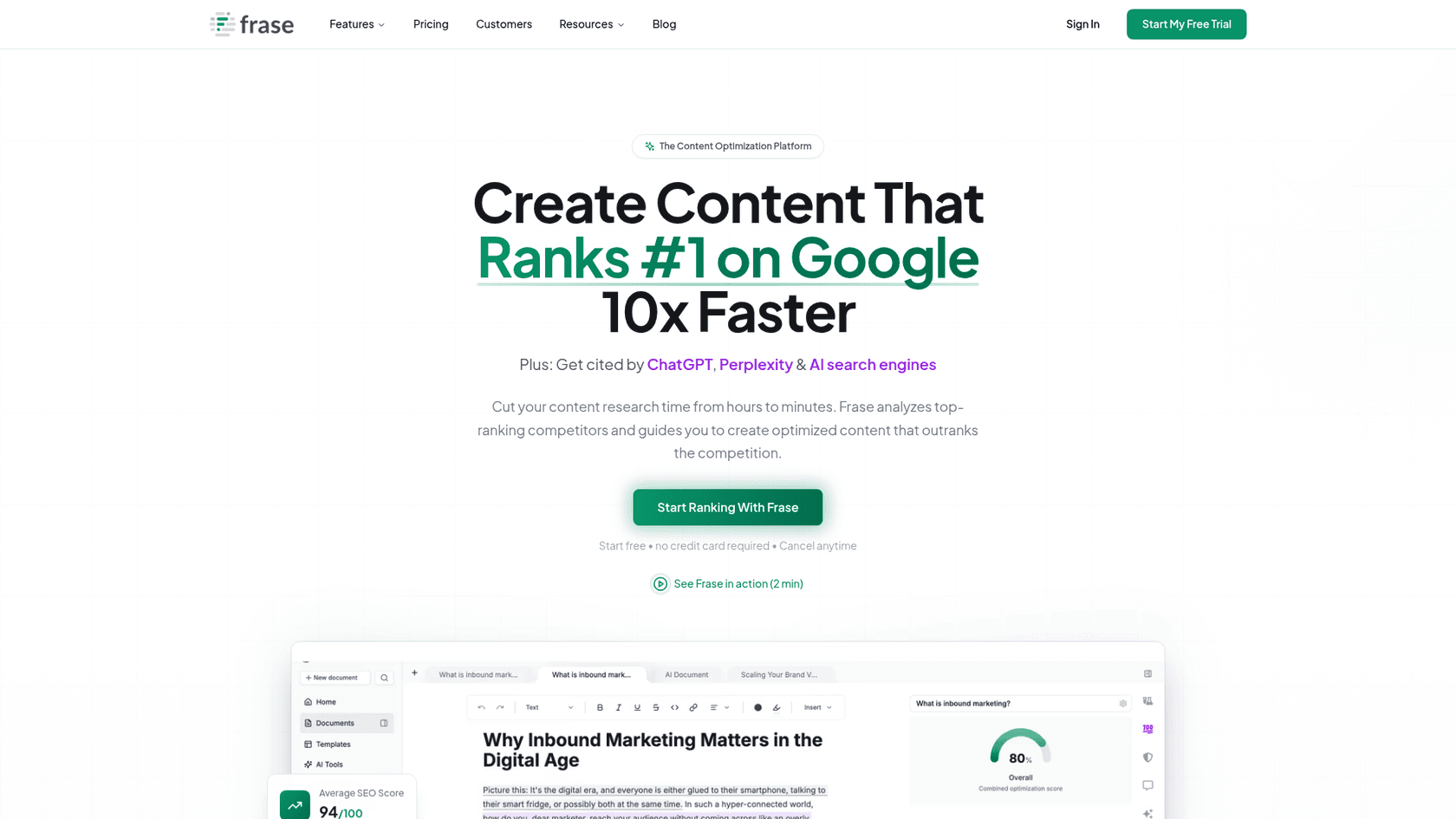
Frase is an AI-powered platform built for both Search Engine Optimization (SEO) and Generative Engine Optimization (GEO). At its core, Frase works by analyzing the top-ranking Google search results for a specific keyword. From that analysis, it creates a data-driven blueprint to guide writers in creating and optimizing content meant to outperform what's currently on page one.
Its main features are centered around a quick, tactical workflow:
- Dual SEO + GEO Optimization: Frase gives you real-time scores for both traditional SEO and GEO. This helps writers build content that can rank on Google and is also structured to be easily cited by AI platforms like ChatGPT, Perplexity, and Claude.
- Content Research & Outlining: The tool quickly scans SERPs to pull competitor headings, questions from sources like Google’s People Also Ask and Reddit, and important topics. It uses this information to generate a complete outline in just a few minutes.
- AI Content Writing: An integrated AI assistant can help with drafting, rewriting sections, or just getting past writer's block. It also has an "Auto-Optimize" feature that can rewrite parts of your content to improve its SEO and GEO scores.
- Content Opportunities: Frase connects with Google Search Console to monitor your pages. It sends daily alerts about decaying content, pages with rising potential, and keyword gaps, using a simple "Fix/Boost/Fill" framework to recommend actions.
- AI Search Tracking: This unique feature keeps an eye on your brand's visibility and share of voice across major AI platforms like ChatGPT, Claude, and Gemini. It shows you which prompts lead to mentions of your brand, giving direct insight into your GEO performance.
What is MarketMuse?
MarketMuse is an enterprise-level AI content intelligence platform that focuses on helping businesses build topical authority. Instead of just looking at the top 20 search results, its core method uses patented AI to analyze thousands of pages on a given topic. This allows it to create an expert topic model that acts as a comprehensive benchmark for your content.
Its features are designed for deep strategic planning and content audits:
- Topic Authority Analysis: MarketMuse goes through your website's entire content library to map out your topical strengths and weaknesses. This helps you find opportunities to build out content clusters and establish your site as an authority.
- Personalized Metrics: It provides a custom Personalized Difficulty score. This score estimates how hard it will be for your specific site to rank for a topic, rather than giving a generic keyword difficulty score. This helps you focus your efforts where you have a real competitive edge.
- In-Depth Content Briefs: The platform generates highly structured and detailed briefs based on its deep topic models. It has nine different brief types, including Article, Comparison, Product Review, and How-to, with each one tailored to a specific format.
- Competitive Gap Analysis: MarketMuse uses heatmaps to show content gaps between your site and your competitors, all measured against its topic model. This makes it easier to spot opportunities to create more thorough content.
MarketMuse is built primarily for larger companies, publishers, and agencies that need in-depth strategic planning to become the go-to authority in their field.
A detailed comparison of Frase AI vs MarketMuse
While both platforms want to improve your content's performance, their approaches, features, and workflows are quite different. Here is a side-by-side look at their key differences.
Approach to content research and strategy
- Frase: Frase takes a tactical, SERP-based approach. It reverse-engineers what is currently ranking to give you actionable advice for a single piece of content. Its strategic tools, like Content Opportunities, work at the page level, focusing on quick wins by monitoring performance data from Google Search Console. This method is very effective for competing on an article-by-article basis and reacting quickly to search landscape changes. It’s about winning the battle for one keyword.
- MarketMuse: MarketMuse uses a holistic, site-level strategic approach. By analyzing a site's entire content inventory, it focuses on building long-term topical authority through content clusters. Its strategy is about finding where you have a competitive advantage and creating a content plan to own entire topics, not just single keywords. It’s about winning the war for industry expertise.
An infographic detailing the strategic differences in the Frase AI vs MarketMuse comparison, showing Frase's tactical approach versus MarketMuse's focus on topical authority.
Comparing content brief quality
- Frase: Frase generates briefs and outlines quickly using SERP data. The optimization process is guided by clear, real-time SEO and GEO scores, which provide specific recommendations to improve topic coverage and AI citability. This feedback is shown directly in its editor or through integrations for platforms like Google Docs and WordPress, making the workflow straightforward for writers. The emphasis is on speed and efficiency.
Try Frase.io - I ran some tests in regards to topics and tried out Market Muse, Clearscope, SurferSEO, ArticleInsights and some others. In my opinion, market muse was the best overall, but I’d have Frase second due to their content briefs.
 Reddit
 - MarketMuse: MarketMuse creates comprehensive, blueprint-like briefs that are more structured and detailed. Each brief comes with an executive summary, a structured outline with topic models for each subheading, and specific guidance on user intent and linking. The aim is to give expert writers a roadmap to create thorough content, rather than just matching what competitors have already done.
Unique features
- Frase: The standout feature for Frase is its AI Search Tracking. It actively monitors brand mentions across five major AI platforms, giving users direct visibility into their performance in the new world of AI-driven search. This is a forward-looking feature that addresses the rising importance of GEO. Its proactive content decay alerts are another useful feature for ongoing maintenance.
- MarketMuse: The key differentiators for MarketMuse are its Personalized Metrics, like Personalized Difficulty and Topic Authority. These metrics are calculated based on your site's existing content, giving you a realistic assessment of your ability to rank for a topic. This helps you prioritize high-impact topics where you already have a competitive edge, ensuring your content efforts are well-spent.
Pricing and target audience for Frase AI vs MarketMuse
-
Frase Pricing: Frase has transparent, tiered pricing that is accessible to a wide range of users, from solo creators to larger teams. Its plans include:
-
Starter: $38 per month for solo creators.
-
Professional: $98 per month for growing teams.
-
Scale: $195 per month, which includes the AI Search Tracking feature.
-
Target Audience: Freelancers, small to medium-sized businesses, and agencies looking for an affordable, all-in-one tool for fast research, writing, and optimization.
-
MarketMuse Pricing: MarketMuse's pricing isn't publicly listed on its website, which is typical for enterprise software that requires a custom quote. They offer four main tiers:
-
Free: A limited plan with 10 queries per month to try out the platform.
-
Optimize: Includes content briefs and a site inventory for ongoing optimization.
-
Research: Offers unlimited queries and a higher volume of briefs.
-
Strategy: Provides access to all nine brief types and a larger number of strategic documents.
-
Target Audience: Enterprises, large content teams, and specialized agencies with big budgets that prioritize long-term, data-driven content strategy over tactical, page-level wins.
From optimization to generation: A look at the eesel AI blog writer

This is where a tool like the eesel AI blog writer fits in. It's designed to manage the entire content workflow, taking you from a single keyword to a complete, publish-ready article in minutes. It fills the execution gap left by optimization tools with a few key differences:
- Complete, Publish-Ready Content: It doesn't just provide a brief or a rough draft. It generates a fully structured article with an introduction, headings, a conclusion, and FAQs, all optimized for SEO and readability.
- Automatic Asset Generation: The AI automatically creates and embeds relevant visuals like infographics, tables, and screenshots directly into the post. This saves hours of manual work for a writer or designer.
- Authentic Social Proof: To add a layer of human experience and credibility, it finds and embeds relevant YouTube videos and real quotes from Reddit threads that match the topic.
- Proven Results: This approach is built for scale. We used this exact tool to grow our own organic traffic from 700 to 750,000 daily impressions in just three months by publishing over 1,000 optimized blogs.
A workflow diagram showing how the eesel AI blog writer automates content creation, a different approach from the optimization focus of the Frase AI vs MarketMuse tools.
This end-to-end generation approach is great for teams that want to scale content production without sacrificing the quality that both readers and search engines expect. Best of all, it's completely free to try.
For a more detailed visual walkthrough of how these platforms compare in a real-world workflow, the following video offers a side-by-side analysis of their features, AI writing capabilities, and pricing structures.
Frase AI vs MarketMuse: Which tool is right for you?
- Choose Frase if you need an affordable, user-friendly tool for fast, SERP-driven content optimization. It's great at tactical execution, workflow speed, and offers unique visibility into the new world of AI search. It's a good fit for teams that need to move quickly and compete on a keyword-by-keyword basis.
- Choose MarketMuse if you are an enterprise with a larger budget that needs a deep, data-driven platform for building long-term topical authority. Its strategic tools and personalized metrics are designed for executing a comprehensive content strategy that establishes you as an industry leader over time.
For teams who find that the entire process of research, briefing, writing, and optimizing is the main bottleneck, a different approach might be better. A tool like the eesel AI blog writer offers a more direct path from keyword to published content by automating the full creation workflow, which lets you focus on strategy and promotion.