Frase AI vs Grammarly: Which tool is right for your content workflow?

Katelin Teen
Katelin Teen
Last edited January 18, 2026
Picking the right AI tool for your content team can feel like you're lost in a sea of options. The market is flooded, and every tool promises to revolutionize your workflow. Two names you'll hear a lot are Frase AI and Grammarly. They’re both big players, but they tackle completely different parts of the content puzzle.
You can think of it like this: Frase is your SEO strategist. It helps you map out and optimize your content so it has the best shot at ranking on Google. Grammarly, on the other hand, is your on-call editor, focused on making your final draft clean, crisp, and enjoyable for people to read.
So, this isn't about finding one single winner. It's about figuring out which tool is right for your workflow. Are you trying to build a content strategy from the ground up, or are you looking to make your existing writing shine?
But what if you need more than just planning or polishing? Frase handles the what and Grammarly handles the how, but you're still left with the most time-intensive part: the actual writing, sourcing visuals, and putting it all together. This is where a tool like the eesel AI blog writer can step in. It manages the whole process, turning a simple keyword into a complete, ready-to-publish article in minutes.
What is Frase AI? An SEO-first content tool
Frase AI is, at its core, a tool for content research and optimization. Its main job is to get your content to rank higher in search results. It’s designed to replace guesswork with data.
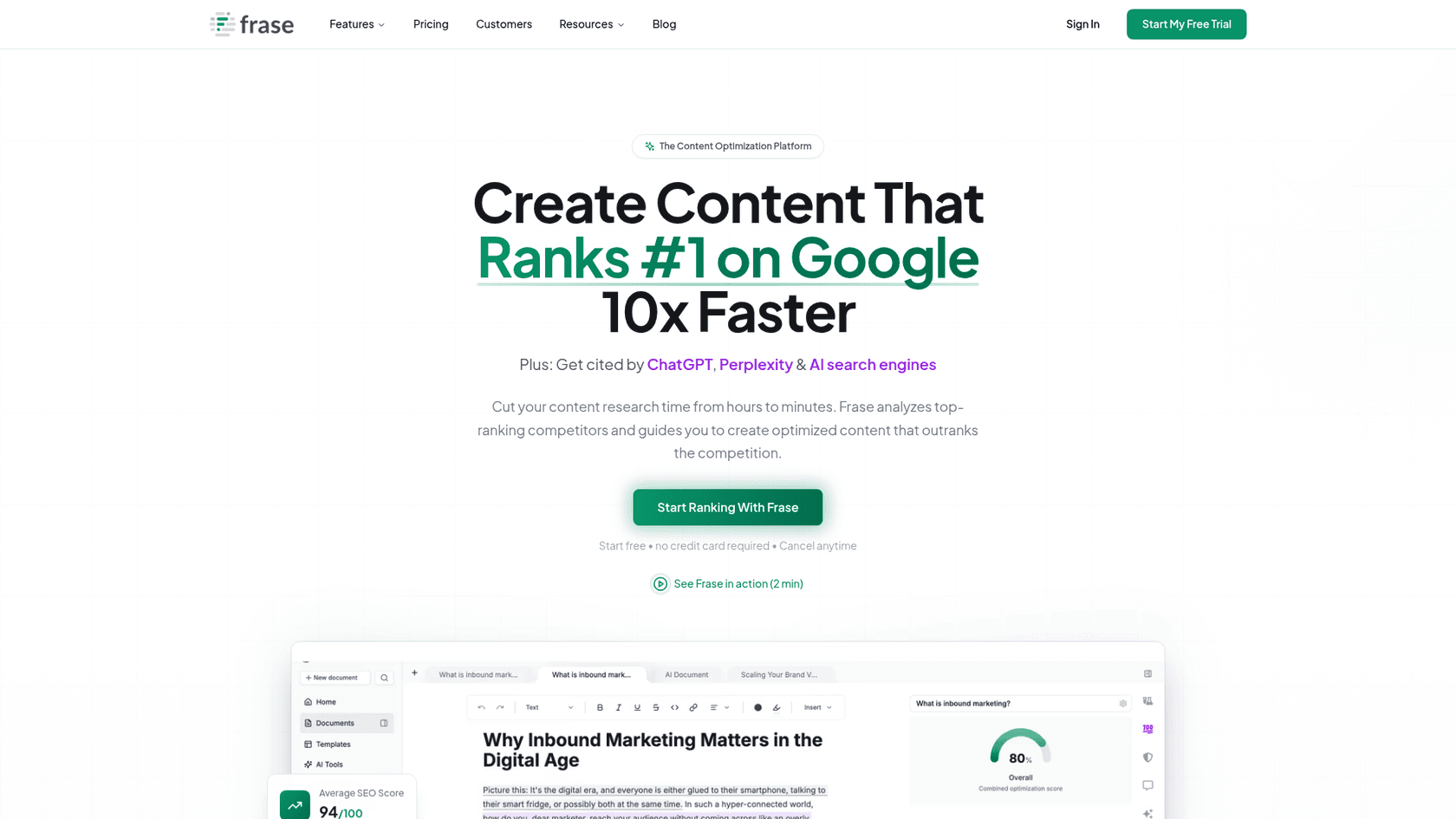
The central idea is pretty smart. You feed it a target keyword, and it analyzes the top-ranking articles on Google for that exact term. It then uses that information to create a data-backed blueprint for you to create content that can compete.
Here’s a quick rundown of its main features:
- Content Briefs: Instead of staring at a blank page, Frase generates a detailed brief for you. It pulls in headings, topics, and common questions from the top search results, giving you a strong structure to start from.
- Content Optimization: As you write within its editor, Frase provides a real-time "Topic Score." It checks your draft against the top competitors and points out keywords and topics you might be missing, helping you fill in any gaps.
- Topic Research: It helps you discover relevant sub-topics and questions your audience is asking on sites like Quora and Reddit, allowing you to create more thorough content.
- AI Writer: Frase includes built-in AI tools that can generate SEO-focused text snippets, draft introductions, or rephrase paragraphs to better align with what search engines are looking for.
the only one that actually helped me was the ai that summarized source articles into outlines before writing. i use it to generate 5-point briefs in 3 minutes, then i write from that instead of staring at a blank page. it cut my blog drafting time in half and lowered how “ai-ish” my final content reads.

Frase is really for SEO specialists, content marketers, and agencies whose success depends on organic traffic. If your primary objective is to create content that climbs the search engine results pages (SERPs), Frase is built for you.
What is Grammarly? A writer's everyday assistant
If Frase is your SEO strategist, think of Grammarly as the helpful editor that sits on your shoulder. It’s an AI-powered assistant that lives in your browser, focused on making your writing clearer, more accurate, and just plain better.
You've probably seen it around. It's the digital proofreader that underlines your mistakes and suggests fixes. But its capabilities go far beyond a simple spell check.
Here’s what makes Grammarly so widely used:
- Grammar and Spell Check: This is its main function. It catches everything from typos and punctuation mistakes to more complicated grammatical errors in real-time, no matter where you're writing.
- Tone Detection: Grammarly looks at your word choice and phrasing to give you feedback on how your text might be perceived. It can help you adjust your writing to sound more confident, friendly, or formal.
- Plagiarism Checker: A huge help for writers and students, it checks your text against billions of web pages to ensure your work is original.
- GrammarlyGO: This is the platform's generative AI feature. It's built for quick, on-the-fly tasks like brainstorming a few ideas, writing a short email response, or rephrasing a clunky sentence for clarity.
I run all my final drafts through Grammarly to polish grammar, clarity, and tone. Even after using AI tools, it always catches something I missed.
The ideal user for Grammarly is, well, almost everyone. Students, professionals, writers, sales teams, and support agents can all benefit. If you write emails, documents, or social media updates, Grammarly can help you do it more effectively.
Frase AI vs Grammarly: A head-to-head feature comparison
Okay, let's get down to the details and compare these two tools directly. They both use AI, but they play in totally different fields. To make it even clearer, here's a visual breakdown of how they stack up:
Here’s a breakdown of where each one excels.
Core functionality and primary use case
- Frase AI: Frase operates in the pre-writing and optimization phases of content creation. It's all about strategy. It helps you answer the question, "What should I write about to rank on Google?" You use it to build a solid, data-informed foundation for your article before you've written most of it.
- Grammarly: Grammarly is all about the post-writing and refinement stages. It comes into play once you have a draft. It answers the question, "Is this writing clear, correct, and easy to read?" Its role is tactical, aimed at polishing what's already on the page for your human audience.
- The verdict: They aren't direct competitors so much as complementary tools. A popular workflow involves using Frase to generate a content brief and optimize a draft for SEO, then running the final text through Grammarly to catch errors and boost readability before publishing.
AI writing capabilities
- Frase AI: The AI writing features in Frase are tuned specifically for generating SEO content. It's good at creating outlines, writing paragraphs that target certain keywords, or building FAQ sections based on its SERP analysis. The output is functional and aimed at satisfying search intent, but it usually needs a human touch to sound natural.
- Grammarly: GrammarlyGO is more of a writing partner that helps you refine your own ideas. It’s great for rewriting a sentence to sound more confident, brainstorming a few bullet points, or composing a quick two-sentence email. It’s not meant to generate an entire long-form article from a single prompt.
- The verdict: Frase's AI is for constructing the SEO framework of an article. Grammarly's AI is for improving the language and flow. Both are assistants that still require you to do the heavy lifting of connecting ideas and creating a cohesive piece.
SEO features
- Frase AI: This is where Frase really shines. It's the heart of the platform. It provides a numerical content score, shows you which keywords your competitors are using, pulls in "People Also Ask" questions from Google, and helps you structure your article in a way that search engines will appreciate. It is, above all, an SEO tool.
- Grammarly: Grammarly has no direct SEO features. You can’t use it for keyword research, SERP analysis, or competitive optimization. While making your content more readable can indirectly help with user engagement (which is a ranking signal), that’s not what the tool is designed for.
- The verdict: There's no competition here. For any task directly related to search engine optimization, Frase AI is the obvious winner because it's the only one of the two that actually performs those functions.
Integrations and workflow
- Frase AI: Frase connects with the tools that content marketers use daily. It offers a Google Docs add-on and a WordPress integration, letting you use its optimization features right inside your editor. It also links with Google Search Console to import data on your content's performance.
- Grammarly: Grammarly is just about everywhere. It has browser extensions for Chrome, Safari, and Firefox, a desktop app, a mobile keyboard, and add-ins for Microsoft Office. It works smoothly across email clients, social media platforms, and project management software. If there's a text box, Grammarly is likely available.
- The verdict: When it comes to being everywhere, Grammarly is hard to beat. It fits into nearly any writing task imaginable. Frase is more specialized, integrating deeply into a specific content marketing workflow, but you won't be using it to check your tweets.
Pricing comparison
Value is always a big consideration, so let's look at what each of these tools costs.
Frase AI pricing
Frase is aimed at professional content creators and has a few different pricing tiers:
- Solo Plan: Starts at $14.99/month for one user, allowing you to write and optimize 4 articles per month.
- Basic Plan: Goes up to $44.99/month, also for a single user, but increases the limit to 30 articles per month.
- Team Plan: Costs $114.99/month for 3 users (with an option to add more) and includes unlimited articles.
It's also worth mentioning their Pro AI Add-on for an extra $35/month, which gives you unlimited use of their AI writer.
Grammarly pricing
Grammarly’s pricing is set up for a much wider audience, from individuals to large companies:
- Free Plan: This is how most people get started. It provides basic grammar, spelling, and punctuation checks. It's helpful, but many of the advanced features are behind a paywall.
- Premium Plan: Costs about $12/month when billed annually. This unlocks the best features: suggestions for clarity, tone adjustments, advanced grammar checks, and the plagiarism checker.
- Business Plan: Begins at $15 per user/month and is built for teams. It has everything in Premium plus features like a central style guide, brand tones, and analytics.
| Feature | Frase AI | Grammarly |
|---|---|---|
| Primary Goal | SEO Content Optimization | Writing Quality & Correctness |
| Free Plan | 5-day money-back guarantee | Yes, with limited features |
| Starting Price | $14.99/month (Solo Plan) | $12/month (Premium Plan) |
| Ideal User | SEOs & Content Marketers | Professionals & Writers |
| AI Generation | SEO-focused content snippets | In-line text rewriting/ideation |
| Key Differentiator | SERP analysis & content scoring | Universal integration & tone detection |
Beyond optimization and editing: Generating complete blogs with eesel AI
So, Frase helps you plan and Grammarly helps you polish. But what about the huge chunk of work in the middle? You know, the actual writing, finding visuals, and piecing it all together. That’s often the most time-consuming part.
This is where the process can slow down for teams trying to scale their content. What if you could skip the manual steps entirely?
The eesel AI blog writer takes a different path. It’s designed to manage the entire content creation workflow from a single keyword, rather than just assisting with one part of it. We developed it to solve our own content challenges, and it's the same tool we used to grow our own daily impressions from 700 to 750,000 in just three months.
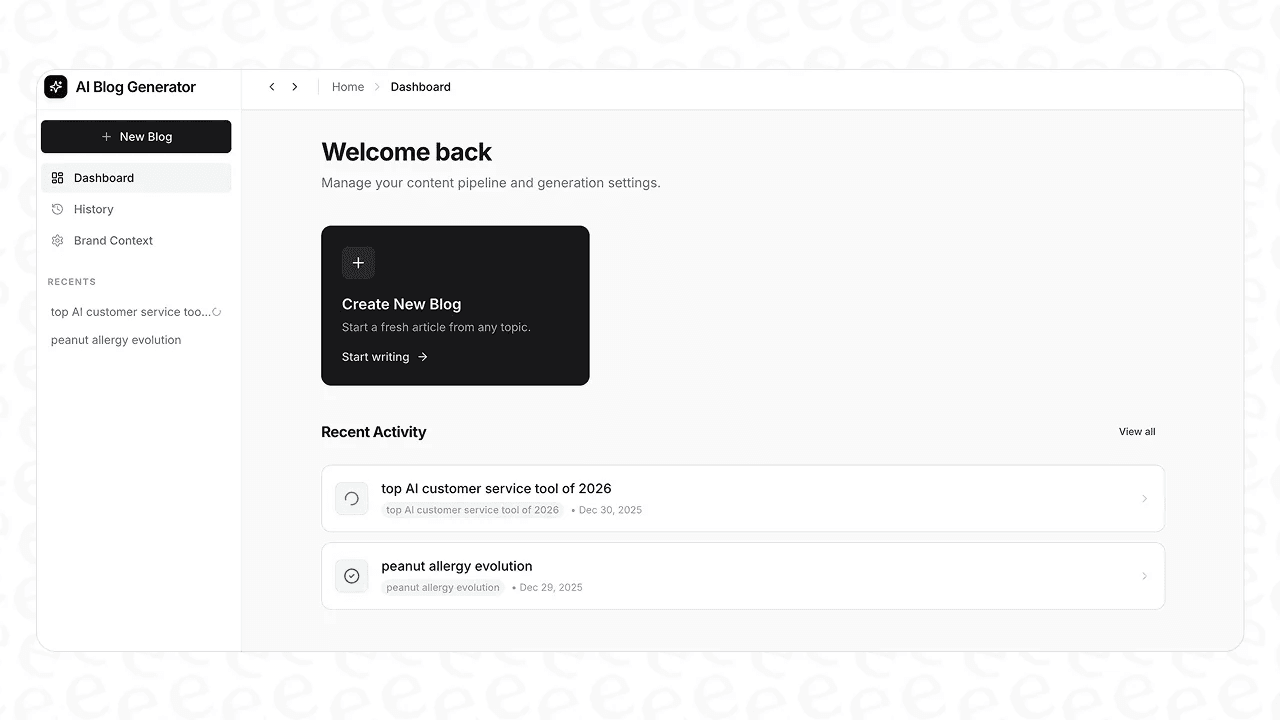
Here’s how it fills the gaps left by Frase and Grammarly:
- From keyword to complete post: You don't just get an outline or a few suggestions. You get a full, publish-ready blog post with a strong intro, a well-organized body, a conclusion, and relevant FAQs.
- Automatic asset generation: This is a massive time-saver. eesel AI creates and includes AI-generated images, infographics, charts, and tables directly in the content, so you don't have to spend hours making them yourself.
- Built-in social proof: It automatically finds and embeds relevant YouTube videos and real quotes from Reddit threads to add credibility and keep your readers engaged.
- AEO optimization: The content isn't just optimized for traditional SEO. It’s also structured for AI Answer Engines like Google AI Overviews and Perplexity, which helps future-proof your content.
Instead of juggling different tools for research, writing, editing, and design, you can manage the entire workflow with just one.
Frase AI vs Grammarly: Which tool should you choose?
The right tool really depends on the job you need to get done.
- Choose Frase AI if your primary goal is to conduct deep SEO research, create data-driven content briefs, and optimize your articles to rank higher on Google.
- Choose Grammarly if your main objective is to make sure every piece of writing you create is clear, professional, and error-free, no matter where you're writing it.
- Use both if you want a robust manual workflow where you use Frase for SEO strategy and Grammarly for the final polish.
But if you're on a team that wants to scale content production without adding more people, there's a more efficient option. Instead of patching together a workflow with multiple tools, you can generate complete, high-quality articles automatically.
Try eesel AI for free and see for yourself how you can go from a single keyword to a fully optimized, media-rich blog post in just a few minutes.

Frequently Asked Questions
Share this article

Article by
Katelin Teen
Katelin is an operations specialist at eesel where she uses her psychology training and education experience to optimize B2B SaaS processes. Outside of work, she unwinds with story-driven games, writing, and keeping up with latest tech innovations.