

The pressure to create great content, and lots of of it, is pretty intense. One minute you're writing a blog post, the next you're trying to whip up social graphics, edit a video, and make sure it's all optimized for SEO. If your workflow is spread across a half-dozen different apps, you probably feel like you spend more time switching tabs than actually creating anything.
This is where modern content creation tools, especially those with some AI smarts, come in handy. They’re built to handle the tedious parts of the job and pull your workflow into one place. The right tools can shift your content strategy from a constant scramble to a reliable way to grow. For instance, platforms like the eesel AI blog writer can automate the entire process, turning a single keyword into a finished article in just a few minutes.
In this guide, we’ll look at six of the best tools that cover everything from planning and writing to design and optimization, helping you find the right setup for your team.
What are content creation tools?
Simply put, content creation tools are any software or platform that helps your team research, plan, write, design, edit, and publish content. Think of them as the digital version of a writer’s pen, a designer’s sketchbook, and an editor’s red marker, all combined.
The category is huge and covers a lot of ground, but you can generally break them down into a few types:
- Writing & Editing: This ranges from AI writers that can generate articles from scratch to simple grammar checkers that just polish your final draft.
- Visual Creation: This includes graphic design platforms, video editors, and infographic makers that let you create professional-looking visuals without a design degree.
- Research & SEO: These are your keyword research tools and on-page optimizers that help your content get seen by the right audience.
- Planning & Management: This covers things like content calendars, project management boards, and team wikis that keep everyone on the same page.
Right now, the biggest shift is toward integrated, AI-powered tools that can handle multiple jobs at once. They save a lot of time and help teams produce better content, faster.
How we chose the best content creation tools for this list
We didn't just pull these names out of a hat. To make this list genuinely useful, we picked tools based on a few key criteria that matter to busy marketers:
- Functionality: Does it actually solve a real problem in the content creation process, and does it do it well?
- Ease of Use: Is the interface intuitive? You shouldn't need a PhD in software engineering to figure it out.
- Integration: How nicely does it play with the other tools you're already using in your marketing stack?
- Value for Money: Does it provide a solid return on investment? We also looked for tools with a great free plan or a no-strings-attached trial.
- Innovation: Is it using interesting tech, like AI, to give you a real advantage over the old way of doing things?
The best content creation tools at a glance
If you're short on time, here's a quick rundown of our top picks and what they do best.
| Tool | Primary Use Case | Best For | Starting Price |
|---|---|---|---|
| eesel AI blog writer | AI Blog Post Generation | Automating publish-ready SEO articles | Free to try ($99 for 50 blogs/mo) |
| Canva | All-in-one visual design | Social media graphics & marketing assets | Free plan available |
| Descript | AI Video & Audio Editing | Repurposing long-form spoken content | Free plan available |
| Jasper | AI Marketing Content | On-brand copy across multiple channels | $59/month (billed annually) |
| Surfer SEO | On-Page SEO Optimization | Data-driven content briefs & optimization | $79/month (billed annually) |
| Notion | AI Workspace & Planning | Content calendars & team knowledge bases | Free plan available |
A deep dive into the top 6 content creation tools
Now, let's get into the details of what makes each of these tools a standout choice for marketers in 2026.
1. eesel AI blog writer
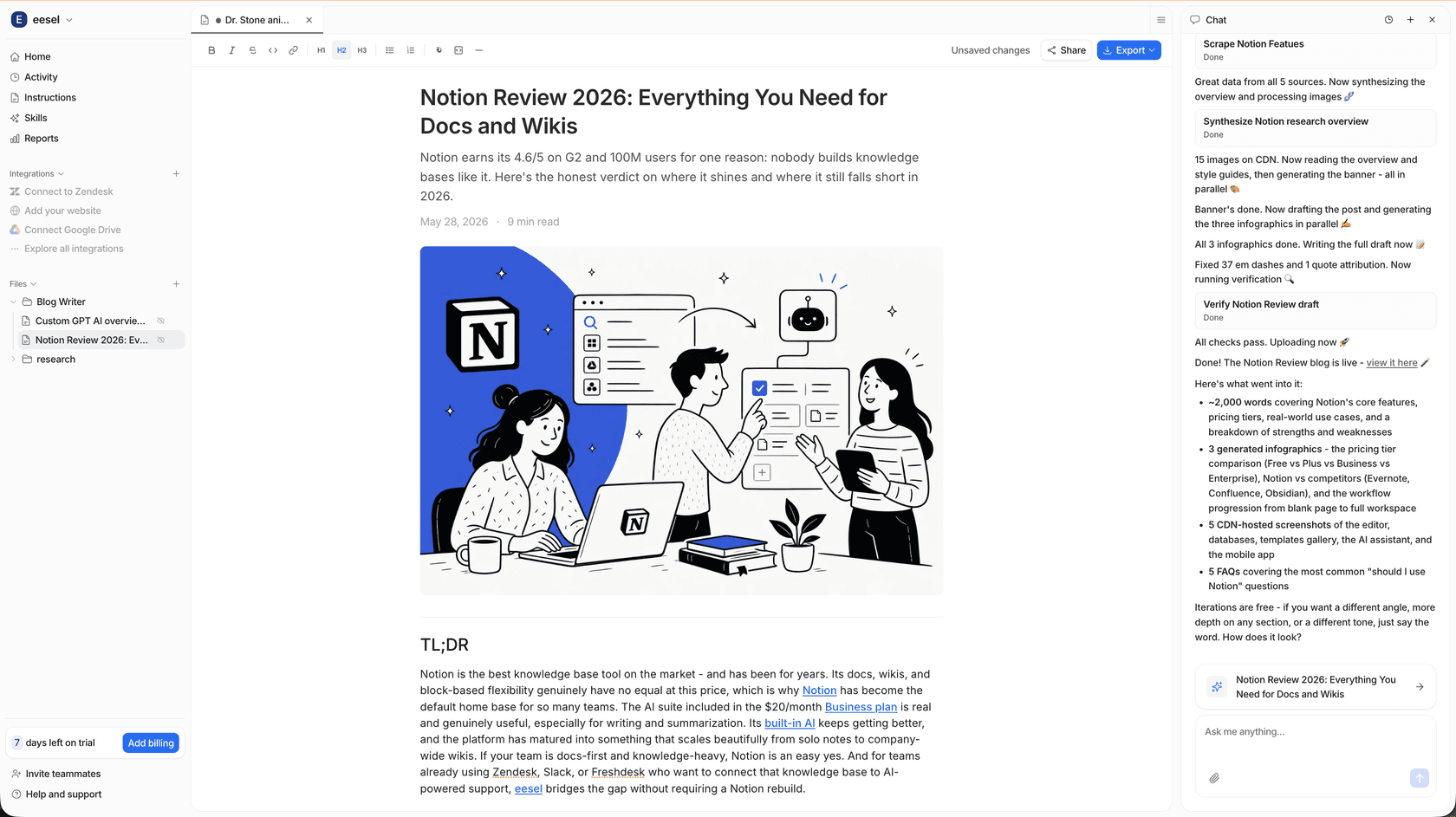
The eesel AI blog writer is a content automation platform designed to turn a single keyword into a complete, publish-ready blog post. Its main feature is its ability to generate a fully structured article with SEO, research, and built-in assets. It's the same tool used internally at eesel AI to grow organic traffic from 70k to 750,000 impressions in three months.
The idea is to streamline that process by letting the AI generate a full draft directly from a URL or a text summary like the one you get from Claude. It pulls context from the source to match the tone, so you can skip jumping between different tools for the outline and draft.

Key Features:
- Automatic Assets: It automatically creates and embeds AI-generated images, infographics, charts, and tables right into the article. This alone saves hours of messing around in design tools.
- Rich Media & Social Proof: To make content more engaging and credible, it finds and embeds relevant YouTube videos and real quotes from Reddit discussions on your topic.
- Deep Research: The AI goes beyond surface-level information to provide genuinely insightful content with citations, so you can avoid the generic "AI slop" that plagues other tools.
- SEO & AEO Optimized: Articles are structured to rank on Google and are also optimized for AI Answer Engines like Google AI Overviews and Perplexity, which is a big advantage.
Pros: It is designed for producing high-quality, long-form content that sounds human and is ready to publish in minutes. The automatic inclusion of assets and social proof is a significant time-saver. It’s completely free to try, so you can evaluate the quality without commitment.
Cons: It's very focused on long-form blog content. If you're looking for something to write short-form social media captions or ad copy, this isn't the tool for you.
Pricing: You can try it for free. The paid plan starts at $99 for 50 blog generations.
2. Canva
Canva has become a popular tool for easy-to-use graphic design. It's now a full Visual Suite that lets anyone create professional-looking visuals for social media, presentations, blog headers, and even videos. With a massive library of templates and a simple drag-and-drop editor, you don't need to be a designer to make beautiful things.
Canva - easy to use for creating graphics, logos, and simple animations quickly.
Key Features:
- Canva AI: The platform has a built-in AI assistant that can help you brainstorm ideas, write copy for your designs, and even generate entire visuals from a text prompt.
- Magic Studio: This is a collection of AI-powered tools, including Magic Write for generating text and Magic Switch for instantly reformatting a design for different platforms (like turning an Instagram post into a Twitter header).
- Brand Kit: This feature lets you store your brand's colors, fonts, and logos in one place, ensuring everything your team creates looks consistent and on-brand.
Pros: The template library is enormous, making it incredibly fast to create visuals that look great. The free version is also one of the most generous out there and is powerful enough for many people's needs.
Cons: If you're a professional designer, you might find it a bit limiting. It doesn't offer the same pixel-perfect control as advanced tools like Adobe Photoshop, but for most marketers, it's more than enough.
Pricing: A very powerful free plan is available. Canva Pro starts at $120 per year for one person.
3. Descript
Descript is a helpful tool for anyone working with video or audio. It’s an editor that works like a word document. You just edit the text transcript, and the video or audio edits itself. This makes it incredibly easy to cut, rearrange, and polish content from podcasts, webinars, and interviews.
Key Features:
- Underlord AI: This is Descript's AI co-editor that can handle tedious editing tasks, generate scripts and videos from a simple prompt.
- Transcription-Based Editing: This is the core feature. Editing spoken-word content is as simple as deleting a word or moving a sentence in a Google Doc.
- AI Tools: It's packed with handy AI features like Studio Sound to remove background noise, Eye Contact to make it look like you're always looking at the camera, and automatic removal of filler words like "um" and "uh."
Pros: The way it handles editing is a fresh approach, especially for repurposing content. You can turn one long webinar into dozens of social media clips in no time. The AI tools save countless hours in post-production.
Cons: It's not a full-blown video editor like Adobe Premiere Pro. It's built specifically for dialogue-heavy content, so it's not the best choice for cinematic projects with complex effects or color grading.
Pricing: There's a free plan available to get you started. The Creator plan starts at $24 per person, per month when billed annually.
4. Jasper
Jasper is an AI content platform designed to help marketing teams create on-brand content across all their channels. It's loaded with templates for just about any format you can think of, from ad copy and email subject lines to social media posts and blog introductions.
Jasper - solid templates, especially for ecommerce or salesy stuff
Key Features:
- Jasper IQ: This is a proprietary AI layer that learns your brand. It combines deep marketing knowledge with your specific brand voice and style guides to make sure everything it generates sounds like you.
- Content Pipelines: This feature lets you automate your entire content workflow, connecting your data and brand guidelines to take an idea from conception to publication with less manual effort.
- Jasper Agents: These are AI assistants you can deploy to automate marketing tasks like conducting research, personalizing outreach, and optimizing campaigns.
Pros: Jasper is effective for quickly generating on-brand, short-form copy. Its huge library of templates and brand-aware AI are powerful for keeping your messaging consistent everywhere.
Cons: While it's great for copy, generating a complete, media-rich, and fully structured blog post still takes a lot of manual work. Jasper writes the text, but you still have to find visuals, add social proof, and format everything into a finished article.
Pricing: Jasper doesn't have a free plan, but it offers a 7-day free trial. The Pro plan starts at $59 per seat, per month when billed annually.
5. Surfer SEO
Surfer SEO is a data-focused tool that helps you write content that ranks well on search engines and in AI chats. It works by analyzing the top-ranking pages for your target keyword and then giving you a detailed breakdown of what you need to include in your article to compete.
Key Features:
- Content Score: As you write in its editor, Surfer gives you a real-time score from 0-100 that tells you how well-optimized your content is. It bases this on over 500 different ranking factors.
- Surfer AI: You can now use Surfer to generate ready-to-rank articles in minutes. It handles the research and optimization for you, baking SEO best practices directly into the content.
- AI Content Humanizer & Detector: These tools help you rewrite AI-generated text to sound more natural and can also scan content to check for patterns that might flag it as AI-written.
Pros: It removes the guesswork from on-page SEO. The live content score makes it easy to see exactly what you need to do to improve your chances of ranking.
Cons: Surfer is very specialized. While its AI writer is a nice addition, its core strength is still optimization. It can also get pricey, especially for freelancers or small businesses.
Pricing: The Essential plan starts at $79 per month when billed annually.
6. Notion
Notion is like a set of digital building blocks for your workspace. It's a flexible, all-in-one tool that's perfect for content planning, organization, and team collaboration. Marketing teams use it to build everything from content calendars and project boards to comprehensive team wikis.
Key Features:
- Notion AI: AI is fully baked into the Notion experience. It can summarize, draft, and automate right inside your notes and databases.
- Flexible Databases: You can create custom databases to manage your content pipeline exactly the way you want, with views like Kanban boards, calendars, and timelines.
- Connected Workspace: It integrates with other tools you use, like Slack and Jira, so you can pull information from other apps directly into your Notion workspace.
Pros: Its biggest strength is its flexibility. You can build a content system that's perfectly tailored to your team's workflow. The AI features are seamlessly integrated, and the generous free plan makes it accessible to everyone.
Cons: That same flexibility can be a bit overwhelming at first. It sometimes suffers from a "blank page" problem, and it takes some time upfront to design a system that works for you.
Pricing: Notion offers a great free plan for personal use. The Plus plan for teams starts at $8 per seat, per month when billed annually.
For a more visual overview of some of the top tools available, the following video provides a helpful summary of must-have apps for content creators.
How to choose the right content creation tools for your workflow
So, how do you pick the right tools from this list? The best approach is to start by looking at your current process. Where are your biggest bottlenecks?
The issue isn't really the AI tool, it's your content production workflow. I've been scaling content for my SaaS with Claude and it keeps performing the best but only if you break longer pieces into 3-4 separate prompts instead of trying to get 2000+ words in one shot.
Is it the initial writing and research? Are you struggling to produce high-quality blog posts at a consistent pace? If so, a content automation platform like the eesel AI blog writer is a fantastic place to start because it tackles the most time-consuming part of the job head-on.
Or maybe your writers are fast, but your design team is drowning in requests for social graphics and blog headers. In that case, a tool like Canva is the obvious choice to empower your team to create their own visuals.
Don't be afraid to experiment. Almost every tool on this list offers a free plan or a trial period. Take them for a spin with a real project before you decide to commit. The goal isn't to have a million different apps, but to build a seamless stack where your tools work together to make your life easier.
Build a smarter content engine with the right tools
Building a great content creation stack isn't about having the most tools; it's about having the right tools. The best platforms automate the tedious work, freeing you and your team up to focus on strategy and creativity.
By using modern, AI-powered tools, you can turn your content marketing from a constant headache into a predictable engine for growth.
Ready to see how AI can generate a complete, SEO-optimized blog post for you in minutes? Try eesel AI for free.