ChatGPT vs RightBlogger: Which AI writer is best for content creation?

Stevia Putri
Last edited January 26, 2026
Choosing an AI writing tool can feel like scrolling through Netflix for an hour: too many options, and they all start looking the same. If you're a blogger, the pressure's even higher. You don't just need to write; you need to write stuff that people actually find and read.
On one side, you have the famous one, ChatGPT by OpenAI, the general-purpose AI that can do just about anything. On the other side is RightBlogger, a tool made specifically for bloggers, with over 47,600 creators using it. Both are strong contenders, but they approach content creation from totally different angles.
This guide will cut through the noise and compare the real-world differences, from how you write an article to how much you'll pay. We’ll dig into their features, workflow, and SEO chops to help you decide. We'll also look at another option, a tool designed to generate complete, publish-ready articles for serious SEO growth. An AI like the eesel AI blog writer works differently than both, and we'll explore where it fits into the picture.
What are ChatGPT and RightBlogger?
Before we pit them against each other, let's quickly cover what each tool is actually for. They both use AI to write, but they're built for very different jobs.
What is ChatGPT?
ChatGPT is like a Swiss Army knife. It's a conversational AI that can do a ton of different things. You can ask it to write an email, help with some code, plan a party, or write a blog post.
It all happens in a simple chat window. You give it a prompt, it gives you an answer. If you want a full blog post, you have to lead it by the hand: ask for an outline, then ask it to write each section one by one, and then ask for a conclusion. It’s powerful, for sure, but it’s not a blogging tool at its core. The output is only as good as your prompts.
What is RightBlogger?
RightBlogger is the opposite of a generalist; it’s a dedicated content platform for bloggers. Instead of one chat box, it gives you a dashboard with over 93 specific tools for every step of the blogging process.
You don't have to be a prompt expert here. Using RightBlogger is more like filling out a form. You pick a tool like "Article Writer" or "Keyword Research," give it some basic info, and it does the heavy lifting. It’s designed to make the whole journey, from idea to published post, much smoother.
Core features and workflow
The biggest difference between these tools is how you actually use them day-to-day to create content. Let's walk through building a blog post with each one.
The content generation process
With ChatGPT, the process is very conversational and requires a lot of your input. You're basically co-writing with the AI. A typical session might go like this:
- Ask for a blog post outline on your topic.
- Copy the first heading from the outline and ask ChatGPT to write that section.
- Do this again for every single heading.
- Finally, you have to copy and paste all the pieces into a document, format everything, and edit it.
This method gives you a lot of control, but it also takes time and depends entirely on your ability to give clear instructions at every stage.
RightBlogger streamlines this into a single action. Its "AI Article Writer" can generate a complete, formatted blog post of over 2,000 words from just a topic and a few keywords. It builds the structure, writes the sections, adds headings, and even includes lists or tables where they make sense. It’s made to get you from an idea to a solid first draft in minutes.
User interface and ease of use
ChatGPT's interface is simple: it's a chat box. That makes it easy to get started. But when you're writing a long blog post, that simplicity can be a problem. The conversation thread gets long and messy, and it's easy to lose track of the different parts you've generated. There's a real learning curve to figuring out the best prompts for high-quality, structured content.
RightBlogger has a dashboard built for one purpose: blogging. All its tools are laid out clearly, guiding you through the workflow without much guesswork. You don't have to figure out how to phrase a prompt; you just pick the tool you need and fill in the fields. This makes it much more straightforward for bloggers who just want to get content made without a lengthy back-and-forth.
SEO and content optimization
For most of us, writing the post is just step one. Getting it to rank on Google is what really counts. Here’s how each tool stacks up on the SEO front.
RightBlogger’s built-in SEO toolkit
A key feature of RightBlogger is its integrated SEO platform. It has a whole set of tools built right in to help you create content that’s meant to rank.
- Keyword Research Tool: Find keywords with low competition and decent search volume without leaving the app.
- Keyword Cluster Tool: Group related keywords to build topical authority, which is a big deal for modern SEO.
- SEO Reports: Check out the top-ranking articles for your keyword to see what headings, questions, and terms they use. This is available on their Pro and Business plans.
- Auto-Optimize: After you run an SEO report, this feature can automatically add the most important keywords into your article, saving you a bunch of time.
This all-in-one setup means you can handle research, writing, and optimization in one place.
ChatGPT's approach to SEO
The standard versions of ChatGPT don't have any SEO tools. They can't access real-time search data, so they can't suggest keywords or tell you how to structure a post to beat the competition.
If you want to optimize content with ChatGPT, you have to do the research yourself. You'd use other tools like Ahrefs or Semrush, analyze the search results, and then feed all that info to ChatGPT with very specific prompts. For instance, you’d have to tell it, "Write a section about X and make sure to include keywords Y and Z." It's a much more manual and disconnected way of working.
Integrations and unique tools
A blogger's job doesn't end at writing. You also have to publish, promote, and engage. Here are some of the extra tools that can make a real difference.
Publishing and CMS integrations
This can be a significant time-saver. RightBlogger lets you connect your blog directly to the platform, with one-click publishing for WordPress, Webflow, Ghost, Wix, and Duda. When your article is done, you can send it straight to your blog as a draft, already formatted. This eliminates the need to copy, paste, and reformat content manually.
ChatGPT has no direct integrations with any blogging platforms. Everything you create has to be manually copied and pasted into your CMS. This adds extra work and often creates formatting issues, since text from the chat window doesn't always translate well to a website.
RightBlogger's specialized content tools
RightBlogger also has a few unique tools that are super helpful for content creators and not something you could easily replicate with ChatGPT.
- Video to Blog Post: Paste a YouTube URL, and RightBlogger will convert the video's content into a unique, SEO-friendly blog post.
- Autoblogging & Content Planner: You can schedule a content plan and have RightBlogger automatically write and publish articles to your blog.
- Tool Studio: A no-code builder that lets you create your own embeddable tools like calculators or quizzes, which are great for lead generation.
Pricing plans compared
Money matters, so let's look at what you get with each platform.
ChatGPT pricing
You can always find the latest info on the official pricing page, but here’s the gist:
- Free Plan: You get access to the base GPT-5.2 model. It’s good, but can be slow during busy times and has usage limits.
- Plus Plan ($20/month): The go-to plan for most people. It offers faster speeds, priority access to the best model, and new features like data analysis, image generation, and Sora video generation.
- Business Plan ($25/user/month, billed annually): For teams. It comes with higher usage limits, a private workspace, and admin controls.
RightBlogger pricing
RightBlogger’s plans are based on how much content you create and which features you need. Check their pricing page for all the details.
- Free Plan: A good way to try it out. You get 2,000 free words per month to play with the tools.
- Lite Plan ($17.99/mo or $9.99/mo annually): Designed for new bloggers, this plan gives you 10,000 words per month.
- Pro Plan ($39.99/mo or $29.99/mo annually): This is their most popular plan, and it's easy to see why. You get unlimited articles and unlimited words. If you're serious about scaling up your content, this is huge. It also unlocks features like autoblogging.
The "unlimited" option on the Pro plan is a notable feature for high-volume content creators. It lets you create as much as you want without worrying about hitting a word limit.
An alternative for scalable SEO content: eesel AI blog writer
ChatGPT is a generalist and RightBlogger is a toolkit. But what if your only goal is to publish high-quality, SEO-optimized content at scale to grow organic traffic? That's where a different kind of tool fits in: the eesel AI blog writer.
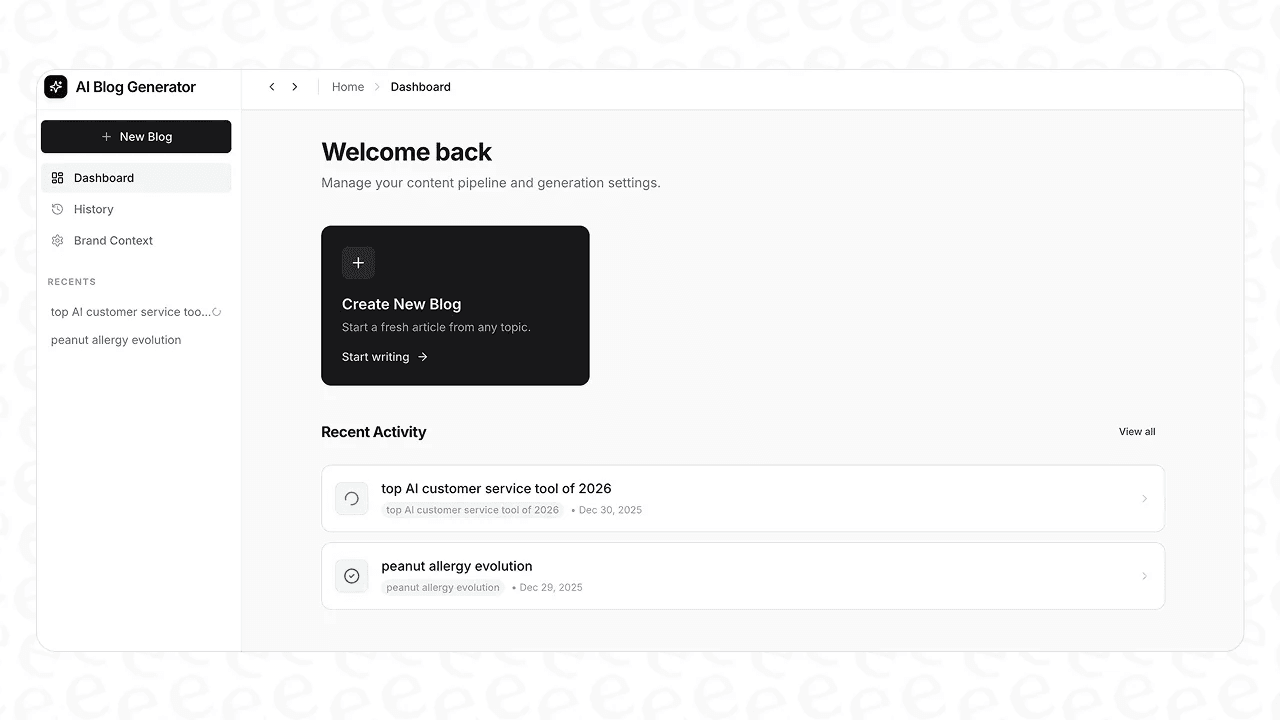
The eesel AI blog writer is a content platform designed to turn a single keyword into a complete, publish-ready article. It functions less as a hands-on AI assistant or a collection of separate tools and more as an end-to-end generator. We actually built it to solve our own content scaling problem, and it’s the same tool that took our blog from 700 to over 750,000 impressions a day in just 3 months.
Here’s why it’s different:
- Automatic Assets: It doesn't just write text. It creates and embeds AI-generated images, infographics, and tables right into the post, giving you a media-rich article from the start.
- Authentic Social Proof: It adds authority by automatically finding and embedding real quotes from Reddit discussions and relevant YouTube videos.
Honestly, I use Gemini, ChatGPT, and Copilot for each of their strengths. I actually used all three simultaneously to brainstorm the best ways to use them and develop a process.
- AEO Optimization: The content is optimized for traditional search engines and for AI Answer Engines like Google AI Overviews and Perplexity, which is becoming more important.
- Context-Aware Research: The AI does real research. If you're writing a comparison, it finds pricing data. If it’s a review, it looks for technical specs. The content is genuinely useful, not just AI fluff.

It’s built for one job: creating high-quality blog posts that are designed to rank, as efficiently as possible.
To get a better sense of how different AI tools can fit into a content creator's workflow, check out this video. It explores several top options and how they can be used for everything from idea generation to final drafts, giving you a broader perspective on the AI landscape.
Final verdict: Which AI writer should you choose?
After looking at everything, the right choice comes down to your goals. There isn't one "best" tool, just the best tool for you.
-
Choose ChatGPT if: You need a flexible, all-around AI assistant for more than just blogging. If you like brainstorming, creative writing, or coding, and you enjoy the process of crafting detailed prompts, ChatGPT is an amazing tool.
-
Choose RightBlogger if: You're a blogger who wants one platform to manage your whole content process. If you want built-in tools for keyword research, SEO analysis, and direct publishing, RightBlogger's structured approach will save you a lot of time.
-
Choose eesel AI blog writer if: Your main goal is to scale organic traffic by publishing complete, media-rich, and SEO-optimized blog posts with minimal effort. If you want to go from a keyword to a publish-ready article quickly, this is the tool for you.
For anyone focused on growth, the results speak for themselves. The best way to decide is to see the quality firsthand. You can generate your first article for free and see what a purpose-built SEO content platform can do.

Frequently Asked Questions
Share this article

Article by
Stevia Putri
Stevia Putri is a marketing generalist at eesel AI, where she helps turn powerful AI tools into stories that resonate. She’s driven by curiosity, clarity, and the human side of technology.