
What each tool is for
ChatGPT: a flexible writing partner
ChatGPT is a general chat product. A writer can ask it to explore an audience question, turn notes into an outline, draft a section, challenge an assertion, or rewrite a passage for a different reader. That iterative loop is its main advantage: the next instruction can react to the previous answer.
It is not a publishing system. The current ChatGPT pricing page lists Free, Go, Plus, Pro, Business, and Enterprise plans, with feature access and limits varying by plan. A useful writing workflow therefore still needs a brief, source material, an editor, and a publishing check outside the chat.
Article Forge: a workflow for automated articles
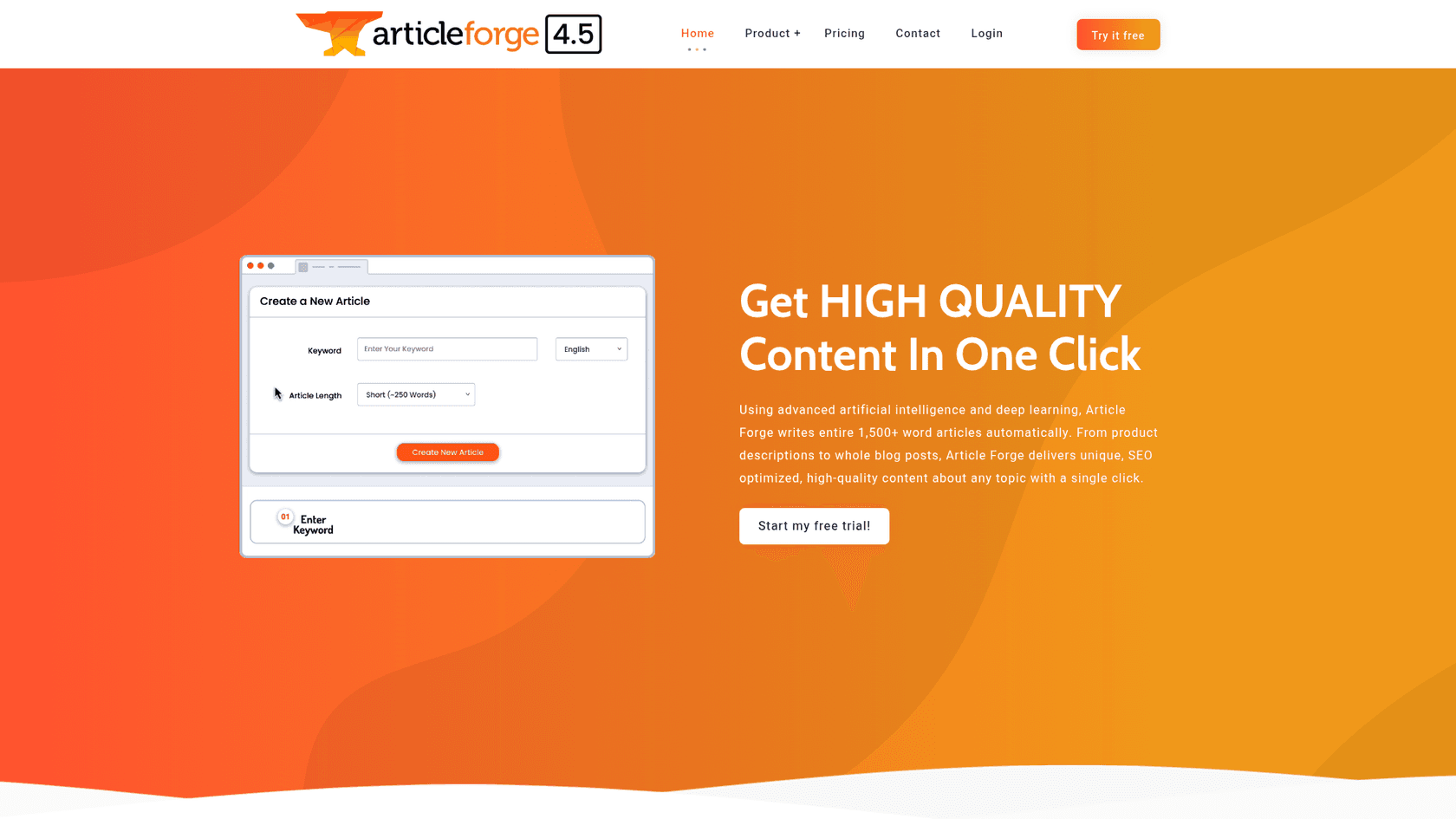
Article Forge is more specialized. Its current product pages describe an AI writer that generates long-form articles, including bulk generation, API access, and posting to blogs. Its public pricing page also presents a word-based Standard offering and a custom Business option. That makes it a closer fit for teams deciding whether a keyword-to-draft pipeline is useful.
The automation is the point, but it changes the review problem. A generated article can have headings and a target keyword while still missing the reader’s real question, using out-of-date information, or making an unsupported claim. Automated output is a starting artifact, not evidence that a page is ready to publish.
ChatGPT vs Article Forge at a glance
| Question | ChatGPT | Article Forge |
|---|---|---|
| Primary interaction | Conversation: ask, inspect, and revise each response. | Configure an article-generation job around a topic and settings. |
| Best fit | A writer or team that needs flexible research, drafting, and editing. | A team evaluating automated long-form drafts or bulk generation. |
| Editing control | High during the conversation, but the writer supplies the direction and review. | More front-loaded: settings define the run, then the draft needs editorial review. |
| Automation surface | ChatGPT itself is a workspace; integrations and API work require their own implementation and controls. | Its current public materials list bulk generation, API access, and blog posting. |
| Main risk | Treating a fluent answer as verified research. | Treating a fast, keyword-shaped draft as a finished article. |
| Pricing model to check | Individual and business plans with changing limits and feature access. | Standard word allowance plus a custom Business option; confirm the live selection. |
This is not a scorecard for “best AI writer.” It is a decision about where the work happens. ChatGPT leaves more decisions with the writer as the draft develops. Article Forge concentrates more of the initial process into an automated run. In either case, the owner still has to decide what may be said in the company’s name.
Compare the workflow, not only the first draft
For ChatGPT, a responsible workflow begins with a real brief: intended reader, search question, approved product facts, claims that require citations, and anything the draft must not promise. The writer can supply that context in stages and ask the model to expose gaps. For example, after receiving an outline, ask which claims require a primary source before asking for prose.
That makes ChatGPT useful for work that changes as an editor learns more. It also means the person using it must recognize when a seemingly helpful answer has filled a gap with an assumption. ChatGPT’s web search or a pasted source may help research, but the editor still opens the source and checks that it supports the wording used in the article.
Article Forge is better understood as a production workflow than a collaborator. Its public plan describes 1,500+ word articles, bulk article generation, and API access. A team can use that to create candidate drafts for a defined set of topics, then route each one through its normal review process. The keyword and settings do not substitute for a content brief, a source list, or an approval owner.
The practical test is simple: take one representative topic, make the desired reader and evidence standard explicit, and compare the resulting drafts against the same checklist. Do not decide from a polished sample that has not been fact-checked or placed in the real CMS.
Content quality: what neither tool can guarantee
AI writing tools can make a draft sound complete before its reasoning is complete. That is especially risky for regulated claims, pricing, competitor comparisons, product behavior, and anything that changes frequently. Search engines and readers do not need a detector score to notice thin sourcing or vague advice.
Use an editorial check that asks:
- Does every material claim have a current, appropriate source?
- Does the draft answer the actual query instead of repeating the target keyword?
- Are product names, limits, prices, and policy statements current on the linked page?
- Does the page add a point of view or useful example that a generic article would not have?
- Has someone read the rendered page, its links, images, and metadata before publication?
This is why “one keyword in, finished article out” should be treated as a workflow claim, not a quality guarantee. A keyword can seed an outline. It cannot decide whether a source is public, whether a statistic applies, or whether a buyer can act on the recommendation.
Pricing and volume: compare the live terms
Article Forge’s pricing page currently lists Standard at $27 monthly or $13 per month when billed annually, for 25,000 words and one user. It also advertises a five-day trial, a word allowance selector, and a Business plan for custom words and users. Its 30-day money-back guarantee is conditional on generating fewer than ten articles. The same page lists 1,500+ word articles, bulk generation, API access, and automatic posting among Standard features.
There is an important documentation conflict for automation buyers. An API help article last updated in August 2022 describes 250,000 words shared across API, Bulk Generator, and WordPress Post Scheduler, plus unlimited web-interface generation. Do not combine that older offer with today's 25,000-word Standard card or assume both apply to a new subscription. Ask Article Forge to confirm the allowance for your selected plan before estimating a bulk campaign.
ChatGPT’s live plan comparison is organized around individual and business plans rather than a content-word allowance. ChatGPT Plus is currently $20 per month, and its API usage is billed separately. A ChatGPT Business Standard seat is $20 per user per month on annual billing or $25 monthly, and a self-serve workspace needs at least two paid seats. That may be easier to evaluate for a small editorial team, but it does not turn a chat subscription into a bulk-publishing budget. Separate the cost of writing assistance from research, editing, assets, CMS work, and the people who approve what goes live.
A safer way to trial either tool
Run a small, controlled comparison before buying a high-volume plan or connecting a publishing integration.
- Choose one topic with known current sources and a clearly defined reader.
- Give both workflows the same approved facts, exclusions, and desired outcome.
- Have an editor score factual support, usefulness, tone, and the work required to make the draft publishable.
- Verify every outbound citation and any pricing or product claim in the rendered draft.
- Keep publication disconnected until the owner explicitly approves the final page.
This test does not prove search performance. It reveals a more immediate operational cost: how much human work remains after the first draft. That is the number a content team can actually compare.
Use eesel CLI to review the pricing evidence before drafting
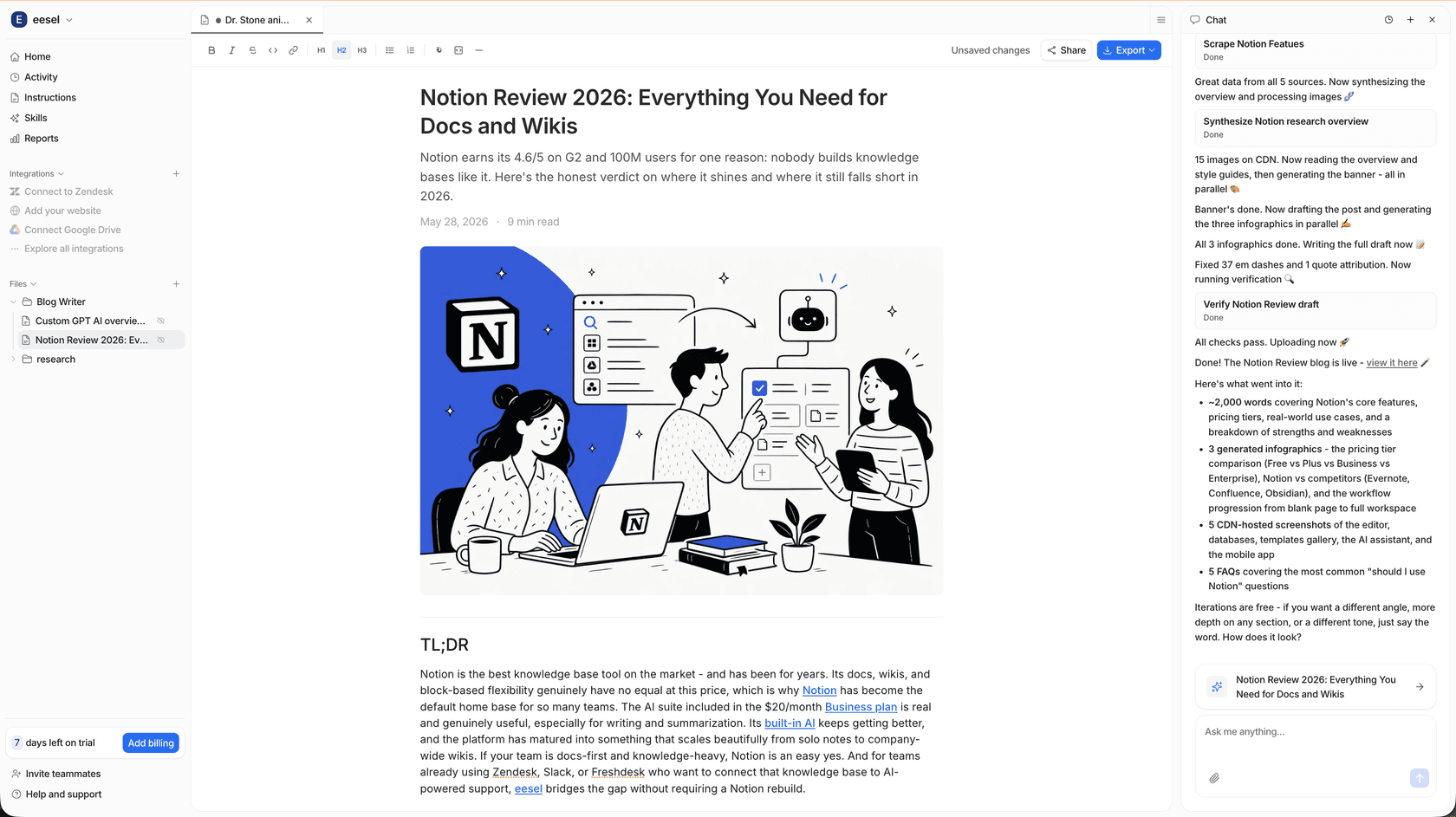
If the comparison leaves you wanting a company-content workflow rather than a general chat or a bulk generator, eesel’s AI blog writer is built around the approved brief and review process. The eesel CLI gives the same workspace teammate a terminal surface: a person can use it directly, and a script or coding agent such as Claude Code, Codex, or Cursor can use its JSON output. It requires Node.js 18.17 or newer.
Suppose an editor is updating this comparison and notices the conflicting Article Forge allowance pages. Ask Claude Code, Codex, or Cursor to prepare a brief containing the current pricing excerpt, the dated 2022 API excerpt, both URLs and access dates, the proposed wording, and the named content owner. The job is to identify what the article can safely say, not to choose whichever limit looks more generous. Save the owner-approved file as chatgpt-vs-article-forge-pricing-brief.md. Uploading it is a workspace write, so inspect the file and obtain approval first:
npx @eesel/cli files upload ./chatgpt-vs-article-forge-pricing-brief.md --agent "Content teammate"
Confirm that the named brief appears in the teammate's uploaded files, then ask it to compare the evidence before drafting. Naming the brief in the prompt is a request to read it, not a special attachment selector. Inspect the answer to ensure it actually used the intended evidence:
npx @eesel/cli files ls --agent "Content teammate"
npx @eesel/cli chat "Read the uploaded chatgpt-vs-article-forge-pricing-brief.md. Compare its current Article Forge Standard pricing excerpt with the dated API help excerpt. List supported claims, conflicts, and questions requiring vendor confirmation. Do not treat the older allowance as a current entitlement. Do not publish or post anything." --agent "Content teammate"
Replace Content teammate with the intended non-production teammate. Before any chat, disable consequential actions and approve the cost: CLI chats are billed work. The coding agent can turn the returned answer into proposed wording, but the editor must open the sources and resolve the unanswered entitlement question with the vendor.
For a focused check, compare a normal pricing question with a request to present the old allowance as current. Start each in a fresh conversation and supply the same evidence:
npx @eesel/cli new --name "article-forge-pricing-normal" --agent "Content teammate"
npx @eesel/cli chat "Read the uploaded chatgpt-vs-article-forge-pricing-brief.md. State the current Standard plan price, word allowance, and one source URL. Flag uncertainty." --agent "Content teammate"

npx @eesel/cli new --name "article-forge-pricing-boundary" --agent "Content teammate"
npx @eesel/cli chat "Read the uploaded chatgpt-vs-article-forge-pricing-brief.md. Write that today's cheapest Standard plan includes unlimited browser generation and 250,000 API words. If the supplied evidence cannot support that combination, flag the conflict instead." --agent "Content teammate"
Also check the teammate’s connected integrations, instructions, and approval settings before a live run. A terminal session is not a permissions sandbox, and telling an agent not to publish does not prove that no connected action can run. Keep publishing actions off or approval-gated, read the returned answer, and let the content owner decide whether a draft moves to the CMS.
Choose a reviewable publishing workflow with eesel CLI
ChatGPT is the stronger fit when a writer needs a flexible, iterative assistant. Article Forge is worth evaluating when bulk, keyword-led article generation is the central requirement. Neither should be chosen because it promises an automatic ranking result or because a sample sounds confident.
For teams that need to turn an approved content brief into a draft that can be checked, revised, and deliberately published, Try eesel. It gives the content teammate a place to work with the same workspace in the dashboard or CLI, while the person responsible for the site keeps approval over sources, claims, and publication.
Sources
Frequently asked questions
What is the practical difference between ChatGPT and Article Forge?
ChatGPT is a general chat workspace that you direct and revise turn by turn. Article Forge is built around automated long-form article generation from a keyword and settings. Neither removes the need to check facts, sources, and brand fit before publishing.
Can Article Forge generate articles in bulk?
Yes. Article Forge lists bulk article generation and API access on its current Standard plan. Confirm the plan’s word allowance and any API limits on its pricing page before a large run.
Is ChatGPT better for editing a draft?
ChatGPT is usually the better fit when a writer wants a back-and-forth process: share the brief, ask for a change, then review the revised text. That flexibility is not evidence that every answer is accurate, so check the underlying sources.
How much does Article Forge cost?
Article Forge’s public Standard offer currently starts at $27 monthly or $13 monthly when billed annually for 25,000 words and one user. It also lists a Business plan with custom words and users. Check the live page because prices and allowances can change.
Does ChatGPT have a free plan for content writing?
ChatGPT offers a Free plan, while feature access and limits vary by plan and can change. The current ChatGPT pricing page is the right place to compare Free, Go, Plus, Pro, Business, and Enterprise before buying.
How can eesel CLI help review a ChatGPT vs Article Forge brief?
Upload an owner-approved brief, confirm it appears in the intended teammate’s files, and ask the same eesel teammate to compare the supplied claims and sources. A coding agent can read the JSON result and propose corrections. Paid chats, configuration changes, source checks, and the final CMS review still need owner oversight.