

The world of AI tools is packed, and "free" often comes with a catch when you're talking about SEO. Many tools advertised as free are actually just limited trials that push for a subscription right away. It's a common frustration when you're just trying to find a tool that helps without needing a credit card to start.
My goal here is to cut through that noise. I've personally tested several AI-powered SEO tools to find the ones that offer real value without cost. We'll look at options for core tasks like content creation, keyword research, and technical analysis. A genuinely useful tool can save a lot of time by handling multiple functions, which is why solutions that combine research, writing, and asset creation, like the eesel AI blog writer, are becoming more common.
What are SEO AI tools used for?
SEO AI tools are applications that use artificial intelligence to help with search engine optimization tasks. Traditional tools often require you to sort through data manually, but AI-powered platforms can analyze large amounts of information to find patterns, predict trends, and suggest what to do next.
The main difference is that they move past just presenting data. For example, an AI tool might not just give you a keyword list; it could also figure out the searcher's intent, find gaps in your content, and create a draft article for you. This helps automate work that used to take a lot of time.
AI works best when used for research, outlining, and speeding up drafts while the real ranking power still comes from expertise, strategy, and links.

Common uses include:
-
Keyword research: Finding new keywords, checking their difficulty, and organizing them into topic groups.
-
Content creation: Writing blog posts, meta descriptions, headlines, and other text based on specific keywords.
-
On-page optimization: Reviewing content for SEO best practices and suggesting improvements for headings or internal links.
-
Technical audits: Automatically checking a website for problems like broken links, slow pages, or indexing errors.
My criteria for choosing the best free SEO AI tools
To keep this list practical, I used a few simple rules. Every tool had to meet these points to make sure it was actually useful and didn't have hidden costs or annoying limits. Here’s how I picked them:
-
Truly free tier: The most important factor was a genuinely free plan. This means no 7-day trials that require a credit card. The free version had to be available permanently.
-
Core function value: A free plan isn't helpful if its features are too restricted to do anything meaningful. Each tool on this list lets you complete a key SEO task, like creating content or running a site audit.
-
Ease of use: You shouldn't have to spend hours learning a new tool. The options I selected are straightforward enough for a solo creator or small team to start using quickly.
-
Actionable output: The results had to be clear and usable. A good tool gives you something you can act on immediately, like a ready-to-publish article, a focused keyword list, or a report of technical issues to fix.
A comparison of the best free SEO AI tools
Here’s a quick look at the tools that made the list, showing what they’re best for and the limitations of their free plans. This visual comparison highlights how each of the best free SEO AI tools fits into a different stage of the content workflow.
| Tool | Best For | Key Free Feature | Limitations |
|---|---|---|---|
| eesel AI blog writer | Generating publish-ready articles | Complete blog post generation | First generation is free to try |
| Google Search Console | First-party performance data | Performance & indexing reports | Only analyzes your own website |
| AIOSEO Analyzer | On-page technical audits | Website SEO issue scanning | Recommendations are geared toward its WordPress plugin |
| Keywords Everywhere | In-SERP keyword research | Trend charts and related keywords | Core metrics require paid credits |
| Quattr Free Tools | Generating specific SEO elements | Individual content generators | Requires using multiple tools |
The 5 best free SEO AI tools to use in 2026
After trying out many options, these five tools were the most consistent in terms of their utility and generous free plans.
1. eesel AI blog writer
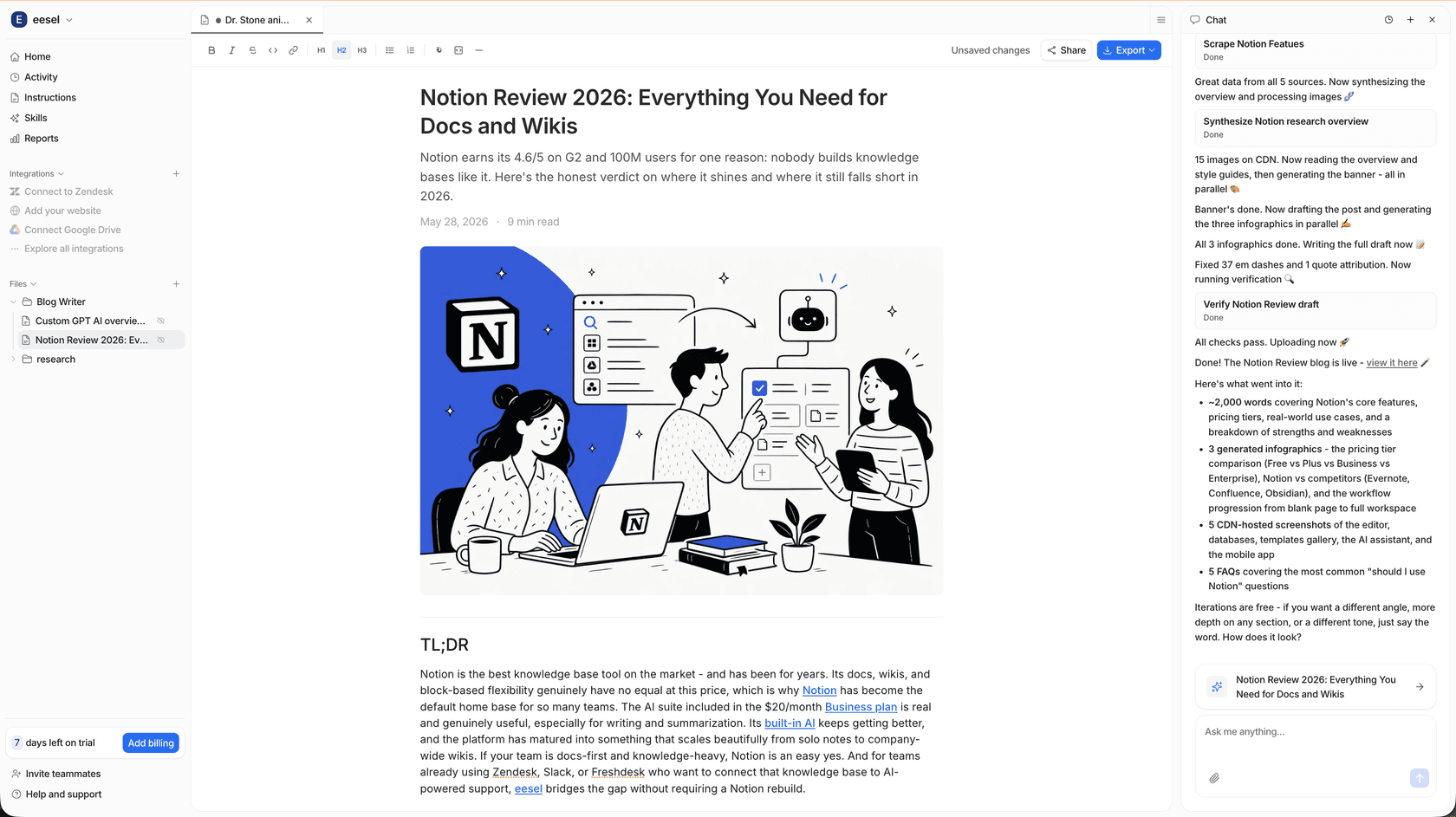
The eesel AI blog writer is built to turn a single keyword into a complete, ready-to-publish blog post. It doesn't just give you a rough draft; it produces a fully structured article with headings, an introduction, a conclusion, and FAQs. It also enriches the content with AI-generated images, relevant YouTube video embeds, and real quotes from Reddit to add authenticity. The tool uses context-aware research to fit the content to the topic and is optimized for AI Answer Engines (AEO).
Pros: Its biggest strength is producing high-quality, readable content that gets results. For example, eesel AI used this tool to grow its blog traffic from 700 to 750,000 daily impressions in three months. This saves hours of manual work. Cons: Content for very technical or specialized fields might still need a final check by an expert to confirm all details are accurate.
Pricing: The eesel AI blog writer is free to try, so you can generate your first blog post at no cost. After that, the paid plan uses a credit system at $99 for 50 blog posts.
2. Google Search Console
Google Search Console (GSC) is a must-have free tool from Google for monitoring your website's performance. It tracks key metrics like impressions, clicks, click-through rate (CTR), and average keyword positions. You can see which search queries bring people to your site and where you rank for them. GSC also provides important info on indexing status, mobile usability, and other technical health checks. Its Insights report offers a simplified overview of your site's performance.
Pros: The tool's main benefit is its accurate, first-party data straight from Google. You see exactly how Google views your site. This is great for tracking performance and fixing technical problems. Cons: The primary limitation is that GSC only shows data for your own website. It provides no information on competitors, so you can't use it to analyze their strategies.
Pricing: Google Search Console is completely free.
3. AIOSEO Analyzer
The AIOSEO Analyzer is a free web tool that runs a quick SEO audit on any webpage. You enter a URL, and it scans for common on-page and technical SEO problems. The report covers things like missing title tags, keyword use in headings, internal linking, and schema markup. It gives you an overall score and a checklist of recommendations.
Pros: This tool is great for quickly finding easy-to-fix on-page optimization issues without a paid subscription. It’s fast and simple. Cons: A notable drawback is its focus on WordPress. Many recommendations are designed for users of the AIOSEO WordPress plugin, so the advice might be less relevant for sites built on other platforms like Shopify or Webflow.
Pricing: The SEO Analyzer tool is free to use.
4. Keywords Everywhere
Keywords Everywhere is a browser extension for Chrome and Firefox that adds keyword data directly into Google's search results page. On the free plan, it shows trend data charts and suggests related keywords in a sidebar. This makes it handy for initial topic research, as you can see related queries and their popularity without leaving Google.
Pros: The main advantage is convenience. Seeing keyword ideas and trend data right in the search results makes research much smoother. The free version's trend charts and related keywords are helpful for understanding a topic's popularity over time. Cons: The biggest limitation is that key metrics like search volume, cost-per-click (CPC), and competition data are behind a paywall and require you to buy credits.
Pricing: The extension is free to download for basic features. Unlocking all data requires purchasing credits, which expire after one year.
5. Quattr's free AI SEO tools
Quattr provides a set of free, single-purpose AI generators for specific SEO tasks. Their offerings include a Title Generator, H1 Heading Generator, and Meta Description Generator. Each tool is straightforward: you give it a keyword, and it gives you several optimized copy options for your on-page elements.
Pros: These tools are very effective for their intended purpose. If you just need a meta description or a few headline ideas, they are simple and deliver good results quickly. Cons: The downside is that the process is disconnected. To get all the on-page elements for one blog post, you have to use several different tools, which can be less efficient than an all-in-one solution.
Pricing: The individual AI generator tools are free to use.
Tips for getting the most out of free SEO AI tools
Free tools are useful, but you'll get better results if you use them strategically. Here are a few tips:
-
Combine tools into a workflow: You can unlock more power by using different free tools together. For instance, use Keywords Everywhere to find a topic, generate a full article with the eesel AI blog writer, and then track its performance with Google Search Console.
-
Add your unique expertise: AI should be a starting point. The best content often includes personal stories or expert opinions that an AI can't provide. Use AI for the heavy lifting, then add your own perspective.
-
Fact-check the output: AI is advanced, but it can still get things wrong. Always spend a few minutes verifying any specific data or claims before publishing.
-
Focus on one task at a time: It’s easy to get overwhelmed. A better way is to pick one area to improve, like content creation, and master one free tool for that job before moving on to others.
Are free SEO AI tools enough?
Based on my tests, free AI SEO tools can handle specific tasks quite well. They are excellent for anyone on a budget or just getting started with SEO. You can definitely use them for keyword ideas, basic on-page optimization, and technical checks without paying anything.
However, the main issue is that creating a workflow from multiple free tools can be inefficient. Switching between different interfaces and moving information manually can slow you down.
For more insights on how different free tools can be used in your SEO strategy, the video below offers a great overview of various options available for content creation and optimization.
For those who want to scale their content strategy, a single tool that handles research, writing, and asset creation is much more effective. A solution like the eesel AI blog writer is valuable in this situation. Instead of juggling multiple tools, you can generate a complete, high-quality article in minutes. Try it for free and see how much time you can save.
Frequently asked questions
What are the best free SEO AI tools for generating content?
For complete articles, the eesel AI blog writer is a strong option as it creates a publish-ready post from a single keyword. For smaller elements like titles or meta descriptions, Quattr's individual generators are effective.
Can I get accurate performance data from free SEO AI tools?
Yes, Google Search Console is an indispensable tool that provides first-party data directly from Google about your site's performance, including clicks, impressions, and keyword rankings.
Are there any free SEO AI tools that can help with technical SEO audits?
The AIOSEO Analyzer is a useful web-based tool for this. It scans any URL and provides a quick report on common on-page and technical issues, helping you identify areas for improvement.
What are the typical limitations of free SEO AI tools?
Common limitations include restricted features, credit systems that limit usage, and a lack of competitive analysis. For example, Keywords Everywhere requires paid credits for core metrics, and Google Search Console only shows data for your own site.