The key benefits of an AI blog writer for scaling your content

Stevia Putri
Last edited January 14, 2026
Content marketing can feel like a treadmill, can't it? You're under constant pressure to create high-quality, deeply researched, and perfectly optimized content. Just when you think you've got a system down, the ground shifts beneath your feet.
How people search for information is changing. They want direct answers, not just a list of blue links. In fact, Gartner predicts that search engine volume will drop by 25% by 2026, largely because of AI-powered answer engines. This shift means your content has to be smarter and more direct than ever.
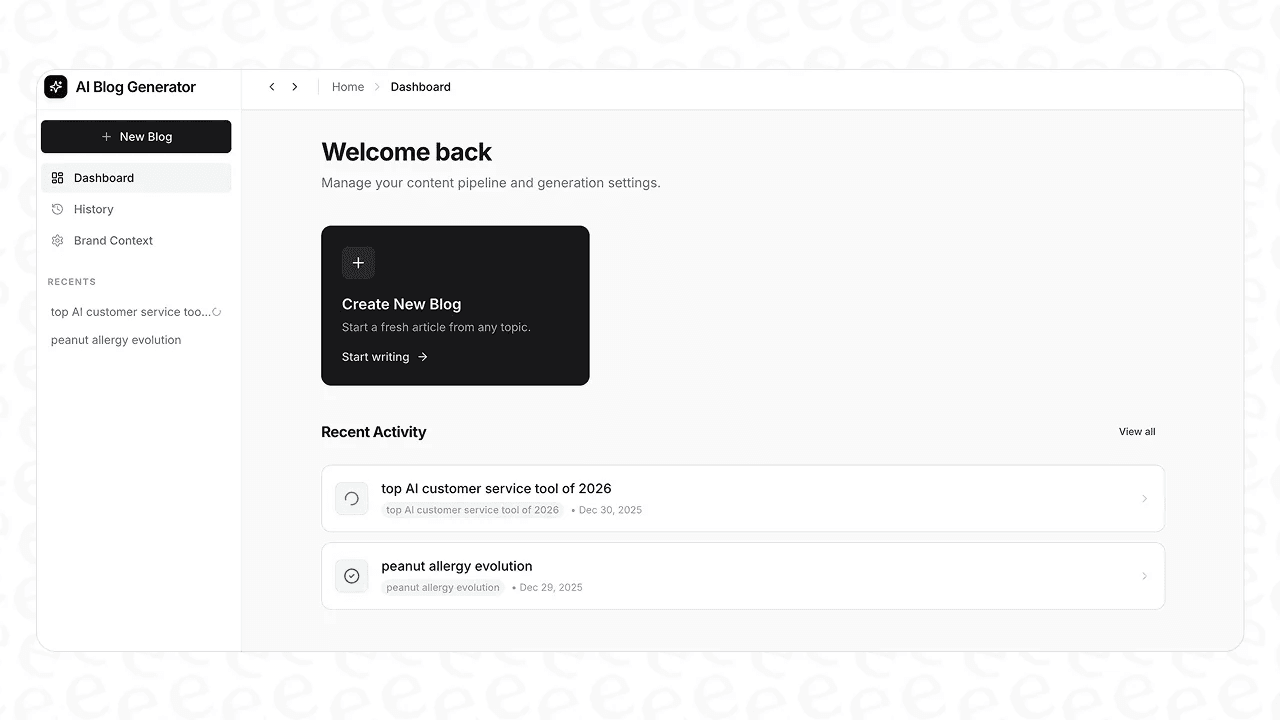
What is an AI blog writer?
At its simplest, an AI blog writer is a tool that uses Large Language Models (LLMs) to generate a complete, structured blog post from a basic prompt, like a keyword or a topic.
But the good ones are much more than that. They are specialized platforms designed to manage the entire content creation process, from the initial research and outlining to a final, publish-ready draft packed with images and data.
These tools are a significant evolution from earlier "content spinners" that just reworded existing articles, often producing text that was barely readable. Modern AI writers create original, human-sounding content that is genuinely helpful to the reader.
The key benefits of an AI blog writer
So, what do you actually get when you start using an AI blog writer? It's about more than just getting words on a page. It’s about fundamentally changing how you approach your entire content strategy.
Unmatched speed and productivity
The most obvious win is speed. A single, well-researched blog post can easily take a human writer a full day or more to finish. An AI tool can produce a solid first draft in just a few minutes.
This isn't just about saving a little time here and there. One marketing agency that adopted AI writing tools found they cut production time by 62% without any drop in quality. When you free up that much time, you can scale your output in ways that were previously unimaginable. You can finally publish consistently and build the topical authority that search engines reward.
Let's put that into perspective.
Manual vs. AI-Assisted Blog Post Creation (1,500 words)
| Task | Manual Workflow (Time) | AI-Assisted Workflow (Time) |
|---|---|---|
| Research & Ideation | 2-4 hours | 10 minutes |
| Outlining | 1-2 hours | 5 minutes |
| First Draft Writing | 4-6 hours | 10 minutes |
| Sourcing Assets | 1-2 hours | 0 (Automatic) |
| Editing & SEO | 2-3 hours | 1-2 hours |
| Total Time | 10-17 hours | 1.5-2.5 hours |
Enhanced SEO and AEO
Every content marketer knows the SEO basics: include your target keywords, use proper headings, and write a good meta description. AI writers can handle all of this automatically, creating content that's perfectly structured for search engine crawlers.
But the game is evolving. Now, we also have to think about Answer Engine Optimization (AEO).
The eesel AI blog writer, for instance, was built from the ground up with AEO in mind. It helps you create content that’s perfectly formatted to be featured by these new answer engines, giving you a real advantage.
Streamlined research and ideation
One of the biggest roadblocks in content creation is just getting started. What should you write about? What points do you need to cover? We've all been there, staring at a blinking cursor with no idea where to begin.
An AI writer is like having a research assistant on call 24/7. It can instantly generate topic ideas, create detailed outlines, and pull in key talking points, effectively eliminating writer's block. This streamlines the pre-writing phase, which is often the most challenging part of the process.
The best tools take this a step further with what's called context-aware research. This is a key difference. A generic tool might give you a vague summary of a topic. But a tool like the eesel AI blog writer understands your intent. If you ask for a comparison post, it knows to find pricing data and feature lists. If you ask for a product review, it looks for technical specs and common user complaints. It does the specific, relevant research for you, saving you hours of manual work.
Consistent brand voice and reduced costs
Let's talk about the budget. Hiring a good freelance writer can cost hundreds or even thousands of dollars for a single article. Building an in-house content team is even more of an investment. An AI writer provides a much more affordable way to scale content. For example, the eesel AI blog writer costs just $99 for 50 complete blog posts. That's not a typo.
Beyond the cost savings, AI helps solve another common problem: brand consistency. When you work with multiple writers, it's hard to keep the tone uniform. Everyone has their own style and quirks.
Advanced AI tools can be trained on your brand. The eesel AI blog writer makes this incredibly simple. You just provide your website URL, and it automatically learns your brand's voice, tone, and context. Every article it generates sounds like it came directly from you, ensuring a consistent experience for your readers.
Common challenges with AI writing tools
Of course, not all AI writers are the same. It's important to know the common pitfalls, especially with more basic tools. Understanding these challenges helps you pick the right platform and use it effectively.
I tested it once by asking it to clean up an essay I wrote and it removed all of my personality, quirks, asides, and aneddotes to just leave the bare facts. It took something engaging and quirky and 'me' and made it bland.

- Factual Inaccuracy ("Hallucinations"): AI can sometimes state things with complete confidence that are just plain wrong. Because it's programmed to be helpful, it will occasionally make up facts or sources to fill gaps in its knowledge. This means human fact-checking is still absolutely necessary.
- Robotic and Repetitive Tone: You can often spot content written by less advanced AI. It tends to use the same cliché phrases and predictable patterns. You know the type: content that starts with "In the ever-evolving landscape..." and says absolutely nothing of substance. It makes for a very boring read.
- Lack of Originality and Depth: AI learns from the vast amount of content already on the internet. This makes it great at summarizing what's already known, but it struggles with new ideas or share insights from real, lived experiences. This can be a problem for Google's E-E-A-T (Experience, Expertise, Authoritativeness, and Trust) guidelines, which prioritize content from actual experts.
- It Only Gives You Text: This is a big one. Most AI writers provide a wall of text and call it a day. They leave it up to you to find or create all the images, charts, tables, and videos needed to make a blog post engaging. The writing is only half the work.
While the benefits are compelling, it's also important to have a balanced view. Many creators and marketers are still debating the ethical considerations and best practices for using AI in their workflows. Understanding both sides of the argument can help you create a strategy that feels authentic to your brand.
From text generation to publish-ready content
So how do you get all the benefits without the drawbacks? You need a tool that was built to solve these specific problems. This is where the eesel AI blog writer comes in. It’s not just a text generator; it's a complete content platform designed to produce articles that are ready to publish.
Here's how it tackles those common limitations:
- Overcoming Tone & Quality: We've spent over a year refining our AI models to produce a genuinely human tone, not generic phrasing. By learning directly from your website, it captures your unique brand voice to ensure every post sounds authentic.
- Solving the Research Problem: Our context-aware research feature means the AI pulls relevant, specific, and up-to-date data for your topic. No more generic filler, just the facts and figures you actually need.
- Including Complete Assets: A key differentiator is the inclusion of assets. The eesel AI blog writer doesn't just give you text. It automatically generates and embeds a full suite of assets right into the draft, including:
- AI-generated images, infographics, charts, and tables.
- Relevant YouTube videos to add depth and keep readers engaged.
- Real, authentic quotes from Reddit forums to add social proof and a human perspective.
You get a complete, media-rich article that’s ready to publish. We don't just claim it works; we've proven it. We used this exact tool to grow our own blog from 700 to 750,000 daily impressions in three months.
The role of AI in modern content strategy
AI blog writers have become powerful tools for any team looking to scale their content. The benefits are clear: you can dramatically increase your publishing speed, improve both your SEO and AEO, and save a significant amount of time and money.
The smartest way to use AI is not as a replacement for human writers, but as a powerful collaborator. Let the AI handle the heavy lifting of research, drafting, and creating assets. This frees up your human experts to focus on strategy, editing, and adding that final layer of unique insight that only they can provide.
I use AI as a tool and have been for about 6-7 years now (yeah, its been around a LONG time.) It is a very good assistant when you need a helping hand. The reality is, AI isn't going anywhere. When used correctly, it can be useful. If you are simply having it write a blog post and then you copy paste in onto your website, then you are not using it correctly, in my opinion.
If you're ready to see what a modern AI content platform can do, why not give it a try? Go ahead and generate your first complete, publish-ready blog post for free with the eesel AI blog writer.

Frequently Asked Questions
Share this article

Article by
Stevia Putri
Stevia Putri is a marketing generalist at eesel AI, where she helps turn powerful AI tools into stories that resonate. She’s driven by curiosity, clarity, and the human side of technology.