The 7 best AI tools for marketing I’m actually using in 2026

Stevia Putri
Last edited January 9, 2026

If you're in marketing, you know AI is everywhere. The question isn't if you should use it, but which tools actually work without making your job more complicated. There's a new "groundbreaking" tool every week, and it's hard to tell what's hype and what's genuinely useful. We're past the point of just experimenting with AI; now it's about finding workflows that save time and get things done.
That's why I wrote this. This isn't a theoretical list. It's a hands-on look at the AI marketing tools I use every day. The best tools today don't just give you a block of text. They create entire, ready-to-publish assets. That's a big reason we built the eesel AI blog writer. We needed a tool that could do the whole job for us.
My two cents is yes. I use Active Inspiration (A.I.) software to 'break me out' of the blank page freeze. The issue is when the content is 70% AI or more. AI should really be used as an Assistive Interface for writing great content, not producing mechanical bastardized word slop by running and rerunning paragraphs through GPT-3.

What's driving the adoption of AI marketing tools?
So, what are "AI marketing tools"? They're apps that use artificial intelligence to make marketing jobs easier. This can be anything from writing content to sifting through customer reviews. The big deal right now is that these tools are powered by Large Language Models (LLMs) like GPT-4, Claude, and Gemini, which gives them a level of capability we didn't have access to just a couple of years back.
Here's what these tools are actually helping marketers do:
- Create content automatically: Not just text, but complete assets like blogs, social media posts, and ads from start to finish.
- Analyze data: Look through customer feedback and social media to see what people are saying right now.
- Personalize experiences: Send tailored messages and offers to individual customers on a large scale.
- Optimize campaigns: Adjust ad spend and find new content ideas based on performance data.
- Streamline tasks: Handle the repetitive work so you can focus on strategy and creative ideas.
How we chose the best AI marketing tools
I didn't just google "top AI tools" to make this list. Each tool here had to pass a few simple tests to be included.
- Practicality: Does it solve a real, everyday marketing problem without a lot of hassle?
- Ease of Use: Can you get it up and running quickly without a degree in prompt engineering?
- Proven Results: Does it actually deliver, whether that's saving time, improving content, or boosting campaign numbers?
- Integration: Does it play nice with the tools you already use, like Google Docs, WordPress, or your CRM?
- Value: Is the price reasonable for what you get back, either in time saved or money made?
A quick comparison of top AI marketing tools
Here is a brief overview of the tools we’ll cover, highlighting what each one does best.
| Tool | Best For | Starting Price | Key Feature |
|---|---|---|---|
| eesel AI blog writer | Scaling SEO content | Free to try ($99/50 blogs) | Generates complete, publish-ready blogs with assets |
| Gumloop | No-code AI automations | Free plan available ($37/month for Solo) | Connects LLMs to internal tools and workflows |
| Surfer SEO | On-page content optimization | $99/month | Real-time SEO scoring and AI search tracking |
| Jasper AI | Versatile copywriting | $69/month | Brand Voice and Content Pipelines |
| Midjourney | High-quality concept visuals | $10/month | Artistic AI image generation via Discord |
| Zapier | Connecting apps & tasks | Free plan available ($19.99/month for paid) | Automates workflows between 8,000+ apps |
| Brand24 | Social media monitoring | $199/month | AI-powered sentiment analysis and mention tracking |
The 7 best AI marketing tools to try
Each tool on this list earned its spot by being genuinely useful. Here’s a detailed breakdown of what makes them stand out.
1. eesel AI blog writer
The eesel AI blog writer is a specialized platform that turns a single keyword into a complete, SEO-optimized blog post that’s ready to publish. It’s the exact tool we used to grow our own site from 700 to 750,000 daily impressions in just three months by publishing over 1,000 optimized blogs.
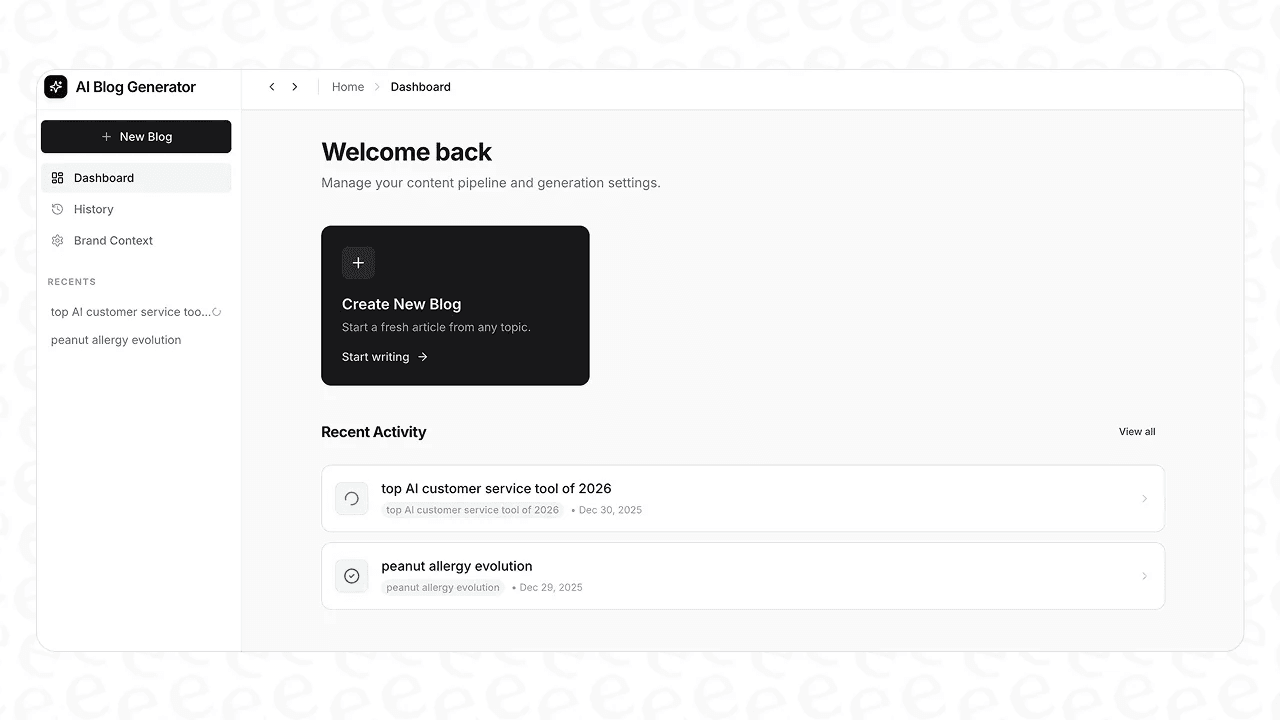
Why it's on the list: What makes it different is that it gives you a full content package, not just a text file. It automatically creates and adds AI images, infographics, and tables. It even embeds relevant YouTube videos and finds real quotes from Reddit to add social proof. Because it builds a complete asset, it's well-suited for Answer Engine Optimization (AEO), which helps your content show up in places like Google’s AI Overviews.
Pros and Cons: The platform is great at producing high-quality, long-form content that sounds human and includes all the necessary assets automatically. This saves hours of work. However, it’s built for blog content, so it’s not the right tool if you mostly need short-form social media copy or ad headlines.
Pricing: It’s completely free to try. Paid plans are simple, starting at $99 for 50 blog posts.
2. Gumloop
Gumloop is an AI automation platform that lets you connect any LLM (like GPT-4 or Claude) to your internal tools using a drag-and-drop interface, no coding needed.
Why it's on the list: It’s perfect for automating complex processes that need some intelligence. For instance, you could build a workflow that scrapes competitor websites for new articles, uses AI to summarize them, and then sends that summary to a Slack channel. A big plus is that you get access to premium LLMs without needing to manage your own API keys.
Pros and Cons: Its clean interface and scraping abilities are great for automating research and sales intelligence. The learning curve can be a bit steeper than Zapier for simple tasks, but it offers much more flexibility for AI-driven workflows.
Pricing: Gumloop offers a generous free plan with 2,000 credits/month. The paid Solo plan starts at $37/month.
3. Surfer SEO
Surfer SEO is a content tool that helps you write articles that are designed to rank. It analyzes hundreds of ranking factors from the top pages for your target keyword and gives you data-driven tips to improve your content.
Why it's on the list: It gives you a real-time "Content Score" that updates as you write, guiding you on things like keyword usage, structure, and readability. Its new AI Tracker feature is also very helpful, as it shows you how visible your brand is in AI search answers on platforms like ChatGPT and Google AI Overviews.
Pros and Cons: Surfer is excellent for refining existing drafts and making sure your on-page SEO is solid. While it has AI writing features, its main strength is in optimization and analysis, not writing from scratch.
Pricing: The Essential plan starts at $99/month.
4. Jasper AI
Jasper is an AI content platform built for enterprise marketing teams. It does more than just generate text, with features like Brand Voice, which learns your company's style, and Content Pipelines, which helps automate the entire content process from idea to distribution.
Why it's on the list: Jasper's flexibility and focus on brand consistency are its key strengths. It uses the best AI model for the job and can maintain a consistent brand voice across different types of copy, which is a huge help for larger teams. It also integrates with Surfer SEO for on-page optimization.
Pros and Cons: It’s a solid all-around tool for teams that create a lot of different marketing copy. Creating a complete, publish-ready blog post requires manual editing and asset sourcing, as the tool's primary focus is on text generation.
Pricing: The Pro plan starts at $69/month per seat (or $59/month if you pay annually).
5. Midjourney
Midjourney is an AI image generator known for producing high-quality, artistic, and conceptual visuals from text prompts. It runs through the Discord chat app, which gives it a unique, community-focused vibe.
Why it's on the list: For marketing teams, Midjourney is great for creating unique blog thumbnails, social media graphics, and creative concepts that don't look like generic stock photos. It can help you build a distinct visual style and test creative ideas much faster than doing it the old-fashioned way.
Pros and Cons: The image quality is often better than many other AI generators, making it perfect for brand visuals that need an artistic touch. The main drawback is the Discord-based interface, which isn't as straightforward as a web app and can be a hurdle for some.
Pricing: The Basic Plan starts at $10/month.
6. Zapier
Zapier is the king of connecting web apps. While it's not strictly an "AI tool," its recent addition of AI features, like Zapier Agents, makes it more powerful than ever for building smart workflows.
Why it's on the list: Zapier's strength is its huge library of nearly 8,000 app integrations. You can create "Zaps" to automate simple tasks, like adding a new email subscriber to a spreadsheet or posting a new blog to all your social channels. With its new AI features, you can now add intelligence to those Zaps, like having an AI summarize an email before it gets added to your CRM.
Pros and Cons: It is incredibly easy to set up for basic automations and can save you hours of manual data entry. For more complex, AI-native workflows, a tool like Gumloop might be a better fit, but for simple app-to-app connections, Zapier is hard to beat.
Pricing: Zapier offers a free plan for simple Zaps. Paid plans with multi-step Zaps and premium apps start at $19.99/month when billed annually.
7. Brand24
Brand24 is an AI-powered social listening tool that keeps an eye on over 25 million online sources, including social media, news sites, blogs, and forums, to find mentions of your brand.
Why it's on the list: It uses AI sentiment analysis to sort mentions as positive, negative, or neutral. It can even detect specific emotions like admiration or anger. This lets you quickly see how the public feels about your brand, manage your reputation, and track how your marketing campaigns are doing in real time.
Pros and Cons: Brand24 gives you a great overview of your online presence and helps you keep up with important conversations. The sentiment analysis is strong, but like any AI, it isn't always perfect and might need a quick manual check for tricky conversations.
Pricing: The Individual plan starts at $199/month ($149/month when billed annually).
How to choose the right AI marketing tools for your team
Feeling stuck? Here's some practical advice to help you decide.
- Start with your biggest headache. Don't just grab the trendiest tool. Figure out your main bottleneck first. Is it creating content? Nurturing leads? Analyzing data? Pick a tool that solves that specific problem.
- Look for "complete" solutions. The best AI tools reduce manual work. For content, that means a platform that gives you not just text but also the visuals, formatting, and optimization to hit "publish."
- Pick something your team will actually use. A powerful tool is useless if it's too complicated. Look for simple interfaces and tools that fit into your current workflow.
- Use the free trials. Nearly every tool on this list offers a free plan or trial. Test them on a real project to see which one works best for you before you pay for anything.
For a deeper dive into how different AI tools can be applied to grow your business, the video below provides a great overview of some of the most impactful options available today and how to master them.
The future of marketing and AI tools
AI isn't some far-off idea anymore; it’s a standard part of a modern marketer's toolkit. The point isn't to replace marketers but to give them a boost, freeing them from repetitive work so they can focus on strategy, creativity, and connecting with people.
Using these tools is how you stay competitive. For any team trying to grow through organic search, creating high-quality content consistently is the most important thing you can do.
If you want to see how AI can generate a complete, SEO-optimized blog post with all the assets included in just a few minutes, try the eesel AI blog writer and create your first article today.

Frequently Asked Questions
Share this article

Article by
Stevia Putri
Stevia Putri is a marketing generalist at eesel AI, where she helps turn powerful AI tools into stories that resonate. She’s driven by curiosity, clarity, and the human side of technology.