The build vs buy question for AI support has evolved. It's no longer a simple either/or decision. Modern AI deployments involve multiple layers: foundation models, orchestration systems, integrations, and governance rails. Each layer carries different risks and benefits.
Here's the reality: 42% of companies scrapped their AI initiatives in 2024, up from 17% the year before. The pattern is clear. Timeline overruns, underestimated complexity, and maintenance burdens kill projects before they deliver value.
This framework will help you evaluate your situation honestly. We'll look at when building makes sense, the hidden costs most teams miss, and how to choose a path that actually gets you results.
Why the AI support build vs buy question has changed
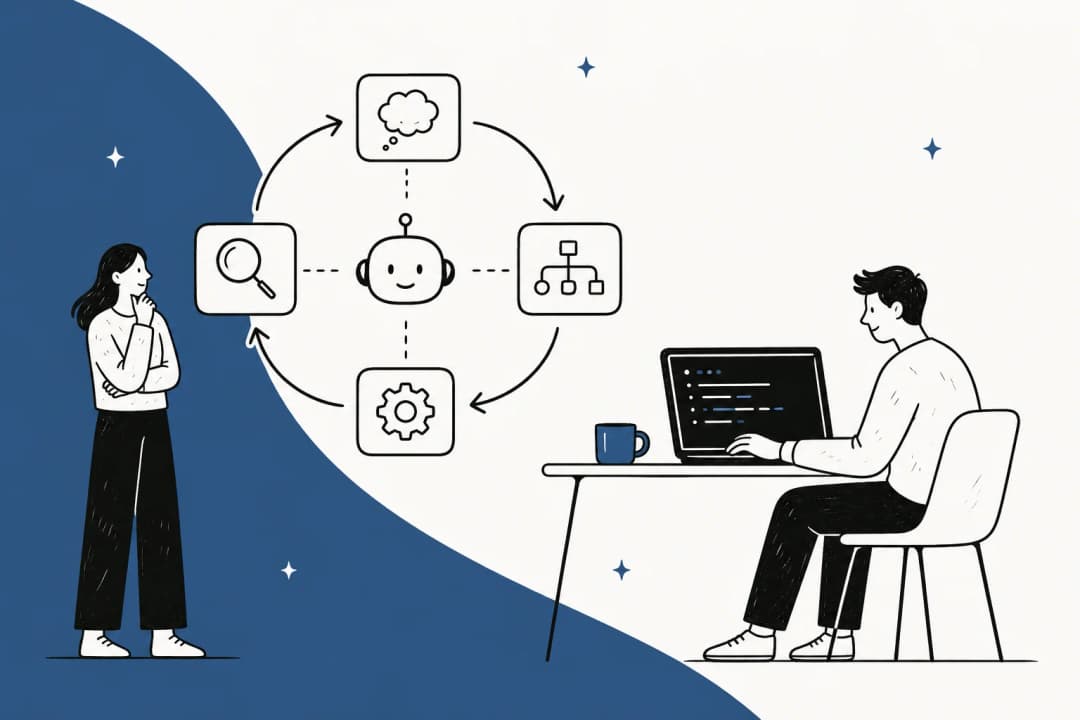
Traditional software is static. You install it, configure it, and it does what you programmed. AI is different. It's a dynamic learning system that evolves with your data, requires continuous tuning, and operates across multiple interconnected components.
The old framework treated build vs buy as a single decision. Today's reality is a continuum:
- Foundation models: Almost always bought (OpenAI, Anthropic, Google)
- Orchestration layers: Sometimes built, often bought
- Domain-specific agents: Hybrid, built on top of bought platforms
- Data fabrics: Usually built internally
- Governance rails: Must remain under your control regardless
As one CIO put it: "We can't simply ask, 'Do we build or do we buy?' We must navigate across multiple components, determining what to procure, what to construct, and how to maintain flexibility."
The tension is between speed-to-value and long-term control. Buying gets you running in weeks. Building gives you complete ownership but takes 12-24 months. Most teams need something in between: a bought foundation with room to customize.
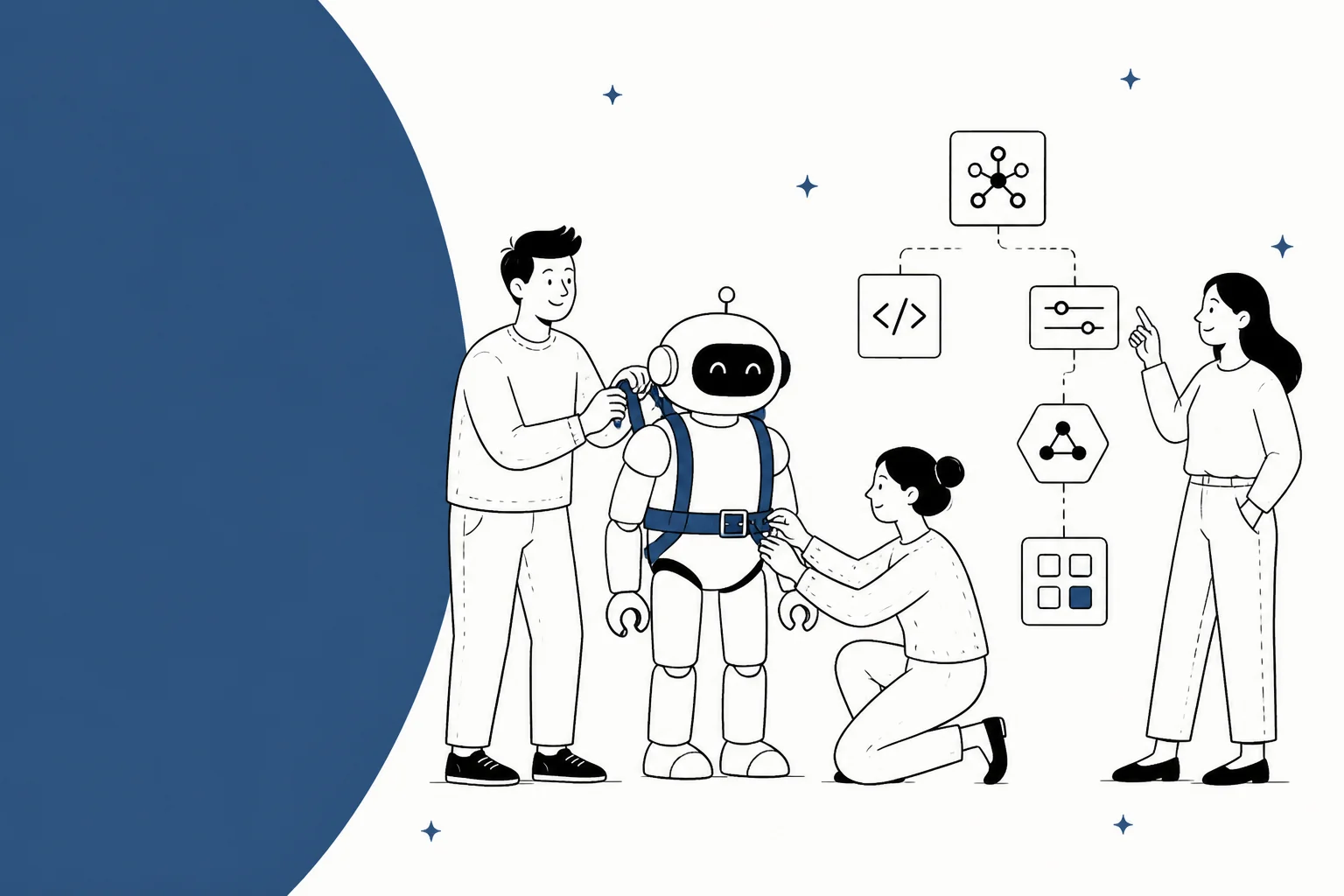
That's where our approach differs. With eesel AI, you're not configuring a tool. You're hiring an AI teammate that learns your business, starts with guidance, and levels up to work autonomously.

When building AI support actually makes sense
Building your own AI support system is the right choice in specific scenarios. Here's the honest assessment of when it makes sense.
AI is your core competitive advantage. If your product IS an AI agent, or AI capabilities differentiate you from competitors, building makes sense. You need full control over the reasoning patterns, decision trees, and data signals. This applies to companies where the AI itself creates defensible value.
You have the resources. Building requires:
- 6+ dedicated engineers
- 12-24 months of runway
- $8.3M+ estimated 3-year TCO (according to Aisera's research)
- $1.5-2.5M annually just for AI/ML talent
Regulatory constraints demand it. If you operate in national security, defense, or highly regulated environments where data can't leave controlled environments, you may need to build. Complete ownership of model parameters, prompts, logs, and data flow becomes non-negotiable.
Your workflows are truly unique. When no vendor platform can support your level of specialization, and your processes are so domain-specific that off-the-shelf solutions fail, building may be necessary.
Here's the honest assessment: most support teams don't meet these thresholds. If you're a typical customer service operation using Zendesk, Freshdesk, or similar platforms, your workflows aren't unique enough to justify the build cost. Your competitive advantage lies in your product, your service, or your brand, not in having a custom-built AI support agent.
The hidden costs of building AI support
The sticker shock of building comes not from the initial development, but from everything that follows. Let's break down what teams consistently underestimate.
Timeline reality. Vendors often quote 6 months for an internal build. The actual timeline to production-ready AI support is 18-24 months. That's multiple quarters for integrations, orchestration logic, security reviews, and pilot testing. During these delays, competitors who bought solutions are already capturing value.
Ongoing maintenance burden. This is the cost most teams miss entirely. RAG pipelines require continuous tuning as documentation changes. Models drift over time. Integrations break. Your AI/ML engineers will spend their time on maintenance instead of product features.
As Inkeep notes: "The hidden cost most teams miss: RAG pipelines require continuous maintenance. Docs change. Models drift. Integrations break. The pattern is consistent. Internal teams get pulled to product work, and AI support degrades."
Talent costs and retention. AI/ML engineers command $1.5-2.5M annually in total compensation for a small team. When one leaves, you lose institutional knowledge about your custom system. The bus factor becomes a real risk.
Opportunity cost. Every engineer working on AI infrastructure is not working on your product. For most companies, product features drive revenue. AI support is a cost center that should operate efficiently, not a differentiator worth massive engineering investment.
Failure risk. According to MIT research cited by Aisera, 95% of in-house AI initiatives fail. That's not a typo. Nine out of ten internal AI projects stall, exceed budgets, or never make it to production.
Shadow AI proliferation. When official tools don't deliver, employees use unauthorized alternatives. Shadow AI usage jumped 250% year-over-year in some industries. This creates data governance issues, inconsistent quality, and security risks.
The case for buying: Speed without sacrificing control
For 90% of enterprise use cases, buying is the pragmatic choice. Here's why.
Deployment speed. Buying compresses your timeline from years to weeks. Platforms like Aisera, Inkeep, and Dataiku deploy in days or weeks, not months. You start seeing value immediately while internal builds are still in architecture review.
Built-in best practices. Bought platforms come pre-trained on support scenarios. They have already solved the hard problems: intent recognition, context management, escalation logic. You benefit from every customer that came before you.
Governance included. Enterprise platforms include guardrails, audit trails, role-based access, and compliance certifications (SOC 2, GDPR, HIPAA) out of the box. You don't have to build security infrastructure from scratch.
Lower execution risk. Vendors have proven performance. They have case studies with metrics. If something breaks, they fix it. You're not betting your support operation on unproven internal technology.
But what about vendor lock-in? Valid concern. Modern platforms like eesel AI address this through:
- Open standards (MCP, A2A protocols)
- API access for custom extensions
- Data export capabilities
- Hybrid approaches that let you build differentiation on top of bought foundations
What about customization limits? This is where the hybrid approach shines. You buy the orchestration, integrations, and security layer. Then you customize the behavior through APIs, SDKs, or plain-English configuration.
With eesel AI, you get the speed of buying with the control of building. Our platform connects to your help desk and learns from your past tickets, macros, and help center in minutes. You define escalation rules in plain English: "If the refund request is over 30 days, politely decline and offer store credit." No code required.

Decision framework: 4 questions to guide your AI support choice
Use these four questions to cut through the noise and make a decision based on your actual situation.
1. Is AI support core to your competitive advantage?
Be honest. Does your product differentiation depend on having a unique AI support experience? Or is AI support a utility function that should work reliably without consuming engineering resources?
- If AI support IS your competitive moat: Consider building
- If AI support is a utility function: Strong case for buying
Most companies fall into the second category. Your customers care that their issues get resolved quickly and accurately. They don't care whether your AI is custom-built or powered by a vendor platform.
2. Do you have 6+ engineers to dedicate for 12+ months?
This is a resource reality check. Building requires not just initial development, but ongoing maintenance. You need:
- AI/ML engineers for model tuning and RAG pipelines
- MLOps engineers for infrastructure and monitoring
- Security engineers for compliance and governance
- Product managers to define behavior and edge cases
If you can't dedicate a full-time team to maintain the AI infrastructure (not just build it), buying is the safer, more scalable option.
3. What is your risk tolerance for failure?
Remember the statistic: 95% of in-house AI initiatives fail. That's the baseline risk you're taking when you choose to build.
Buying reduces execution risk dramatically. Vendors have already made the mistakes, found the edge cases, and hardened their systems. You're adopting proven technology, not conducting an experiment.
4. How fast do you need to show value?
Building: 12-24 months to production Buying: Weeks to months for deployment
In fast-moving markets, the opportunity cost of waiting two years often exceeds the cost of the system itself. While you're building, your competitors are capturing market share with faster response times and lower support costs.
This is why we built simulation into eesel AI. Before going live, you can run our AI on thousands of past tickets to see exactly how it would respond. Measure resolution rates. Identify gaps. Gain confidence before touching real customers. It's the best of both worlds: the speed of buying with the validation that building promises.
The hybrid approach: Best of both worlds
The emerging consensus across the industry is that the future isn't build OR buy. It's both.
Buy the foundation: Orchestration, integrations, security, and governance. Let vendors handle the undifferentiated heavy lifting.
Build the differentiation: Custom workflows, business logic, and domain-specific reasoning that give you competitive advantage.
Use APIs and SDKs: Extend bought platforms without rebuilding core infrastructure. Modern platforms offer TypeScript SDKs, REST APIs, and webhook integrations that let you customize behavior programmatically.
Progressive rollout: Start with AI Copilot drafts for human review. Validate quality. Then expand to autonomous responses for specific ticket types. Finally, level up to full frontline support with an AI Agent as the AI proves itself.
This is how we approach it at eesel AI. You're not just buying software. You're hiring an AI teammate. Like any new hire, eesel starts with guidance (drafting replies for review) and levels up to autonomy (handling tickets end-to-end) based on actual performance. You control the pace.
Define escalation rules in plain English. No complex configuration, no decision trees, no code. "Always escalate billing disputes to a human." "For VIP customers, CC the account manager." The AI follows your instructions.

Making your AI support build vs buy decision
Let's recap. Most support teams (90%+) should buy. Building only makes sense when:
- AI support is your core product differentiator
- You have 6+ engineers and $8M+ to invest
- Regulatory constraints prohibit third-party solutions
- Your workflows are so unique that no vendor can support them
For everyone else, the question isn't whether to build or buy. It's how to buy smart: choosing a platform that gives you speed without sacrificing control, that lets you customize behavior without maintaining infrastructure, and that scales with your needs.
The real metric is time-to-value. How fast can you go from decision to deployed AI support that actually helps customers? With modern platforms, that timeline is measured in weeks, not years.
If you're evaluating AI support options, consider how eesel AI approaches this. We've built a platform that deploys in minutes, learns your business from existing data, and lets you level up from AI Copilot drafts to full AI Agent autonomy on your own timeline. You can run simulations on past tickets before going live, define behavior in plain English, and maintain full control over escalation and governance.

The build vs buy decision is important. But don't let analysis paralysis delay you from delivering better support to your customers. The teams that win are the ones that ship.
Ready to see eesel AI in action?
If you're leaning toward buying but want to validate before committing, try eesel AI free. Connect your help desk, run simulations on past tickets, and see exactly how our AI teammate would handle your customer conversations. No credit card required. Deploy in minutes, not months.
Want a personalized walkthrough? Book a demo and we'll show you how eesel AI learns your business, integrates with your existing tools, and levels up from drafting replies to handling tickets autonomously.
Frequently Asked Questions
Share this article

Article by
Stevia Putri
Stevia Putri is a marketing generalist at eesel AI, where she helps turn powerful AI tools into stories that resonate. She’s driven by curiosity, clarity, and the human side of technology.