Running a startup often feels like you're trying to do a dozen jobs at once. You’re the CEO, the salesperson, and somehow, also the entire marketing department. The need to create high-quality content to grow your business is always there, but finding the time, budget, or people to do it is another story. It's a classic startup dilemma: build the product or write about it?
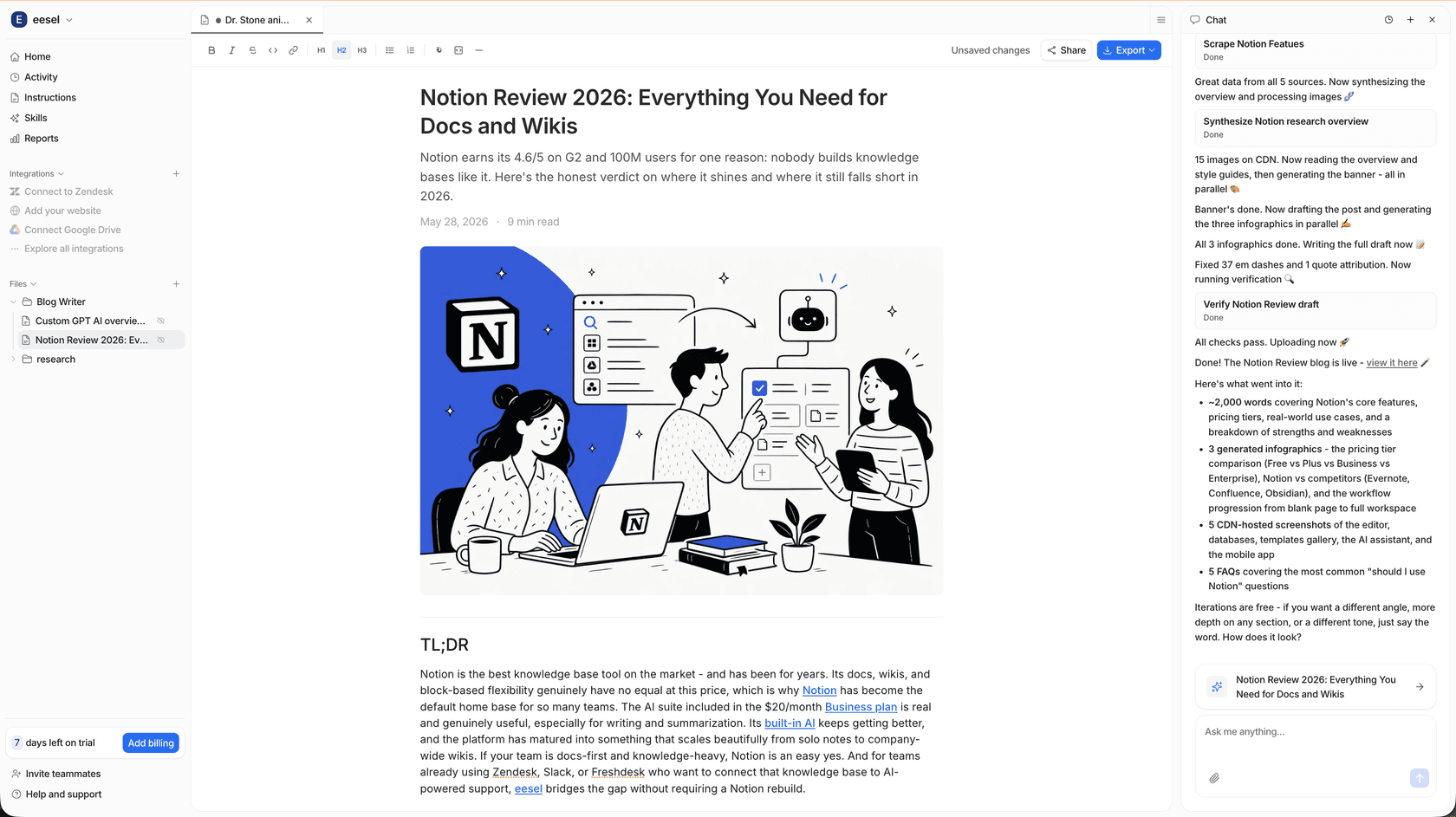
This is where an AI blog writer can step in. It’s a way for startups to scale their content marketing without having to scale their team. A good tool does more than just generate text; it acts as a full content engine. For example, we used the eesel AI blog writer to grow our own site from a modest 700 impressions a day to an incredible 750,000 in just three months.
In this guide, we’ll walk through what to look for in an AI writer, compare some of the top tools available, and get you ready for the next wave of search technology.
What is an AI startup blog writer?
An AI startup blog writer is not just a slightly more advanced version of ChatGPT. While general-purpose AI is useful for brainstorming or drafting a quick paragraph, a dedicated blog writer is a complete platform designed for the entire content creation process. It can take you from a single keyword to a publish-ready draft, handling the research, structure, and media along the way.
For startups, these tools are incredibly helpful because they solve some common and frustrating problems:
- Speed and Consistency: You need to publish regularly to build authority and keep your audience coming back. An AI writer helps you keep up that pace without burning out.
- SEO and AEO Optimization: Your content has to be built to rank on search engines. Even more importantly, it needs to be optimized to get cited by AI answer engines (we'll get to that later), which is where search is headed.
- Brand Alignment: The content needs to sound like it came from your company. The best tools can learn your brand voice and weave in your product naturally, without sounding like a bad advertisement.
- Resource Efficiency: You likely don't have a huge marketing team or an unlimited budget. AI blog writers can give you the output of a small team of writers for a fraction of the cost.
These tools vary in their capabilities. Some focus on basic text generation, while others offer more comprehensive support for a content strategy. Let's look at what separates the good from the great.
What to look for in an AI startup blog writer
When you're looking for an AI writer, it's easy to get sidetracked by flashy features. But for a startup, what you really need is a tool that can handle the heavy lifting of the entire content creation workflow.
Beyond basic text generation
Anyone can type a prompt into ChatGPT and get a block of text. This output typically serves as a starting point that requires further editing. A real AI writer for startups manages the full process. It should handle the in-depth research, create a logical structure, and add rich media to produce a complete, polished post that’s ready to publish.
Context-aware research and outlining
The best content does more than just include keywords; it understands the search intent behind them. What is the user actually trying to achieve? A top-tier AI writer should figure this out for you. It should analyze the top-ranking content, pull in relevant data, and build an SEO-friendly outline. This saves a huge amount of time compared to tools that require you to do all the research and structuring yourself.
Automatic asset and media creation
A blog post composed solely of text may not hold a reader's attention as effectively as one with visuals. Visuals and social proof are critical for keeping readers engaged and building trust. The best platforms don't just write words; they automatically generate or source relevant images, infographics, and tables. Some tools, like the eesel AI blog writer, go a step further by embedding relevant YouTube videos and Reddit quotes to add social proof and expert opinions to your content.
SEO and product integration
Your content has two main jobs: to rank in search results and to promote your product. A great AI writer should handle both automatically. It needs to manage all the on-page SEO basics (headings, keyword placement, meta descriptions) and be smart enough to mention your product in a way that feels helpful, not forced. The most advanced platforms can even learn about your business from your website URL, making sure every mention is natural and adds value.
Comparing top AI blog writer options
Now that we know what to look for, let's see how the leading tools compare. We've evaluated them based on the core features that matter most to a growing startup.
1. eesel AI
The eesel AI blog writer is an all-in-one solution built for startups that need to scale their organic growth. We developed it to solve our own content problem, and we used it to grow our blog from 700 to over 750,000 impressions in just three months by publishing over 1,000 optimized posts.
Key Features:
- Deep Research with Citations: It goes beyond a surface-level skim. It dives deep into a topic to understand user intent, pulling in real-time information and adding external citations to build authority.
- Full Asset Generation: You get a complete post, not just text. This includes AI-generated images, infographics, tables, embedded YouTube videos, and even relevant Reddit quotes for real-world social proof.
- Human-Like Tone: We've spent over a year refining the output to ensure it's engaging, readable, and doesn't have that generic, robotic "AI slop" feel.
- Effortless Brand Integration: Simply add your website URL, and it learns about your product to include natural, non-promotional mentions that genuinely help the reader.
- AEO Optimized by Default: It’s designed from the start to get your content cited by AI answer engines like Google AI Overviews and Perplexity, giving you an advantage in the future of search.
Limitations:
The eesel AI blog writer is a specialist tool. It's built to create high-quality blog content that drives organic traffic. If you're looking for a general-purpose AI assistant to write a little bit of everything (like social media captions or ad copy), you might find it more focused than other platforms.
Pricing:
You can start with the early bird plan at $99 for 50 blog posts. Best of all, it's completely free to try, so you can see the quality for yourself.
2. Jasper
Jasper is a well-known name in the AI world, positioning itself as a comprehensive content platform for marketing teams. It’s designed to unify your brand voice and help automate the entire content lifecycle, from planning to creation.
Key Features:
- Jasper IQ: This is their proprietary context layer that combines broad marketing knowledge with your specific brand voice, style guide, and company facts to keep content consistent.
- Canvas & Studio: It offers a collaborative workspace where you can plan entire campaigns and build custom AI workflows for different marketing assets.
- AI-Powered Integrations: Jasper connects with popular tools like SurferSEO and has a Chrome extension that lets you use its AI capabilities across various platforms.
- Versatile Templates: With over 100 purpose-built marketing apps, it can generate everything from social media campaigns and ad copy to email newsletters.
I have tested most of these too, and found real differences once you get past the surface features. Based on Sprout Score comparisons, Jasper scored higher (8.2) for brand voice and long-form consistency, especially in team use. Surfer SEO scored strong (8.0) in post-publish optimization and SERP alignment, but depends heavily on pairing with another tool like Jasper. Copy.ai lagged a bit (7.4) for structured content workflows, it is fast, but less controllable. Writesonic sat in the middle (7.8), solid for ecommerce and quick drafts but needed a lot of manual editing in B2B use.

Limitations:
Jasper is a versatile platform that can assist with a wide range of content. For long-form blog posts, it functions as a writing assistant, where users can combine outputs from various tools to assemble the final article. This process may include finding social proof like Reddit quotes or videos and ensuring the content is optimized for Answer Engine Optimization (AEO).
Pricing:
The Pro plan starts at $59 per month per seat when billed annually. A 7-day free trial is available if you want to test it out. For larger teams, a custom-priced Business plan is also offered.
3. Contentpen
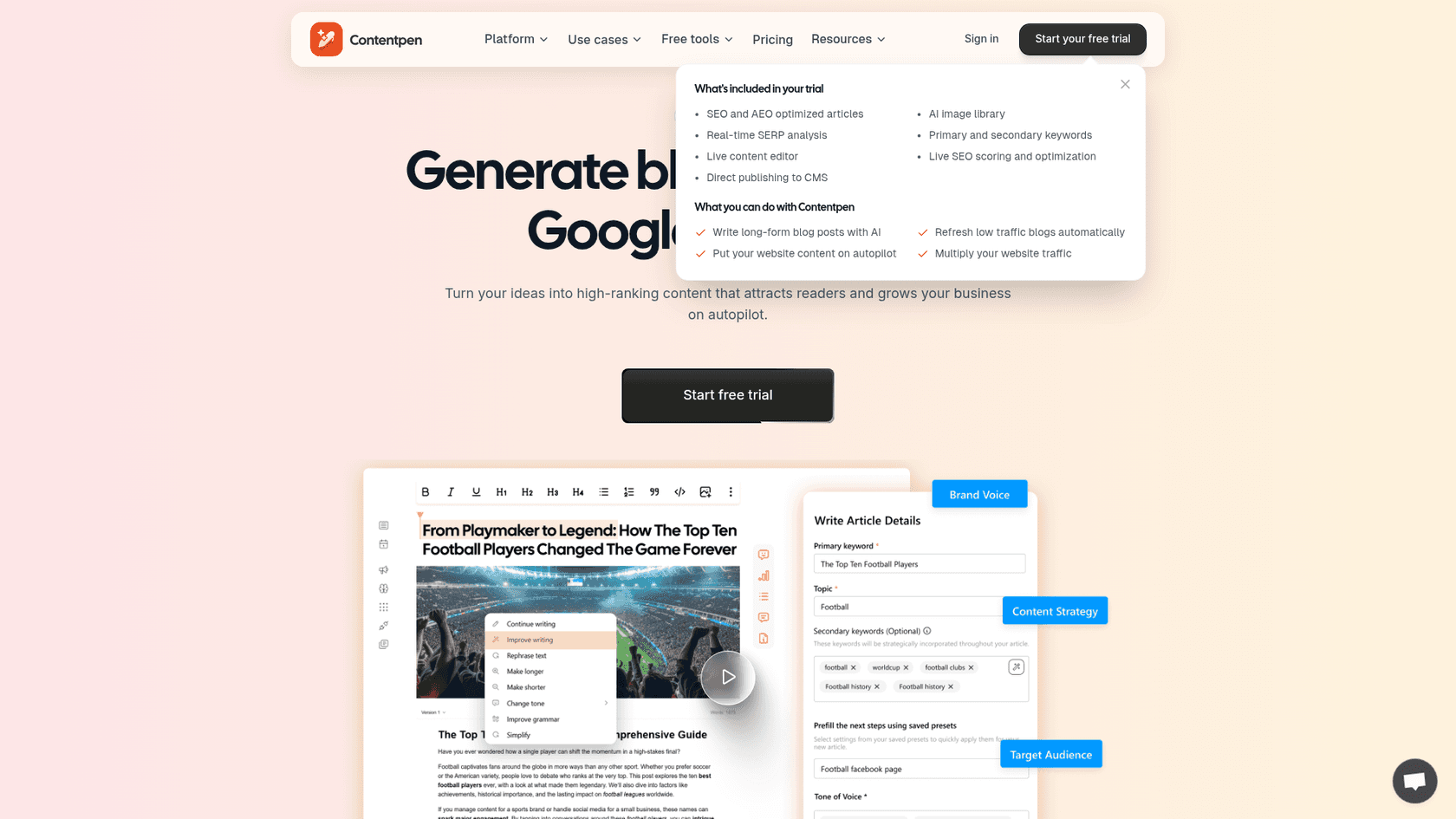
Contentpen is focused on automating the blogging process at a large scale. Its main goal is to get you from keyword research to a published article on your site with as few steps as possible.
Key Features:
- Automated Content Calendar: You can let the AI find keywords and pre-plan your content calendar for months, removing the guesswork from your strategy.
- Bulk Generation: Its main feature is the ability to generate dozens of SEO-ready blogs at once, which is great for quickly filling your content pipeline.
- Direct CMS Publishing: It integrates directly with WordPress, Ghost, Shopify, and other platforms, allowing for one-click publishing.
- SEO & GEO Optimization: Contentpen includes AI-generated images and internal/external links, and it's optimized for both traditional search and what they call Generative Engine Optimization (GEO).
Limitations:
Contentpen is focused on automation and high-volume content generation. Given its emphasis on speed, users may want to perform additional edits to refine the tone for specific audiences. For complex topics, supplementing the output with deep, context-aware research can enhance its authoritativeness for AI answer engines, which prioritize unique answers.
Pricing:
Plans start at $39 per month for 10 articles, with a 14-day free trial available to get started.
Optimizing for search in 2026 and beyond
The way people find information is changing. We’re moving from a world of Search Engine Optimization (SEO) to one of Answer Engine Optimization (AEO).
So, what is AEO? It's the practice of creating content that is easily understood, verified, and cited by AI assistants like ChatGPT, Perplexity, and Google's AI Overviews. According to Gartner, 25% of organic traffic will shift to AI chatbots by 2026. This is a major shift in how search works.
For startups, being cited by an AI is the new "ranking #1." It establishes your brand as an authority and drives highly qualified traffic to your site. Adapting to AEO can help ensure visibility in this new search environment.
Here’s how to optimize for it:
- Structured Data: Use clear headings, lists, and tables. AI models love well-structured content because it's easy for them to parse and understand.
- Factual Accuracy: Provide clear, verifiable information. Citing your sources and linking to trusted external sites is more important than ever.
- Concise Answers: Directly answer common questions. A dedicated FAQ section at the end of your posts is a great way to do this.
This is why the eesel AI blog writer was built with AEO in mind. Its structured output, inclusion of FAQs, and fact-based approach are designed to make content more "citable" for AI models.
Automating your content workflow can seem complex, but many no-code solutions now make it possible to build your own AI writing agents. These systems can handle everything from research to publishing, giving you a hands-on approach to scaling your content. The video below provides a step-by-step guide on how you can create an AI agent that writes and publishes blogs for you, offering a practical look at the power of content automation.
Your startup needs a content engine, not just a writer
A simple text generator may not be sufficient for startups that want to scale their content marketing. Many need a complete system, or a content engine, that handles everything from research and writing to asset creation and optimization for both current search engines and future answer engines.
While there are several good tools out there, the eesel AI blog writer is built to be that engine. It creates complete, brand-aligned, and AEO-optimized content automatically, freeing you up to focus on what you do best: building your business. You can evaluate the quality of the output for yourself.
Ready to put your content creation on autopilot? Generate your first high-ranking blog post for free with the eesel AI blog writer.