A practical guide to the best AI SEO optimization tools

Stevia Putri
Last edited January 6, 2026

SEO is no longer just about Google's ten blue links. With AI Overviews appearing at the top of search results and people getting answers directly from ChatGPT and Perplexity, the landscape has changed. The ground feels as if it is constantly shifting.
To adapt, a new wave of "AI SEO optimization tools" has appeared, each claiming to be the key to ranking number one. It can be overwhelming to determine which tools are genuinely helpful and which are less effective.
This guide cuts through the noise to provide a clear overview of what these tools are, what they do, and which ones deliver results. We’ll cover everything from creating content that ranks to tracking your visibility in AI answers, so you can find the right tool for your strategy.
What are AI SEO optimization tools?
"AI SEO optimization tools" are platforms that use artificial intelligence to assist with or handle tasks across the entire SEO workflow. They can be thought of as an assistant for everything from research to reporting.
Their capabilities extend beyond writing blog posts. These tools can handle a wide range of jobs:
-
Discovering keywords and mapping out topic clusters.
-
Creating content briefs and assisting with on-page optimization.
-
Running technical audits on your site and suggesting fixes.
-
Tracking your visibility in AI-generated answers, a new field called Generative Engine Optimization (GEO).
-
Automating tasks like internal linking and refreshing old content.
The primary benefit is the automation of tedious, repetitive tasks. This allows you to focus on strategy, creative ideas, and understanding your audience's needs. Marketers are already seeing how AI can boost website traffic.
Key types of AI SEO optimization tools and what they do
To better understand these tools, it helps to break them down into a few main categories. Most platforms specialize in one or two of these areas, while a few aim to be all-in-one solutions.
Tools for content creation and optimization
These tools focus on the content itself. They analyze the top-ranking pages for a keyword and provide data-backed advice on topics to cover, article structure, and phrases to include.
For example, a tool like Surfer SEO provides a real-time "Content Score" as you write. It suggests terms to add to make your content more relevant and authoritative, guiding you toward a better-optimized draft.
While these tools are effective for polishing a draft, they generally rely on human input for research, writing, and sourcing images. The final article's quality depends on the draft it is given.
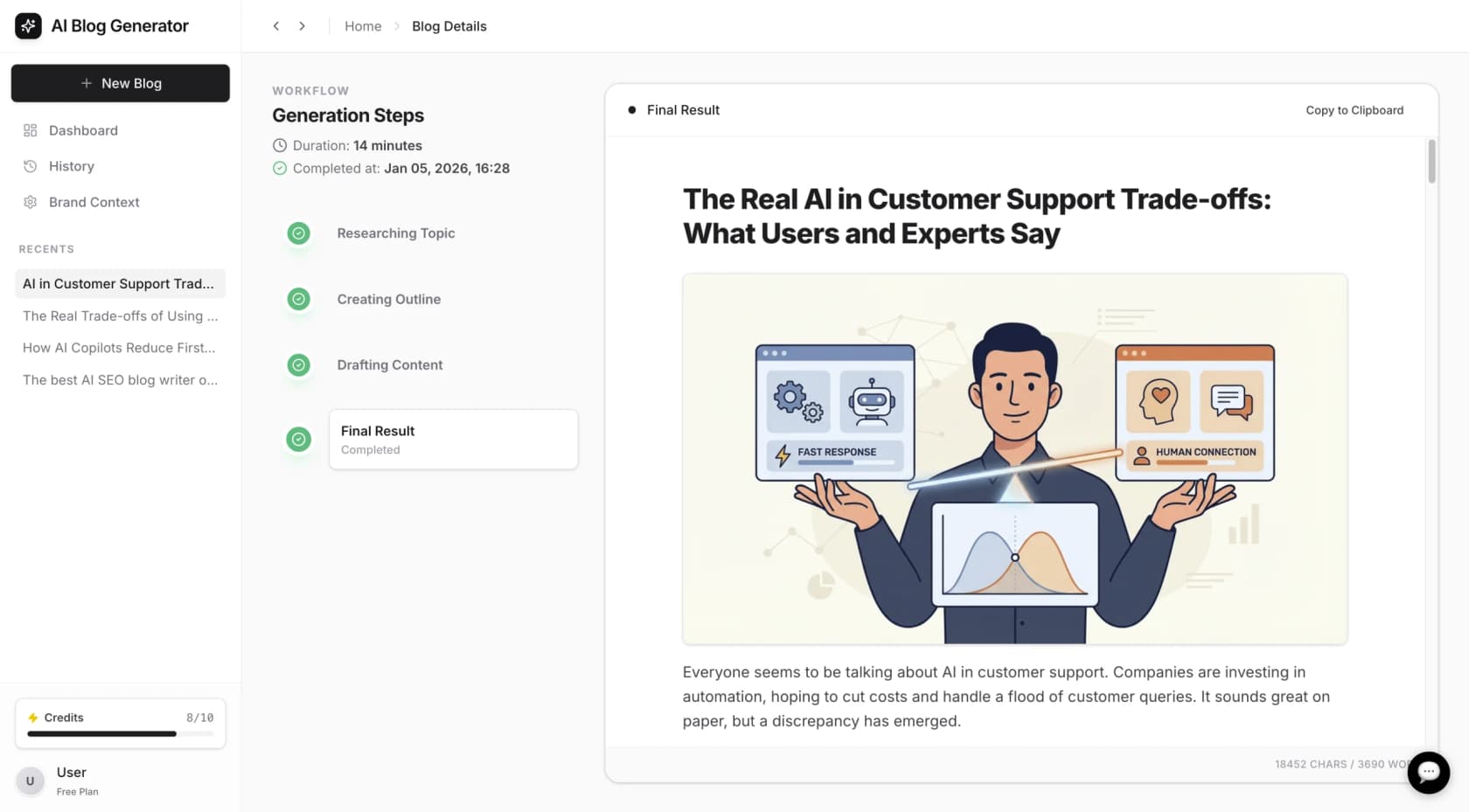
Some newer platforms take a more complete approach. For instance, the eesel AI blog writer generates a complete, publish-ready article from just a keyword. It handles the entire process, including an SEO-friendly structure, internal links, AI-generated images, and relevant YouTube videos.
Tools for AI search and rank tracking (GEO)
This is a newer and important category. These tools focus on "Generative Engine Optimization" (GEO), which involves tracking how and where your brand appears in AI-generated answers on platforms like Google AI Overviews, ChatGPT, and Perplexity.
Here are a few examples:
-
SE Ranking's AI Results Tracker monitors your presence in Google’s AI answers and shows how it compares to your traditional organic rankings.
-
Surfer's AI Tracker checks how often top AI tools mention your brand when people ask questions with buying intent.
-
Frase's AI Search Tracking shows your brand mentions across five major platforms: ChatGPT, Claude, Gemini, Perplexity, and Google AI.
This matters because as more people get their answers directly from AI, being cited as a source is the new form of ranking. These tools provide insight into this important new channel, a concept illustrated in the graphic below.
Tools for technical SEO
These tools automate the technical but necessary parts of SEO, like site audits and performance checks.
For instance:
-
SE Ranking's Website Audit tool scans your site and checks it against over 115 technical SEO metrics. It identifies everything from broken links and slow pages to missing meta tags.
-
Surfer's Content Audit connects to your Google Search Console to analyze your existing content and flags pages that could get a quick traffic boost with some optimization.
The primary advantage is the automation of finding technical issues that could be impacting your site's performance. This lets you focus on fixing the problems that will make a difference to your rankings.
A review of popular AI SEO optimization tools
Here’s a closer look at a few of the most popular tools available, breaking down their features, pricing, and primary uses.
Surfer SEO: On-page content scoring
-
Best for: Content teams and writers who want instant, data-driven feedback as they write.
-
Key features: Its primary feature is the "Content Editor", which gives you a live "Content Score" by analyzing top-ranking competitors. It also has an "Audit" tool for existing pages, a "Topical Map" for planning content, and it integrates with Google Docs and WordPress. An API is available on the Enterprise plan.
-
Limitations: Surfer's main focus is on optimizing content that has already been written. Some features, like the "AI Tracker", are paid add-ons. The platform also uses a credit system for generating and optimizing articles, and these credits might not roll over on monthly plans, so users should monitor their usage.
-
Pricing (annual billing):
- Essential: $79/month for 30 articles/month.
- Scale: $175/month for 100 articles/month.
- Enterprise: Custom pricing.
Frase: Combined SEO and GEO optimization
-
Best for: Content teams who want a single workflow to optimize for both traditional search engines and AI answer engines.
-
Key features: Frase's main feature is its dual "SEO + GEO optimization". It provides separate scores for Google and for AI platforms like ChatGPT, Perplexity, and Claude. It also comes with SERP analysis, an AI outline generator, and a "Content Opportunities" feature that flags content that is either losing or gaining traffic.
-
Limitations: The "AI Search Tracking" feature is an optional add-on for the Starter and Professional plans. It is included as a standard feature only on the top-tier Scale plan.
-
Pricing (annual billing):
- Starter: $38/month for 15 content projects.
- Professional: $83/month for 75 content projects.
- Scale: $165/month for 75 content projects and includes AI search tracking.
surferseo is great for detailed content optimization but pricey frase is a solid cheaper alternative better for content creation and outlines both work just depends on your needs

SE Ranking: A comprehensive SEO toolkit
-
Best for: Agencies and in-house teams who need a full suite of SEO tools that includes AI tracking.
-
Key features: SE Ranking is an all-in-one platform. It offers everything from rank tracking and a comprehensive website audit (with over 115 checks) to backlink analysis. Its "AI Results Tracker" is included on the Pro plan and monitors your presence in AI Overviews and ChatGPT for 50 prompts.
-
Limitations: The platform's extensive features may have a learning curve for new users.
-
Pricing (annual billing):
- Pro: Starts at $95.20/month for tracking 2,000 keywords.
- Business: Starts at $207.20/month for tracking 5,000 keywords.
Writesonic: Content and visibility management
-
Best for: Marketers who are looking for a single platform to handle research, writing, publishing, and AI search tracking.
-
Key features: Writesonic aims to be a complete SEO and GEO solution. Its "AI Article Writer 6.0" generates articles using real-time data and competitor analysis. Higher-tier plans include "AI Visibility Tracking" for platforms like ChatGPT, Perplexity, and Google AI Overviews.
-
Limitations: The most advanced GEO features, like tracking on Gemini and Claude or getting sentiment analysis, are only available on the more expensive Advanced and Enterprise plans.
-
Pricing:
| Plan | Price (Annual) | Articles / Month | AI Prompts Tracked |
|---|---|---|---|
| Lite | $39/month | 15 | , |
| Standard | $79/month | 30 | , |
| Professional | $199/month | 100 | 100 |
| Advanced | $399/month | 200 | 200 |
How to choose the right AI SEO optimization tools
With so many options, choosing the right one comes down to a few questions.
First, start with your main goal. Are you trying to scale content production, help writers with on-page optimization, or track visibility in AI search? Avoid paying for a large suite if you only need one specific function.
Next, think about your workflow. The best tool is one your team will use. Does it fit with your current systems, like Google Docs or your CMS? Is it easy to learn, or will it require extensive training?
Also, judge the output, not just the features. Many tools promise AI-generated content, but the quality can vary. A tool that produces a mediocre draft requiring hours of rewriting isn't saving time.
Finally, consider the scope of the solution. Some tools focus on a single function, like text generation, while others, such as the eesel AI blog writer, offer an end-to-end process that includes text, images, videos, and social proof. Choosing a more comprehensive platform can help streamline the publishing workflow.
Augmenting strategy, not replacing it
Regardless of the chosen tool, it’s important to remember that AI is an assistant, not a replacement for a strategist. The best SEO strategies still rely on human expertise. A person is needed to understand an audience's needs, check facts, and add the unique insights that make content valuable.
The purpose of these tools is to automate much of the groundwork so you can focus on the strategic elements that drive results. Using these tools to create generic, low-quality content is an ineffective strategy, particularly with Google's focus on helpful content.
To see a practical comparison of how various platforms perform, the following video offers a detailed tier list of popular AI SEO optimization tools, breaking down which ones deliver the best results.
Scaling content with AI
For teams focused on scaling content, some tools are designed to manage the entire creation process. For example, the eesel AI blog writer automates the creation of complete articles, including images, data tables, and video embeds. This approach aims to reduce the manual work involved in taking a piece of content from an idea to a published post. To see if this type of tool fits your workflow, you can try it for free.

Frequently asked questions
The biggest benefit is efficiency. They automate tedious parts of SEO like keyword research, technical audits, and content briefs, freeing you up to focus on strategy and creativity. They also provide data-driven insights to help you create content that ranks.
No. These tools are best viewed as co-pilots. They handle the groundwork, but a human is still needed for strategic thinking, fact-checking, and adding the unique insights and voice that make content valuable to readers.
Start by defining your primary goal. Do you need to scale content creation, improve on-page SEO, or track your visibility in AI answers (GEO)? Pick a tool that excels at your main objective and fits into your team's existing workflow. It is often more practical to select a tool that meets your primary needs rather than investing in a comprehensive suite with unnecessary features.
No, while content generation is a common feature, many tools specialize in other areas. Some focus on technical SEO audits, others on backlink analysis, and a new category tracks your brand's presence in AI-generated search results from platforms like Google AI Overviews and ChatGPT.
It depends on the quality. Google's focus is on helpful, high-quality content, regardless of how it's created. If you use a tool to produce generic, low-value articles, it may not perform well. However, when AI is used to assist in creating well-researched, original, and helpful content, it aligns with search engine guidelines.
GEO is the practice of optimizing your content to be cited in AI-generated answers (like Google's AI Overviews). As more people get answers directly from AI, being a trusted source in those results is becoming a new form of "ranking." Tools with GEO features help you track and improve your visibility in this new channel.
Share this article

Article by
Stevia Putri
Stevia Putri is a marketing generalist at eesel AI, where she helps turn powerful AI tools into stories that resonate. She’s driven by curiosity, clarity, and the human side of technology.