The complete guide to using an AI medical blog writer

Stevia Putri
Last edited January 15, 2026
Writing medical content feels like walking a tightrope. You have to be clinically accurate, keep up with regulations, and sound like an actual person, all while deadlines are breathing down your neck. If you're a healthcare professional or marketer, you know the drill: hours spent on research, drafting, and what feels like a million rounds of edits. It's a lot.
But what if you had an assistant to do the grunt work? That's the idea behind an AI medical blog writer. It’s not here to take over your job, but to give you a tool that makes the whole process smoother, from the initial idea to the final published article.
In this guide, we'll get into all of it. We’ll look at the real-world benefits, the risks you absolutely need to know about, and how to pick the right tool. For example, the eesel AI blog writer is built to help you produce more content without sacrificing quality, so you can spend more time on the message itself.
What is an AI medical blog writer?
What exactly is an AI medical blog writer? Think of it as a specialized writing tool that’s been trained on medical and healthcare information. This is what separates it from general models like ChatGPT. Instead of producing generic text, it’s built to grasp the specific needs of the healthcare world.
AI will complement medical writers but you will still need verifiers for the final draft etc

Its main job is to take a simple prompt, like a topic or keyword, and turn it into a well-researched, structured draft. It can sift through credible sources and simplify complex medical data for different readers, whether you’re writing for experienced doctors or concerned patients.
The best way to see it is as a co-pilot, not an autopilot. It handles the tedious parts, like initial research and outlining, so you can focus on the human side of things. Your role is still to check for clinical accuracy, add your own insights, and ensure everything meets ethical and regulatory standards. It's a partnership that helps you maintain professional standards while getting more done.
The benefits of using an AI medical blog writer
Adding a specialized AI tool to your workflow is about more than just speed. It’s about giving your team the ability to produce better content, more quickly. Let's look at how it can really help.
Boost efficiency and scale content production
The most obvious win is the sheer amount of time you get back. An AI writer can shorten the time it takes to get from an idea to a published article from days to just hours. It speeds up the research by scanning databases and summarizing studies in minutes. By generating a full first draft, it gets rid of the "blank page" problem for good.
I agree with others who said there isn't a lot of time savings because you basically have to babysit it and double check everything. But I still find it really helpful for offloading tedious or challenging tasks simply to preserve my mental energy for other things, or at least not be so burnt out by the end of the day.
This is a huge help for teams trying to publish consistently to build authority and trust. Suddenly, that demanding content calendar doesn't seem so daunting.
Ensure consistency in medical content
Precision is everything in medical writing. You have to follow strict rules for terminology, formatting, and brand voice. When you're under pressure, it's easy for small mistakes to slip by.
An AI writer can act as your consistency checker. You can configure it to follow your style guide, making sure that drug names, procedures, and conditions are always written correctly. This cuts down on manual editing time and lowers the risk of preventable errors.
Simplify complex topics for any audience
Let's be real: explaining dense, technical information in a way a patient can understand is tough. It takes a lot of skill to break down complex biological processes or clinical trial data into simple terms.
AI tools are quite good at this. They can take a complicated subject and structure it in a way that’s easy to follow, with clear, understandable sections. This lets you, the writer, concentrate on the core message and the human story, rather than getting stuck on the jargon.
Risks and limitations of an AI medical blog writer
While AI is a great tool, using it in a field like medicine means you have to be very aware of its limits. Human oversight isn't just a good idea; it's a must. The following infographic highlights the key risks to keep in mind when using an AI medical blog writer.
Factual inaccuracies
AI models can sometimes "hallucinate," which is a nice way of saying they make things up. They might generate information that sounds perfectly reasonable but is completely false. This is a problem in any field, but in medicine, it can have serious consequences.
If you ask it for citations, never ever use them without going to the source material yourself. The hallucinations seem particularly bad with citations.
For instance, AI has been known to invent things like non-existent clinical trials. One report found that OpenAI's transcription tool, Whisper, created a fake drug called "hyperactivated antibiotics." An editorial in the medical journal Cureus also pointed out that AI has fabricated paper titles and cited PubMed IDs that belong to different papers.
The takeaway is simple: every single claim, statistic, and citation from an AI has to be carefully fact-checked against original, credible sources before you even think about publishing it.
Lack of clinical nuance
AI models are great with language, but they don't understand it like a human does. They are based on language patterns, not knowledge. They can't replicate the critical thinking of a healthcare professional who understands the context behind clinical data or a patient's own experience.
Medical writing is just way too nuanced. AI won’t know that certain journal reviewers don’t like the word 'significant' related to findings; they don’t know how to interpret results in a way humans need them seen. They are lousy at revisions.
Because of this, AI might generate advice that’s technically correct but not right for a specific clinical situation. As experts have noted, AI-generated text always needs a thorough review by a subject matter expert to make sure it’s not just accurate, but also clinically appropriate and safe.
Data privacy and compliance concerns
This is a major one. When you use free, public AI tools, you often don't know where your data is going. Confidential information, like unpublished trial data or Protected Health Information (PHI), could end up being used to train the model, which is a huge privacy breach.
For any professional medical writing, you have to use a secure, compliant platform. Look for tools that are HIPAA compliant, offer a signed Business Associate Agreement (BAA), and use end-to-end encryption. Professional tools like Medwriter.ai and Paperpal are built with these protections. At eesel AI, we also contractually guarantee that user data is never used for training our models, so your information stays private.
How to choose the right AI medical blog writer
The "best" tool really comes down to your goals. If you're creating SEO-focused blog content for a general audience, you'll want a strong generative tool. If you're drafting clinical notes or polishing an academic paper, you'll need a different kind of assistant.
For SEO-driven blog content: eesel AI blog writer
When your aim is to create high-quality, publish-ready blog posts that rank on search engines, the eesel AI blog writer is made for the task. It’s designed to produce complete articles that are not just optimized for search engines but are also readable and engaging.
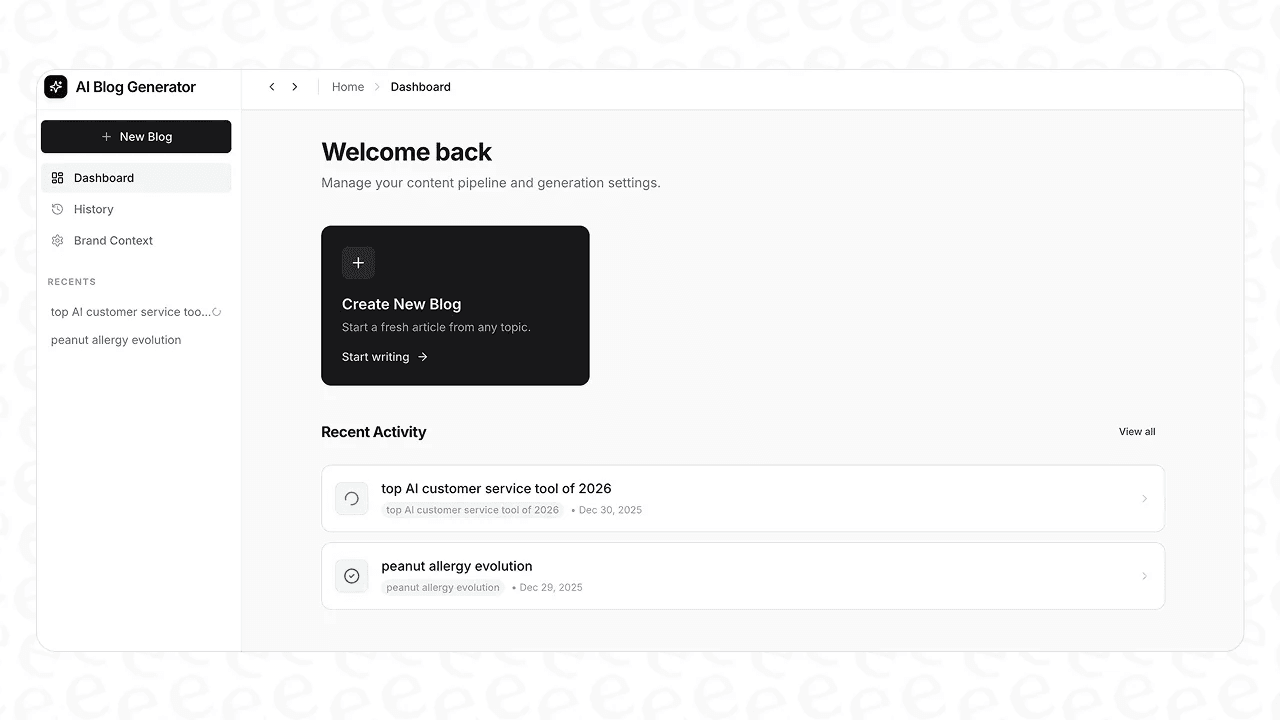
We built this tool to solve our own content challenges, and the results were pretty clear. It helped us grow our organic traffic from 700 to 750,000 daily impressions in just three months.
Here’s what sets it apart:
- Context-Aware Research: It automatically figures out what kind of content you’re creating and pulls in the right data and sources, saving you hours of work.
- Automatic Asset Generation: It does more than just write. It creates and embeds AI-generated images, infographics, and tables to help explain complex information and break up long blocks of text.
- Social Proof and Media Integration: To add a layer of authenticity, it can pull in real Reddit quotes for genuine perspectives and embed relevant YouTube videos directly into your post.
- Human-First Tone: Most importantly, it produces conversational content that sounds like a person wrote it, avoiding that robotic, formulaic language that often gives AI away.
There's no reason not to see the quality for yourself. You can try it for free and generate your first complete blog post in minutes.
Comparing other AI writing tools for healthcare
While the eesel AI blog writer is great for content marketing, other tools are built for different, very specific tasks in the medical field. Here’s a quick comparison.
| Feature | eesel AI blog writer | Medwriter.ai | Paperpal |
|---|---|---|---|
| Primary Use | SEO Blog Content Generation | Clinical Documentation Scribe | Academic Manuscript Editing |
| Output | Complete, publish-ready articles | Structured clinical notes for EHRs | Edited & refined text |
| Key Features | Asset generation, social proof, SEO | HIPAA compliance, EHR integration, billing codes | Citation tools, plagiarism check, grammar editing |
| Ideal User | Content Marketers, Health Orgs | Clinicians (Doctors, Therapists) | Researchers, Academics |
| Pricing Model | Starts at $99 for 50 posts | Starts at $99/user/month | Free plan; Prime at ~$11.5/month (billed annually) |
Medwriter.ai
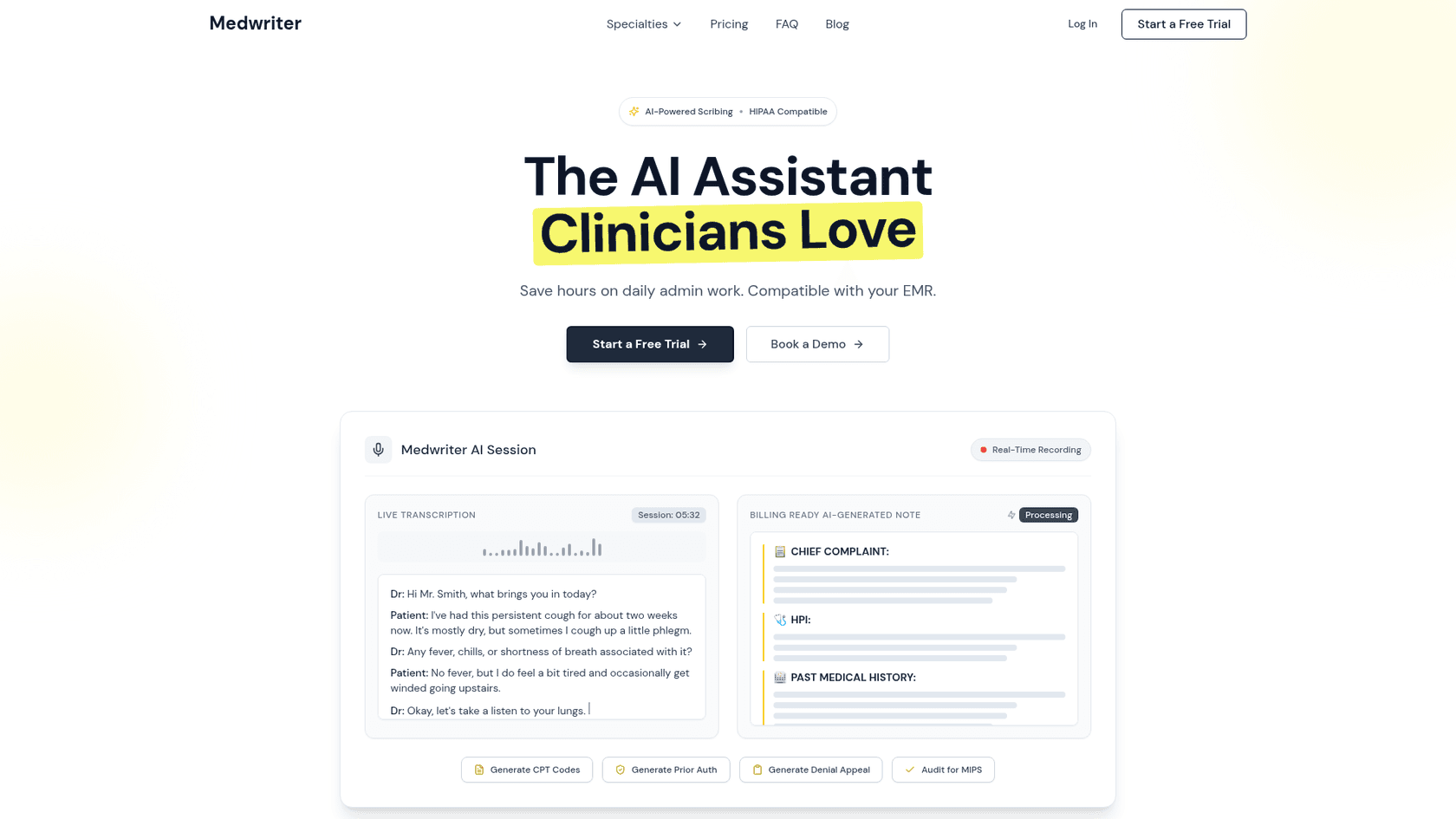
Medwriter.ai is an AI-powered medical scribe made to automate clinical documentation. It’s for clinicians who need to generate structured notes for Electronic Health Records (EHRs) quickly. It’s HIPAA-compliant, has templates for different specialties, and can even generate billing codes. It is, however, a tool for clinical documentation, not for creating the kind of narrative, SEO-friendly blog posts that a general audience would read.
Paperpal
Paperpal is an AI writing assistant made for academic and scientific manuscripts. It’s an editor, not a generator. It helps researchers improve their writing with advanced grammar checks, citation tools, and plagiarism detection. It’s excellent for polishing a research paper before submission, but it isn’t designed to create conversational blog content from scratch.
An AI writer as your partner in medical communication
An AI medical blog writer isn't a silver bullet, but it is a very practical tool that can change how healthcare organizations communicate. By automating the most time-consuming parts of creating content, it lets your team focus on what they do best.
Success comes down to a smart partnership. Let the AI handle the speed and scale, while your human experts provide the critical thinking, ethical oversight, and clinical expertise that no machine can offer.
For a deeper dive into how different AI tools are being used in the medical writing field, check out the video below for a real-world perspective on their application and limitations.
The future of medical content isn't about human versus machine. It's about using the best of both to create content that is more accurate, engaging, and effective than ever.
Ready to streamline your medical content workflow? Generate your first blog post for free with the eesel AI blog writer and see the difference a context-aware AI partner can make.

Frequently Asked Questions
Share this article

Article by
Stevia Putri
Stevia Putri is a marketing generalist at eesel AI, where she helps turn powerful AI tools into stories that resonate. She’s driven by curiosity, clarity, and the human side of technology.