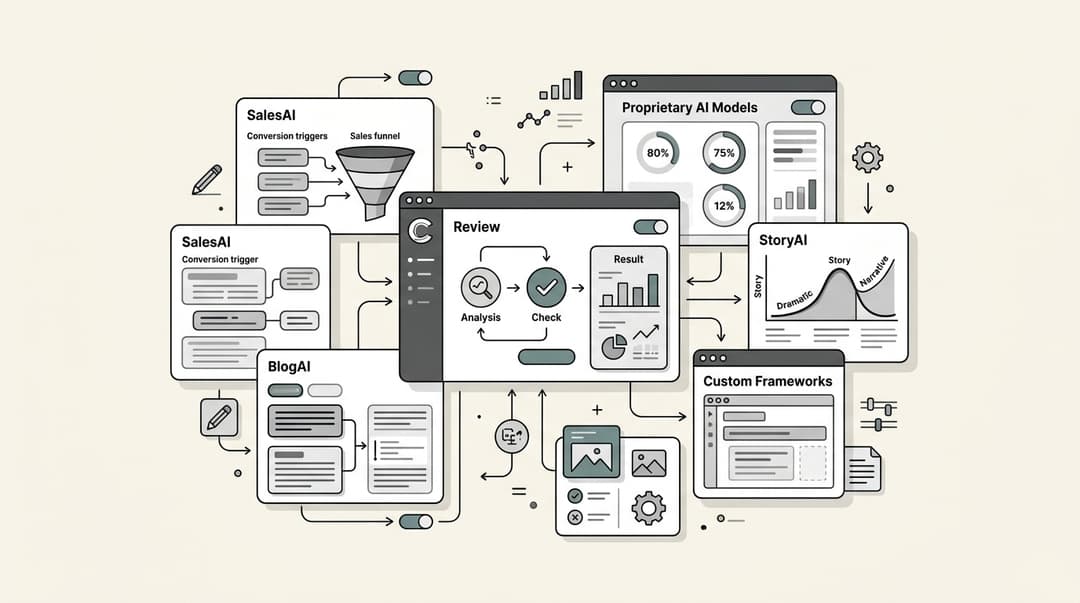
I tested dozens of AI driven marketing tools in 2026: Here are the 6 best

Kenneth Pangan

Katelin Teen
Last edited January 16, 2026

The proliferation of AI tools can be overwhelming. Each new application promises to automate tasks, multiply marketing efforts, and improve efficiency. The challenge is to identify the tools that genuinely save time and deliver results.
To find a clear path, I evaluated numerous AI driven marketing tools, from established platforms to emerging applications. This guide is the result of that research: A practical overview of the six best tools that proved to be effective.
The potential of these tools is significant. For example, using an AI blog writer can dramatically scale content production. This prompted a deeper look into what other AI tools can offer across the marketing stack. Let's find out.
What are AI-driven marketing tools?
In simple terms, AI marketing tools are software that use artificial intelligence to make marketing tasks easier, faster, and more effective. They use technologies like machine learning to analyze large volumes of data and identify patterns that might be missed by human analysis.
The primary objective is to offload repetitive, data-intensive work, allowing marketers to focus on strategy and creative initiatives. These tools assist in data analysis for better decision-making, creating personalized customer experiences, and automating routine tasks.
They can be categorized into four main areas:More than the tools, I think the use cases. Some basic data analysis ones I've used recently: 1. I love chatgpt and other tools for excel formulas. Nothing like explaining in plain english what you want to do and having it write a perfect formula with everything you need (for complex formulas especially) 2. Uploading data and asking it questions about the data - like which characteristics are the most common, or which have the highest association to specific results (our main point of contact on a sale can be in multiple departments. Which department has the highest impact on sales in terms of deal size, deal speed, and total lifetime value) 3. Writing api connectors for me 4. Writing code or classes to standardize the data (normalizing departments, roles, titles, etc) without a pre-set list to match to. Ah-Mazing! 5. Creating documentation 6. Taking notes in meetings, summarizing the notes, highlighting my tasks, and creating calendar tasks for me. Also Amazing. 7. Upscaling images 8. Generative image creation. 9. Understanding and categorizing sentiment from reviews, survey responses, etc.

-
Content Creation: Writing blog posts, social media updates, and ad copy.
-
Data Analysis & Insights: Predicting customer behavior or gauging brand sentiment.
-
Personalization: Delivering the right message to the right audience at the right time.
-
Automation: Scheduling posts, sending email sequences, and integrating different applications.
How we selected the best AI-driven marketing tools for 2026
To ensure this list is practical, each tool was evaluated against several key criteria. The goal was to identify platforms that a busy marketer could implement and use effectively.
Here’s what I looked for:
-
Practical Impact: Did it save time and improve work quality, or did it introduce a new, complex process?
-
Ease of Use: How quickly can a user become proficient without extensive technical knowledge? The interface needed to be clean and intuitive.
-
Integration: Does it work well with other tools in a typical marketing stack? A standalone tool with limited connectivity is less useful.
-
Quality of Output: Was the AI-generated content high-quality and human-like, or did it feel robotic and generic?
-
Value for Money: Is the price justified by the features and the results?
The best AI-driven marketing tools at a glance
If you're short on time, here's a quick rundown of the top picks. We'll get into the details of each one right after.
| Tool | Best For | Starting Price | Key Feature |
|---|---|---|---|
| eesel AI blog writer | Scaling SEO Content | Free to try ($99/mo for 50 blogs) | Generates complete, publish-ready SEO blogs |
| Jasper AI | Versatile AI Content Automation | $59/mo (billed yearly) | 100+ templates for marketing workflows |
| Semrush | Integrated SEO & AI Visibility | $165.17/mo (billed annually) | Integrated AI Visibility Toolkit |
| Synthesia | AI Video Creation | $29/mo | AI avatars for videos in 140+ languages |
| HubSpot | Marketing & Sales Automation | $15/mo/seat (Starter) | Breeze AI integrated with Smart CRM |
| Zapier | Workflow Automation | Free plan available ($19.99/mo) | Connects 8,000+ apps with AI workflows |
A closer look at the 6 best AI-driven marketing tools
Okay, let's get into the details of what makes each of these tools stand out.
1. eesel AI blog writer
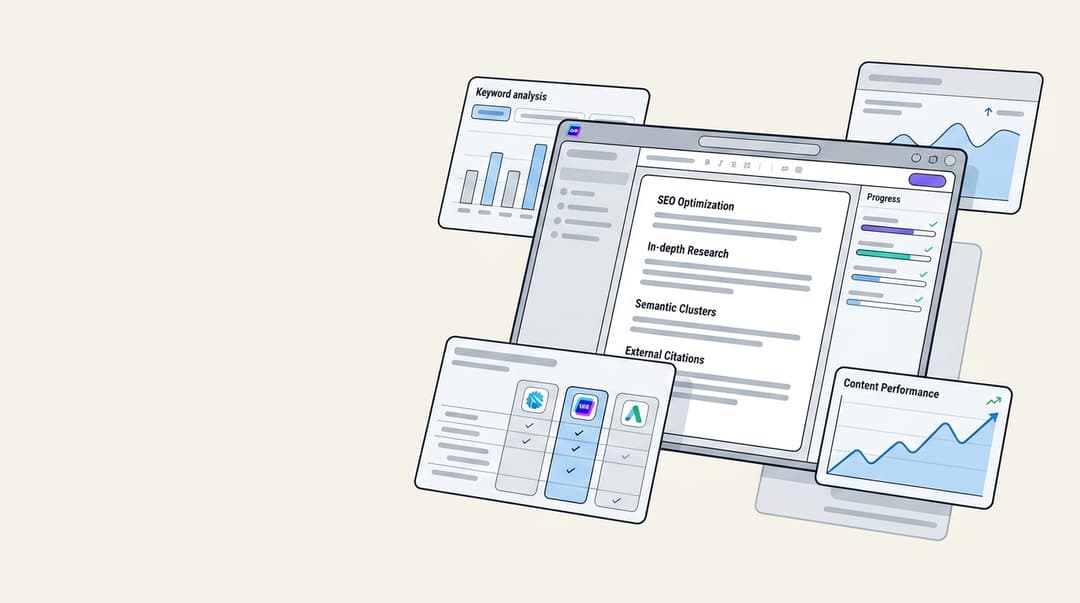
The eesel AI blog writer is a specialized tool designed to turn a single keyword into a complete, SEO-optimized blog post that’s ready to publish. Its key capability is understanding your brand. By providing a website URL, it learns your voice, products, and positioning to create content that aligns with your brand identity. Our own use of this tool led to an increase from 700 to 750,000 daily impressions in just three months.
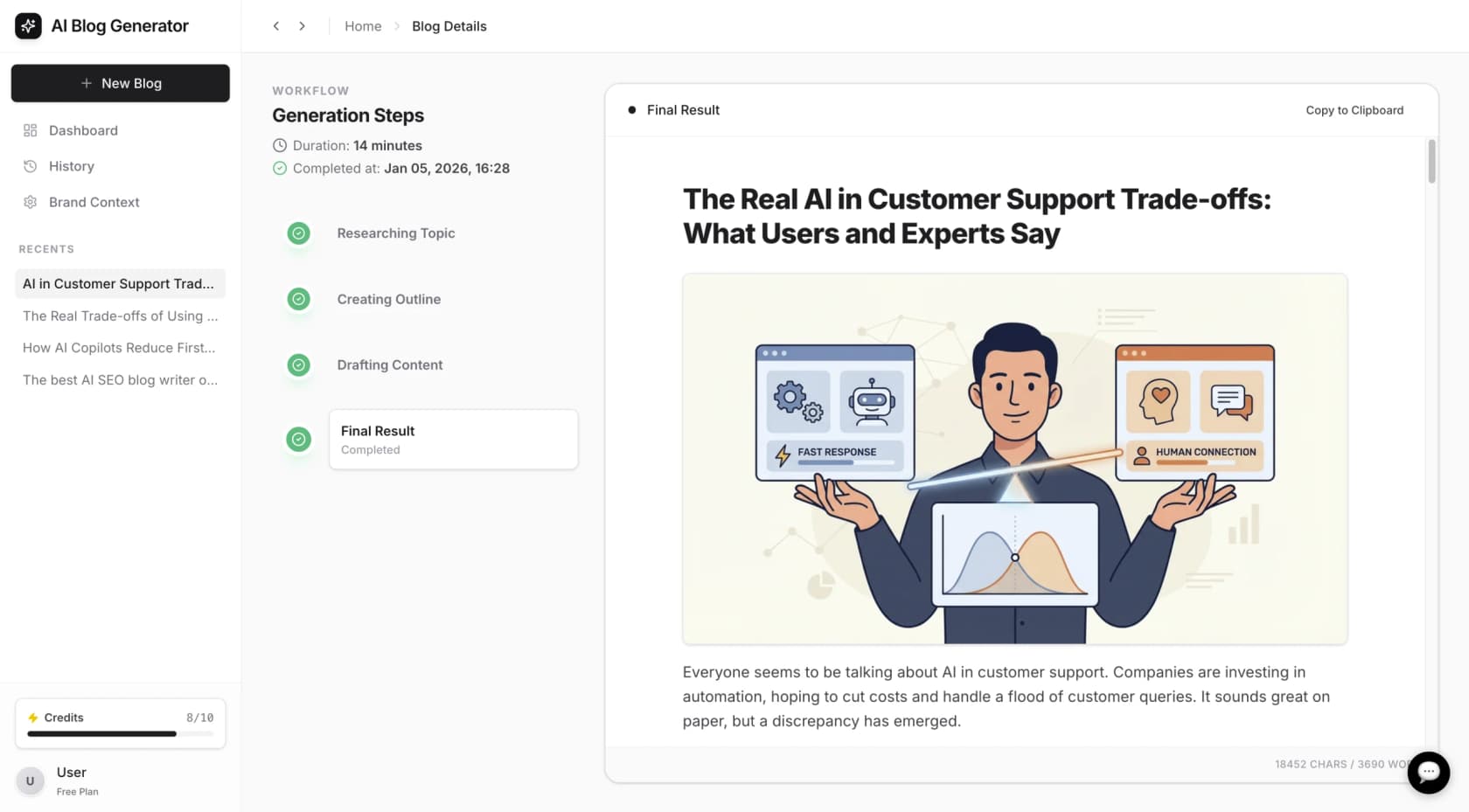
A key advantage is that it provides a finished product. It’s not just a block of text; it's a fully structured article with a title, meta description, intro, headings, and a conclusion. It also creates AI images, tables, and incorporates Reddit quotes and YouTube videos to enhance the content's authenticity and depth. Its primary focus is on long-form blog content, so it is not designed for short-form copy like social media posts or ads.
Pricing: It's completely free to try. After that, the "Early Bird" plan is $99 for 50 blog generations.
2. Jasper AI
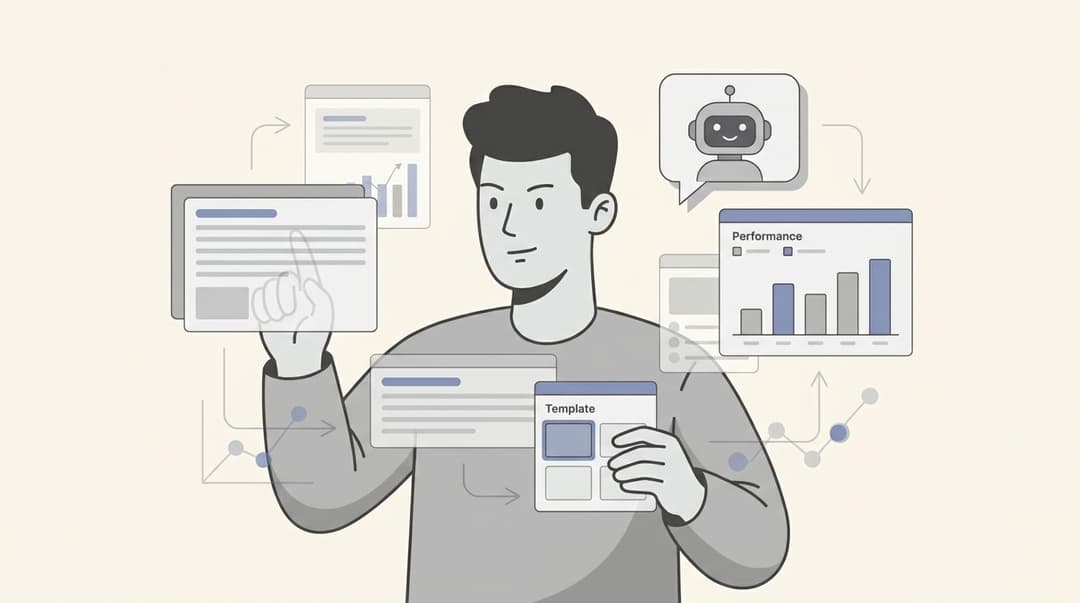
Jasper is a well-known name in AI content generation. It functions as a versatile tool for marketers, offering over 100+ templates for various copy needs, including ad headlines, product descriptions, email subject lines, and social media posts. It is well-suited for teams that need to produce a high volume of different types of short-form content.
Jasper is fast, and its variety of templates can be a useful asset for brainstorming or creating first drafts. The Brand Voice feature helps maintain consistency across different content formats. While it offers great versatility for short-form copy, creating a comprehensive long-form article may require more manual assembly of the generated sections compared to a tool specialized in blog post generation.
Pricing: The Pro plan starts at $59 per month per seat when billed annually. Custom plans are available for larger businesses.
3. Semrush
Semrush is a comprehensive marketing platform with integrated AI features. It is suitable for marketers who rely on data to inform their research and strategy. One of its standout features is the AI Visibility Toolkit, which tracks brand mentions in AI search results like Google's AI Overviews.
The main advantage of Semrush is that its AI is built on extensive search and marketing data, providing insights that a standalone writing tool may not offer. It connects content, keywords, and performance metrics. However, the platform can be complex for beginners and has a higher price point than many other tools on this list.
Pricing: The Starter plan, which includes the AI Visibility Toolkit, begins at $165.17 per month when billed annually.
4. Synthesia
Synthesia is an AI video platform that lets you create professional videos using realistic AI avatars. This allows for the creation of training videos, product demos, or internal announcements without the need for a studio, actors, or cameras. Users can type a script, choose from over 230+ AI avatars, and generate a video quickly.
The time and cost savings compared to traditional video production can be significant. Additionally, the ability to translate videos into 140+ languages is beneficial for global companies. For certain high-touch, brand-heavy content, AI avatars may feel less personal than a real person, but for most informational content, it's an effective solution.
Pricing: The Starter plan is $29 per month and includes 10 minutes of video generation.
5. HubSpot
HubSpot is an industry-leading CRM platform with a built-in AI called "Breeze," designed to improve efficiency for marketing, sales, and service teams. Breeze is integrated directly into the platform and analyzes customer data to perform tasks like predictive lead scoring, suggest content ideas, and automate campaigns.
The strength of HubSpot's AI is that it learns from your specific business data, making its recommendations highly relevant. This integration with the CRM is its key advantage. HubSpot offers tiered plans to suit different needs, with advanced AI features available for those scaling their operations. This ensures that businesses of all sizes can access the right level of automation for their growth stage.
Pricing: The Marketing Hub Starter plan is available for $15 per month per seat. Advanced AI features are also available in higher-tier plans, starting at around $3,600 per month for Enterprise users.
6. Zapier
Zapier functions as a connector for marketing applications, and its AI features enhance its automation capabilities. You can use it to build "Zaps" (automated workflows) that connect nearly 8,000 apps. It allows you to chain different AI tools together to create powerful custom automations. For instance, a Zap could automatically take a new lead from a Facebook Ad, send their information to an AI to draft a personalized welcome email, and then log it in your CRM.
A key strength of Zapier is its flexibility. It's possible to build a wide range of workflows without writing code. As Zaps become more complex, there can be a learning curve. Additionally, costs can increase as more tasks are run through the platform.
Pricing: Zapier offers a free plan for basic automations. Paid plans with more complex features start at $19.99 per month when paid annually.
How to choose the right AI-driven marketing tools for your stack
Now that you've seen the options, how do you select the right one for your needs? Here’s a simple framework to follow.
-
Start with the Problem, Not the Tool: First, identify your biggest bottleneck. Is it content creation, campaign data analysis, or personalizing outreach? Find the pain point, then find the tool that addresses it.
-
Consider Your Workflow: The best tool is one that fits seamlessly into your existing processes. If it doesn't integrate with your CRM, project management software, or other key platforms, it might add unnecessary complexity.
-
Test Before You Invest: Almost every tool on this list offers a free trial or a free plan. Use it. Generate a blog post, create a test campaign, or build a simple automation to see if it meets your expectations before committing.
-
Balance Specialization and Versatility: Consider whether you need a tool that excels at one task or one that is proficient in many. A specialized tool like the eesel AI blog writer is designed to excel at long-form content, which may yield different results than a generalist tool.
For a broader perspective on how different AI tools can be combined in a marketing strategy, this video offers a great overview of several must-have applications for businesses and marketers.
The future is AI-augmented marketing
If there's one key takeaway, it's that AI-driven marketing tools are no longer a novelty; they are becoming essential for staying competitive.
The greatest value emerges when these powerful tools are paired with a skilled human marketer. They function as assistants and force-multipliers, handling heavy lifting and freeing up professionals to be more strategic and creative. The biggest risk is not that AI is coming for your job, but that a marketer who knows how to use AI is.
The best approach is to start experimenting. Pick one tool that solves a real problem for you and give it a try.
Ready to see what a specialized AI content tool can do? Generate your first blog post free and see the difference for yourself.

Frequently asked questions
The biggest benefits are saving time on repetitive tasks, getting deeper insights from your data, and creating more personalized experiences for your customers. They handle the grunt work, so you can focus on strategy and creativity.
Absolutely. Many powerful AI-driven marketing tools, like Zapier or the eesel AI blog writer, have free plans or affordable starting tiers. You don't need a huge budget to start automating workflows or scaling your content creation.
Start by identifying your biggest bottleneck: Is it content, data analysis, or workflow automation? Then, look for tools that solve that specific problem and integrate well with the software you already use. Always take advantage of free trials to test them out first.
Not at all. Most modern tools are designed to be user-friendly with intuitive interfaces. Platforms like Synthesia or the eesel AI blog writer are built so marketers can get great results without writing any code or having a technical background.
It's highly unlikely. These tools are best seen as assistants or co-pilots. They augment a marketer's skills by handling data analysis and repetitive tasks, freeing up humans to focus on strategy, creativity, and building relationships - things AI can't replicate.
Share this article

Article by
Kenneth Pangan
Writer and marketer for over ten years, Kenneth Pangan splits his time between history, politics, and art with plenty of interruptions from his dogs demanding attention.