Why is my AI blog writer SEO score not improving? (And how to fix it)

Stevia Putri

Katelin Teen
Last edited February 1, 2026
You've been using an AI blog writer, producing articles faster than ever, but the results are disappointing. Your SEO scores are stuck, your traffic graph is flat, and you're questioning the effectiveness of AI for content creation.
This is a common frustration. The issue likely is not the AI itself, but the approach. Most AI tools are designed to generate text, not necessarily to create content that ranks. Google's guidelines are clear: they reward high-quality, helpful content, whether a human or an AI wrote it.
This post will walk you through why your AI content may be falling flat and provide a straightforward plan to fix it. We will examine common mistakes and explore how to start creating articles that both search engines and people appreciate.
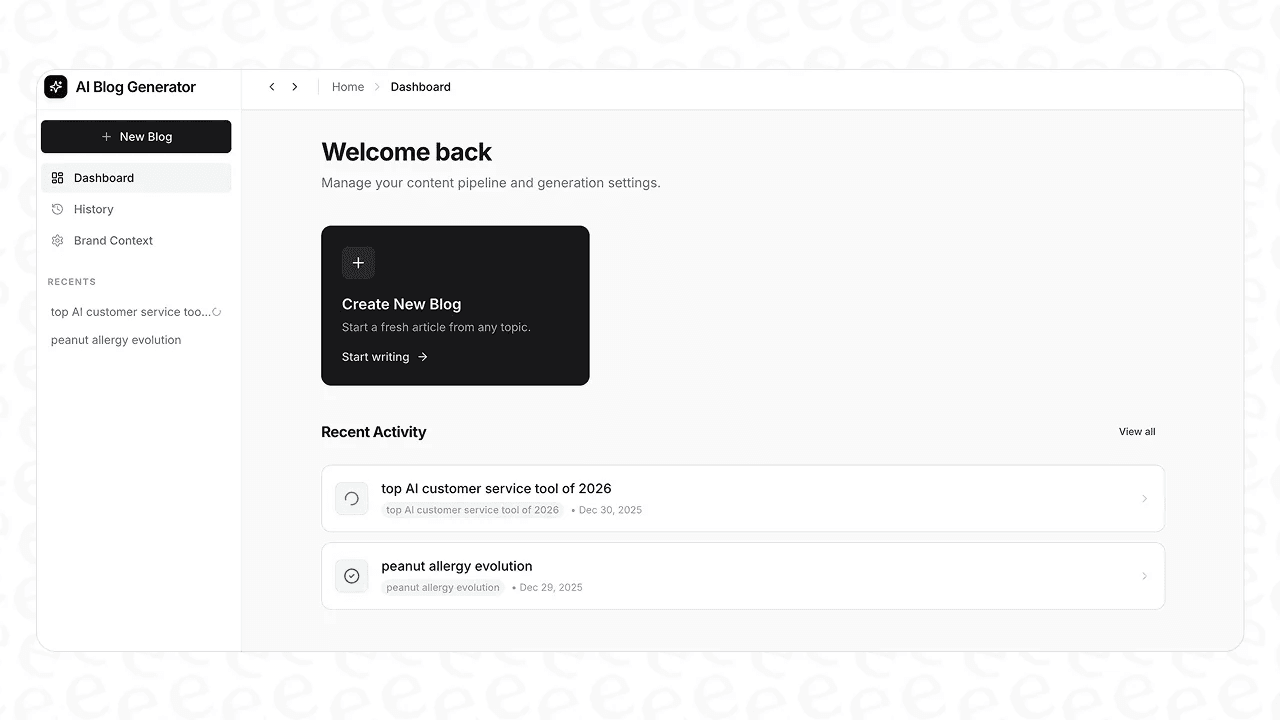
This is the same approach we used to build the eesel AI blog writer, the tool that took our own blog's traffic from a few hundred daily impressions to over 750,000 in just three months. Let's get started.
The core problem: Why AI-generated content doesn't rank
Many AI writing tools are primarily text generators, not SEO experts. They can construct sentences, but they often lack the context to create content that performs well with both search engines and human readers in 2026.
When an AI-generated blog does not rank, the issue typically falls into one of these three areas:
- Poor Content Quality & Originality: The AI produces generic, rehashed information that does not meet Google's E-E-A-T (Experience, Expertise, Authoritativeness, Trustworthiness) standards. It might sound correct, but it lacks substance.
- Weak Technical & Structural SEO: The tool overlooks technical details search engines require, such as a logical heading structure, internal links, and optimization for modern AI search, known as Answer Engine Optimization.
- Low Human Engagement: The article is often a wall of text. It can feel robotic and lack the visuals, social proof, and real examples that encourage a visitor to stay and read.
These are significant gaps that can be addressed with the right process and tools.
How to fix content quality issues
For years, Google has promoted helpful, people-first content. They aim to rank articles that show real-world experience and offer genuine value. Generic, surface-level AI content is often the opposite, typically summarizing what is already on the first page of search results, which does not help you stand out.
Bridging the E-E-A-T gap with authentic details
E-E-A-T is Google's framework for assessing content quality. To align with it, your content needs to demonstrate Experience, Expertise, Authoritativeness, and Trustworthiness. This is where many AI writers do not perform well.
For example, an AI might write an article on "the best hiking boots" by pulling from product descriptions and reviews. It will likely sound fine, but it will not have the details you would only know from spending a week breaking in those boots on a rocky trail. It is missing the experience.
To fix this, you need to add unique data, social proof, and real human perspectives. This traditionally involves hours of searching through forums and social media. To address this, some platforms, like the eesel AI blog writer, are designed to automate this step. It can automatically find and embed real quotes from Reddit into articles, giving them a layer of human experience that makes them more trustworthy and relatable.
It doesn't really hurt your SEO, as long as it's on-topic to your site. There are a few things, though, that you can do ahead of time, and then after, that will really help. First, include as many details in the prompt that you give the AI. Just don't say, write a blog post about 'keyword' and let it write something. You need to be much more specific. Maybe first ask for 5 different post title and topic ideas for your blog about 'keyword'. Then choose one of those, ask it to detail the headings and subheadings you should use, and list the entities that you should mention in the post. Then, use that output to give a very specific prompt for it to write the article.

Ensuring factual accuracy and originality
A common challenge with AI writers is their potential to "hallucinate" (invent information) or rewrite existing content without adding new value. Search engines may flag this, as they are designed to reward original, valuable information. If your blog post is a slightly reworded copy of existing content, it is less likely to rank.
To build trust, your content must be factually accurate and well-researched. This includes citing sources and linking to other authoritative sites. This manual step can slow down the content creation process.
Tools built for deep, context-aware research can handle this. For example, the eesel AI blog writer performs its own in-depth research and automatically adds citations and external source links. This makes your content more credible and shows Google you have done the work.
How to fix technical SEO issues
A great article will not rank if its technical foundation is not solid. On-page SEO is more than just using keywords. It involves structuring your content so search engines can easily crawl, understand, and index it.
Mastering on-page structure and linking
An AI-generated article that is a massive wall of text or has an illogical heading structure is a common issue. This is detrimental for both readers and SEO.
A good heading structure (one H1, followed by a logical flow of H2s and H3s) acts like a table of contents. It tells search engines what your article is about and which parts are most important. It also helps people scan your content quickly.
Internal and external links are also crucial. Internal links help search engines discover more of your content and understand how your pages are related, building your site's authority on a topic. External links to credible sources show that your content is well-researched. Many AI writing workflows overlook this step. The eesel AI blog writer, however, automatically adds both internal and external links, creating a well-connected article from the start.
Optimizing for the answer engine era (AEO)
How people search is evolving. With features like Google's AI Overviews, Perplexity, and ChatGPT, the goal is not just to be one of ten blue links. The goal is to be the answer. This is what is meant by Answer Engine Optimization (AEO).
This is important because over half of Google searches now end without a click on a search result. If your content is not structured to be featured in these AI answers, you are missing out on significant traffic.
AEO involves structuring your content in a specific way. You need to use headings that are questions, provide concise answers immediately, and break information into small, digestible pieces. This is a more advanced strategy that many AI writers are not equipped to handle. It is a core feature of the eesel AI blog writer, which is built to generate content that is ready for answer engines like ChatGPT and Perplexity.
How to improve user engagement
Much AI-generated content can be uninteresting because it is only text. In 2026, text alone is often not enough to hold a reader's attention.
Search engines analyze engagement signals like bounce rate and time on page. If visitors click on your article and leave immediately, that signals to Google your content is not very helpful. A robotic, text-only article is a perfect recipe for a high bounce rate.
Going beyond text with automated rich media
Visuals are essential. They break up text, make complex information easier to understand, and keep people engaged. Elements like images, custom infographics, and data tables can transform a dry article into something genuinely useful.
The typical process for adding visuals can be cumbersome. You generate text with one tool, search for stock photos or use another tool to create visuals, and then manually insert everything into your post. This can negate the speed and efficiency benefits of using AI.
Advanced AI content platforms can automate this. For instance, the eesel AI blog writer automatically creates and adds relevant assets directly into the article as it's being written. This includes AI-generated images, custom infographics, and data tables, turning a keyword into a media-rich, publish-ready post in one step.
Adding social proof and human context automatically
Besides visuals, adding real-world context can make your content feel more trustworthy. Including a relevant YouTube video or showing real conversations from platforms like Reddit adds a layer of authenticity that a basic AI cannot replicate. It demonstrates that you are aware of the actual conversations happening around your topic.
This is another area where a comprehensive AI platform can save time. Instead of you having to search YouTube for the right video or scroll through Reddit for relevant comments, the eesel AI blog writer can automatically find and embed them. It is a detail that makes the content feel more dynamic and human.
For a deeper dive into creating AI content that ranks, this video provides a practical guide on how to structure and optimize your blog posts effectively.
Upgrading your AI content strategy
If you're frustrated that your SEO score is not improving, the issue likely lies in one of three areas: the content quality is generic and lacks E-E-A-T, the technical and AEO aspects are weak, or the article is an unengaging wall of text.
The solution is not to abandon AI, but to refine your tools and approach. View AI as a partner in the entire content creation process. A modern AI content platform can manage everything from deep research and strategic writing to on-page SEO, AEO, and even visual creation. It offers a single workflow designed to produce content that ranks well and connects with people.
Ready to create SEO content that gets results? Generate your first publish-ready blog post for free with the eesel AI blog writer. You can go from a single keyword to a complete, optimized article with visuals in just a few minutes.

Frequently Asked Questions
Share this article

Article by
Stevia Putri
Stevia Putri is a marketing generalist at eesel AI, where she helps turn powerful AI tools into stories that resonate. She’s driven by curiosity, clarity, and the human side of technology.