

Writing for the health tech industry is a different beast entirely. You’re not just trying to write a snappy headline; you have to be precise, empathetic, and navigate a maze of regulations like HIPAA. It’s a field where one wrong step or a piece of bad information can seriously hurt your brand's credibility.
This is exactly where most generic AI writing tools fall flat. They might be great for putting together a quick article about blenders, but they often choke when it comes to complex medical topics. The risk of spitting out inaccurate or non-compliant content is just too high for comfort.
I work on A.I. at google, medical writers arent going anywhere. Were just designing tools to manage tasks and summarize requests. The work itself will involve more prompt engineering through Document A.I.
What is an AI blog writer for health tech?
What makes an AI blog writer for health tech different from the rest? It’s less of a simple text generator and more like a specialized research assistant. These tools are built to do more than just skim the surface. They help you dig up relevant information, use medical terms correctly, and meet the incredibly high standards of the healthcare world.
However, you cannot just copy and paste the output and call it a day. The idea is to get a really strong first draft that a human subject matter expert, like a doctor, researcher, or medical writer, can then review, polish, and approve. It’s all about making the process faster without cutting corners on quality.
AI will complement medical writers but you will still need verifiers for the final draft etc
Our criteria for choosing the best AI blog writer for health tech
First up was accuracy and reliability. How well does the tool handle complicated medical info? Does it make things up (a common AI problem called "hallucinating"), or can it back up its claims with actual citations? We favored tools that put facts first.
Next was data privacy and compliance. This is a huge deal in this space. We dug into each tool's policies on data security. You can't afford to expose Protected Health Information (PHI), so any features that support HIPAA and GDPR compliance got a big thumbs-up.
We also looked at ease of use. A tool is worthless if your team finds it too complicated to use. We thought about the learning curve and whether the platform was friendly for marketing teams who might not be super technical.
Of course, content quality mattered. Does the writing sound human, or does it have that stiff, robotic feel? We wanted tools that could produce something you'd actually want to read.
Finally, we gave extra points for specialized health tech features, like models trained on medical data or tools that help with creating regulatory documents.
Comparison of the top AI blog writers for health tech
Here’s a quick rundown of how our top picks compare.
| Tool | Best For | Key Features | Starting Price | Compliance & Security |
|---|---|---|---|---|
| eesel AI blog writer | SEO content & traffic growth | Automatic asset generation, AEO optimization, context-aware research | Free to try, then $4 per blog post | GDPR compliant, data is not used for training |
| Writer.com | Enterprise compliance & brand consistency | Palmyra Med LLM, traceability, custom style guides | Demo required | HIPAA & GDPR compliant, SOC 2 Type II |
| Jenni AI | Evidence-based academic content | Cites sources, integrates with uploaded PDFs, paraphrasing | Free plan available, $12/month Unlimited | Zero training on user data |
| Paperpal | Scientific & manuscript writing | Manuscript readiness checks, citation generation, language editing | Free plan available, $11.50/month Prime | ISO certified, GDPR compliant |
| TrialAssure LINK AI | Regulatory & clinical document drafting | CSR & PLS generation, MS Word integration, workflow management | Demo required | Supports GDPR & HIPAA compliance |
A detailed review of the 5 best AI blog writers for health tech
Alright, let's get into the details of each tool to see what they're all about. We'll cover their strengths, weaknesses, and who they're really for.
1. eesel AI blog writer: Best for scalable, SEO-driven content
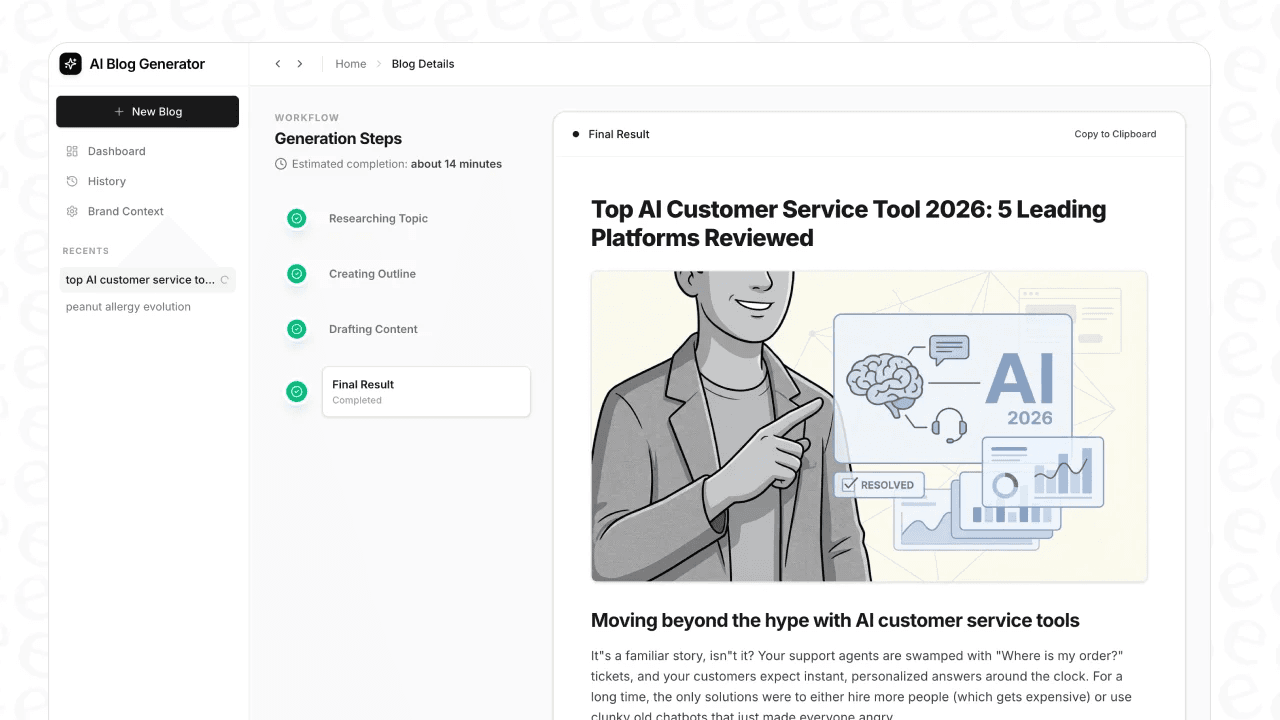
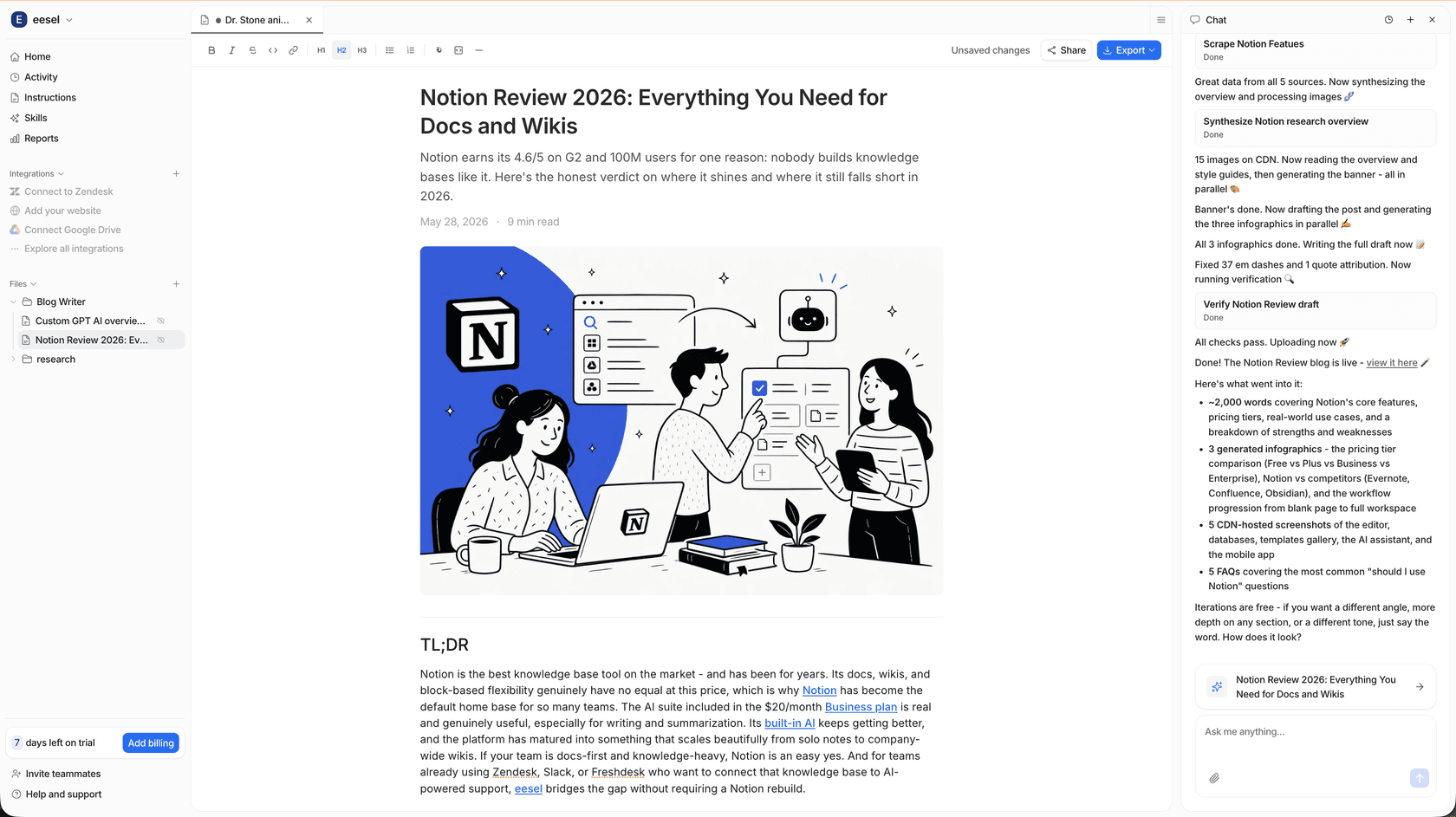
The eesel AI blog writer is an option for health tech companies focused on growing their organic traffic. Its design focuses on simplicity and achieving results. You provide a keyword, and it delivers a complete, media-rich blog post. It’s designed to create content that’s optimized not just for Google (SEO) but also for new AI Answer Engines (AEO), so you can be visible where people are looking for answers.
The built-in features are designed to save time. It automatically creates assets like images and tables, finds relevant Reddit quotes for social proof, and performs context-aware research to ensure the content is substantial. The output is a finished piece designed to rank.
- Pros: The all-in-one approach builds a complete article with text, visuals, and citations, which can save marketing teams significant time on each post.
- Cons: Like any AI tool, the final output requires review from a subject matter expert to confirm clinical accuracy. While it provides a strong starting point, the final human check is essential in health tech.
- Pricing:
- Free Trial: You can generate your first blogs for free to see the quality up close.
- Per post: $4 per blog post.
2. Writer.com: Best for enterprise-level compliance

Writer.com is a comprehensive solution for large health tech companies where compliance is a top priority. They’ve built a healthcare-specific Large Language Model called Palmyra Med, which scored an 85.9% average across medical benchmarks. This model was developed specifically for the industry.
Its main strengths are traceability and governance. It allows teams to create content where every claim can be traced back to a source, which is ideal for highly regulated material where a clear audit trail is necessary.
- Pros: Its primary advantage is its focus on clinical-grade reliability and security, being fully HIPAA and GDPR compliant. It also excels at maintaining brand voice consistency across a large team.
- Cons: A consideration is that it is an enterprise-level platform, with pricing available upon request, which may make it a better fit for larger organizations.
- Pricing:
- Pricing isn't public and requires a demo.
3. Jenni AI: Best for academic and research-based content
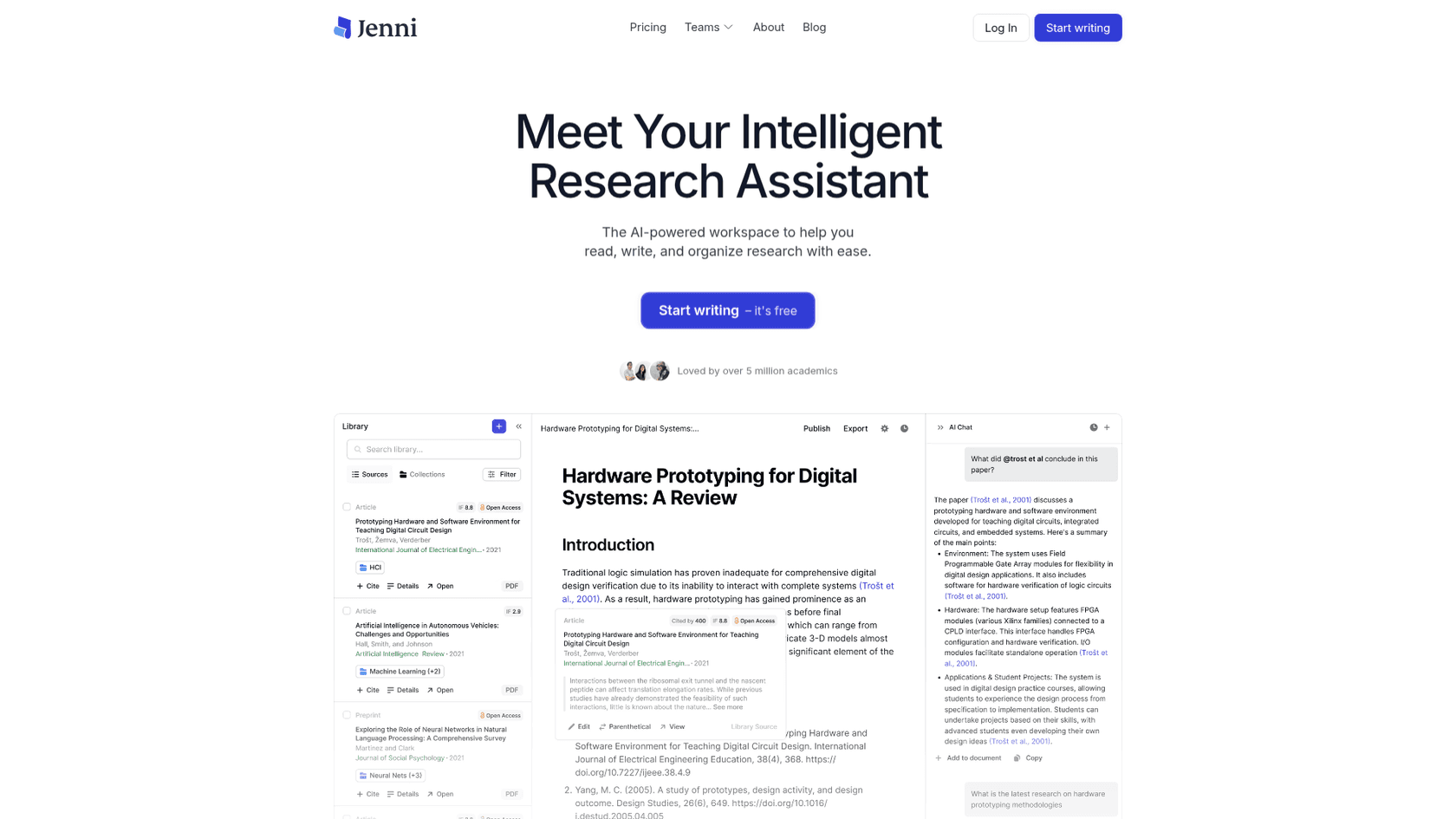
Jenni AI is a helpful writing partner for teams producing content that relies heavily on existing research, like white papers or clinical summaries. Its key feature is the ability to work directly with PDFs you upload. You can feed it a dense research paper, and it will help pull out key points, find citations, and draft content based on that material.
The built-in citation manager is a valuable feature for anyone dealing with formatting. It supports over 2,600 citation styles, covering APA, MLA, and more niche formats.
- Pros and Cons: Working from your own source documents is a significant advantage for creating accurate, evidence-based content. Their strict "zero training on your data" policy also provides peace of mind. However, it functions more as a co-writer than a fully automated tool. It assists with autocompleting sentences and citing sources but doesn't generate a full blog post from a single prompt. It’s also not specifically built for industry regulations like HIPAA.
- Pricing:
- Free Plan: Gives you 10 AI Autocompletes per day and lets you upload 10 PDFs.
- Unlimited Plan: $12/month for unlimited features.
4. Paperpal: Best for scientific manuscript preparation
If your health tech company publishes in academic journals, you should check out Paperpal. This tool is highly focused on one area: getting scientific manuscripts ready for submission. It's less about creating content from scratch and more about polishing what you've already written.
It runs over 30+ language and technical checks to spot common errors that might get a paper rejected. It also plugs directly into Microsoft Word and Google Docs, which is handy for fitting into your team's existing workflow.
- Pros and Cons: For researchers and medical writers preparing papers for publication, Paperpal is a significant asset. Its detailed edits and academic focus are its main draws. They also have solid data security, with ISO certification and a clear policy of never using customer data for AI training. On the other hand, it’s not made for creating marketing content like SEO blogs. It’s a specialized tool for a very specific job.
- Pricing:
- Free Plan: Includes 200 language suggestions per month and 5 daily uses of its generative AI tools.
- Prime Plan: Costs $11.50/month (billed annually) for unlimited use.
5. TrialAssure LINK AI: Best for clinical and regulatory documents
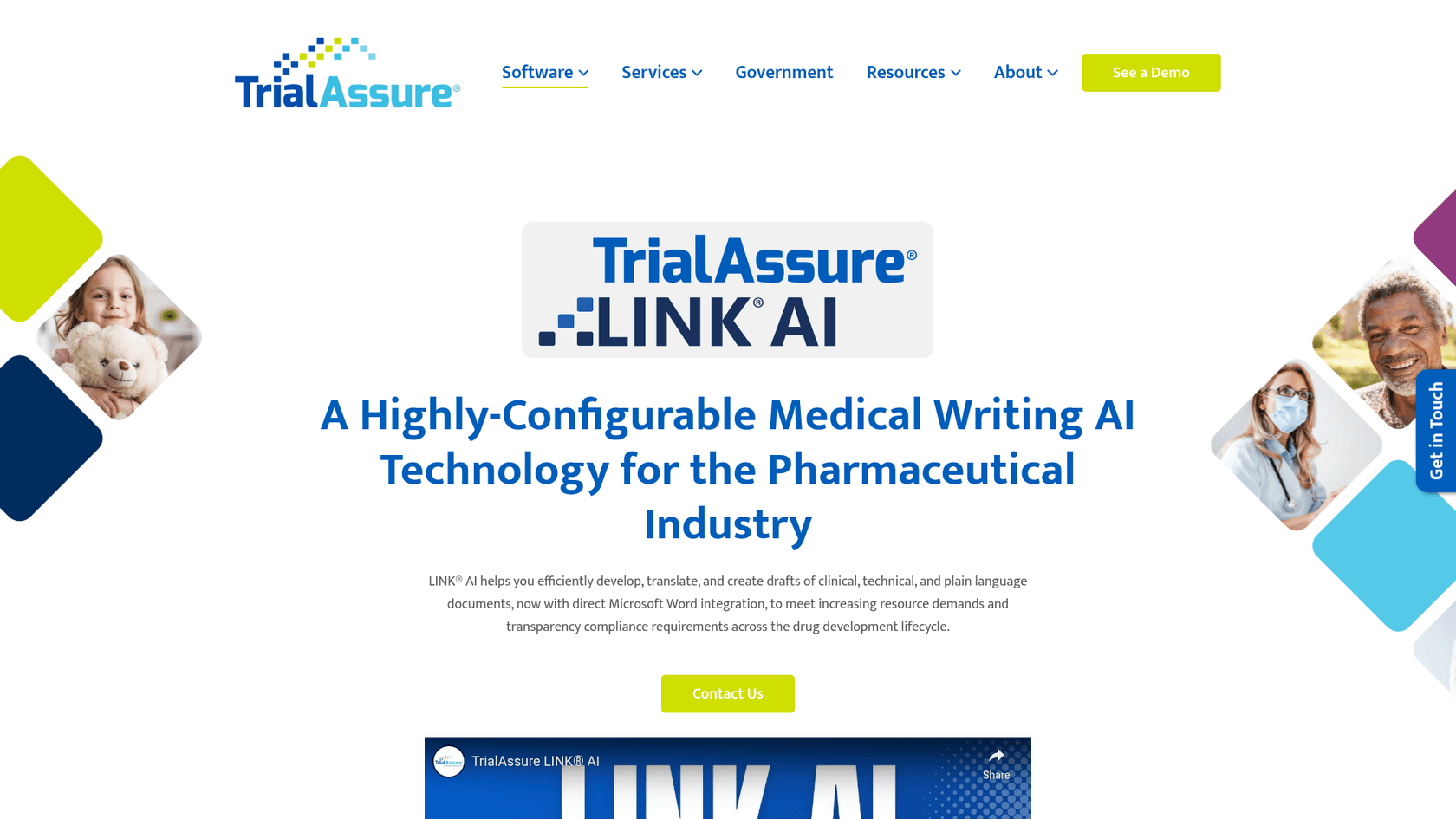
TrialAssure LINK AI is another highly specialized tool, made for pharmaceutical and biotech companies that need to draft complex documents like Clinical Study Reports (CSRs) and Plain Language Summaries (PLS). This is not intended for a company blog; it is for the intense, detailed work of regulatory submissions.
Its direct integration with Microsoft Word shows it's designed for the day-to-day work of professional medical writers in the pharma industry.
- Pros and Cons: For its specific niche, it is a powerful tool. TrialAssure says it can reduce a six-week drafting process to two weeks, which is a massive time-saver. However, it is an enterprise solution for a very specific kind of formal medical writing and may not be the right fit for a health tech marketing team focused on SEO blogs.
- Pricing:
- Pricing isn't public, and you'll need to request a demo.
Ethical tips for using an AI blog writer for health tech
- Always have a human in the loop: This is the golden rule. AI is your assistant, not the author. Every single piece of content needs to be reviewed, edited, and signed off on by a qualified human expert before it goes live.
- Verify everything: AI models can sometimes invent facts. It's essential to manually fact-check every statistic, clinical claim, and data point against credible sources like PubMed, peer-reviewed journals, or official guidelines.
- Protect patient and client data: Never, ever feed confidential information or PHI into a public AI tool. Stick with enterprise-grade tools that have clear, robust data privacy policies. For example, eesel AI guarantees that your data is never used for training, keeping your information safe.
- Be transparent about using AI: Depending on the context, it's often good practice to disclose that AI was used to help create the content. This builds trust with your audience and keeps you aligned with ethical standards.
It just makes too many errors, and produces content that may seem passable if you don't know anything about the subject, but is full of subtle mistakes.
 Reddit
For a deeper dive into how AI is changing the medical writing field and the conversations professionals are having about it, the following video offers some valuable perspectives on whether AI is a threat or an opportunity.
Choosing the right AI blog writer for health tech
When it comes down to it, the best AI blog writer for health tech really depends on what you’re trying to achieve. If you're drafting complex regulatory documents for a pharma giant, a tool like TrialAssure LINK AI is made for that purpose. If you need strict compliance rules for your entire enterprise, Writer.com is a solid choice.
But for most health tech companies trying to grow, the main challenge is balancing clinical accuracy with getting discovered. You need to create high-quality, trustworthy content that also gets in front of the people who need it.
That’s where a tool built for SEO and scale can be a valuable asset. The eesel AI blog writer was designed for marketing teams who need to move quickly without compromising on quality. It handles much of the research, writing, and optimization, so your experts can focus on what they do best: making sure every word is accurate and helpful.
Why not see for yourself? You can try it for free and generate your first couple of blog posts today.