Salesforce Service Cloud AI add-on pricing explained (2026)

Stevia Putri
Last edited March 15, 2026
Understanding Salesforce Service Cloud AI pricing feels like trying to solve a puzzle where the pieces keep changing shape. Between base licenses, AI add-ons, and the new consumption-based Flex Credits system introduced in 2025, getting a clear picture of what you'll actually pay requires some digging.
Here's a complete breakdown so you can make an informed decision before talking to sales.
What is Salesforce Service Cloud AI?
Salesforce Service Cloud AI, now branded as Agentforce, represents the company's evolution from Einstein AI to what they call "agentic AI." Unlike earlier AI features that simply suggested responses or categorized tickets, Agentforce aims to operate as autonomous agents that can handle tasks with minimal human intervention.
The platform combines three types of AI capabilities:
- Predictive AI forecasts outcomes based on your historical data patterns
- Generative AI creates responses, summaries, and knowledge articles
- Agentic AI executes tasks autonomously, like routing cases or updating records
Here's the catch: you cannot buy Agentforce as a standalone product. It exists only as an add-on to existing Service Cloud licenses, which creates the first layer of complexity in understanding the true cost.
Understanding the three pricing layers
Salesforce AI pricing works like a stack. You need each layer before you can add the next, and skipping any layer means you don't get AI functionality at all.
Layer 1: Base Service Cloud licenses
Before you can add any AI capabilities, you need a Service Cloud foundation. Salesforce offers several editions, but only Enterprise and above support AI add-ons.
| Edition | Monthly Price | Annual Contract | AI Eligible? |
|---|---|---|---|
| Free Suite | $0 | No | No |
| Starter Suite | $25/user | Optional | No |
| Pro Suite | $100/user | Required | No |
| Enterprise | $175/user | Required | Yes |
| Unlimited | $350/user | Required | Yes |
| Agentforce 1 Service | $550/user | Required | Included |
If you're on Starter or Pro Suite and want AI features, you must upgrade to Enterprise first. This isn't optional. Salesforce designed the pricing tiers so that AI capabilities only unlock at the Enterprise level.
Enterprise includes core service features like case management, workflow automation, and a self-service help center. Unlimited adds chat and bots, Salesforce Knowledge, and bundles the Premier Success Plan.
Layer 2: AI add-on pricing
Once you have an eligible base license, you can add Agentforce for Service at $125 per user per month. This is where the AI capabilities actually live.
What you get for that $125:
- Unmetered employee agents for licensed users
- Generative replies and conversation summaries
- Knowledge article creation
- Search answers for agents and customers
- Case classification and routing
- Reply recommendations
- Customer Signals Intelligence dashboards
The "unmetered" part only applies to employee-facing AI. When AI interacts with customers directly, that falls under consumption-based pricing (layer 3).
Regional pricing varies:
- USD: $125/user/month
- EUR: €125/user/month
- GBP: £100/user/month
- AUD: AU$175/user/month
Industry-specific add-ons cost more. Financial Services Cloud, Health Cloud, Manufacturing Cloud, and other specialized editions run $150 per user per month instead of $125.
Layer 3: Consumption-based costs
This is where Salesforce AI pricing gets interesting, and where many teams get surprised by their bills.
In May 2025, Salesforce introduced Flex Credits, a consumption-based model that runs parallel to the older per-conversation pricing. You choose one model for your organization, not both.
Flex Credits pricing:
- Minimum purchase: 100,000 credits for $500
- Cost per action: approximately $0.10 (20 credits per standard action)
- Token limit: 10,000 tokens equals one action (roughly 8,000 words)
Legacy conversation pricing:
- $2 per conversation (24-hour session)
Which model works better depends on your use case. Flex Credits favor teams with complex, multi-action workflows. The per-conversation model might work better for simple chatbot interactions.
Salesforce provides a Digital Wallet interface to track usage across your organization in real time. Sandbox usage bills at 80% of production rates, and unused credits expire at the end of your subscription term.
Complete pricing breakdown by edition
Let's look at what you actually pay per user depending on which route you take:
| Edition | Base Price | + Agentforce | Total/Month | Best For |
|---|---|---|---|---|
| Enterprise | $175 | $125 | $300 | Mid-market teams starting with AI |
| Unlimited | $350 | $125 | $475 | Larger teams needing advanced features |
| Agentforce 1 Service | $550 (bundled) | Included | $550 | Teams wanting unlimited AI + credits |
The math changes based on team size and usage patterns. Agentforce 1 Service includes 1 million Flex Credits per organization per year and 2.5 million Data Cloud credits, plus Tableau Next analytics and Slack Enterprise+. If your team would consume significant credits, the bundled edition might actually save money.
For a team of 50 users on Enterprise with Agentforce, you're looking at $15,000 per month just in license fees, before any consumption costs.
Hidden costs to factor into your budget
The headline prices tell only part of the story. Based on user reports and implementation guides, here are the additional costs that catch teams off guard:
Required add-ons for full functionality:
| Add-on | Price | Purpose |
|---|---|---|
| Einstein Bots | $75/user/month | Customer-facing chatbots |
| Enhanced Messaging | $75/user/month | Advanced messaging capabilities |
| Knowledge (Read-Write) | $75/user/month | Full knowledge base management |
| Web Services API | $25/user/month | API access for Enterprise editions |
Success plans:
- Standard: Included with all licenses (basic support, documentation access)
- Premier: 30% of net license fees (24/7 support, health checks)
- Signature: Custom pricing (dedicated CSM, fastest response times)
Implementation and ongoing costs:
- Professional services: $50,000 to $150,000 for enterprise implementations
- Training: $2,000 to $5,000 per user
- Data Cloud: $25 to $50 per user per month additional
- Digital Engagement for messaging channels: $75 to $100 per user per month
- Ongoing optimization: $10,000 to $25,000 monthly for enterprise
A mid-market company with 50 users might budget $90,000 annually for Agentforce licenses but encounter actual costs exceeding $200,000 when accounting for implementation, training, and consumption fees.
Total cost of ownership examples
Let's run the numbers for realistic scenarios.
Small team (25 users)
| Cost Component | Annual Cost |
|---|---|
| Enterprise licenses (25 × $175 × 12) | $52,500 |
| Agentforce add-on (25 × $125 × 12) | $37,500 |
| Flex Credits (estimated moderate usage) | $6,000 |
| Implementation services | $50,000 |
| Training (25 × $2,500) | $62,500 |
| Year 1 Total | $208,500 |
Mid-market (100 users)
| Cost Component | Annual Cost |
|---|---|
| Unlimited licenses (100 × $350 × 12) | $420,000 |
| Agentforce add-on (100 × $125 × 12) | $150,000 |
| Flex Credits (estimated high usage) | $24,000 |
| Implementation services | $100,000 |
| Training (100 × $3,000) | $300,000 |
| Year 1 Total | $994,000 |
These figures assume you need professional services and training. If you have in-house Salesforce expertise, you might reduce those costs. But most organizations new to Agentforce require external help to get up and running.
Is Salesforce Service Cloud AI right for your team?
Salesforce AI makes sense for specific scenarios. You should consider it if:
- You're already invested in the Salesforce ecosystem with significant CRM data
- You have dedicated Salesforce administrators on staff
- You need deep integration between service, sales, and marketing data
- Your organization can absorb six-figure implementation costs
- You have the technical expertise for prompt engineering and ongoing optimization
The platform delivers powerful capabilities for enterprises that can fully utilize them. The autonomous agent features, when properly configured, can genuinely reduce manual work for service teams.
However, the complexity is real. User reviews consistently mention steep learning curves, the need for prompt engineering skills, and unexpected cost scaling. One senior associate noted that costs "ramped up pretty quickly" once they started scaling to more users and use cases.
A simpler approach to AI customer service
If you're reading this and thinking the complexity and cost feel excessive for your needs, you're not alone. Many teams want AI customer service capabilities without the enterprise overhead.
This is exactly why we built eesel AI.
Instead of layering AI on top of an existing CRM requiring multiple licenses and add-ons, we offer an AI teammate that works alongside your existing help desk. You don't need to migrate data or reconfigure workflows.
Here's how our approach differs:
| Factor | Salesforce Agentforce | eesel AI |
|---|---|---|
| Base requirement | Enterprise license ($175/user/month) | None |
| AI cost | $125/user/month add-on | Starting at $299/month (not per user) |
| Consumption fees | Flex Credits or per-conversation | Pay per interaction |
| Implementation | Months with professional services | Minutes, not months |
| Training required | Prompt engineering expertise | None needed |
| Setup | Complex configuration | Connects to existing help center |
We designed eesel AI to learn from your existing help center articles, past tickets, and macros. It integrates with Zendesk, Freshdesk, Intercom, Gorgias, and other platforms you already use.
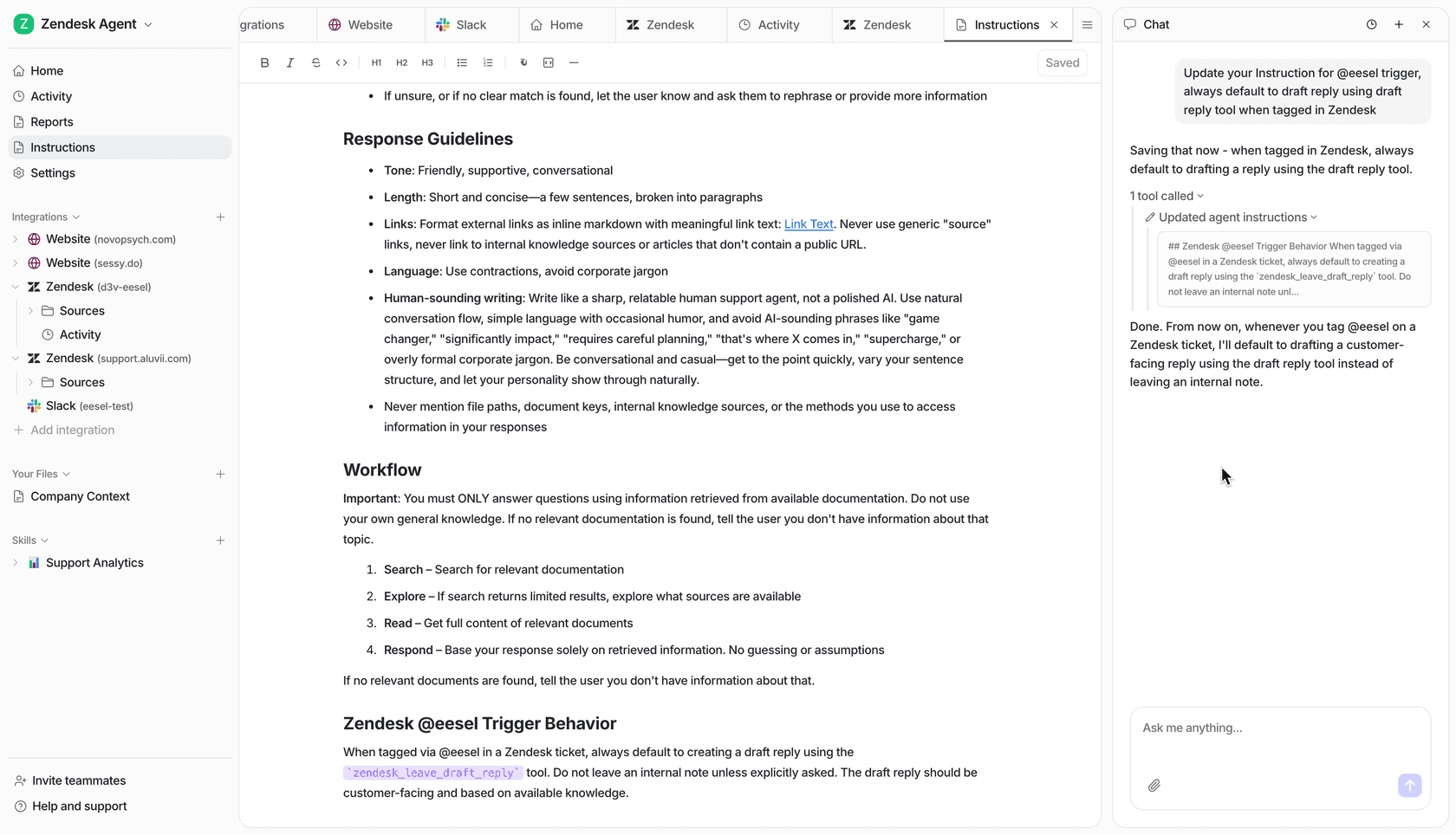
You can start with eesel AI drafting replies for review, then expand to autonomous responses as it learns your business. No credit systems to manage. No surprise bills based on usage. Just a flat monthly fee that scales predictably.
For teams that want AI customer service without the enterprise complexity, we offer a simpler path.

Frequently Asked Questions
Share this article

Article by
Stevia Putri
Stevia Putri is a marketing generalist at eesel AI, where she helps turn powerful AI tools into stories that resonate. She’s driven by curiosity, clarity, and the human side of technology.