B2B customer service is fundamentally different from B2C. You're not just resolving one-off issues; you're managing complex relationships with multiple stakeholders, long sales cycles, and technical products that require deep expertise. When a customer contacts support, they expect your team to know their account history, understand their technical setup, and provide solutions that work within their business constraints.
This is where AI can make a real difference. But not all AI solutions are built for B2B complexity. Salesforce Service Cloud has positioned itself as a comprehensive platform for enterprise customer service, with AI capabilities that promise to handle everything from routine inquiries to complex case resolution. The question is whether it delivers on that promise for B2B teams specifically.
Let's break down what Salesforce Service Cloud AI offers, how it works for B2B use cases, and what you should consider before implementing it.
What is Salesforce Service Cloud AI?
Salesforce Service Cloud is the company's customer service platform, designed to handle support across multiple channels including email, phone, chat, and social media. The AI capabilities have evolved significantly over the past few years, culminating in the current Agentforce platform.
Agentforce represents Salesforce's shift from simple automation to autonomous AI agents. These agents can reason through complex requests, retrieve information from your business data, take actions on your behalf, and escalate to humans when needed. The platform uses what Salesforce calls the Atlas Reasoning Engine, which breaks down customer requests into smaller tasks and proposes action plans.
For B2B companies already using Salesforce CRM, Service Cloud AI integrates natively with your existing customer data. This means agents can access account history, opportunity data, and contact information without complex integrations. The platform also connects to Data Cloud, Salesforce's data platform that unifies information from multiple sources including external systems like Snowflake, Databricks, and Google BigQuery.
The key thing to remember is that Service Cloud AI is designed as part of a broader ecosystem. It works best when you're already invested in Salesforce's platform, with clean data and established processes.
Key AI features for B2B customer service
Salesforce Service Cloud AI offers several capabilities that matter specifically for B2B support teams. Here's how each one works in practice.
Agentforce Service Agent
The Agentforce Service Agent is Salesforce's autonomous AI agent for customer service. Unlike traditional chatbots that follow rigid scripts, these agents can handle a wide range of service issues by reasoning through the problem and taking appropriate actions.
For B2B teams, this means the agent can handle routine inquiries like password resets, order status checks, and basic troubleshooting without human intervention. When a customer asks a complex question or expresses frustration, the agent recognizes its limitations and escalates to a human agent with full context.
The agent operates 24/7 across multiple channels including self-service portals, messaging apps, and embedded chat. For B2B companies with customers in different time zones, this provides coverage during off-hours without requiring round-the-clock staffing.
AI-powered case management
Case management in B2B support is often more complex than B2C. A single case might involve multiple contacts at the customer organization, cross-reference several previous issues, and require coordination across your own internal teams.
Salesforce's AI case management uses Einstein AI to automatically classify incoming cases, route them to the right team or agent, and prioritize based on factors like account value and issue urgency. The system learns from historical case data to improve its routing decisions over time.
For example, if a case comes in from a high-value account with keywords indicating a production outage, the AI can immediately flag it as critical and route it to your senior technical team. Cases from smaller accounts with routine questions might be routed to your tier-one team or handled entirely by the AI agent.
Einstein Reply Recommendations
Einstein Reply Recommendations generates suggested responses for human agents based on your knowledge base, past cases, and the current case context. Agents can review, edit, and send these suggestions, or generate new ones if the first attempt isn't quite right.
For B2B support, this is particularly valuable because responses often need to be technically accurate while maintaining the right tone for the relationship. The AI learns from how your best agents write and can help newer team members respond consistently with your company's voice.
The recommendations are grounded in your actual knowledge base and case history, not generic AI responses. This means they're more likely to include the specific technical details and product nuances that B2B customers expect.
Service Rep Assistant
The Service Rep Assistant provides dynamic action plans and real-time guidance to human agents as they work through cases. Based on the case data and customer history, it suggests next steps, surfaces relevant knowledge articles, and can even automate routine actions.
In a B2B context, this helps agents navigate complex cases that span multiple products, involve contractual considerations, or require coordination with other departments like sales or professional services. The assistant acts like a knowledgeable colleague who's always available to provide guidance.
B2B-specific use cases and benefits
B2B customer service has unique challenges that consumer-facing support rarely encounters. Here's how Salesforce Service Cloud AI addresses them.
Account-based support
B2B relationships are account-based, not transaction-based. A single account might have dozens of contacts, each with different roles, technical setups, and support histories. Salesforce's Data Cloud creates unified profiles that combine service data with sales and marketing data, giving agents a complete view of the account.
The AI can identify patterns across the account, such as recurring issues with a particular product configuration or satisfaction trends among different user groups. This allows your team to proactively address systemic problems rather than treating each case in isolation.
Complex case resolution
B2B cases often involve multiple stakeholders, both on the customer side and internally. A technical issue might require input from engineering, while a billing question might need coordination with finance. The AI can help route cases through these complex workflows, ensuring the right people are involved at the right time.
The platform also supports long-running cases that span weeks or months, which is common in B2B support. Agents can see the full case history, including previous attempts at resolution and any commitments made to the customer.
Proactive service with Data Cloud
Perhaps the most powerful B2B use case is proactive service. By combining service data with engagement signals from sales and marketing, the AI can identify accounts at risk of churn or opportunities for expansion.
For example, if a customer has opened multiple support cases about a particular feature, the AI might flag this as a potential churn risk and suggest a proactive outreach from the account manager. Or if usage data shows a customer is approaching a license limit, the AI could trigger a conversation about upgrading before they hit a wall.
Salesforce Service Cloud pricing and AI add-ons
Understanding Salesforce pricing requires looking at both the base platform costs and the AI feature add-ons. Here's the breakdown:
| Plan | Price (per user/month, annual) | AI Features Included |
|---|---|---|
| Starter Suite | $25 | Basic automation, lead and account management |
| Pro Suite | $100 | Enhanced workflows, real-time chat, sales forecasting |
| Enterprise | $175 | AI for Customer Service, workflow automation, self-service help center |
| Unlimited | $350 | Everything in Enterprise plus Chat & Bots, Salesforce Knowledge, Premier Success |
| Agentforce 1 Service | $550 | Full AI suite, unmetered Agentforce usage, Tableau Next, 1M Flex Credits, 2.5M Data Cloud Credits |
Source: Salesforce Service Cloud Pricing
A few important notes on pricing:
- The AI features that matter most for B2B (Agentforce, advanced case management, proactive service) require at least the Enterprise tier, and realistically the Agentforce 1 Service tier for full capabilities.
- Data Cloud integration, which powers the unified customer view and proactive service features, involves additional credits that can add significant cost at scale.
- All pricing is per-user, per-month, billed annually. If you have a team of 50 support agents, you're looking at $8,750 to $27,500 per month just for the platform.
- Implementation costs, training, and ongoing administration are not included in these prices. Most enterprise deployments require consulting support.
For smaller B2B teams or those not already in the Salesforce ecosystem, these costs can be prohibitive. The platform is designed for companies that are already Salesforce customers and can leverage existing data and integrations.
Implementation considerations for B2B teams
Before deploying Salesforce Service Cloud AI, there are several factors B2B teams should consider.
Data preparation requirements
AI is only as good as the data it learns from. Salesforce's AI requires clean, well-structured data to function effectively. This means:
- Case histories need to be properly categorized and tagged
- Account hierarchies must be accurately mapped
- Knowledge base articles should be up-to-date and well-organized
- Customer data should be deduplicated and standardized
For companies with messy data (which is most companies), this preparation work can take weeks or months before the AI can be deployed effectively.
Integration complexity
While Service Cloud integrates natively with other Salesforce products, connecting to external systems requires additional work. B2B companies often have complex tech stacks including ERP systems, product databases, billing platforms, and custom internal tools.
MuleSoft, Salesforce's integration platform, can connect these systems but adds both cost and complexity. Each integration needs to be configured, tested, and maintained. For companies with many external systems, this can become a significant ongoing effort.
Change management and training
Introducing AI to a support team requires more than just technical implementation. Agents need to learn how to work with AI suggestions, when to trust them versus when to override them, and how to provide feedback that improves the system over time.
Salesforce provides training resources, but the real work happens internally. Teams need to develop new workflows, establish quality standards for AI-assisted responses, and create feedback loops that help the AI improve. This cultural shift often takes longer than the technical deployment.
eesel AI: A simpler alternative for B2B support
If you're looking for AI customer service capabilities without the complexity and cost of Salesforce, we built eesel AI specifically for teams that want to get up and running quickly.
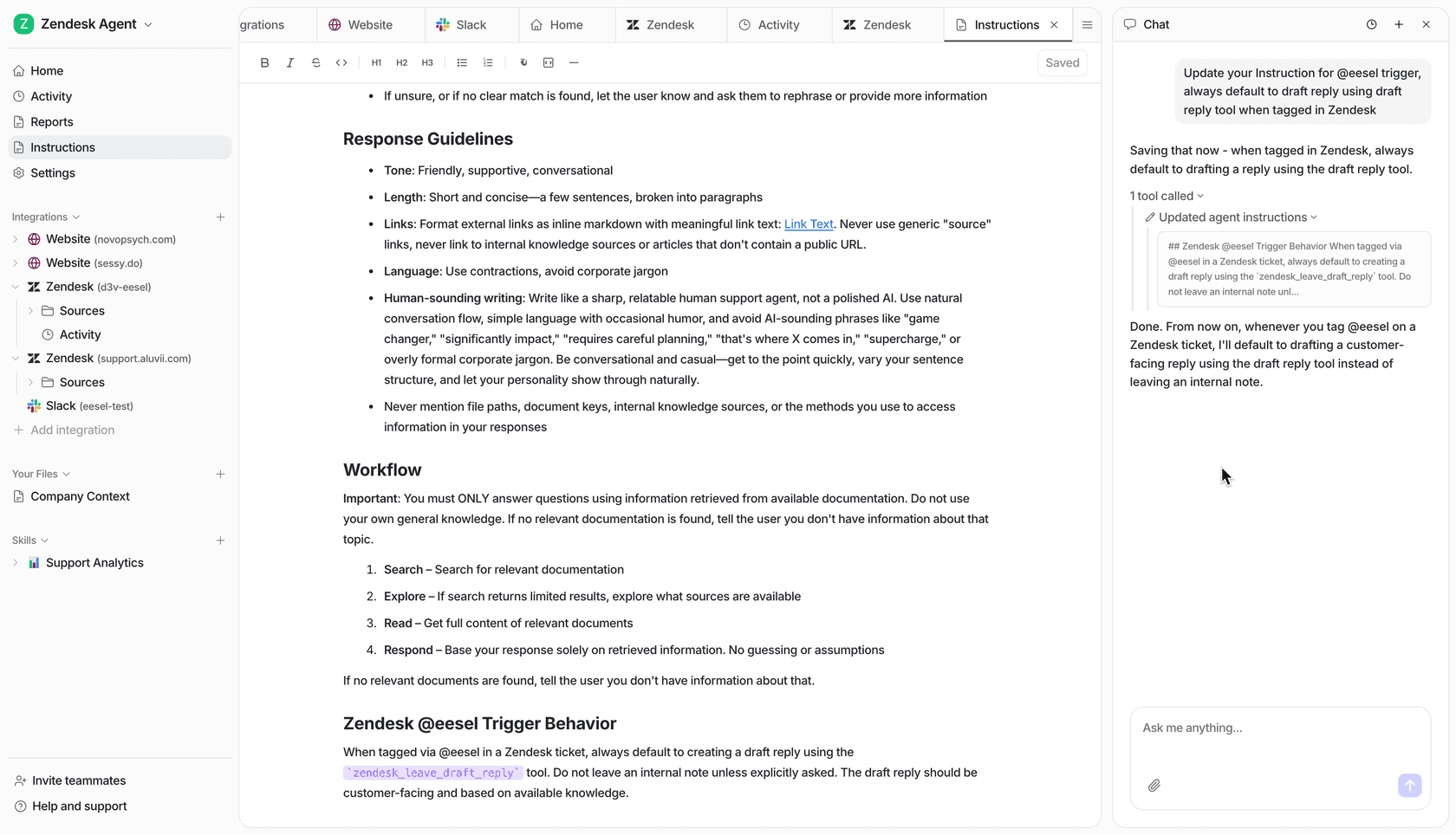
Here's how we approach B2B support differently:
Deployment in minutes, not months. Instead of requiring weeks of data preparation and integration work, eesel AI connects to your existing help desk (Zendesk, Freshdesk, Intercom, Jira, and 40+ others) and learns from your past tickets and documentation immediately. Most teams are seeing value within their first day.
Progressive autonomy. Like Salesforce, we believe AI should start with guidance and level up based on performance. But we've made the process simpler. You describe in plain English when you want the AI to engage, what you want it to do, and how you want it to sound. No complex configuration or workflow building required.
Test before you deploy. Our simulation feature lets you run the AI over your past tickets to see how it would have performed before it ever touches a real customer. This gives you confidence in the quality before going live.
Pricing that scales with usage, not seats. Our Team plan starts at $239 per month (billed annually) and includes up to 3 bots and 1,000 AI interactions. The Business plan at $639 per month adds unlimited bots, 3,000 interactions, and full AI agent capabilities including triage and autonomous responses. No per-user fees, no hidden costs.
For B2B teams that want AI benefits without enterprise complexity, eesel AI offers a path to autonomous support that doesn't require a dedicated Salesforce administrator or months of implementation work.
Choosing the right AI solution for your B2B service team
The right AI solution depends on your specific situation. Here's a framework for deciding:
Salesforce Service Cloud AI makes sense if:
- You're already invested in the Salesforce ecosystem with clean CRM data
- You have complex, multi-department workflows that need deep customization
- You have the budget for enterprise pricing and dedicated administration
- Your support team is large enough (50+ agents) to justify the per-user cost structure
- You need advanced features like predictive analytics and proactive service orchestration
Consider alternatives like eesel AI if:
- You want to deploy AI quickly without extensive data preparation
- Your team is smaller (5-50 agents) and per-user pricing would be prohibitive
- You use multiple tools outside the Salesforce ecosystem
- You prefer a simpler, more guided approach to AI deployment
- You want to test AI capabilities before making a major investment
The key is being honest about your current state and what you're trying to achieve. AI can transform B2B customer service, but only if it fits your team's workflow and capabilities.

Frequently Asked Questions
Share this article

Article by
Stevia Putri
Stevia Putri is a marketing generalist at eesel AI, where she helps turn powerful AI tools into stories that resonate. She’s driven by curiosity, clarity, and the human side of technology.