7 best Re:amaze alternatives for customer support in 2026

Stevia Putri
Last edited March 12, 2026

Re:amaze has been a popular choice for e-commerce customer support, but many teams are hitting its limits. Whether you are frustrated by per-user pricing that balloons as you grow, limited AI capabilities that leave agents doing repetitive work, or collaboration features that slow your team down, you are not alone in searching for alternatives.
This guide compares seven of the best Re:amaze alternatives for 2026. We have evaluated each option across pricing, AI capabilities, ease of setup, and ideal use cases so you can make an informed decision without spending weeks on trials.
What to look for in a Re:amaze alternative
Before diving into the options, here are the key criteria to evaluate:
AI and automation capabilities. The best modern helpdesks do not just organize tickets, they resolve them. Look for tools that can autonomously handle common questions, draft replies for agents, and learn from your existing conversations.
Pricing model. Per-user pricing punishes growth. Consider alternatives with per-ticket or per-interaction pricing, or flat-rate structures that scale more predictably.
E-commerce integrations. If you run a Shopify, WooCommerce, or BigCommerce store, native integrations for order lookups, refunds, and inventory checks are essential.
Collaboration features. Shared inboxes, internal notes, and collision detection help teams work together without stepping on each other.
Ease of setup. Some tools require weeks of implementation. Others are ready in minutes. Be realistic about your team's technical resources and timeline.
Omnichannel support. Email, live chat, social media, and messaging apps should all flow into one unified inbox.
Quick comparison table
| Tool | Starting price | Free trial | Best for | Key differentiator |
|---|---|---|---|---|
| eesel AI | $299/month | Yes | AI-first teams | Hires as a teammate, learns in minutes |
| Gorgias | $10/month | Yes | E-commerce stores | Deep Shopify integration |
| Zendesk | $49/user/month | Yes | Enterprises | Comprehensive feature set |
| Freshdesk | Free (10 agents) | Yes | Budget-conscious teams | Generous free plan |
| Tidio | Free | Yes | Small businesses | Easy AI automation |
| Help Scout | $25/user/month | Yes | SaaS companies | Simple, clean UI |
| Enchant | $20/user/month | Yes | SMBs wanting simplicity | Gmail-like interface |
1. eesel AI
Best for: Teams wanting AI that actually resolves tickets end-to-end without complex configuration
eesel AI approaches customer support differently than traditional helpdesks. Instead of configuring workflows and rules, you hire eesel as an AI teammate. It learns your business from existing data, starts with guidance, and levels up to work autonomously.
Key features:
- AI Agent handles frontline support tickets end-to-end with up to 81% autonomous resolution rate in mature deployments
- AI Copilot drafts replies for agents to review and send
- AI Triage automatically tags, routes, merges, and closes tickets
- Learns from past tickets, macros, and help center articles in minutes, not weeks
- Progressive rollout lets you start with drafts and expand to full autonomy based on performance
- Plain-English instructions for escalation rules, no complex workflow builders
- Simulation mode to test responses on past tickets before going live
- 100+ integrations including Zendesk, Freshdesk, Intercom, Gorgias, Shopify, and Slack
Pricing:
- Team: $299/month (up to 3 bots, 1,000 interactions)
- Business: $799/month (unlimited bots, 3,000 interactions, past tickets, AI Actions)
- Custom: Contact for pricing (unlimited everything, multi-agent orchestration)
Pros: Instant learning from existing data, progressive autonomy model, no per-user fees, pays for itself in under 2 months typically
Cons: May be overkill for teams not ready for AI automation
2. Gorgias
Best for: E-commerce stores needing deep platform integration
Gorgias is built specifically for e-commerce support. Its deep Shopify integration lets agents process refunds, check inventory, and manage orders without leaving the helpdesk.
Key features:
- One-click order management including refunds, cancellations, and duplicates
- AI intent detection and sentiment analysis
- 100+ e-commerce app integrations
- Revenue reporting to track support's impact on sales
- Multi-channel support across email, chat, social, WhatsApp, SMS, and voice
- Macros and automation rules for repetitive tasks
Pricing:
- Starter: $10/month (3 users, 50 tickets)
- Basic: $60/month (5 users, 300 tickets)
- Pro: $300/month (100 users, 2,000 tickets)
- Enterprise: Custom pricing
Pros: Excellent Shopify integration, revenue tracking, strong automation features
Cons: Expensive at scale, steep learning curve, limited non-Shopify integrations
3. Zendesk
Best for: Large enterprises with complex support needs and dedicated IT teams
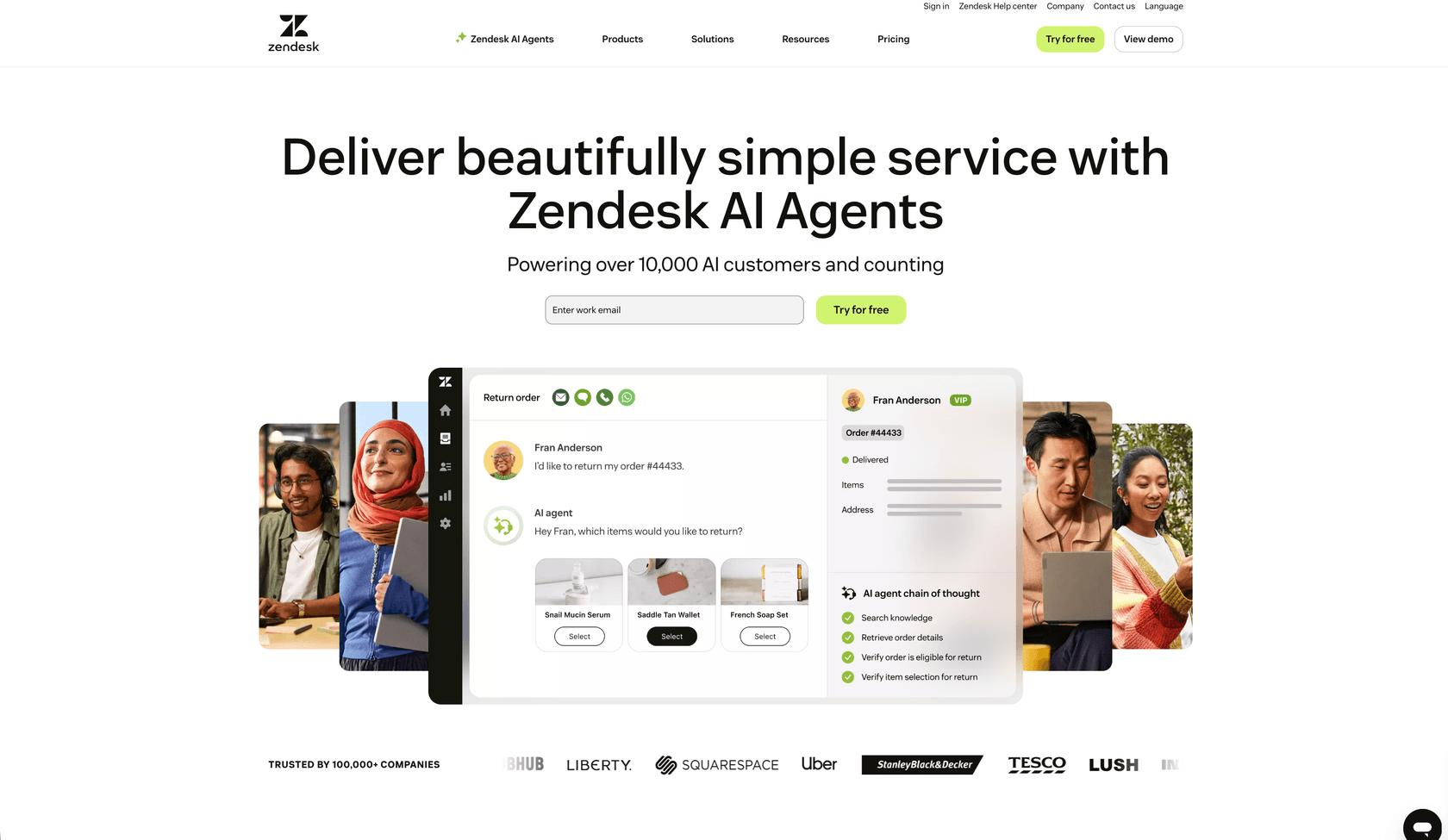
Zendesk is the established leader in enterprise customer service software. It offers a comprehensive feature set that can handle virtually any support scenario, though that power comes with complexity.
Key features:
- AI-powered chatbots and automation
- Omnichannel support across all major channels
- Advanced analytics and reporting through Zendesk Explore
- 1,000+ app integrations
- Highly customizable workflows and ticket fields
- Robust knowledge base and self-service options
Pricing:
- Suite Team: $49/user/month
- Suite Growth: $79/user/month
- Suite Professional: $99/user/month
- Suite Enterprise: $150+/user/month
Pros: Comprehensive feature set, robust reporting, extensive integrations, proven at scale
Cons: Expensive per-user pricing, complex setup, steep learning curve, slow to implement
4. Freshdesk
Best for: Small teams and startups wanting a free starting option
Freshdesk from Freshworks offers a generous free plan and straightforward pricing that makes it attractive for growing teams. The interface is clean and the learning curve is manageable.
Key features:
- Free plan for up to 10 agents
- Omnichannel support including email, chat, phone, social, and WhatsApp
- Freddy AI chatbot for basic automation
- 600+ integrations
- Team collaboration tools including shared ownership
- SLA management and helpdesk reporting
Pricing:
- Free: $0 (up to 10 agents, limited features)
- Growth: $19/agent/month
- Pro: $55/agent/month
- Enterprise: $89/agent/month
Pros: Generous free plan, easy to use, good value for money, part of larger Freshworks ecosystem
Cons: Limited e-commerce features, advanced features locked behind higher tiers, AI capabilities less advanced than competitors
5. Tidio
Best for: Small businesses wanting AI automation without enterprise complexity
Tidio combines live chat, chatbots, and AI-powered automation in an accessible package. Its Lyro AI Agent can handle a significant portion of common customer questions automatically.
Key features:
- Lyro AI Agent with up to 67% resolution rate
- Visual chatbot builder with 40+ e-commerce templates
- Help desk with ticket management
- Multi-channel support including email, Messenger, Instagram, and WhatsApp
- Shopify integration for order management
- Real-time visitor monitoring
Pricing:
- Free: $0 (50 Lyro conversations, basic chat)
- Starter: $24.17/month
- Growth: $49.17/month
- Plus: $749/month (advanced Lyro, multi-channel)
Pros: Easy setup, strong AI capabilities, affordable entry point, good Shopify integration
Cons: Limited advanced reporting, can get expensive with high conversation volumes, some features require higher tiers
6. Help Scout
Best for: SaaS companies and startups prioritizing simplicity
Help Scout takes a different approach than most helpdesks. It focuses on simplicity and treating customers like people, not ticket numbers. The result is a clean, fast interface that teams enjoy using.
Key features:
- Shared inbox with collision detection and internal notes
- Beacon widget combining chat and self-service knowledge base
- Customer management with conversation history
- AI Drafts for faster replies
- Workflows for automation
- Satisfaction ratings built into every email
Pricing:
- Standard: $25/user/month
- Plus: $45/user/month
- Pro: $75/user/month
Pros: Clean, intuitive UI, easy setup, "people not tickets" philosophy, good for small teams
Cons: Limited automation compared to AI-first tools, basic reporting, e-commerce features behind paywall
7. Enchant
Best for: Small-medium businesses wanting simplicity without sacrificing features
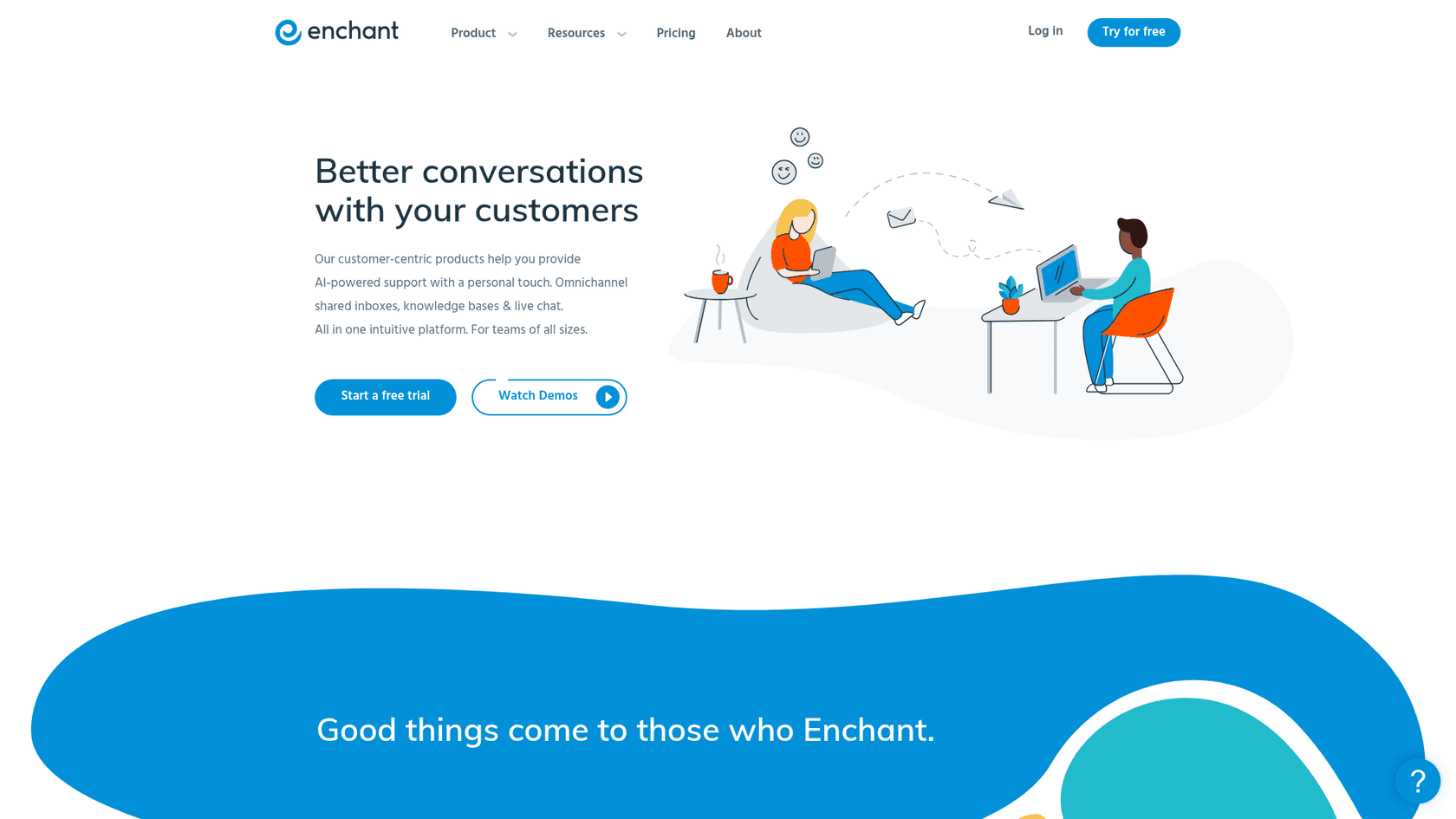
Enchant offers a Gmail-like interface that feels familiar from day one. It bundles all features at every pricing tier, so you never have to wonder what you are missing.
Key features:
- Gmail-like interface for minimal learning curve
- Shared inboxes with custom smart folders
- Omnichannel including voice, SMS, WhatsApp, Facebook, and Instagram
- AI Writer, AI Drafts, AI Summarize, and AI Translate
- Knowledge base with custom domains
- Call center with Twilio integration
Pricing:
- $20/user/month flat (all features included)
Pros: Intuitive interface, affordable flat pricing, quick setup, all features included at every tier
Cons: No customer forums, limited proactive messaging, smaller ecosystem than competitors
How to choose the right Re:amaze alternative
The best choice depends on your team's specific situation:
For AI-first teams: eesel AI or Tidio offer the strongest autonomous capabilities. eesel AI is better for teams wanting end-to-end resolution, while Tidio suits those wanting simpler chat automation.
For e-commerce: Gorgias has the deepest Shopify integration, though eesel AI also offers strong e-commerce capabilities with AI Actions for order management.
For enterprises: Zendesk remains the safe choice for large organizations with complex needs, provided you have the budget and implementation resources.
For budget-conscious teams: Freshdesk's free plan for 10 agents is hard to beat, while Enchant offers excellent value at $20/user with all features included.
For simplicity: Help Scout or Enchant both prioritize ease of use, with Help Scout being ideal for SaaS and Enchant for general SMB use.
Before committing, ask yourself:
- How many tickets could AI realistically handle for us?
- What is our true cost per ticket today?
- Which integrations are must-haves versus nice-to-haves?
- How quickly do we need to be up and running?
Which Re:amaze alternative will you choose?
Every tool on this list can handle the basics of customer support. The difference lies in how they scale, how they leverage AI, and how they fit your specific workflow.
If you are ready to move beyond organizing tickets to actually resolving them autonomously, eesel AI offers a unique approach. By learning from your existing data and operating as a teammate rather than a tool, it can transform how your team handles support. Most teams see payback in under two months.
Whatever you choose, start with a trial. Run it alongside your current system, measure the results, and make the switch when you are confident. The right helpdesk should make your team faster, not create more work.

Share this article

Article by
Stevia Putri
Stevia Putri is a marketing generalist at eesel AI, where she helps turn powerful AI tools into stories that resonate. She’s driven by curiosity, clarity, and the human side of technology.