ITSM for healthcare IT: what's different and how to get it right

Stevia Putri

Katelin Teen
Last edited May 20, 2026
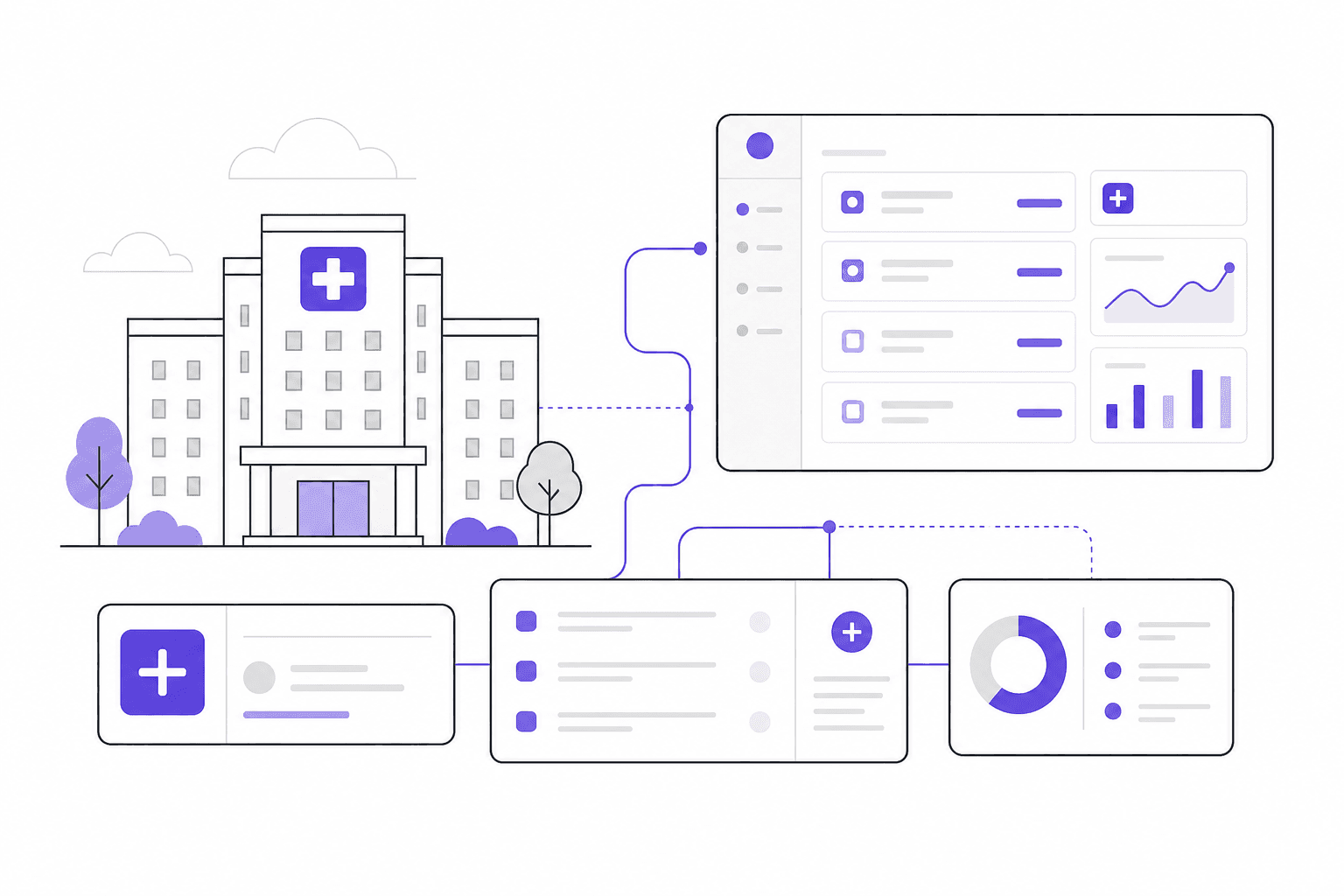
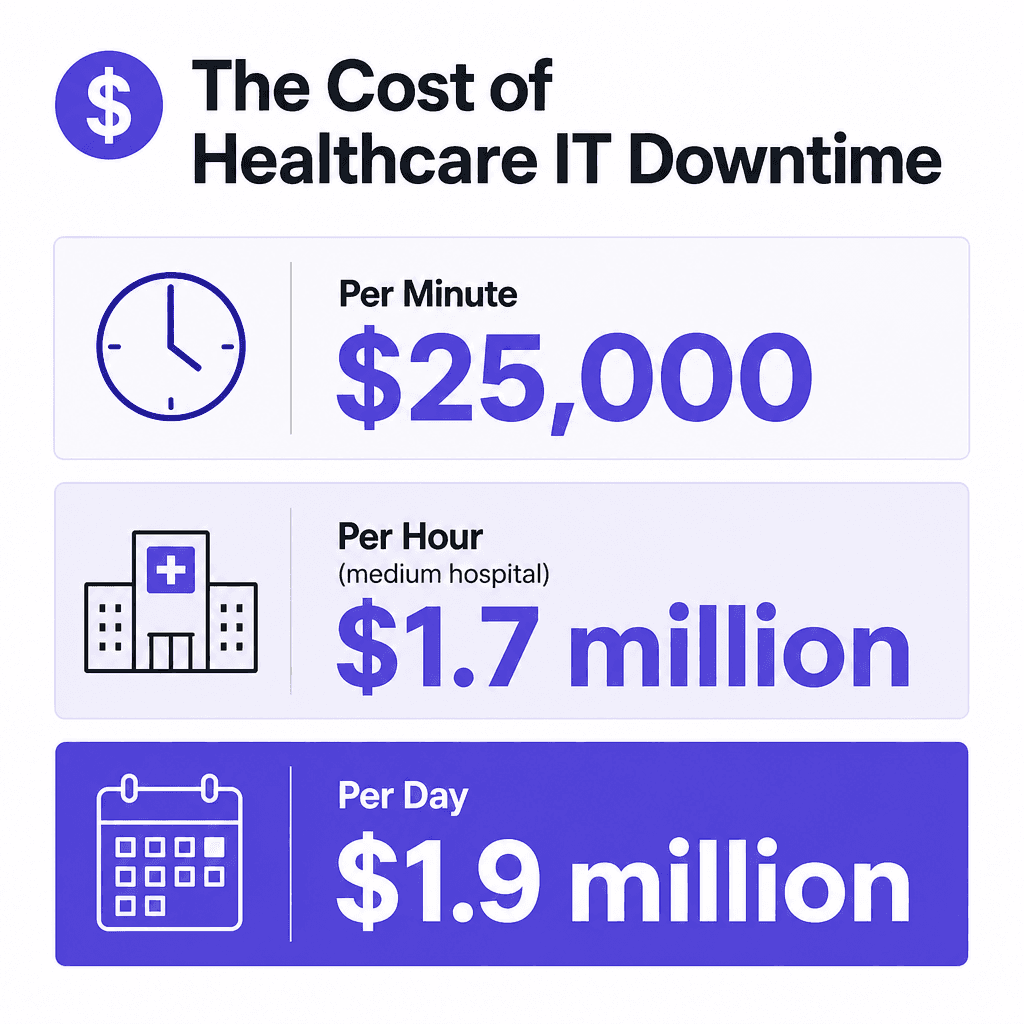
When a nurse can't log into the EHR at 2 AM, that's not an IT inconvenience. It's a patient safety event. The clinician reverts to paper, loses real-time access to medication history, and the attending physician makes decisions without current lab results. Minutes matter.
This is why healthcare ITSM sits in a different category from every other industry. Healthcare organizations spend $279.5 billion on IT globally in 2025, with nearly 48% dedicated to IT services. The scale of that investment reflects the stakes: healthcare IT is clinical infrastructure, not office overhead.
If you're managing IT service delivery for a hospital, clinic network, or health system, the standard ITSM playbook doesn't fully apply. This guide covers what's genuinely different, why those differences matter, and how to build an ITSM practice that keeps clinical systems running reliably - including how AI fits in without creating new compliance risks.
What makes healthcare ITSM different
Most IT service management guides talk about incident classification, SLA targets, and ticket routing. Those things matter in healthcare too. But the context is completely different.
In a typical business, an IT outage is expensive and disruptive. In healthcare, the same outage can delay emergency care, interrupt ICU monitoring, or prevent a pharmacist from verifying a drug interaction. The stakes change everything from how incidents are prioritized to how on-call rotations are structured.
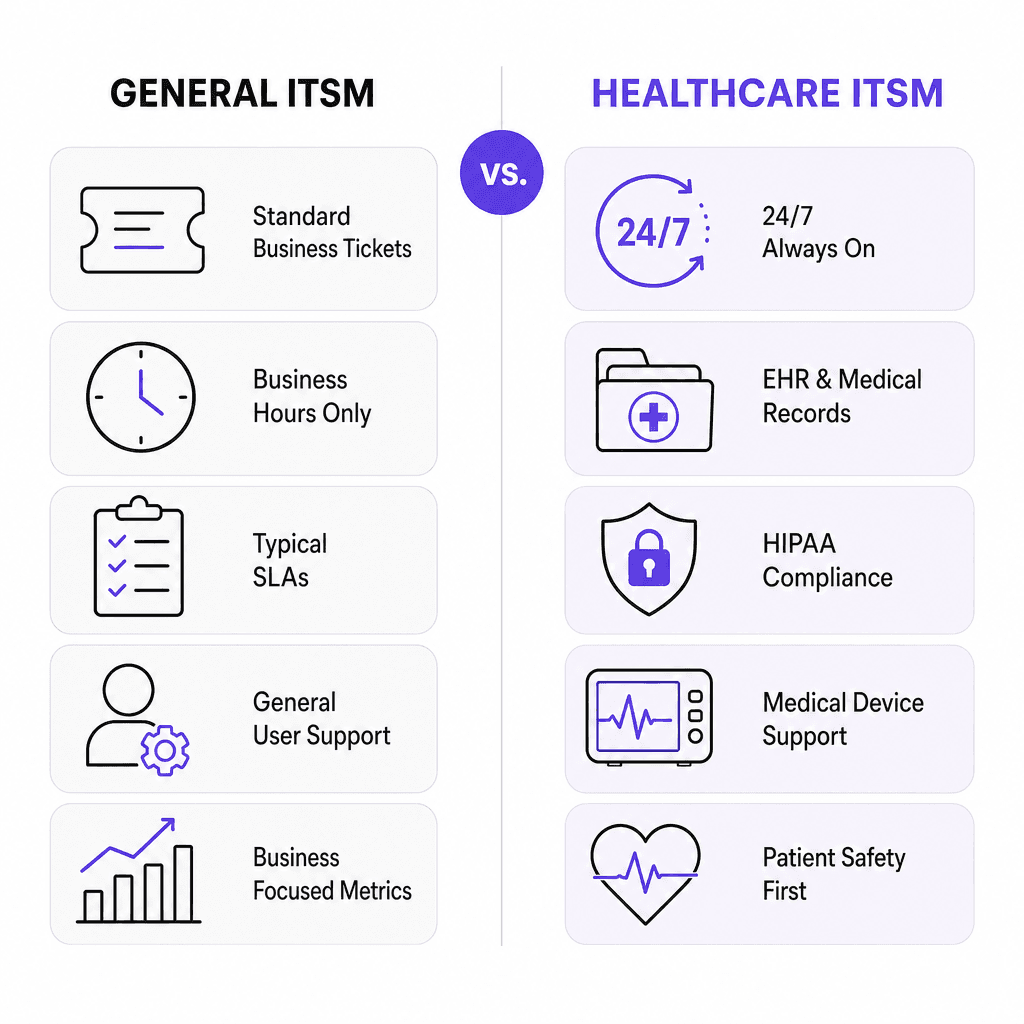
ITSM in healthcare means managing IT services that directly enable patient care delivery - not just keeping laptops running and printers online. The systems under management include EHR platforms, patient monitoring equipment, diagnostic imaging, laboratory systems, and connected medical devices. When any of these fail, clinical workflows break.
Understanding that distinction is the starting point. The five challenges below are where that distinction shows up most concretely.
The 5 core challenges of healthcare ITSM
1. 24/7 uptime tied to patient outcomes
Healthcare can't schedule maintenance windows the way a SaaS company can. Emergency departments, ICUs, and operating rooms run continuously. Any IT system failure that disrupts EHR access, patient monitoring, or medication administration can have immediate clinical consequences.
This creates fundamentally different SLA requirements. Critical clinical system incidents in healthcare typically require acknowledgment within 5-15 minutes and resolution within 1-4 hours - compared to 30 minutes to 8 hours in standard business IT. EHR systems and lab software require constant uptime, and when access issues occur, ITSM helps prioritize incidents based on urgency, making sure clinical disruptions are addressed first.
The practical implication is that healthcare IT teams operate in perpetual on-call mode. The cost of that arrangement shows up in staff burnout rates - more on that below.
2. HIPAA compliance without a clean solution
One of the more frustrating realities in healthcare ITSM is that there's no such thing as a "HIPAA-compliant" ticketing system, at least not in the way vendors advertise it. A healthcare privacy officer with direct experience put it plainly in a Reddit discussion: "If you see any ticketing system that says they are HIPAA compliant, ignore it. There is no such thing as a HIPAA compliant ticketing system."
What actually exists is a combination of controls that together reduce risk: Business Associate Agreements (BAAs) with vendors, encryption at rest and in transit, role-based access controls, detailed audit trails, and breach notification procedures. Platforms like Freshservice and ServiceNow will sign BAAs, but compliance depends heavily on how those platforms are configured - including disabling specific features, enforcing SAML SSO, and implementing data masking for protected health information.
Tracking system changes, keeping audit logs, and applying consistent access controls are all part of a strong ITSM framework - key elements for complying with standards like HIPAA. But it's organizational practice, not software certification, that determines actual compliance.
3. EHR and medical device complexity
Healthcare IT manages system categories that don't exist in most other industries. Electronic Health Record platforms represent the single most critical system in any clinical environment - they're the source of truth for patient history, current medications, allergies, diagnostic results, and care plans. When EHR access fails, organizations revert to paper charts, creating dangerous information gaps.
Beyond EHRs, healthcare IT supports hundreds of connected medical devices: patient monitors, infusion pumps, ventilators, diagnostic equipment, and laboratory analyzers. ITSM supports the full lifecycle of these assets - tracking status, scheduling maintenance, and managing service history - so they're available when needed and replaced before they fail.
In Reddit discussions among healthcare IT professionals, EHR integration surfaces repeatedly as a persistent source of complexity. "The biggest challenges are staff resistance to change, poor training, data migration issues, and workflow disruption" when implementing EHR systems - and those challenges land squarely on IT to manage.
4. Cybersecurity escalation
The threat landscape for healthcare has worsened dramatically. In 2024, 725 large healthcare data breaches involving 500 or more records were reported to HHS - roughly two breaches every day. Ransomware attacks on healthcare increased 278% between January 2018 and September 2023, and Health-ISAC reported 8,903 healthcare cybersecurity incidents in 2025, up 55% from 5,744 in 2024.
The financial consequences are severe. The average healthcare data breach costs $7.42 million - the highest of any industry for 14 consecutive years, significantly higher than financial services ($6.08M) or manufacturing ($5.56M). HIPAA violations carry civil penalties ranging from $141 to $2,134,831 per violation, and HHS OCR issued $12.84 million in fines in 2024 alone.
ITSM plays a direct role in cybersecurity response. Healthcare organizations are particularly vulnerable to cyber threats, which can severely compromise patient safety by preventing access to medical records and critical healthcare devices. ITSM frameworks provide the incident response, change control, and audit trail infrastructure that security teams need to respond quickly and demonstrate compliance.
5. Staffing and burnout
Healthcare IT runs on people, and those people are leaving. The on-call demands of a 24/7 environment are fundamentally different from business IT. Healthcare IT professionals describe on-call as essentially 24/7 availability, not the emergency-only model most IT professionals expect.
One healthcare sysadmin describes handling 45 tickets per week while simultaneously managing four cross-department projects. The mental health impact of being on call 24/7 has become one of the most-discussed threads in the sysadmin community, with healthcare settings specifically cited as the most intense environment.
The result is high turnover and difficulty replacing experienced staff. More than 80% of healthcare executives expect significant external workforce challenges this year, including hiring difficulties - a crisis that extends directly into IT departments.
ITSM frameworks adapted for healthcare
The two major frameworks healthcare organizations use are ITIL 4 and COBIT, but both require healthcare-specific adaptation.
ITIL 4's service lifecycle provides a solid foundation. Healthcare organizations rely most heavily on incident management (clinical urgency-based classification), change management (change windows that don't disrupt clinical operations), problem management (root cause analysis for recurring EHR issues), and knowledge management (documentation of clinical workflows, device configurations, and troubleshooting procedures).
The key adaptation is in incident classification. Standard ITIL priority matrices use factors like impact and urgency in abstract terms. Healthcare requires a different lens: is a patient-facing clinical system affected? Is active patient care compromised? A printing outage is low priority in most environments; in a pharmacy or nursing station, it may require immediate escalation.
A Service Catalog with SLA definitions makes it easier for clinical staff to access IT services and understand the commitments from IT regarding acknowledgment and resolution. Building that catalog around clinical departments - and communicating clearly what "critical" means for each system type - is one of the highest-leverage ITSM investments a healthcare IT team can make.
What healthcare IT service desks actually manage
The ticket categories in healthcare IT are different from what most internal helpdesk teams handle. Understanding the volume and nature of requests is essential for resourcing and automation decisions.
EHR and clinical application support is the highest-priority category. This includes access issues, performance problems, integration failures, and user workflow questions. It requires IT staff with clinical system knowledge, not just general IT skills.
Medical device management covers connectivity issues, firmware updates, device provisioning, and maintenance scheduling for diagnostic equipment, patient monitors, and laboratory analyzers. Unlike standard IT hardware, medical devices have specialized support requirements and regulatory documentation obligations.
Identity and access management handles clinician credential management, role-based access provisioning, temporary access for traveling clinicians, and access revocation. In a HIPAA context, access control is a compliance obligation, not just an operational preference.
Network and infrastructure encompasses network availability for clinical systems, connectivity for remote care settings, telemedicine platform support, and wireless coverage in patient care areas. Clinical environments require higher availability standards than office environments.
Security incident response addresses ransomware, phishing, unauthorized access attempts, and breach notification workflows. These incidents trigger mandatory regulatory responses and require coordination with legal and compliance teams.
ITSM tool options for healthcare
Three tiers of tooling are relevant for healthcare IT teams, depending on organization size and current ITSM maturity.
ServiceNow
Half of the top 40 U.S.-based healthcare providers trust ServiceNow for their ITSM operations, and the platform has earned a 90.7 out of 100 KLAS rating from healthcare customers. ServiceNow's healthcare-specific modules include Healthcare and Life Sciences Service Management, ITAM for clinical equipment, and Epic EHR integration that lets clinical staff manage IT requests without leaving the EMR.
ServiceNow supports HIPAA compliance through BAA, AES 256-bit encryption, role-based access control, and comprehensive audit logging. It also supports HITRUST CSF, FedRAMP, GDPR, SOC 2, and ISO/IEC 27001 - the full compliance stack that large health systems require.
The trade-off is implementation complexity. ServiceNow typically requires 6-12 months to deploy, custom licensing negotiations, and a dedicated internal team for ongoing administration. If you're evaluating alternatives, see the best ServiceNow AI alternatives in 2026.
Freshservice
Freshservice targets mid-sized healthcare providers with an emphasis on affordability and faster deployment. The Western Sussex Hospitals NHS Foundation Trust case study shows what's possible: wait times dropped from 15 minutes to 16 seconds, first call resolution improved from 55% to 91%, and self-service adoption rose from 10% to 42%.
Standard pricing starts at $19/agent per month, but HIPAA compliance requires the Enterprise plan with mandatory configuration: IP whitelisting, SAML SSO, custom mail server, SSL certificates, data masking, and disabling the Freshconnect collaboration feature. According to HIPAA Journal, non-compliance with these configuration requirements can invalidate the BAA entirely.
Freshservice's Freddy AI Agent (Enterprise plan) provides conversational AI that resolves end-to-end IT requests across Slack, Teams, email, and the end-user portal. For teams evaluating Freshservice, the best Freshservice alternatives in 2026 covers the competitive landscape.
Jira Service Management
For healthcare organizations already in the Atlassian ecosystem, Jira Service Management is a strong option. The Premium plan ($51.42/agent/month) includes change management, AIOps, and a virtual service agent - the full ITSM feature set for teams where Jira Software is the existing development platform.
How AI is changing healthcare ITSM
AI automation in healthcare ITSM has to operate differently than in other industries. The stakes are too high for an AI that confidently gives wrong answers.
What works well is a layered approach: AI handles the high-volume, well-defined request types, and humans handle anything that requires clinical judgment or compliance sensitivity. AI-powered chatbots can handle common questions from healthcare providers - password resets, access issues, training scheduling - reducing pressure on the IT service desk while humans focus on complex incidents.
Organizations using AI-enabled ITSM features resolve tickets 30.5% faster on average; top adopters have cut average resolution time from 51 hours to 23 hours - a 54.3% reduction. That efficiency gain matters enormously in a healthcare context where IT teams are consistently understaffed and overloaded. See how AI for IT service management actually works for a detailed breakdown of the automation patterns.
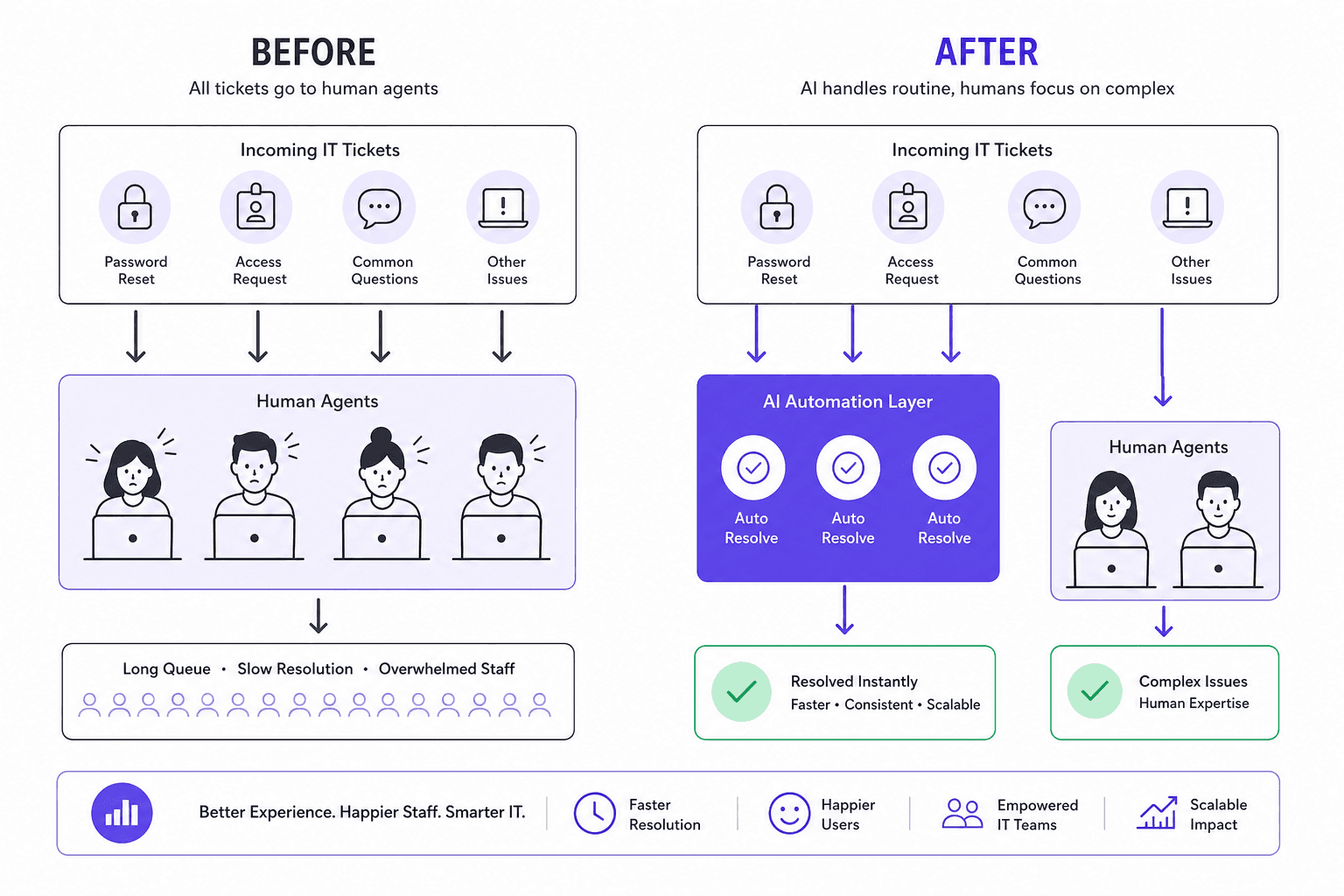
The specific automation targets that yield the highest return in healthcare IT are:
Password resets and account unlocks. This is consistently the most common ticket type in any ITSM environment and a safe automation target - no clinical judgment required, high volume, predictable workflow. Automating password resets alone can reduce tier-1 ticket volume by 20-30%.
Software access provisioning. New staff provisioning, role changes, and temporary access requests follow defined workflows. Automated IT ticketing handles these request types without agent involvement, reducing provisioning time from hours to minutes.
Knowledge management. AI can surface relevant knowledge base articles during ticket triage, automatically identify gaps (where tickets are coming in that the KB doesn't address), and draft new articles from resolved tickets. A well-maintained knowledge base is the foundation of healthcare IT self-service.
Incident triage. AI can read incoming tickets, classify them by type and clinical impact, and route them to the right team or on-call responder. This reduces the time-to-route for critical incidents and ensures that clinical urgency is factored into prioritization, not just technical complexity.
"We use it to be the first responder to our Helpdesk tickets in Jira. It essentially acts just like an agent would."
- Jason Loyola, Head of IT, InDebted
Getting healthcare ITSM right: practical principles
A few patterns show up consistently in healthcare ITSM implementations that work.
Build the foundation before adding sophistication. Many healthcare IT departments lack basic asset inventory - a challenge documented repeatedly in the community. Without knowing what systems you're managing, ITIL-based change management and proactive monitoring are aspirational rather than operational. Start with asset inventory, then move to incident management process, then add predictive capabilities.
Classify incidents by clinical impact, not just technical severity. A slow printer in a clinical area may be higher priority than an application error in an administrative office. Build an incident priority matrix that explicitly includes clinical impact assessment - which systems, which clinical workflows, which patient populations are affected.
Treat knowledge management as ongoing operational work, not a one-time project. The knowledge base degrades faster in healthcare than in other environments because clinical workflows, EHR configurations, and medical device configurations change regularly. Assign ownership for knowledge base maintenance, and use AI tools that automatically surface gaps from ticket patterns. See ITSM best practices for knowledge management for a framework.
Build HIPAA requirements into workflows from the start. Retrofitting compliance controls onto an existing ITSM implementation is significantly harder than designing with compliance in mind. Document which ticket categories might involve PHI, implement access controls accordingly, ensure audit trails capture what regulators require, and periodically review BAA coverage across all vendors.
Protect your team. The staffing and burnout crisis in healthcare IT is real. Implementing AI automation for routine tickets is partly a patient safety investment (faster response to critical issues) and partly a staff welfare investment (reduced burden on the people covering overnight shifts). The two aren't in conflict. IT ticket automation that handles password resets and access requests at scale directly reduces the burden on on-call staff.
Try eesel AI for healthcare IT support
eesel AI is an AI layer that sits on top of your existing ITSM platform - Jira Service Management, Freshdesk, Zendesk, or ServiceNow - without requiring a migration. For healthcare IT teams, that means adding AI-powered ticket triage, knowledge base search, and autonomous resolution for high-volume request types without a 6-month implementation project.
What makes it relevant for healthcare environments specifically: eesel uses confidence-based escalation, meaning the AI only handles tickets it's highly confident about and flags everything else for human review. Before going live, you run simulations on 90 days of historical tickets to see exactly what the AI would have resolved and where it would have made mistakes. There are no surprises.
The Enterprise plan includes HIPAA compliance and BAA support at $1,000/month flat plus usage. For teams processing 500+ IT tickets monthly, the math typically works out to substantially less than the cost of a single on-call hour averted. Start with a $50 free trial - no credit card required.

Frequently Asked Questions
Share this article

Article by
Stevia Putri
Stevia Putri is a marketing generalist at eesel AI, where she helps turn powerful AI tools into stories that resonate. She’s driven by curiosity, clarity, and the human side of technology.