Investing in AI for your IT service desk sounds promising. The pitch usually includes faster resolution times, reduced ticket volumes, and happier employees. But when the renewal conversation comes around, the question is always the same: what did we actually get for our money?
This guide gives you a practical framework for measuring Freshservice AI ROI. We'll look at what Freddy AI actually delivers, where the pricing gets complicated, and how to build a business case that holds up to scrutiny.
What Freshservice Freddy AI actually delivers
Freddy AI is Freshservice's AI layer, built on Microsoft's Azure OpenAI infrastructure. It's positioned as a three-part system that works across IT service management.
Freddy AI Agent handles autonomous resolution. It converses with employees through Slack, Microsoft Teams, email, and the self-service portal to resolve requests without human intervention. Freshworks claims this can deflect up to 66% of tickets with AI-powered self-service.
Freddy AI Copilot assists your IT agents in real-time. It drafts responses, summarizes long ticket threads, and helps build knowledge base articles. This is designed to reduce the busywork that burns out agents.
Freddy AI Insights provides analytics for IT leaders. It identifies trends, performs root cause analysis, and surfaces patterns that might otherwise go unnoticed.
Freshworks makes bold claims about the impact: 356% ROI in under 6 months, 77% decrease in average resolution time, and 98% employee satisfaction scores. These numbers come from their 2025 Benchmark Report and a commissioned Forrester Total Economic Impact study.
The catch? Those results require the full Freddy AI suite, which brings us to the first major consideration.
Understanding Freshservice AI pricing and access tiers
Here's something Freshservice does not make obvious on its marketing pages: Freddy AI Agent is Enterprise-only.
Let's break down what's actually available at each tier:
| Plan | Price (Annual Billing) | AI Features Available |
|---|---|---|
| Starter | $19/agent/month | None |
| Growth | $49/agent/month | None |
| Pro | $99/agent/month | Freddy AI Copilot only |
| Enterprise | Custom pricing | Full Freddy AI suite |
Source: Freshservice Pricing
If you're on Starter or Growth, you get no AI features at all. The Pro plan only includes Freddy AI Copilot, which drafts replies and summarizes tickets but does not autonomously resolve anything.
To get the autonomous AI Agent that Freshservice showcases in its marketing (the one that deflects tickets and resolves issues without human intervention), you must upgrade to Enterprise. And here's where it gets murky: Enterprise pricing isn't published. You have to contact sales for a quote.
Based on typical enterprise software pricing patterns, you're likely looking at significantly more than the $99/agent Pro plan, plus potential overage charges for AI usage.
Session limits that could stall your operations
Even if you do upgrade to Enterprise, you're not getting unlimited AI usage. Each Enterprise license includes 1,200 AI Agent sessions per year.
A "session" is defined as any interaction a unique user has with Freddy AI Agent within a 24-hour period. If one employee chats with the AI three times in one day, that's one session. If they come back the next day, that's a second session.
Let's do some math. If you have 100 employees and each interacts with the AI Agent just once per week on average, you're looking at 5,200 sessions per year. With 1,200 sessions per license, you'd need roughly 5 Enterprise licenses just to cover basic usage. And that's assuming relatively light usage.
What happens when you hit your limit? According to Freshservice's documentation, Freddy AI Agent continues operating to prevent service disruptions, but "additional sessions will be charged." The rates aren't publicly disclosed. You have to contact your Customer Success Manager to find out what those overages cost.
There's also no rollover of unused sessions. If you have a slow month, those sessions don't carry over. They reset at the start of each billing cycle.
Source: Freddy AI Agent Pricing FAQs
How to calculate Freshservice AI ROI for your organization
To build a credible ROI calculation, you need to compare the costs of the AI investment against the measurable benefits it delivers. Here's a practical framework.
Step 1: Establish your baseline
Before implementing any AI, document your current state:
- Monthly ticket volume how many tickets does your team handle?
- Average resolution time how long from ticket creation to resolution?
- Agent hours per ticket how much human time goes into each resolution?
- Cost per ticket fully loaded cost (salary + benefits + overhead) divided by tickets handled
- Escalation rate what percentage of tickets require senior agent intervention?
Step 2: Calculate your investment costs
Include all costs associated with the AI implementation:
- Licensing costs Enterprise plan pricing (contact sales for quote)
- Implementation costs setup, configuration, integration time
- Training costs time spent training agents and employees on the new system
- Ongoing management administrative time to monitor and optimize
Step 3: Estimate efficiency gains
Based on Freshservice's claims and customer case studies, realistic targets might include:
- Ticket deflection rate percentage of tickets resolved by AI without human touch (Freshworks claims up to 66%, though your mileage may vary)
- Resolution time improvement reduction in time to resolve non-deflected tickets (Freshworks claims 77% decrease)
- Agent productivity gain additional tickets each agent can handle per day
Step 4: Build your ROI formula
A simple ROI calculation looks like this:
Annual Savings = (Deflected Tickets × Cost Per Ticket) + (Time Saved × Cost Per Hour)
Annual Investment = Licensing + Implementation + Training + Management
ROI = (Annual Savings − Annual Investment) / Annual Investment × 100
Example calculation for a 100-employee IT team
Let's say you have 5 IT agents handling 500 tickets per month:
- Baseline: 6,000 tickets/year, $75,000 annual agent cost each = $375,000 total
- With Freddy AI: 40% deflection (2,400 tickets), 30% faster resolution on remainder
- Savings: 2,400 deflected tickets × $62.50 cost per ticket = $150,000 + productivity gains
- Investment: $125,000 estimated (Enterprise licenses + implementation)
- ROI: Roughly 100-150% in year one, depending on actual deflection rates
The key is being realistic about deflection rates. Freshworks' 66% figure likely represents best-case scenarios with mature implementations.
Real-world results and case studies
Freshservice has accumulated a solid roster of customer success stories. Here are some documented outcomes:
Databricks achieved a 23% ticket deflection rate and consolidated from 10 different platforms down to Freshservice. Their VP of Infrastructure noted this saved "a significant amount of money."
University of Oxford saved an estimated 405 working days annually across their IT team, with resolution times decreasing by 81%.
Village Roadshow cut IT costs by 60% annually while improving service quality and speed, according to their CIO.
Fairmoney, a financial services company, reported 20% faster response times and a 15% improvement in customer satisfaction.
Freshworks' 2025 Benchmark Report aggregates data from over 10,000 teams. Their findings show that "trendsetting" teams using AI achieve response times under 20 seconds across messaging channels and resolve most queries in under 2 minutes. Retail and travel companies see deflection rates above 50%.
The Kansas City Chiefs use Freddy AI Copilot across IT and finance departments. New Balance runs Freshservice Enterprise with Device42 integration for global IT operations.
These results are impressive, but remember: most of these customers are on Enterprise plans with full Freddy AI suites, not the limited Pro tier.
Why many AI pilots fail (and how to succeed)
Here's a sobering statistic: MIT research suggests 95% of AI pilots fail. Gartner predicts that by 2027, over 40% of agentic AI projects will be abandoned due to unforeseen costs and risks.
Why does this happen?
Deploying without defining success. Teams buy AI tools, chase trends, and end up searching for problems the technology can solve. Progress gets measured by the wrong metrics: model accuracy instead of customer impact, data speed instead of better decisions.
Treating AI as technology deployment, not business transformation. The most successful companies identify their goals first, line up investments behind them, establish tools to measure success, and train teams to make the most of AI initiatives.
Pilot purgatory. Impressive demonstrations that never scale to meaningful business impact. A chatbot that handles 50 tickets in a pilot looks good in a demo, but what happens at 5,000 tickets?
How to succeed with Freshservice AI
Freshworks themselves publish an AI ROI Roadmap in partnership with the Return on AI Institute. Their recommended approach:
- Define your destination know what success looks like before you start building
- Prioritize investments choose high-value use cases with measurable outcomes
- Design for action build systems that turn insight into impact, not just dashboards
- Measure what matters establish ROI frameworks that drive continuous improvement
- Start with guidance, level up to autonomy begin with Copilot assisting agents, expand to full Agent automation as you prove value
The key is treating AI as business transformation, not a technology experiment.
A transparent alternative: How eesel AI approaches ROI
If the Enterprise-only access and opaque pricing of Freshservice Freddy AI gives you pause, there are alternatives designed with transparency in mind.
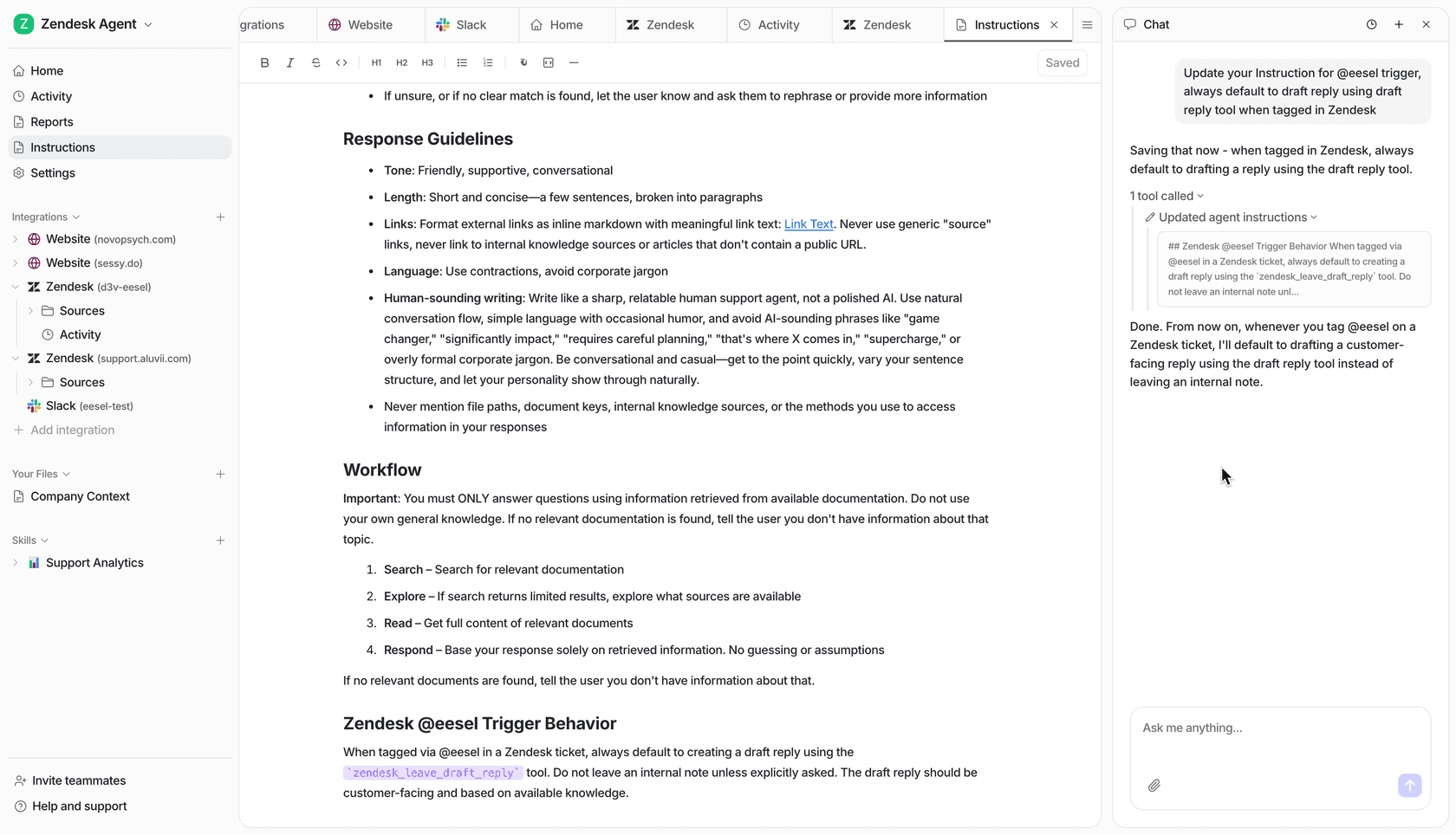
At eesel AI, we take a different approach to AI for IT service management. Instead of per-agent pricing that penalizes growth, we charge based on actual AI interactions. Our pricing starts at $299/month for the Team plan (1,000 interactions) and $799/month for Business (3,000 interactions). No per-seat fees. No arbitrary session limits. No Enterprise gatekeeping.
Here's how we address the common Freshservice limitations:
Transparent pricing without Enterprise gates. Our AI Agent is available on all plans, not locked behind a "contact sales" tier. You know exactly what you're paying before you commit.
No arbitrary session limits. We don't count "sessions" in confusing 24-hour windows. You get a clear monthly interaction allowance that rolls over if unused.
Plain-English customization. Instead of rigid decision trees, you define behavior in natural language: "If the refund request is over 30 days, politely decline and offer store credit." No code required.
Progressive rollout with confidence. Start with our AI Copilot drafting replies for agent review. Once you're confident in the quality, level up to full autonomy. You control the pace based on actual performance, not vendor pressure.
Simulation before going live. Run our AI on thousands of your past tickets before touching real customers. See exactly how it would respond, measure resolution rates, identify gaps, and tune prompts. Gain confidence before deployment.
We also integrate directly with Freshservice, so if you're already using Freshservice for ITSM, you can add eesel AI's autonomous capabilities without ripping and replacing your entire system.
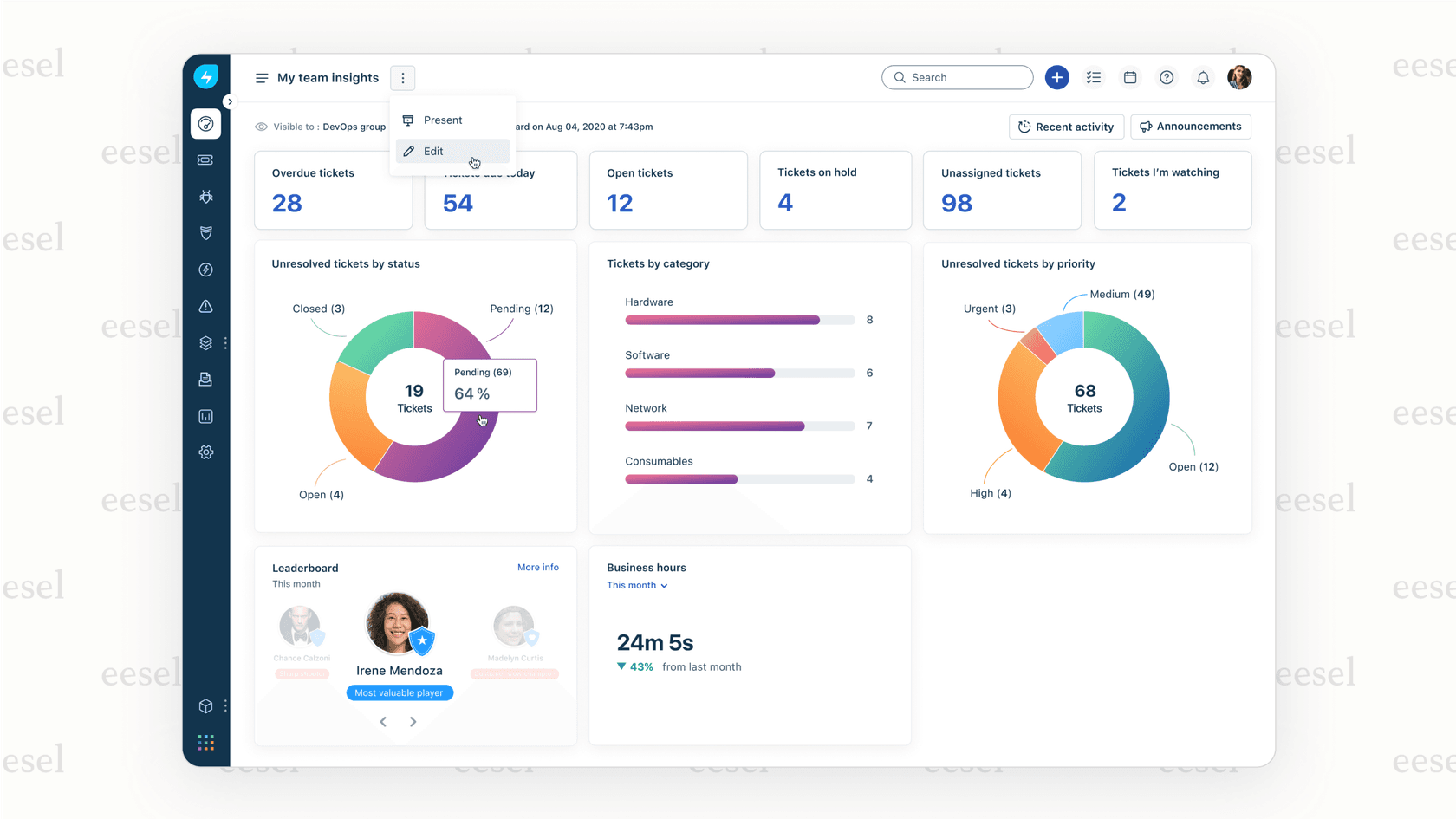
You can use our ROI calculator to estimate potential savings based on your actual ticket volume and agent costs.
Making your Freshservice AI investment decision
Let's summarize the key factors to consider when evaluating Freshservice AI ROI:
Budget reality check. To get the autonomous AI Agent that delivers the deflection rates Freshworks advertises, you need Enterprise. That means custom pricing, likely significantly higher than the $99/agent Pro plan.
Usage forecasting. Will you hit the 1,200 session limit per license? For a 100-person company with moderate AI usage, you might need 5+ Enterprise licenses just for basic coverage. Factor in overage costs (undisclosed rates) if you exceed limits.
Implementation approach. Consider starting with Pro plan Copilot features to prove value, then upgrading to Enterprise once you have data to support the investment. Don't buy the full suite on a hope and a prayer.
Alternative evaluation. If transparent pricing and predictable costs matter to your organization, alternatives like eesel AI offer AI Agent capabilities without Enterprise gates or per-seat pricing models.
The bottom line? Freshservice AI can deliver real ROI, but it requires careful planning, realistic expectations, and a willingness to invest in the Enterprise tier. Treat it as business transformation, not a quick technology fix, and you'll be in the 5% of AI pilots that actually succeed.

Frequently Asked Questions
Share this article

Article by
Stevia Putri
Stevia Putri is a marketing generalist at eesel AI, where she helps turn powerful AI tools into stories that resonate. She’s driven by curiosity, clarity, and the human side of technology.