Setting up an AI-powered knowledge base sounds straightforward until you actually try to do it. You've got help articles scattered across Confluence, FAQs buried in Google Drive, and years of support tickets sitting in Zendesk. Getting all of that into a format an AI can actually use? That's where platforms like Decagon come in.
Decagon takes an enterprise-focused approach to knowledge base setup, promising to unify all your scattered content into something their AI agents can actually work with. But how does the process actually work, and is it the right fit for your team? Here's what you need to know.
What is Decagon and how does it handle knowledge bases?
Decagon is an AI customer support platform founded in 2023 that builds conversational AI agents for enterprise teams. Unlike basic chatbots that follow rigid scripts, Decagon's agents are designed to understand context, handle complex queries, and take real actions like processing refunds or updating account information.
The platform has gained traction with notable customers including Duolingo, ClassPass, Chime, and Rippling. According to their case studies, some teams have achieved deflection rates above 80% and cost reductions as high as 95%.
At the heart of Decagon's approach is the knowledge base: a centralized, searchable collection of information that feeds their AI agents. But Decagon doesn't just dump your docs into a database. They use a process called knowledge ingestion to unify content from multiple sources into what they call a knowledge graph.
The knowledge ingestion process
Decagon's knowledge ingestion pulls from wherever your content currently lives: help centers, Confluence pages, Google Drive, SharePoint, past support tickets, even agent macros. The system reads all of this, organizes it, and creates connections between related pieces of information.
The result is what Decagon calls a "single source of truth" that their AI agents can reference instantly. When a customer asks a question, the agent doesn't just search for keywords. It understands the intent and pulls from the most relevant parts of your documentation.
Agent Operating Procedures (AOPs)
Here's where Decagon differs from simpler AI tools. Instead of just answering questions, Decagon uses Agent Operating Procedures (AOPs): natural language instructions that compile into code and tell the AI exactly how to handle specific situations.
Think of AOPs as Standard Operating Procedures (SOPs) for AI. You write instructions in plain English like "If a customer requests a refund within 30 days and has no previous refunds, process it automatically." The system turns that into executable logic.
This lets non-technical CX teams shape AI behavior directly, while engineers maintain control over core code and security.
Decagon knowledge base setup: A step-by-step guide
Decagon's implementation follows a 6-week timeline. Here's what the knowledge base setup process actually looks like.
Step 1: Connect your knowledge sources
The first phase is all about getting your content into the system. Decagon connects to:
- Help centers and FAQ pages
- Confluence and internal wikis
- Google Drive and SharePoint folders
- Past support tickets and conversation history
- Agent macros and saved replies
- CRM data and customer records
During this phase, you'll also set up communication channels (usually Slack or Teams) for rapid feedback loops with Decagon's team, and establish a sandbox environment for safe testing.
Step 2: Prepare your data for training
Raw data isn't enough. Decagon recommends cleaning up your documentation before training:
- Ensure help articles are clear, accurate, and easy to understand
- Use consistent terminology for products and features across all docs
- Remove or archive outdated information
- Implement version control so the AI always references current docs
This step matters more than most teams expect. The AI can only be as good as the information you feed it.
Step 3: Configure Agent Operating Procedures
With your knowledge ingested, it's time to write your AOPs. This involves converting existing SOPs into AI-ready instructions that define:
- How to handle different types of customer requests
- When to escalate to human agents
- What actions the AI can take autonomously
- Guardrails for sensitive operations like refunds
Decagon's team works with you during this phase to draft and refine these procedures based on your specific workflows.
Step 4: Test and refine
Before going live, you'll run internal testing on core workflows. Decagon provides tools for simulated conversations and unit testing. The team tests for:
- Response accuracy and tone
- Proper workflow execution
- Edge cases and error handling
- Integration reliability
Based on test results, you'll iterate on AOPs and prompts to improve accuracy. This phase typically happens in parallel with technical integration testing.
What data sources can you connect to Decagon?
Decagon integrates with most major business systems. Here's what's supported:
Help desk platforms: Zendesk, Freshdesk, Gorgias, Help Scout
CRM: Salesforce Service Cloud
Knowledge bases: Confluence, Google Drive, SharePoint
Communication: Slack, Microsoft Teams
Custom: API connections for internal systems
The depth of these integrations matters. Decagon doesn't just read data, it can write back to your systems too. That means when an AI agent processes a refund, it actually updates your payment system. When it escalates a ticket, it creates the ticket in your help desk with full context.
Continuous improvement and knowledge gaps
A knowledge base isn't a set-it-and-forget-it project. Decagon includes features for ongoing maintenance.
Knowledge gap analysis
Decagon's Suggestions feature analyzes conversations where the AI struggled or failed to provide complete answers. It identifies patterns and highlights missing or outdated knowledge in your documentation.
Automated article generation
When the system identifies gaps, it can automatically draft new help articles based on how your best human agents resolved similar issues. These drafts are grounded in actual customer conversations, not guesswork.
Feedback loops
The AI learns continuously from corrections. When human agents edit AI-generated responses or handle escalations, that feedback gets incorporated back into the system. Over time, the AI gets better at handling the specific types of questions your customers ask.
Decagon pricing and implementation timeline
Let's talk about what this actually costs and how long it takes.
Typical implementation timeline
Decagon's standard implementation takes about 6 weeks:
- Week 1: Discovery and foundation (tech stack audit, sandbox setup)
- Week 2: Kickoff and parallel workstreams (defining success metrics, drafting AOPs)
- Weeks 3-4: Build and testing (configuration, internal testing, refinement)
- Week 5: Convergence and preparation (compliance review, team training)
- Week 6: Go-live and scaling (controlled rollout, monitoring, full deployment)
Pricing model
Decagon doesn't publish public pricing. You'll need to contact their sales team for a custom quote based on your conversation volume, channels, and integration complexity.
The model is enterprise-focused. You get dedicated "Agent Product Managers" who guide you through implementation and ongoing optimization. This white-glove approach makes sense for large teams but may be overkill if you're looking for something you can set up yourself.
An alternative approach: eesel AI's knowledge base setup
Decagon's approach works well for large enterprises with dedicated implementation resources. But what if you need something faster and more flexible?
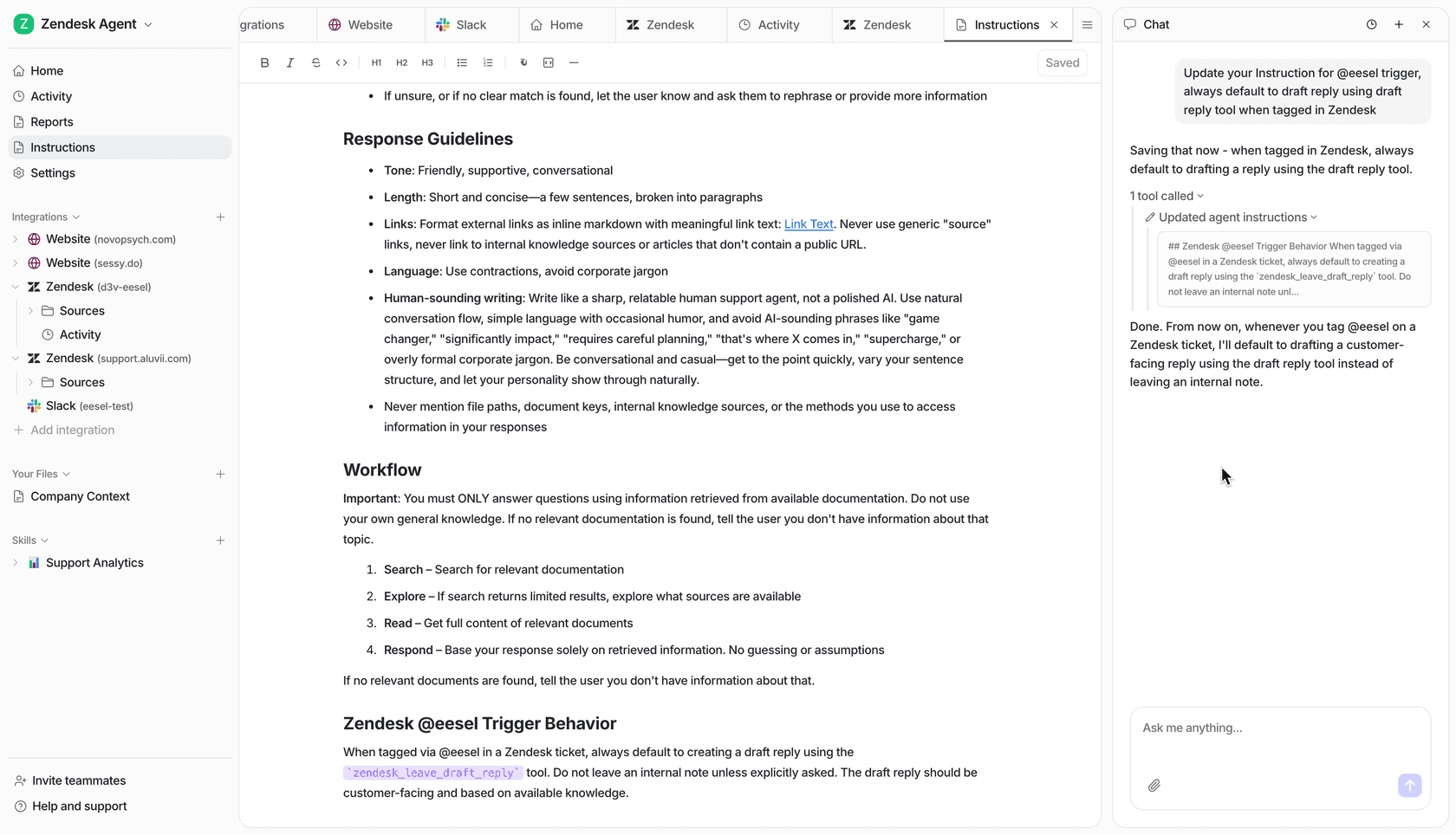
We built eesel AI with a different philosophy: instead of configuring an AI system, you hire an AI teammate who learns your business automatically.
Here's how our approach differs:
Automatic learning from existing data
With eesel, there's no manual ingestion process. Connect us to your help desk (Zendesk, Freshdesk, Gorgias, or any of our 100+ integrations), and we immediately start learning from your past tickets, macros, and help center articles. No migration, no data preparation, no engineering tickets.
Progressive rollout
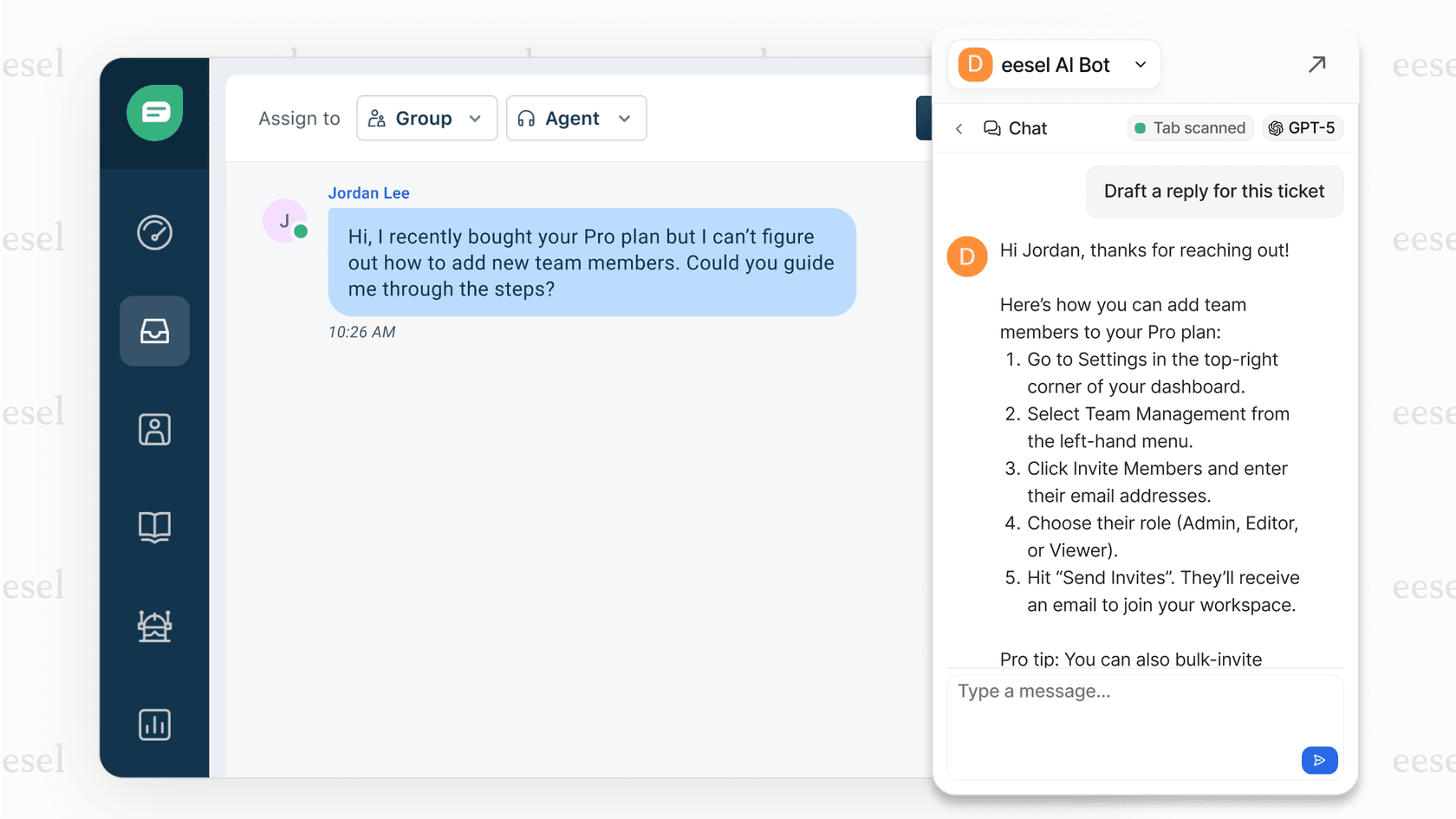
Instead of a 6-week implementation, you can start with eesel in minutes. Begin with AI drafting replies for your agents to review. Once you're confident in the quality, level up to full autonomy. You control the pace based on actual performance, not a predetermined timeline.
Plain-English customization
Define behavior in natural language without writing AOPs or technical instructions. Want to change how we handle refunds? Just tell us: "If the refund request is over 30 days, politely decline and offer store credit." No code, no configuration languages.
Our pricing is transparent and scales with your usage, not headcount. Pay for AI interactions, not seats.
Choosing the right knowledge base approach for your team
So which approach makes sense for you?
Decagon might be a fit if:
- You're a large enterprise with complex, multi-product support operations
- You have engineering resources to dedicate to implementation and maintenance
- You prefer a white-glove, managed service approach
- You need extensive customization and are willing to invest 6+ weeks in setup
eesel AI might be a better fit if:
- You want to get started quickly without a lengthy implementation
- You prefer a teammate model where the AI learns automatically from your existing data
- You want to start supervised and level up to autonomy based on performance
- You need transparent, usage-based pricing without enterprise sales cycles
The bottom line? Both approaches can work. The right choice depends on your team size, technical resources, timeline, and how much control you want over the implementation process.